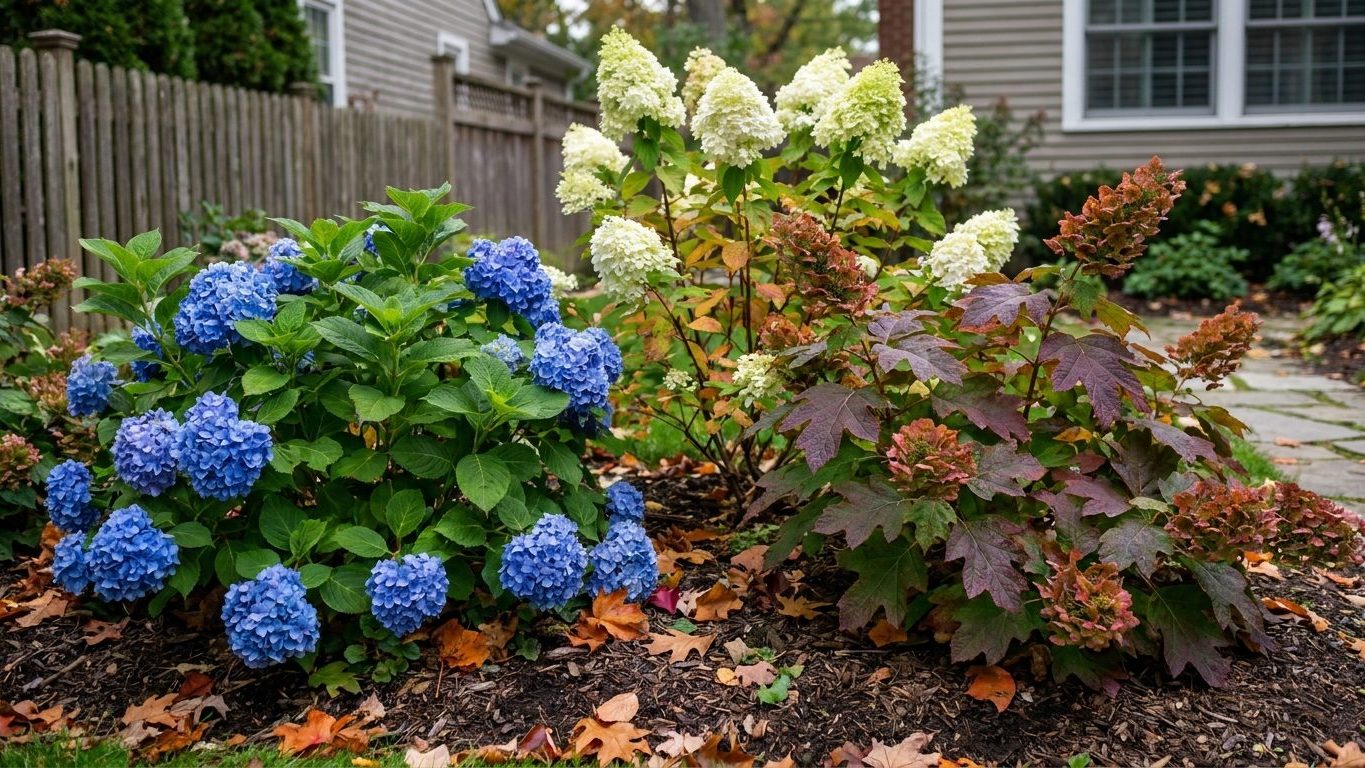
Six hydrangea types handle Massachusetts winters and summers well, though not equally. Panicle and smooth hydrangeas take the state’s cold in stride, oakleaf and mountain hydrangeas do fine in most yards, and bigleaf hydrangea is the one that disappoints homeowners most often, especially inland, where flower buds don’t survive a hard freeze the way the plant itself does.
Hydrangeas that grow well in Massachusetts: The Short Answer
Boston sits on the mild edge of the state’s zone 5a to 7b range on the USDA Plant Hardiness Zone Map, and that range decides which hydrangeas hold up here.
Its frost window runs April 1 to April 8 in spring and November 3 to November 14 in fall, long enough for panicle and smooth hydrangeas but tight for bigleaf’s early buds.
Panicle Hydrangea

This is the safest bet in the state. It blooms on new wood, so a hard freeze that reaches the colder inland pockets doesn’t touch next summer’s flowers, and it takes full sun better than any other type here.
Smooth Hydrangea

Also a new-wood bloomer, so it recovers from winter dieback without losing a season of flowers. It handles the clay-heavy soils common around Worcester and the Pioneer Valley better than most hydrangeas do.
Oakleaf Hydrangea

Reliable through most of the state, with fall color most hydrangeas skip entirely. It struggles only in the coldest inland valleys, where a hard winter can knock back the buds set the year before.
Mountain Hydrangea

A close relative of bigleaf hydrangea bred for tougher winters. Its buds survive more of the state’s cold snaps than bigleaf’s do, though it still flowers best where winters stay closer to the coast.
Reblooming Bigleaf Hydrangea

These push a second round of buds on new wood after a rough winter, so a yard near Boston still gets some color even when the old-wood buds don’t make it. Inland, it can still skip a year.
Bigleaf Hydrangea

The riskiest name on this list. It blooms only on old wood, and the state’s frost swings kill those buds often enough that many yards get healthy green shrubs with few or no flowers most summers.
Massachusetts — the year and the numbers
- State
- Massachusetts
- USDA zones
- 5a-7b
- Last spring frost
- April 1 to April 8
- First fall frost
- November 3 to November 14
- Annual rain
- 44 in
- Lawn zone
- cool-season
- Source
- NOAA NCEI 1991-2020 Climate Normals, 32F freeze probabilities · Boston
How to Work Out the Dates for Your Own Yard
Work out your own planting and pruning windows by starting from the frost dates for your yard, not the calendar month alone.
- Find your last spring frost: NOAA NCEI 1991-2020 Climate Normals put Boston’s window at April 1 to April 8, so anyone inland or in the Berkshires should push that range back by a week or two before trusting bare soil.
- Count forward to the plant window: the state’s plant window opens in April and runs into May, then picks up again in September and October, giving roots time to settle before summer heat or winter cold arrives.
- Mark the first fall frost: Boston’s window runs November 3 to November 14, and that date decides whether a fall-planted hydrangea gets enough weeks to root before the ground locks up.
- Time the first feeding: fertilize in March, again in May, and a third time in July, spacing feedings around the plant’s active growth rather than the calendar page.
- Hold pruning until June or July: that’s the only window for pruning bigleaf hydrangea here, since cutting earlier removes the buds already set from the fall before.
Panicle hydrangea shrugs off a late frost swing since it blooms on new wood, while a bigleaf hydrangea planted in that same spot can lose its flowers most years for the same reason. A gardener in Worcester or the Pioneer Valley should treat every one of these windows as running later in spring and earlier in fall than Boston sees.
Massachusetts North to South: How the Dates Shift
Elevation and distance from the coast move these dates more than latitude does within a state this size.
- The Berkshires (Berkshire County, zone 5a): the highest, coldest corner of the state pushes both frost dates outward, so spring planting waits longer and fall cleanup starts sooner.
- The Pioneer Valley and Central Massachusetts (Hampden, Hampshire, and Worcester counties): valley floors trap cold air on clear nights and often frost before the higher ground around them does.
- Greater Boston and the North Shore (Suffolk, Essex, and Middlesex counties): urban heat and the harbor keep this corner on the milder end of the state’s range.
- Cape Cod and the Islands (Barnstable, Dukes, and Nantucket counties): the ocean on three sides delays both the first frost and the last one, stretching the growing season longest here.
Check your own town against the state guide before trusting any single date as gospel for your particular yard.
Mistakes Massachusetts Punishes
Pruning bigleaf hydrangea in fall
Cutting back stems in October or November removes the very buds meant to open next summer, since bigleaf sets its flowers on old wood. Wait for the June to July window the state’s calendar allows, and only remove dead wood before that.
Planting too close to the fall frost
NOAA NCEI 1991-2020 Climate Normals put Boston’s first fall frost at November 3 to November 14, and a hydrangea planted in late October has only a few weeks to root before that window closes. Move fall planting earlier, into September or early October, instead.
Leaving bigleaf hydrangea unprotected inland
Yards away from the coast swing colder than Boston’s numbers suggest, and an exposed bigleaf hydrangea there loses its buds most winters. Mulch heavily at the base going into winter, or plant a mountain or panicle hydrangea instead.
Massachusetts Extension Offices and County Contacts
Boston’s frost window and the state’s zone range are a starting point, not the last word for your yard. The USDA NIFA Land-Grant University Extension directory lists the University of Massachusetts Extension as the state’s go-to source for local soil and pest differences.
- UMass Extension: county-level soil test results, pest alerts, and planting advice, available at ag.umass.edu.
- Your county extension office: local frost data and hands-on diagnosis for a shrub that isn’t blooming.
- Your state guide: the full Massachusetts hydrangea calendar and pruning window for where you live.
Call before the June pruning window opens if a bigleaf hydrangea in your yard didn’t flower this year, since a county agent can tell you in one visit whether it’s the cold or something else.
Common questions
Will bigleaf hydrangea ever bloom reliably in Massachusetts?
Not every year, and not in every yard. Coastal spots near Boston see it bloom more years than not, but inland yards should expect a skipped season now and then, and reblooming types close that gap somewhat.
What is the safest hydrangea to plant near the coast?
Panicle hydrangea holds up best across the whole state, coast or inland, because it flowers on new wood and doesn’t depend on buds surviving a hard freeze.
Can I still plant hydrangeas in October?
Early October works in most of the state, but push planting into September if you’re inland or in the Berkshires, since the ground there locks up sooner than it does near Boston.