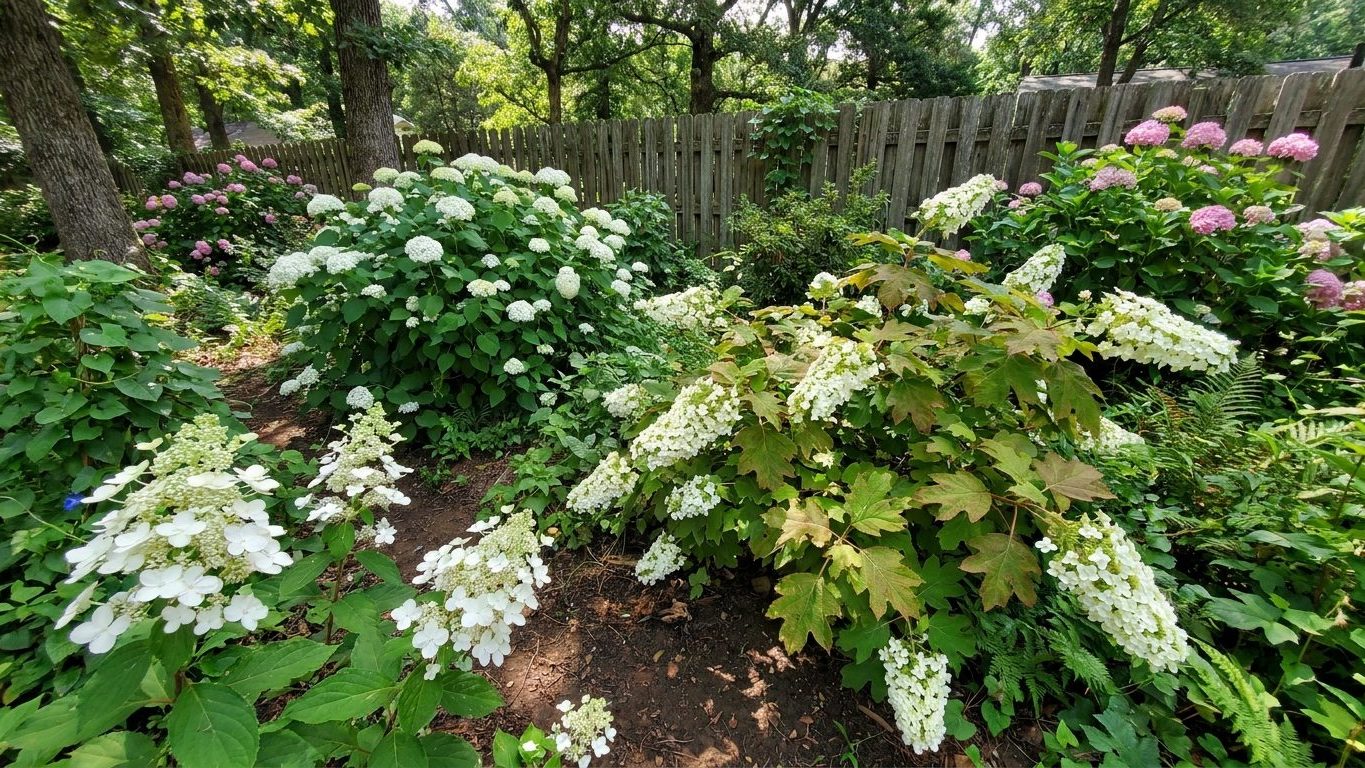
Panicle, smooth, and oakleaf hydrangeas grow well across nearly every Tennessee yard, from the Cumberland Plateau to the Mississippi bottomlands near Memphis. Bigleaf and mountain hydrangeas can work too, but their flower buds sit closer to the edge of what a Tennessee winter and a late spring frost allow. The safest bets bloom on new wood, the riskiest ones gamble on buds surviving a freeze that arrives most years in early April.
Hydrangeas that grow well in Tennessee: The Short Answer
USDA Plant Hardiness Zone Map 2023 places Tennessee between zone 5b and 8a, with Nashville, the reference city for the state’s frost data, sitting inside that range rather than at either edge. Panicle, smooth, and oakleaf hydrangeas grow well anywhere in that spread, while bigleaf, mountain, and climbing hydrangeas narrow their odds as the zone number drops toward 5b on the Cumberland Plateau.
Panicle hydrangea

Hydrangea paniculata blooms on new wood, so a late frost between March 31 and April 12 cannot cost it a season of flowers. It handles Tennessee summers, including the humidity around Memphis, and shrugs off cold winters on the Cumberland Plateau. This is the shrub to plant if you want blooms without watching the forecast.
Smooth hydrangea

Hydrangea arborescens, native to Tennessee’s own hillsides, tolerates the coldest pockets of the state without protection and reblooms on new wood after a hard prune. It wilts in afternoon sun during a West Tennessee August but recovers by evening. Few hydrangeas ask so little of a Tennessee yard.
Oakleaf hydrangea

Hydrangea quercifolia is native to the Southeast and holds up across the full 5b to 8a range, tolerating both Cumberland Plateau winters and Middle Tennessee heat. It blooms mostly on old wood, but its buds are hardier than a bigleaf’s, so a typical winter rarely erases the show. Fall color is a bonus few new-wood bloomers offer.
Climbing hydrangea

Hydrangea anomala subsp. petiolaris tolerates the same 5b to 8a spread and climbs brick or a pergola without much fuss once established. It takes two or three seasons to root in before it flowers, which tests patience more than it tests hardiness. Give it that time and it holds up to Tennessee’s freeze-thaw winters.
Mountain hydrangea

Hydrangea serrata carries flower buds that survive cold better than a true bigleaf’s, but it still blooms mostly on old wood exposed to whatever arrives after the last frost window closes. In Middle Tennessee it usually comes through fine. In colder pockets of East Tennessee it can lose a season of blooms to a late snap.
Bigleaf hydrangea

Hydrangea macrophylla is the riskiest name on this list in Tennessee, because its old wood flower buds sit exposed through winter and a frost landing anywhere in the March 31 to April 12 window can strip a season’s blooms even though the plant itself survives. It performs best in the milder pockets near Memphis and struggles more on the Cumberland Plateau.
Tennessee — the year and the numbers
- State
- Tennessee
- USDA zones
- 5b-8a
- Last spring frost
- March 31 to April 12
- First fall frost
- October 28 to November 8
- Annual rain
- 51 in
- Lawn zone
- transition-season
- Source
- NOAA NCEI 1991-2020 Climate Normals, 32F freeze probabilities · Nashville
How to Work Out the Dates for Your Own Yard
Finding your own hydrangea calendar starts with the same numbers used above, but applied to your street rather than the whole state.
- Find your zone inside the 5b to 8a range: the USDA Plant Hardiness Zone Map 2023 sets that spread for Tennessee, and a yard on the Cumberland Plateau reads colder than one near Memphis.
- Mark the last spring frost window: count on March 31 to April 12 passing before you trust a new hydrangea outdoors without cover.
- Match the plant window: set panicle, smooth, or oakleaf hydrangeas into the ground in March, April, August, or September, when soil is workable and heat hasn’t peaked.
- Hold pruning until early summer: cut bigleaf hydrangeas back only in June or July, once new growth shows which stems actually flowered.
- Feed on the state schedule: fertilize in March, May, or July, never later, so new growth has time to harden before fall.
- Watch the first fall frost window: October 28 to November 8 is when tender new growth on a bigleaf can still get caught, while a panicle planted the same week shrugs it off.
Panicle hydrangea passes this test twice over. It blooms on new wood, so the spring frost window never touches its flowers, and it tolerates the cold end of the state’s zone range.
Bigleaf hydrangea fails the same test on the Cumberland Plateau. Its old wood buds sit through a winter colder than the variety was bred to expect, and a late frost finishes the job.
Tennessee North to South: How the Dates Shift
Elevation and river valleys move these dates more than latitude does inside Tennessee’s own borders.
- East Tennessee and the Cumberland Plateau (higher elevation, cooler pockets): frost lingers later into spring and arrives earlier in fall than the state average suggests, which raises bigleaf and mountain hydrangea bud loss above what the valleys see.
- Middle Tennessee around Nashville (the reference city for the state’s frost data): dates track closest to the ranges cited above, since the monitoring station sits here.
- West Tennessee near Memphis and the Mississippi River bottomlands (milder, lower elevation): the growing season stretches longer on both ends, giving bigleaf and mountain hydrangeas a better shot at keeping old wood buds through winter.
Check your own county against the state guide before trusting any of these ranges for a specific planting date.
Mistakes Tennessee Punishes
Pruning bigleaf hydrangea in fall
Bigleaf hydrangea sets next year’s flower buds on old wood as soon as it finishes blooming, so cutting it back in October or November removes the buds meant to open next June. Wait for the June or July window instead, once new growth shows which stems survived winter.
Fertilizing after midsummer
A feeding in August or September pushes soft new growth right before the first fall frost, which lands between October 28 and November 8 most years. That tender growth freezes back and weakens the shrub. Stick to March, May, and July, and stop there.
Planting bigleaf without wind shelter
A bigleaf hydrangea set in an open, windswept spot on the Cumberland Plateau loses more flower buds to winter than the same plant tucked against a house wall or a windbreak. The zone reads colder there than it does near Nashville. Plant against structure, or choose oakleaf instead.
Tennessee Extension Offices and County Contacts
Your county sits somewhere inside Tennessee’s 5b to 8a range, and that number is only a starting point for your yard. The University of Tennessee Institute of Agriculture Extension service and your county office turn it into a planting date that fits your soil and your slope.
- Your state page: the frost dates and the pruning window for Tennessee, laid out month by month.
- What goes wrong here: the pests and mistakes that actually show up in Tennessee hydrangea beds, and how to catch them early.
- UT Extension: county agents who confirm your local zone and test your soil before you plant.
Common questions
Can bigleaf hydrangeas survive winter in Tennessee?
Yes in the milder parts of the 5b to 8a range near Memphis, but they risk losing flower buds in colder pockets like the Cumberland Plateau, where the same winter reads closer to zone 5b.
When should I plant new hydrangeas in Tennessee?
Stick to the state’s plant window: March, April, August, or September. Avoid the stretch around the last spring frost, March 31 to April 12, and the first fall frost, October 28 to November 8.
Which hydrangea blooms every year without fail in Tennessee?
Panicle hydrangea, since it flowers on new wood grown each spring rather than on wood that has to survive a Tennessee winter first.