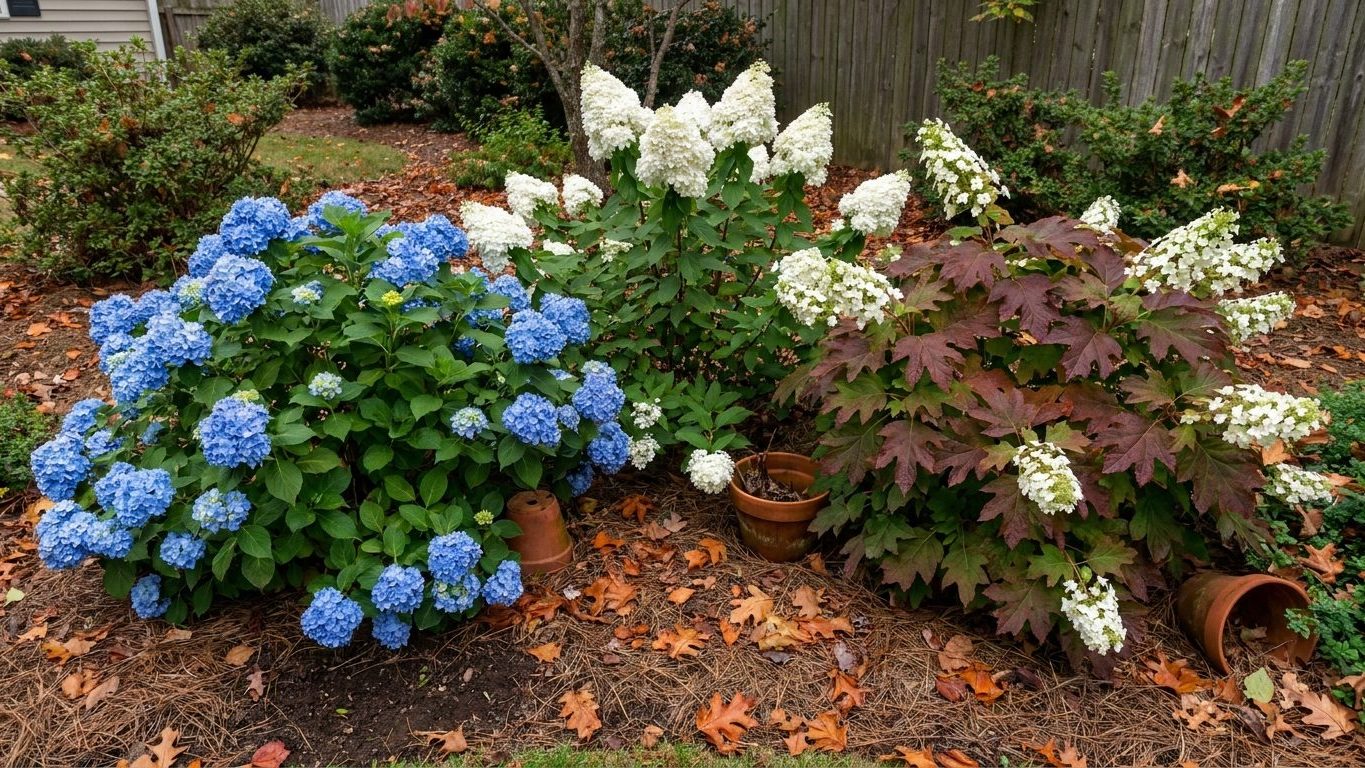
Panicle and smooth hydrangeas shrug off a Hoosier winter without any help, hardy across Indiana’s entire USDA range. Bigleaf hydrangea is the one that gambles, its flower buds can freeze out most years near Indianapolis and points north. This guide ranks six species from safest to riskiest for Indiana yards, then walks through the mistakes that cost bloom here and the dates that decide everything.
Hydrangeas that grow well in Indiana: The Short Answer
The USDA Plant Hardiness Zone Map puts Indiana at 5b to 7a, with Indianapolis sitting near the middle of that range. That spread decides which hydrangea species shrug off a Hoosier winter and which ones need a sheltered wall or a pile of leaves come November.
The six species below run from the safest bet to the biggest gamble.
Panicle hydrangea

Hydrangea paniculata blooms on new wood every year, so even a brutal freeze that kills the top growth doesn’t cost you flowers. It tolerates the full 5b to 7a spread without protection and takes more sun than any other type on this list, which matters in Indiana’s open, windy farm-country yards.
Smooth hydrangea

Hydrangea arborescens, the native often sold as ‘Annabelle’, is just as forgiving as panicle and blooms on new wood too. It’s the pick for shaded foundation beds and for gardeners in the far northern counties near the Michigan line where winters run coldest.
Climbing hydrangea

Hydrangea anomala subsp. petiolaris is hardy through the whole state range but slow, often taking three seasons before it flowers at all. Give it a sturdy trellis or brick wall and patience, not a spot where you need color right away.
Oakleaf hydrangea

Hydrangea quercifolia handles most of Indiana fine but blooms on old wood, so a late hard freeze after a warm spell can strip a season’s flowers even though the shrub survives. It does best south of Indianapolis, where the warmer end of the zone range gives buds a better shot.
Mountain hydrangea

Hydrangea serrata is a step riskier again, rated for the warmer end of the state’s range. Northern Indiana gardeners who plant it should expect some winter dieback on the flower buds most years, even with a good mulch layer.
Bigleaf hydrangea

Hydrangea macrophylla is the gamble on this list. Its old-wood flower buds routinely freeze out anywhere near Indianapolis and north of it, leaving a healthy green shrub that skips bloom for a year. It belongs in a protected courtyard or against a south-facing wall, not out in the open.
Indiana — the year and the numbers
- State
- Indiana
- USDA zones
- 5b-7a
- Last spring frost
- April 9 to April 21
- First fall frost
- October 21 to October 30
- Annual rain
- 44 in
- Lawn zone
- cool-season
- Source
- NOAA NCEI 1991-2020 Climate Normals, 32F freeze probabilities · Indianapolis
How to Work Out the Dates for Your Own Yard
Working out your own hydrangea calendar starts with the frost window, not a fixed date, because that window shifts across the length of the state.
- Start with the reference window: NOAA NCEI 1991-2020 Climate Normals puts the Indianapolis last spring frost at April 9 to April 21, and the first fall frost at October 21 to October 30.
- Shift for your county: south of Indianapolis, both windows move earlier in spring and later in fall by a fortnight or more, and north of the city they move the other way.
- Pick your planting window from the calendar: the month-by-month table above lists April, May, August, and September as plant months, giving new roots time to settle before summer heat or winter cold arrives.
- Match the variety to the risk you just calculated: panicle hydrangea tolerates the early edge of that window because a late freeze only nips new growth, not flower buds it hasn’t set yet.
- Hold bigleaf hydrangea for the safer half of the window: since its old-wood buds are already vulnerable, planting in May instead of early April spares a first-year shrub one extra stress.
- Set your pruning date last: the calendar’s prune bigleaf window falls in June and July, after bloom, so cutting back then never removes next year’s buds.
Panicle hydrangea passes this test because its flower buds form on wood the plant grows fresh each spring, so nothing exposed since October has anything to lose. Bigleaf hydrangea fails the same test in an average year, its buds already set by fall with nothing shielding them from a January cold snap.
Indiana North to South: How the Dates Shift
Indiana’s frost dates don’t hold still from one end of the state to the other, and the Indianapolis reference window only describes the middle stretch, not the shores of Lake Michigan or the Ohio River valley.
- Northern Indiana (South Bend, Fort Wayne, Gary): lake-effect cold off Lake Michigan pushes the last spring frost later and the first fall frost earlier than NOAA NCEI’s Indianapolis reference window, and the growing season runs noticeably shorter, which is why bigleaf hydrangea faces its sharpest odds here.
- Central Indiana (Indianapolis, Muncie, Lafayette): this is the reference band itself, the stretch the data actually describes, with the fewest surprises for panicle and smooth hydrangea, and the safest place in the state to try oakleaf hydrangea without extra winter protection.
- Southern Indiana (Evansville, Bloomington, New Albany): the Ohio River valley moves both frost dates outward by a fortnight or more, the same shift the source’s own caution flags, giving oakleaf and mountain hydrangea a real shot at keeping their old-wood buds through winter.
The state guide page carries the full month-by-month breakdown for wherever you garden, worth a look before committing a bigleaf hydrangea to a spot the Indianapolis window doesn’t quite describe.
Mistakes Indiana Punishes
Bigleaf hydrangea planted in the open
An exposed, windy yard strips the flower buds bigleaf hydrangea sets each fall, leaving a green shrub with no bloom the following June, especially north of Indianapolis where the zone range runs toward its colder end. Choose panicle or smooth hydrangea for open sites instead, or reserve bigleaf hydrangea for the sheltered wall described above.
Bigleaf hydrangea pruned in fall
Cutting bigleaf hydrangea back in October removes the very buds it set for next summer, since it blooms on old wood, not new growth like panicle or smooth hydrangea. The calendar’s prune bigleaf window sits in June and July, right after bloom, a mistake that costs an entire summer of color if missed.
Planting too early in a cold April
Setting a hydrangea out at the very start of the April to May planting window risks the roughly 10 percent chance of a freeze after the published spring date that Purdue Extension flags for this region, hard on a young root ball. Wait a week or two into the window before digging, especially for bigleaf hydrangea.
Indiana Extension Offices and County Contacts
The zone range and frost window above are a starting point, not the final word for your yard. Your county’s Purdue Extension office adjusts for local soil and microclimate, and it’s the surest way to confirm which hydrangea handles your exact address.
- Purdue Extension: the statewide directory of county offices, soil test kits, and hydrangea fact sheets for Indiana growers.
- Your state page: the frost dates and the pruning window where you live, laid out month by month.
- What goes wrong here: the pests and diseases this state’s hydrangeas run into, and how to catch each one early.
Common questions
What is the easiest hydrangea to grow in Indiana?
Panicle hydrangea takes the least fuss statewide, since it blooms on new wood and tolerates the full 5b to 7a range without winter protection.
Do hydrangeas need winter protection in Indiana?
Panicle and smooth hydrangea don’t, but bigleaf and mountain hydrangea benefit from a thick mulch layer and a sheltered spot, especially anywhere at or north of Indianapolis.
What USDA zone is Indiana for hydrangeas?
The USDA Plant Hardiness Zone Map places the state between 5b and 7a, with the colder end running along the Michigan line and the warmer end along the Ohio River.