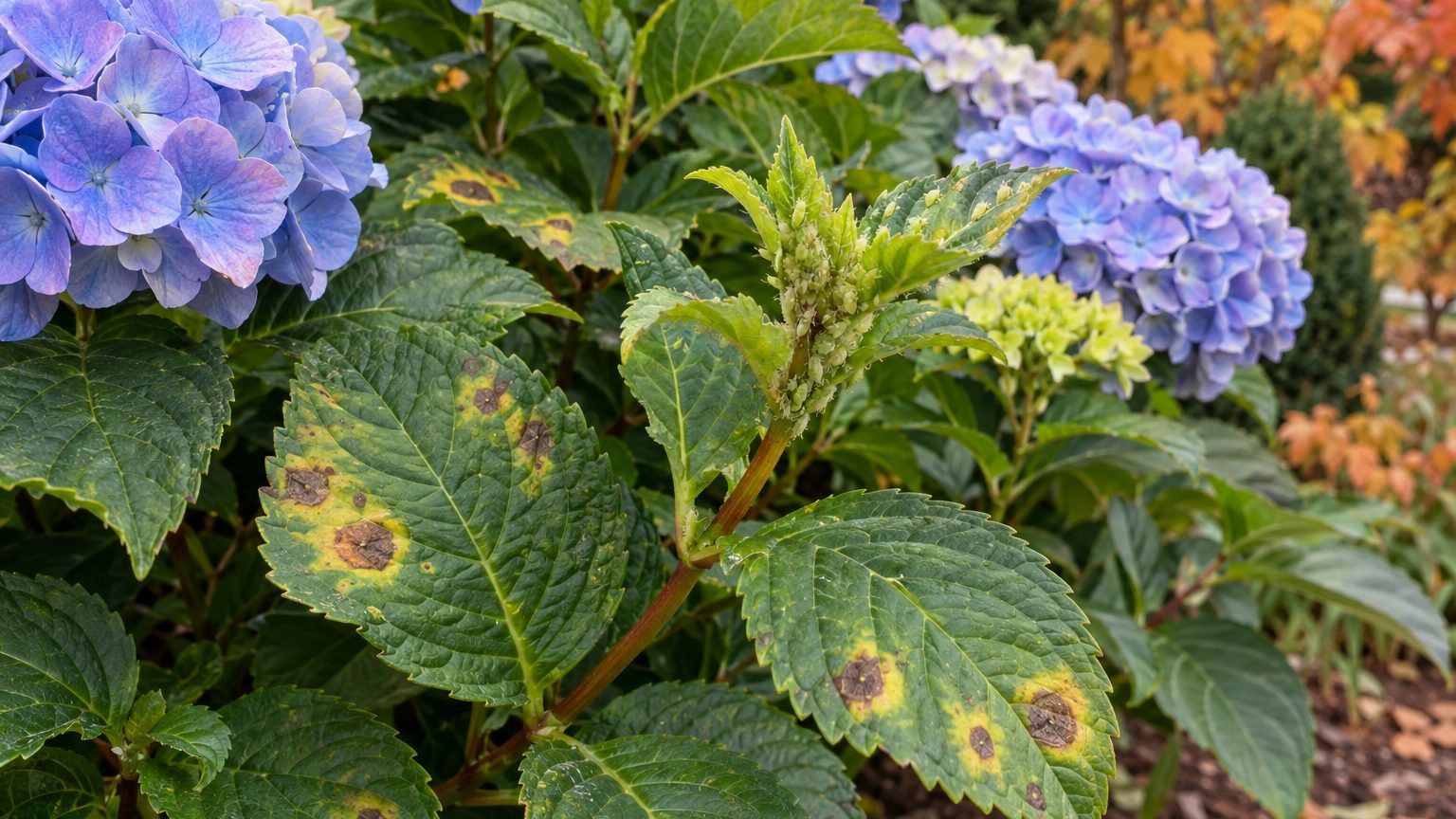
Hydrangea trouble in Tennessee rarely arrives as a mystery insect or a rare disease. It arrives as a symptom on a leaf, and the date tells you most of what you need. Nashville’s frost windows set the frame for the whole season, from the first flush of leaves in spring to the last blooms of fall. Read the leaf against that calendar before you reach for a spray.
Hydrangea pests and diseases Tennessee: The Short Answer
In Nashville, NOAA NCEI 1991-2020 Climate Normals put the last spring frost at March 31 to April 12 and the first fall frost at October 28 to November 8. Between them, Tennessee hydrangeas show a short list of symptoms, and each one points to a habit you can change.
Blackened new growth in spring
A frost after buds break kills the soft tips, and the damage looks like disease but isn’t. Wait until Nashville’s March 31 to April 12 window has passed before you judge, then trim only clearly dead wood. Timing details sit in When to Plant and Prune Hydrangeas in Tennessee.
Curled, sticky, distorted leaves
Tiny sap-feeding insects gather on soft new growth and leave a sticky film. Check leaf undersides and rinse them off with a firm stream of water. Feed only in March, May and July, since surplus nitrogen pushes the tender growth they favor. The basics are in Hydrangeas in Tennessee.
Brown spots after wet weather
Fungal leaf spots spread when foliage stays wet in humid weather. Water at the soil line in the morning, open up crowded stems for airflow, and rake up spotted leaves in fall instead of leaving them beneath the shrub. Cleanup comes after Nashville’s first fall frost, October 28 to November 8.
White dusty coating on leaves
A powdery film means a fungus is thriving where air moves poorly and shade runs deep. Thin the center of the clump and skip overhead sprinklers. If the pattern returns every year, the site is the problem. Compare options in Hydrangeas That Grow Well in Tennessee.
Holes chewed in leaves
Many chewing insects feed after dark, so the culprit is rarely visible at noon. Go out at dusk with a flashlight, pick off what you find, and leave broad-spectrum sprays alone, since they also kill the predators keeping numbers down. A few ragged leaves are cosmetic.
Wilting despite moist soil
Roots sitting in soggy clay can’t take up water, so leaves droop even when the ground is wet. Test the soil with a finger before watering, improve drainage at planting, and set new shrubs in March, April, August or September. Site advice lives in Hydrangeas in Tennessee.
Tennessee — the year and the numbers
- State
- Tennessee
- USDA zones
- 5b-8a
- Last spring frost
- March 31 to April 12
- First fall frost
- October 28 to November 8
- Annual rain
- 51 in
- Lawn zone
- transition-season
- Source
- NOAA NCEI 1991-2020 Climate Normals, 32F freeze probabilities · Nashville
How to Work Out the Dates for Your Own Yard
Nashville is the reference city, and a short countdown from its frost windows plus a few quick checks will tell you which problem you actually have.
- Count back from the last spring frost: NOAA NCEI 1991-2020 Climate Normals put Nashville at March 31 to April 12, so subtracting two weeks gives March 17 to March 29, the stretch when early leaf growth is gambling on the weather.
- Count back from the first fall frost: it runs October 28 to November 8, so six weeks earlier gives September 16 to September 27, the tail end of the September planting window, when a new shrub still has time to root.
- Locate the damage on the plant: tips and new leaves point to frost or sap feeders, older lower leaves point to splashing water and wet foliage, and a drooping shrub points to roots. Blackened tips inside the spring window are frost until proven otherwise.
- Audit your own habits: compare what you did with the fertilizing months of March, May and July, and with how often the sprinkler hits the leaves. Extra feeding and wet foliage are the two habits you can change today.
- Photograph before you spray: shoot the whole shrub, then close-ups of a leaf top and underside, and note the date. A dated photo lets the county extension office narrow the cause without guessing.
Nashville is the reference, not the whole state. If you garden in East Tennessee or on the Cumberland Plateau, expect spring to arrive later, and shift the countdown to match.
Tennessee North to South: How the Dates Shift
Tennessee stretches from the Mississippi River to the Appalachians, and elevation and latitude push the same symptoms earlier or later across that distance.
- East Tennessee (Knoxville, Johnson City, Gatlinburg): cooler than Nashville, with spring arriving later, so push every spring date back and watch for late frost on tips in mountain valleys.
- The Cumberland Plateau (Crossville, Sewanee, Monteagle): higher ground runs cooler and later in spring, so frost damage is the first thing to rule out before blaming an insect.
- Middle Tennessee (Nashville, Franklin, Murfreesboro): the reference area, where the dates above apply directly.
- West Tennessee (Memphis, Jackson, Dyersburg): generally lower and warmer, so dates tend to run earlier and long humid summers make wet-foliage problems worth watching.
For the wider picture of where each region sits, start with Hydrangeas in Tennessee.
Mistakes Tennessee Punishes
Three errors show up again and again in Tennessee yards, and each has a cheaper alternative.
Fertilizing after July
NOAA NCEI 1991-2020 Climate Normals put Nashville’s first fall frost at October 28 to November 8, and late feeding pushes soft growth that frost then kills. Stop after the July round, since feeding runs March, May and July. Feeding basics are in Hydrangeas in Tennessee.
Pruning bigleaf at the wrong time
Cutting bigleaf in fall or early spring removes flower buds and invites frost-tender regrowth. Prune in June or July, once bloom is done, and limit other months to snipping dead wood. The full pruning window is in When to Plant and Prune Hydrangeas in Tennessee.
Using Nashville dates everywhere
Nashville’s dates fit Middle Tennessee, not the whole state. East Tennessee and the Cumberland Plateau run cooler and later in spring, so push your countdown later. Ask your county office to confirm, and compare plants in Hydrangeas That Grow Well in Tennessee.
Tennessee Extension Offices and County Contacts
The USDA NIFA Land-Grant University Extension directory lists the Tennessee extension service at utia.tennessee.edu/extension. Nashville’s dates are a starting point, and your county office knows the local soil and elevation.
- Hydrangeas in Tennessee: the frost dates and the pruning window where you live.
- Hydrangeas That Grow Well in Tennessee: which ones hold up here.
- When to Plant and Prune Hydrangeas in Tennessee: the month-by-month gestures. Then send your dated photos to the county office before you spray anything.
Common questions
When is the last spring frost in Nashville?
NOAA NCEI 1991-2020 Climate Normals put it at March 31 to April 12. East Tennessee and the Cumberland Plateau run later, so check your own county before you trust the range.
When does the first fall frost arrive?
In Nashville it falls between October 28 and November 8. That is the signal to rake up spotted leaves, and the reason feeding should already have ended after July.
Who can identify a hydrangea problem in Tennessee?
Your county office of the Tennessee extension service, reached through utia.tennessee.edu/extension. Bring dated photos of the whole shrub and of a leaf top and underside.