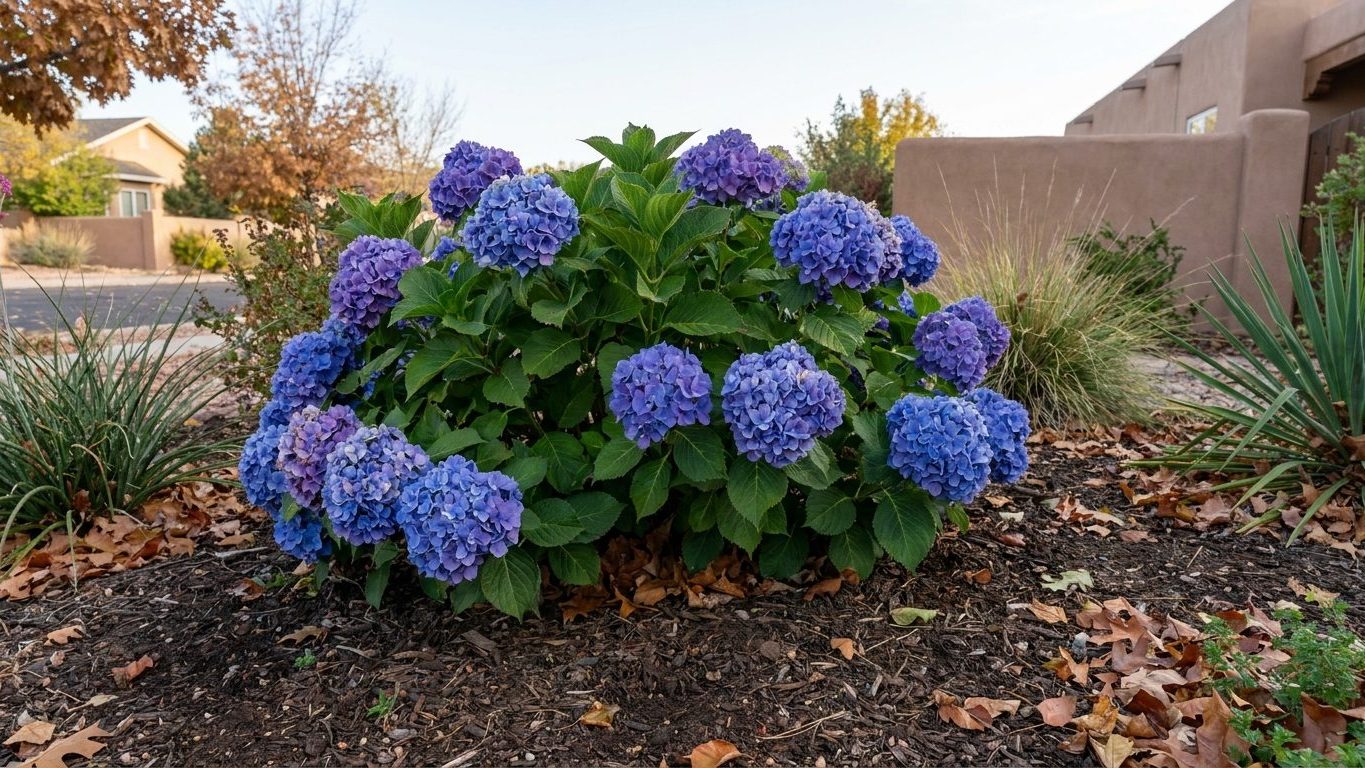
In Albuquerque, the safest stretch to plant hydrangeas falls in April, once spring frost clears, and again in August into September once summer heat eases, while bigleaf types get pruned in June or July after their first bloom fades. Elsewhere in New Mexico, especially higher up, push those dates back a week or two and check with your county extension office first.
When to prune hydrangeas in New Mexico: The Short Answer
NOAA NCEI U.S. Climate Normals 1991-2020 puts Albuquerque’s last spring frost at March 31 to April 12 and the first fall frost at October 29 to November 9, and every month below is set against that stretch.
- January: Hydrangeas sit fully dormant and the ground is usually too cold to dig, so this stays a planning month, not a planting one. Check that fall mulch is still in place over the root zone.
- February: Frost is still weeks from breaking, so keep new plants in their nursery pots on a bright porch rather than in the ground. Order bareroot stock now if you want it in the yard by April.
- March: This opens the calendar’s plant window, but with the last frost not clearing until March 31 to April 12, hold off on the earliest days. It’s also the first of the year’s three fertilize months, so feed established shrubs once new growth shows.
- April: Once the frost window closes, mid to late April is the safest stretch to get container-grown hydrangeas into the ground. Water deeply right after planting and keep the root ball from drying out for two weeks.
- May: This is the second fertilize month, timed to push leafy growth before summer heat arrives. Skip planting this month and let spring transplants settle in instead.
- June: Bigleaf varieties that finished their first bloom get pruned now, cutting spent flower heads back to the first strong bud below them. Afternoon shade matters more as temperatures climb.
- July: Pruning continues for any bigleaf shrub still carrying faded blooms, and this is the year’s third and final fertilize month. Water more often, since dry heat pulls moisture out of beds fast.
- August: The calendar’s second plant window opens once the sharpest summer heat eases. Choose a cloudy stretch or plant in early morning to spare new roots from transplant stress.
- September: Planting continues, giving roots the longest run to establish before the first fall frost lands October 29 to November 9. Hold off on any pruning this late.
- October: With frost approaching, this is the month to lay down mulch over the root zone rather than start anything new. Stop fertilizing so growth doesn’t get caught out by cold.
- November: Frost typically arrives somewhere in this stretch, and leaves blacken fast once it does. Leave dead foliage on the plant through winter, since it helps insulate the buds beneath it.
- December: Shrubs are fully dormant and need nothing beyond an eye on mulch after wind or a hard freeze. This is a good month to plan replacements for spring.
Those Albuquerque dates are a starting point, not a promise. Gardens outside the city, especially at higher elevation, often see frost linger later in spring and arrive earlier in fall, so confirm timing with your own county before you dig.
New Mexico — the year and the numbers
- State
- New Mexico
- USDA zones
- 4b-9a
- Last spring frost
- March 31 to April 12
- First fall frost
- October 29 to November 9
- Annual rain
- 9 in
- Lawn zone
- transition-season
- Source
- NOAA NCEI U.S. Climate Normals 1991-2020, 32F freeze probabilities · Albuquerque
How to Work Out the Dates for Your Own Yard
Your own frost window decides everything else, and a five-step check gets you there even without a soil thermometer.
- Find your zone first: The USDA Plant Hardiness Zone Map 2023 places New Mexico anywhere from 4b to 9a, and a shrub rated for zone 6 will struggle at 4b in the mountains north of Santa Fe but thrive in Las Cruces.
- Count back from your last frost: Take Albuquerque’s March 31 to April 12 window as your reference point, then add a week or two if you’re higher up or further from the city center.
- Match the plant window to your soil: Even inside the state’s plant months, wait until soil crumbles in your hand rather than clumps, since cold wet clay around new roots is worse than a slightly later start.
- Test one shrub before committing a bed: A panicle hydrangea against a west wall in Albuquerque often survives both winter cold and summer sun, while a bigleaf hydrangea in the same spot usually scorches by July.
- Recheck before pruning: Bigleaf types get their cut in June or July only after you’ve confirmed which buds are old wood and which are new, since pruning the wrong ones removes next year’s flowers entirely.
None of this replaces a look at your own yard. Wind exposure, wall reflection and soil type shift these numbers as much as elevation does, so treat the calendar as a start and adjust after the first year.
New Mexico North to South: How the Dates Shift
Elevation does more to shift these dates in New Mexico than latitude does, since the state runs from around 3,000 feet along the Rio Grande in the south to over 7,000 feet in the northern mountains.
- Northern mountains (Santa Fe, Taos, Los Alamos): frost lingers later into spring and returns earlier in fall than Albuquerque’s numbers suggest, so push both windows back and lean toward panicle or smooth hydrangeas over bigleaf.
- Central river valley (Albuquerque, Rio Rancho, Belen): this is the reference zone the calendar above is built on, with the most moderate swing between spring and fall frost anywhere in the state.
- Southern desert (Las Cruces, Deming, the Mesilla Valley): frost clears earlier and returns later, stretching the planting season on either end, though summer heat becomes the bigger limit on which varieties hold up.
- Eastern plains (Clovis, Roswell, Portales): open exposure brings harder wind and sharper swings than the river valley sees, so windbreak placement matters as much as the calendar date.
Check the state guide for New Mexico for the zone breakdown by county before you settle on a date.
Mistakes New Mexico Punishes
Planting in full afternoon sun
New Mexico’s sun intensity at altitude scorches hydrangea leaves fast, especially on a west-facing wall with no afternoon shade. Choose a spot with morning sun and afternoon shade instead, or plant against an east-facing wall where the shrub gets light before the heat peaks.
Pruning bigleaf hydrangeas outside the window
Cutting back bigleaf types outside June or July removes flower buds already set for next year, leaving a healthy shrub with no blooms. Stick to the calendar’s June to July window, and only cut spent flower heads, not healthy stems.
Skipping mulch before the first fall frost
NOAA NCEI U.S. Climate Normals 1991-2020 puts Albuquerque’s first fall frost at October 29 to November 9, and bare soil around the root zone loses heat fast as temperatures drop toward that window. Lay mulch three to four inches deep by mid-October instead, and leave it through winter.
New Mexico Extension Offices and County Contacts
Albuquerque’s numbers are a starting point, and New Mexico State University Extension keeps county-level detail that adjusts them for your elevation and soil.
- New Mexico State University Extension: county offices that can confirm your local frost window and soil results before you plant.
- Which hydrangeas hold up here: the variety-by-variety breakdown for New Mexico’s dry heat and alkaline soil.
- What goes wrong here: the pests and problems specific to hydrangeas grown in this state, in the order they show up.
Call your county office before the first frost either way, since local advice beats any calendar.
Common questions
Can I plant hydrangeas in New Mexico in the fall?
Yes, the calendar’s second plant window opens in August and runs into September, giving roots time to establish before the first fall frost arrives October 29 to November 9 in Albuquerque.
Do hydrangeas need full shade in New Mexico?
Not full shade, but afternoon shade matters far more here than in wetter states, and morning sun with protection after midday keeps leaves from scorching through summer.
Why didn’t my bigleaf hydrangea bloom this year?
The most common cause is pruning outside the June to July window, which cuts off buds already set for the following year’s flowers.