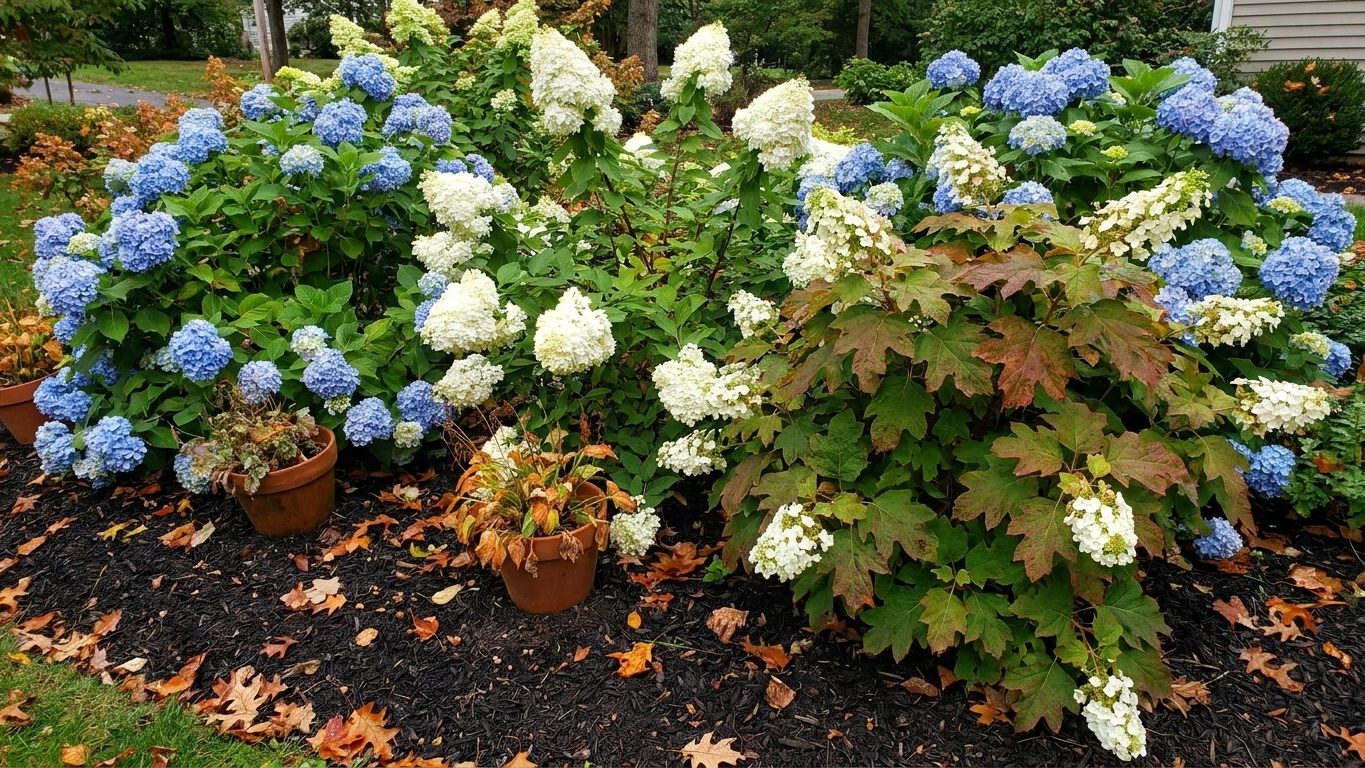
Smooth and panicle hydrangeas grow well in Wisconsin. Annabelle, Incrediball, Limelight and Quick Fire flower on wood that grows each spring, so a brutal winter costs them little. Bigleaf and oakleaf types can work, but they gamble their flower buds every January. Below, each variety gets a verdict, then a method for checking any other name against your own yard.
Hydrangeas that grow well in Wisconsin: The Short Answer
The USDA Plant Hardiness Zone Map spans Wisconsin from 3b to 6a, a rating built on one variable, the average annual extreme minimum temperature. Milwaukee sits inside that spread, and colder parts of the state shift the odds, so the list below runs from safest to riskiest.
Annabelle

This smooth hydrangea (Hydrangea arborescens) can die back to the ground in a rough winter and still bloom, because its flower buds form on new wood grown that spring. That makes it the low-risk default for cold sites. The big white heads can flop after heavy rain.
Incrediball
Incrediball is a smooth hydrangea selected for stronger stems than Annabelle, so the white heads stay upright in summer storms. It blooms on new wood too, so it carries the same winter tolerance. Choose it where flopping bothers you, such as beside a walkway.
Limelight
Limelight (Hydrangea paniculata) opens lime green in summer and fades to cream and pink by fall. Panicle hydrangeas bloom on new wood and tolerate cold, so a hard Wisconsin winter rarely costs the flowers. It also handles more sun than smooth types. Plan for a big shrub.
Quick Fire
Quick Fire is a panicle hydrangea that blooms earlier than most, an edge in a northern season that ends with the first fall freeze. Its white flowers age to rosy red. It flowers on new wood like its cousins, so it belongs in the safe group.
Endless Summer
Endless Summer is a bigleaf hydrangea (Hydrangea macrophylla) bred to rebloom, so it is the bigleaf most worth trying here. Buds on old wood can still die in a hard winter, leaving leaves and no early flowers, and the blooms on new growth arrive late.
Oakleaf hydrangea
Oakleaf hydrangea (Hydrangea quercifolia) offers lobed leaves and burgundy fall color, but it sets flower buds on old wood and sits near the edge of its range here. A cold winter can erase a year of blooms. Try it only in a sheltered spot, such as against a south-facing wall.
Wisconsin — the year and the numbers
- State
- Wisconsin
- USDA zones
- 3b-6a
- Last spring frost
- April 16 to April 29
- First fall frost
- October 17 to October 29
- Annual rain
- 35 in
- Lawn zone
- cool-season
- Source
- NOAA NCEI 1991-2020 Climate Normals, 32F freeze probabilities · Milwaukee
How to Work Out the Dates for Your Own Yard
NOAA NCEI Climate Normals puts Milwaukee’s last spring frost at April 16 to April 29 and its first fall frost at October 17 to October 29, and every date below counts from those two windows.
- Check the winter rating first: Hardiness ratings rest on one variable, the average annual extreme minimum, so they say whether a shrub survives January and nothing about when frost arrives. That is why the next steps use frost windows.
- Ask where the flower buds form: Annabelle passes the winter test because its buds form on new wood, so a stem frozen to the ground still flowers that summer. A plain bigleaf fails it, since its buds sit on last year’s stems and one hard January can end the show.
- Count forward from the last spring frost: Frost risk fades once the April 16 to April 29 window closes, so a shrub bought in April can wait in its pot until then, and May is the safe month to plant.
- Count back from the first fall frost: I allow six weeks for roots to settle before the ground freezes. Six weeks before October 17 to October 29 gives September 5 to September 17, so a fall shrub goes in early in September, or in August.
- Shift the count for your street: Milwaukee is a lakeshore number, and inland southern Wisconsin typically freezes in early October, so pull the fall count earlier there.
Write both ranges on a calendar before you shop. A range minus weeks is still a range, so treat the result as a target zone, not a deadline.
Wisconsin North to South: How the Dates Shift
NOAA NCEI Climate Normals gives Milwaukee a last spring frost of April 16 to April 29, and each step away from that lakeshore station slides the window.
- Lake Michigan shore (Milwaukee, Racine, Sheboygan): the water holds summer heat, so the first fall freeze arrives later than inland, though spring warms more slowly.
- Inland southern Wisconsin (Madison, Janesville, Beloit): without the lake’s buffer, fall freezes arrive earlier than at Milwaukee, so late plantings have less time to root.
- Driftless hills and valleys (La Crosse, Viroqua, Prairie du Chien): cold air drains into low ground, so a valley bed can frost before the ridge above it. Slopes beat the lowest spot.
- Northwoods and the far north (Rhinelander, Hayward, Eagle River): freezes come far earlier and winters run colder, so stick to smooth and panicle types and plant in spring.
The statewide picture, with the full zone spread, lives in Hydrangeas in Wisconsin.
Mistakes Wisconsin Punishes
Winter gets the blame, but three habits do most of the damage, and each one has a simple fix.
Pruning bigleaf in early spring
Bigleaf buds sit on last year’s stems, so a spring cut removes the season’s flowers. Wait until the calendar’s June and July window and cut only spent heads and dead wood. The full timing is in When to Plant and Prune Hydrangeas in Wisconsin.
Fertilizing after midsummer
Feeding late pushes soft new growth that winter cold burns before it hardens. Stick to the March, May and July feedings from the calendar and skip anything later. New shrubs planted in August or September need water, not fertilizer. See Hydrangeas in Wisconsin for the wider picture.
Crowded shrubs with wet leaves
Overhead watering and tight spacing keep leaves damp, and damp foliage invites disease. Water at the base in the morning and leave room for airflow between shrubs. If spots or coatings appear anyway, Hydrangea Pests and Diseases in Wisconsin walks through what to look for.
Wisconsin Extension Offices and County Contacts
The Milwaukee numbers are a starting point, not a verdict on your street. The USDA NIFA Land-Grant University Extension directory lists extension.wisc.edu as Wisconsin’s extension service, and your county office knows the local frost pockets and soils.
- Hydrangeas in Wisconsin: the statewide picture, with zones, frost dates and the pruning window where you live.
- When to Plant and Prune Hydrangeas in Wisconsin: the planting, feeding and pruning months in order, so you can match a variety to a date.
- Hydrangea Pests and Diseases in Wisconsin: what goes wrong on these shrubs here. Read it before you buy, then call your county extension office with your street address and your shortlist.
Common questions
Can I grow bigleaf hydrangeas in Wisconsin?
Yes, but expect uneven flowering. Bigleaf types carry buds on old wood, so a hard winter can leave a healthy shrub without blooms. Reblooming selections improve the odds, and any pruning belongs in the calendar’s June and July window.
When should I plant hydrangeas in Wisconsin?
The calendar lists April, May, August and September as planting months. Spring planting starts once the frost window passes, and the fall months work if roots get time to settle before the ground freezes.
Do hydrangeas grow in northern Wisconsin?
The USDA Plant Hardiness Zone Map spans Wisconsin from 3b to 6a, and the north sits at the cold end. Smooth and panicle types are the ones to try there, planted in a sheltered spot. Bigleaf and oakleaf are long shots.