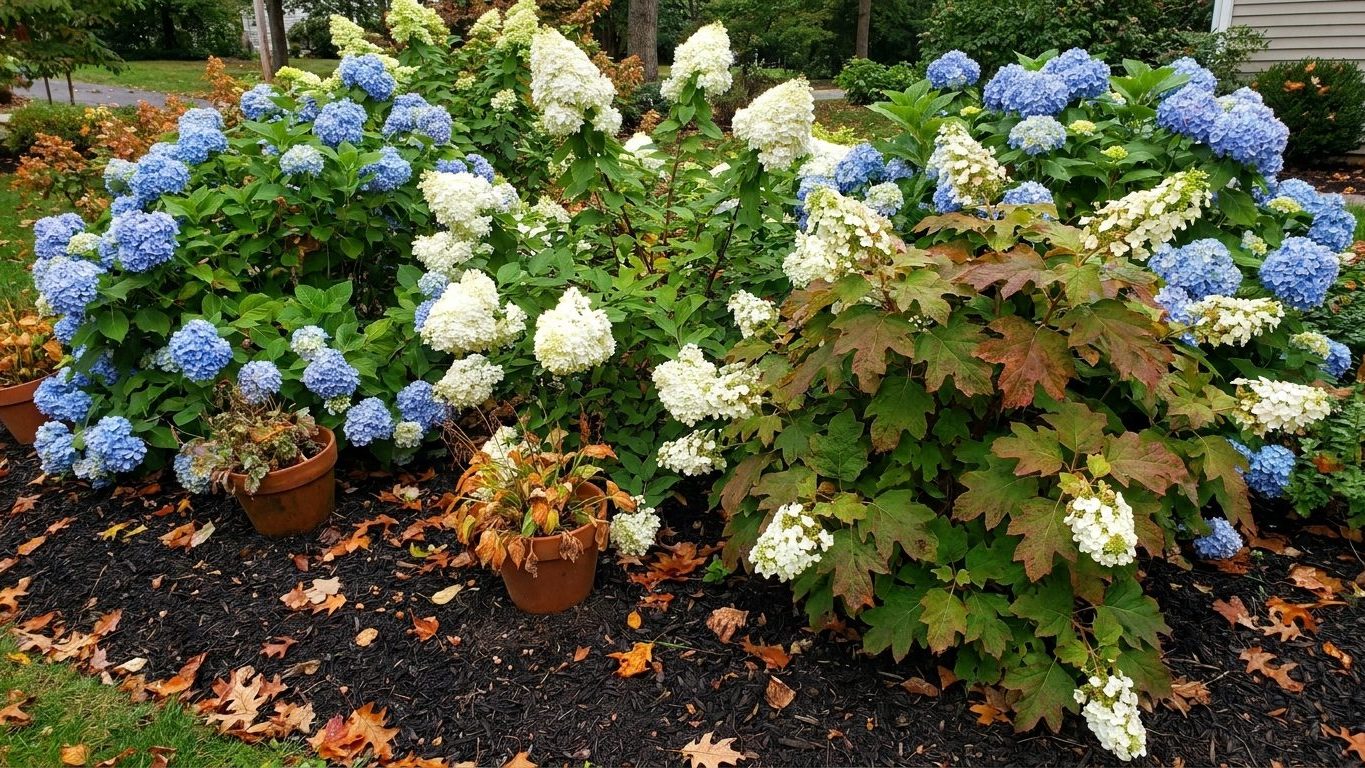
Panicle, smooth and oakleaf hydrangeas are the safest bets in West Virginia, with climbing and mountain types close behind. Bigleaf can work, but it is the gamble of the group. Most of the difference comes down to when each one sets its flower buds, and how hard a spring freeze or a ridge-top winter hits them. The ranking below runs from most dependable to riskiest.
Hydrangeas that grow well in West Virginia: The Short Answer
NOAA NCEI Climate Normals put Charleston’s last spring freeze between April 9 and April 23, and its first fall freeze between October 18 and November 1. USDA hardiness zones run from 5a to 7a statewide, and ridge tops freeze earlier than Charleston’s river valley, so favor hydrangeas that flower on new wood.
Panicle hydrangea

Hydrangea paniculata blooms on the current season’s growth, so a late freeze inside Charleston’s April 9 to April 23 window cannot erase the summer show. It also handles the cold end of the state’s zone range. Give it full sun, and thin crowded stems instead of shearing the whole shrub into a ball.
Smooth hydrangea ‘Annabelle’
Hydrangea arborescens also flowers on new wood, so even a winter that kills stems back to the ground still leaves the plant blooming. The catch is weak stems, and big flower heads flop after a summer storm. Choose a sturdier cultivar or stake the clumps, and shade it from harsh afternoon sun.
Oakleaf hydrangea
Hydrangea quercifolia flowers on old wood, but its buds are usually tougher than a bigleaf’s. The peeling bark and burgundy fall leaves earn the spot even in a poor bloom year. Plant it in well-drained soil and part shade, and skip hard pruning. On a cold ridge, tuck it against a wall.
Climbing hydrangea
Hydrangea petiolaris is a self-clinging vine that shrugs off cold, but it blooms on old wood and spends its first years building roots and stems. Patience is the price. Give it a sturdy wall, fence or tree trunk in part shade, and leave the pruners alone until it has covered its support.
Mountain hydrangea
Hydrangea serrata is smaller than bigleaf and usually handles cold better, but it also forms buds on old wood, so a hard winter still costs flowers. Plant it on the sheltered side of the house and mulch the roots. Common problems are covered in Hydrangea Pests and Diseases in West Virginia.
Bigleaf hydrangea
Hydrangea macrophylla forms flower buds the summer before, so a late freeze around Charleston’s April 9 to April 23 window can wipe out a year of bloom. Plant it in a sheltered spot and prune only in June and July, right after flowering. See When to Plant and Prune Hydrangeas in West Virginia.
West Virginia — the year and the numbers
- State
- West Virginia
- USDA zones
- 5a-7a
- Last spring frost
- April 9 to April 23
- First fall frost
- October 18 to November 1
- Annual rain
- 46 in
- Lawn zone
- cool-season
- Source
- NOAA NCEI 1991-2020 Climate Normals, 32F freeze probabilities · Charleston
How to Work Out the Dates for Your Own Yard
Every date starts from the frost window, counted forward for spring and backward for fall.
- Find the frost window: NOAA NCEI Climate Normals put Charleston’s last spring freeze between April 9 and April 23 and its first fall freeze between October 18 and November 1, and ridges and hollows shift those ranges, so treat them as the middle of the picture.
- Count forward from spring: the calendar’s spring planting months are April and May, but I would lean toward May, once the April 9 to April 23 window has passed.
- Count back from fall: subtract the weeks a new root system needs from October 18 to November 1 and the answer is a range too, which is why August and September are the fall planting months.
- Match the name to the winter: panicle flowers on new wood, so it comes through a cold snap and still blooms, while bigleaf carries last summer’s buds through the winter and loses them after a hard freeze.
- Set the feeding and pruning months: fertilize in March, May and July, and prune bigleaf only in June and July.
- Diagnose before you treat: a healthy shrub with no flowers points to frozen buds or mistimed pruning, while marked leaves belong on the Hydrangea Pests and Diseases in West Virginia page.
Higher ground freezes earlier in fall, so a yard above the valley should treat August as safer than September. Mark your two ranges on a calendar once, and every other task falls into place around them.
West Virginia North to South: How the Dates Shift
Elevation moves West Virginia’s dates more than latitude does, and Charleston’s river valley sits toward the mild end.
- Allegheny Highlands (Canaan Valley, Snowshoe, Pocahontas County): the highest ground freezes earliest in fall and thaws latest in spring, so panicle and smooth types are the sound choices and bigleaf is a real gamble.
- Southern Mountains (Beckley, Bluefield, Princeton): elevation outweighs the southern latitude here, so plant early in the fall window and expect a cooler season than Charleston’s.
- Kanawha and Ohio River Valleys (Charleston, Huntington, Parkersburg): valley sites tend to freeze later in fall, so these yards follow the Charleston ranges most closely and give bigleaf its best odds.
- Eastern Panhandle (Martinsburg, Berkeley Springs, Harpers Ferry): the lower valleys tend to run milder than the mountains, though nearby ridges bring the cold back, so match dates to the exact site rather than the county.
The statewide picture, zones included, sits on the Hydrangeas in West Virginia page.
Mistakes West Virginia Punishes
Bigleaf on an exposed ridge
Higher ground freezes earlier than the October 18 to November 1 window NOAA NCEI Climate Normals give Charleston, and wind and cold punish exposed buds. Move bigleaf to a sheltered spot near the house, or switch to a panicle, which blooms on new wood and shrugs off the cold.
Pruning bigleaf at the wrong time
Cutting a bigleaf back outside its window removes buds that formed the summer before, and the shrub answers with leaves and no flowers. Prune only in June and July, straight after bloom, and cut just the spent heads. The dates are in When to Plant and Prune Hydrangeas in West Virginia.
Feeding too late in the season
Fertilizer after July pushes soft new growth that the first fall freeze, October 18 to November 1 in Charleston, can burn. Stay with the fertilizing months of March, May and July, and water the plants in when you feed. For spotted leaves, start with Hydrangea Pests and Diseases in West Virginia.
West Virginia Extension Offices and County Contacts
The state figures here are a starting point. The USDA NIFA Land-Grant University Extension directory lists West Virginia University Extension at extension.wvu.edu, and your county office knows how local elevation shifts the frost window.
- Hydrangeas in West Virginia: the frost dates and the zone range for the whole state.
- When to Plant and Prune Hydrangeas in West Virginia: the planting, feeding and pruning months in order.
- Hydrangea Pests and Diseases in West Virginia: what to look for on leaves and stems, so you can describe it clearly when you call your county extension office.
Common questions
Can bigleaf hydrangeas grow in West Virginia?
Yes, in sheltered spots, but they carry the most risk of any type here because their buds form the summer before and can freeze. Panicle and smooth types bloom on new wood and are the safer picks if you want flowers every year.
When is the best time to plant hydrangeas in West Virginia?
The state calendar lists April, May, August and September as planting months. Either season works, and fall planting gives roots time to settle before the first freeze. Yards on higher ground should lean toward August.
What is the easiest hydrangea to grow in West Virginia?
A panicle hydrangea. It flowers on new wood, copes with the cold end of the USDA Plant Hardiness Zone Map range of 5a to 7a, and does not depend on its buds surviving the winter. Smooth hydrangeas are a close second.