Skip to content

When to Move a Rose Bush, and How to Transplant It

When to Move a Rose Bush, and How to Transplant It

A rose that has outgrown its corner starts leaning toward the light, and its canes crowd the path or the foundation. Moving it solves the problem if the timing and the digging are right.

When Can You Move a Rose Bush?

Move a rose while it is dormant, which means after growth has stopped in fall or before the buds open in spring. Climate decides which end of that stretch suits your yard, and the bloom habit of the rose changes how much pruning goes with the move.

In Arkansas, the dormant months between November and February suit moving plants. In Iowa, early spring, before the plant begins to leaf out, is the time to transplant. Ground that can still be worked matters as much as the date.

A rose already in leaf can still be moved when there is no choice, as New Mexico guidance allows for plants whose buds have started to grow. The page for your state gives the months.

How to Transplant a Rose Bush

When to Move a Rose Bush, and How to Transplant It

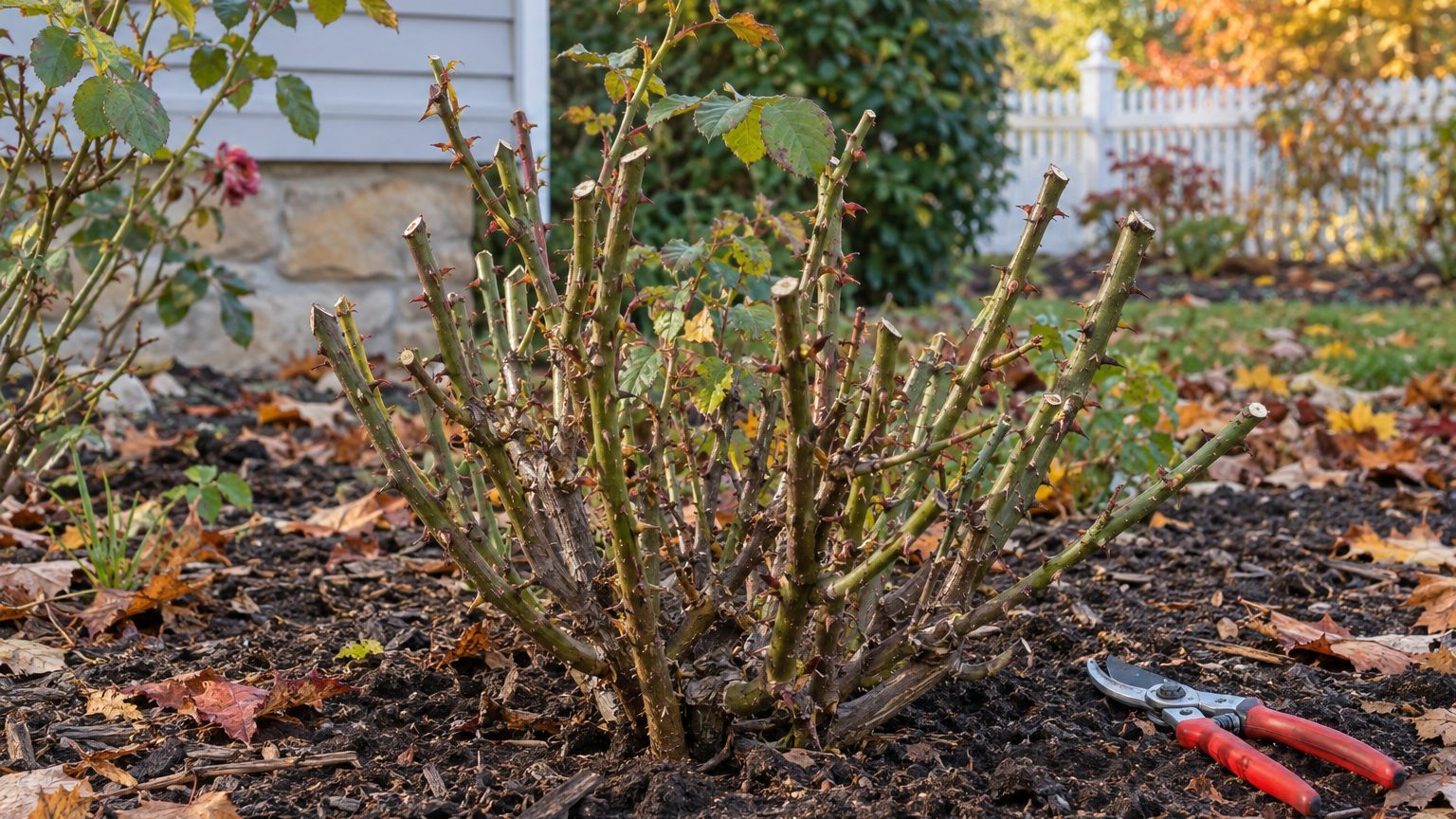
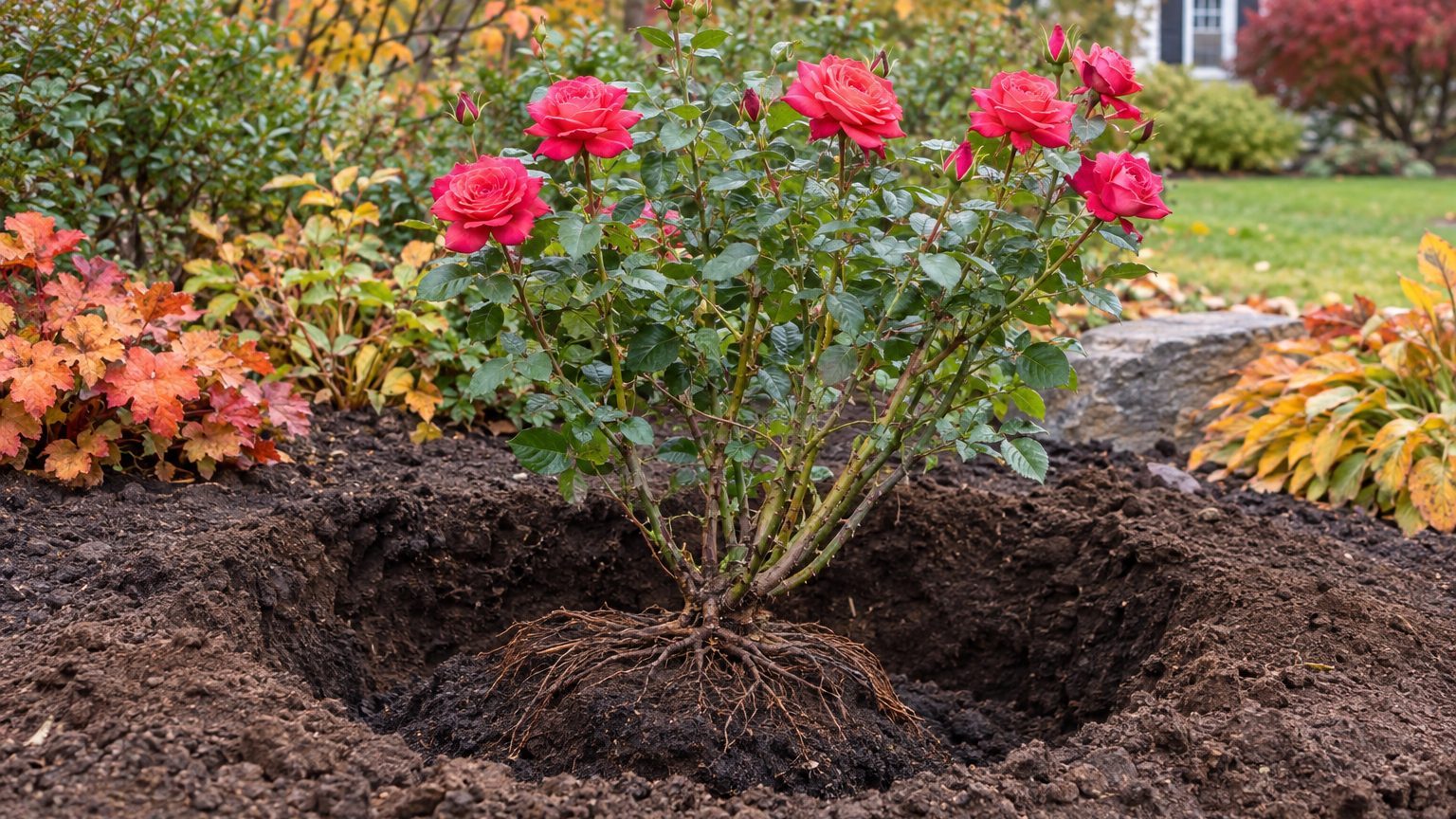
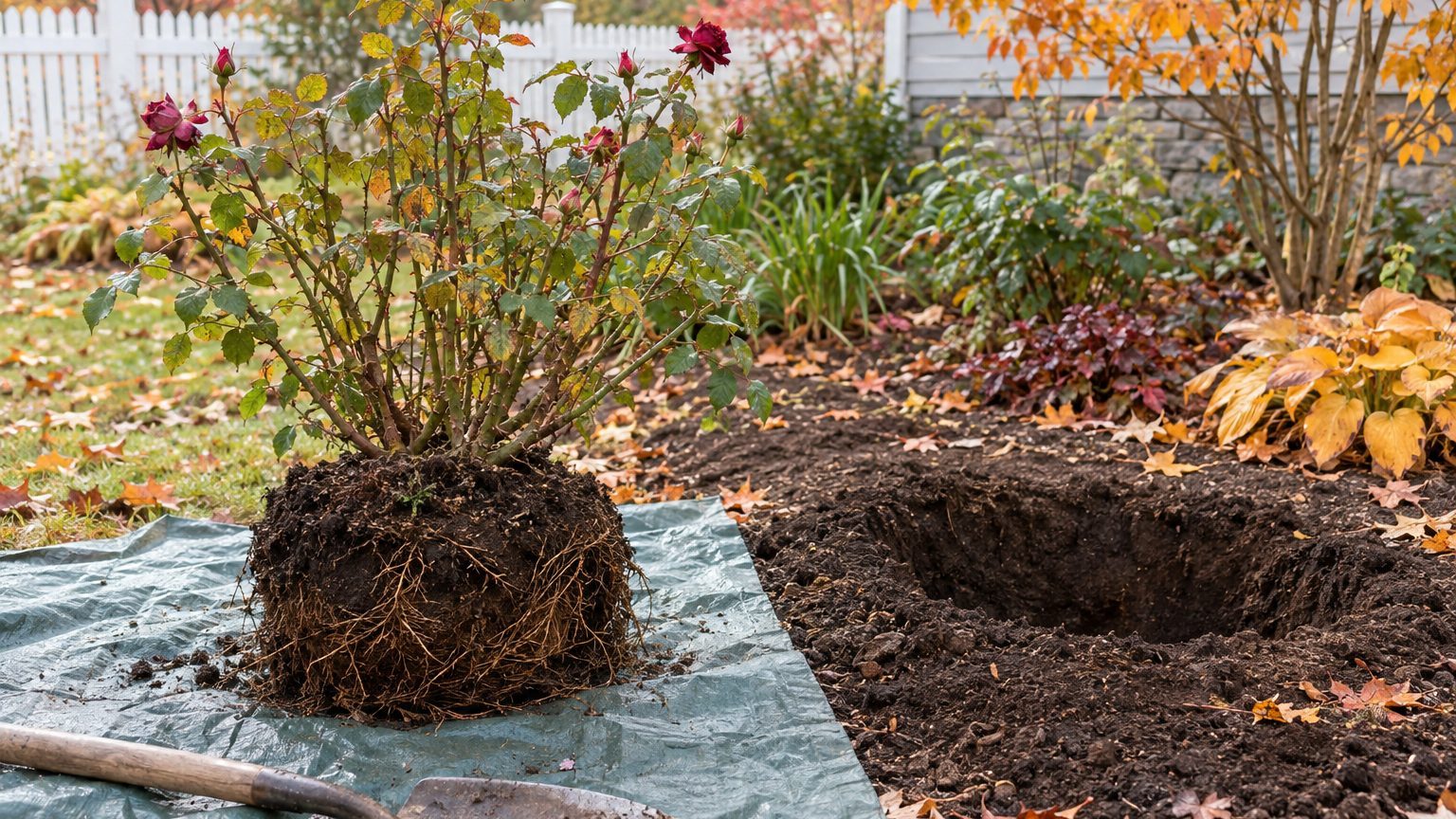
Moving a dormant rose comes down to digging a generous root ball and getting it back into the ground quickly, so the order of the work matters.

  1. In Alabama, dig the new hole first, 6 inches deeper than the depth at which the rose will sit, so the roots spend as little time as possible out of the ground.
  2. In Illinois, cut the roots in a circle about 12 inches from the base once growth has stopped and while the soil can still be worked, so the feeder roots are severed cleanly rather than torn.
  3. In Iowa, dig a trench with a spade around the plant to a depth of 8 to 12 inches, then undercut the ball so it lifts as a single block of soil and roots.
  4. Size the root ball generously, 15 to 30 inches across in Iowa depending on the plant, and keep it from falling apart, because the soil protects the fine roots that take up water.
  5. In New Mexico, remove any container or burlap and twine, then set the plant in the new hole with the graft union 1 or 2 inches below the soil surface.
  6. In Kentucky, fill the hole to within 1 to 1½ inches of the original soil surface, then firm the soil gently so the rose stays upright and no air pockets remain around the roots.

Mulch and regular watering help keep a newly moved rose from drying out. In Florida, the advice is to irrigate frequently for 6 to 8 weeks while the plant establishes. Cooler regions with a longer dormant season often give roots more time to settle before growth restarts.

Transplanting by Rose Type

How a rose arrives in the ground changes the details more than its label does. A dormant bare-root plant, a balled or container plant and an established bush dug from your own border each ask for slightly different handling.

The differences show up in the timing, the wrapping and the size of the root ball.

Rose Type What changes Why it matters
Bare-root rose Planted in early spring before new growth begins in Washington, and kept near 40°F in Iowa if planting is delayed Dormant roots can settle in before leaves ask for water
Balled or container rose Container or burlap and twine removed, graft union 1 or 2 inches below the surface in New Mexico Roots must reach the surrounding soil, and the union stays covered
Established bush from your border Root ball 15 to 30 inches across in Iowa, depending on the plant A larger, intact ball brings more roots along

Hybrid teas, shrub roses, climbers, old garden roses and rugosas all follow this same dormant-season routine, and bloom habit decides the pruning. Pruning still depends on when you move them. Leave a once-blooming rose uncut in early spring and check with your local extension office about pruning.

Rose Transplanting Mistakes to Avoid

Digging Too Small a Root Ball

Digging Too Small a Root Ball — When to Move a Rose Bush, and How to Transplant It

A trimmed-down ball crumbles as it leaves the ground, and the fine roots that drink for the plant stay behind. Aim for a ball as large as you can manage, at a minimum of 15 inches across in Iowa, and move it intact on a tarp or in a wheelbarrow.

Planting at the Wrong Depth

Planting at the Wrong Depth — When to Move a Rose Bush, and How to Transplant It

A rose set too high leaves the graft union exposed, and one set too deep sits low in the soil with its stems buried. Check the depth before backfilling by laying a spade handle across the hole. In New Mexico, the graft union goes 1 or 2 inches below the surface.

Letting the New Spot Dry Out

A moved rose has lost part of its root system, so even moist-looking soil can fall short of what the canes need. Water regularly and keep mulch around the plant. In Florida, the advice is frequent irrigation for 6 to 8 weeks, and a rose moved after its buds have started to grow needs that attention even more.

When to Move Roses in Your State

The plant gives the signal. Follow the timing on your state page, and choose a day when the ground is workable. In Iowa, dig in early spring before the rose begins to leaf out.

  • The page for your state gives the months for your climate, so check it before you mark a day on the calendar.
  • If your soil is frozen or soggy, hold off, because roots tear and the ball breaks apart in ground that cannot be worked.
  • If the buds have already opened into leaves and the move cannot wait, give the rose extra attention after transplanting.

Common Questions

Should You Prune a Rose Before Moving It?

Pruning is not required before the dig. In Arkansas, the advice for a fall move is to skip pruning if possible. Once-blooming roses can wait until after they flower.

What If You Cannot Replant a Rose Right Away?

Keep the plant in a cool spot that does not freeze. In Iowa, around 40°F in a refrigerator, unheated garage or root cellar is the suggested range for dormant bare-root roses that have to wait.

How Wide Should the New Planting Hole Be?

In Alabama, the advice is a hole twice the diameter of the root ball. A hole wider than the ball gives the roots loose soil to push into as the rose settles in its new place.
Where to Plant Roses: Sun, Soil and Spacing

Where to Plant Roses: Sun, Soil and Spacing

A rose in a shady corner may stay leggy with few buds while the rose by a sunny fence fills out. Where you put a rose shapes how it grows and flowers. Sun, soil and spacing set that spot, and each is simple to get right before planting.

Where Is the Best Place to Plant Roses?

Roses do well in a sunny, open spot where the soil drains freely and air moves through the plant. That rule holds across the country. What shifts it is the rose itself, since a compact miniature, a sprawling shrub and a climber need different amounts of room.

Either way, a bright site keeps the canes healthy. Climate adjusts the details, such as how much afternoon sun a hot summer region can give and how soon the ground thaws.

The state selector just below this section leads to the page for your state, where the local timing sits.

How to Prepare a Rose Bed

Where to Plant Roses: Sun, Soil and Spacing

A good bed is built in a set order, because each step depends on the one before it, and all of it happens before the rose goes in.

  1. In West Virginia, choose an open spot where the plant gets full sun all day or at least 6 hours of direct sun.
  2. Fill an 18-inch-deep hole with water and watch it, because in Illinois a hole that empties in 5-6 hours means the drainage is satisfactory.
  3. Check the soil pH, since roses want it slightly acid to neutral, about 6.5 to 7.0 in Montana, and a little lower, 6.2–6.8, in Oregon.
  4. Work in compost across the whole bed, so that roots find loose, rich soil in every direction, at least 2 inches in Oregon, mixed in well.
  5. Mark each planting spot from the center of one plant to the center of the next, so that neighbors do not crowd each other, and in Oregon that distance is at least 33 inches.
  6. Finish with a mulch layer of 3–4 inches around each bush, a depth Arizona rose growers use to hold moisture in the root zone.

Heavy clay asks for more work. In Kansas, where clay is common, gardeners are told to amend to a depth of 18 to 24 inches with organic matter such as composted leaves, manure or milled peat moss. Washington gardeners use a general rule of about 24 inches between roses, a tighter spacing than the Oregon figure, which is why it helps to match spacing to the rose you are planting.

Sun and Soil Needs by Rose Type

Sun and drainage matter for every rose. What changes from type to type is the room each one needs, and that decides where on the property it fits.

Spacing is also tied to walls and fences. A rose pushed against a wall gets stagnant air, so leave a gap between plant and masonry.

Rose Type What changes Why it matters
Shrub and old-fashioned roses In Kentucky, 4 to 6 feet apart Wide, arching canes need space to fill out
Climbers along fences In Kentucky, 8 to 10 feet apart Long canes need room to reach along the support
Miniature roses In Florida, most can be spaced about 12 inches apart Small plants fit close together in a bed or border
Modern roses near a wall In Arizona, 12–18 inches from the wall Air can circulate around the plant
Climbers on a trellis In Oklahoma, not closer than 18 to 24 inches to a wall The trellis stands clear of the surface behind it

For hybrid teas and rugosas, match the spacing to the plant’s mature size. For you, the practical result is a quick sketch before digging: shrubs and climbers claim the most ground, miniatures the least, and anything near a wall needs a gap.

Rose Placement Mistakes to Avoid

Amending Only the Hole

Amending Only the Hole — Where to Plant Roses: Sun, Soil and Spacing

Digging a rich pocket and refilling around it leaves roots stuck in a small pot of good soil, surrounded by native ground that is much tougher. Roots tend to circle inside the improved patch.

In Georgia, soil amendments go into the whole bed, mixed evenly to a depth of 12 inches, not just into the planting hole.

Planting on a Hilltop

Planting on a Hilltop — Where to Plant Roses: Sun, Soil and Spacing

A breezy rise looks like good airflow, but in Florida, cultivated roses on hilltops or downwind of known multiflora rose plantings are more likely to be invaded by eriophyid mites.

Choose a spot away from wild multiflora and not on the exposed crest.

Overlooking Salty Soil

Roses do not tolerate salt. In California, the guidance is that the soil’s salt reading should be less than 2.0 dS/m, a level that is hard to judge by eye.

If the yard sits near a road that gets de-icing salt, or the water is salty, have the soil tested before planting, then move the bed or improve the drainage.

Where to Plant Roses in Your State

Planting time depends on your climate and on whether the rose is bare-root or potted. The calendar months differ by state.

  • The state page gives the planting months for your state, so check it before buying roses.
  • Check the state page before planting and follow its local timing.

Common Questions

How Much Compost Should You Add to a Rose Bed?

In Georgia, the advice is at least 4 inches of organic matter. In Oregon, compost can be tilled 6 to 12 inches deep into the soil before planting.

Can Roses Grow in Partial Shade?

In California, planting sites may have full sun to partial shade, but roses do best with 6 hours or more of direct sun. Partial shade works as a compromise, not as a goal.

How Far Apart Should Roses Be in the Arizona Desert?

Arizona growers are advised to plant roses at least 3 feet apart, in a location with at least 6 hours of sunlight a day.

When to Prune Roses, by Type and by State

When to Prune Roses, by Type and by State

Roses tell you when they are ready. On last year’s canes, the buds begin to swell, and the hardest freezes are behind you. When to prune roses depends on whether a rose reblooms and on where you garden, and the cut itself is simple once the moment arrives.

When Should You Prune Roses?

Prune repeat-blooming roses in late winter to early spring, once the buds begin to swell and the hardest freezes have passed. Cut sooner and the tender shoots that follow can be burned by a late frost. Wait too long and the plant has already put energy into growth you would be removing.

Roses that bloom only once flower on last year’s wood, so they wait until the flowers fade. Climate moves the window as well. In Oklahoma, most roses should not be pruned before March 15, and milder winters pull the work earlier while long cold ones push it later.

How to Prune Roses

When to Prune Roses, by Type and by State

When the proper pruning time arrives for that rose, the work goes in a steady order, from clearing dead wood to making the final cut.

  1. Look over every cane before cutting anything, so you can tell live green wood from dead brown wood and know where the healthy buds are.
  2. Cut out dead or diseased canes back to healthy wood, so problems do not travel down into the crown of the plant.
  3. Thin weak, thin and crossing canes so the center stays open to light and air, which in Illinois means keeping 3-5 canes per plant.
  4. Shorten the remaining canes, to 12–15 inches in North Carolina, so new growth starts low on the plant and builds a sturdy frame.
  5. Make each cut about 1/4 inch above an outward-facing bud in Illinois and Colorado, so the new cane grows away from the center instead of across it.
  6. Slope each cut downward and away from the bud, at 45 degrees in Colorado, so rain runs off the cut rather than settling on the bud.

How much comes off depends on the rose and the place. In California, between one- to two-thirds of healthy wood may be removed through a mix of heading and thinning cuts. A once-blooming rose gets the same care only after its flowers fade, because a spring cut would take away the buds that carry this year’s bloom.

Pruning Time by Rose Type

The type of rose decides how hard you cut and when. Repeat bloomers flower on new wood, so they take a firm cut in late winter and respond with fresh growth that carries the summer flowers.

Rose Type What changes Why it matters
Hybrid tea Pruned in late February in Arkansas Cutting at the same time as shrub roses lets one outing cover a mixed bed
Shrub rose such as Knock Out Cut back by about 1/3 in late February in Arkansas It is a shrub rose, so it follows the hybrid tea schedule
Reblooming rose Cut back to a height of 12 inches in South Carolina A hard cut leaves a compact plant that flowers on new growth

Climbing, old garden and rugosa roses get no row here because their timing follows how they bloom. A once-blooming one flowers on last year’s wood, so you prune it after the flowers fade, and a repeat bloomer follows the late winter schedule. Check the bloom habit before you pick up the pruners.

Rose Pruning Mistakes to Avoid

Pruning Too Early

Pruning Too Early — When to Prune Roses, by Type and by State

A warm spell in winter can tempt you into cutting, but the new shoots it triggers are the ones a later freeze damages. In Oklahoma, most roses should not be pruned before March 15.

Wait until the buds on the canes swell, and choose a mild day after the hardest freezes. A rose cut at the right moment grows away cleanly instead of losing its first flush of shoots.

Cutting Far from the Bud

Cutting Far from the Bud — When to Prune Roses, by Type and by State

A cut made well above a bud leaves a stub that dies back, and a cut that slices into the bud wastes the growth you wanted. In Colorado, the final cut sits 1/4 inch above a healthy, outside-facing bud.

Use sharp pruners so the cut is clean, and slope it away from the bud so water drains off.

Pruning Late in the Season

Fresh cuts in fall push a rose to grow when it should be slowing down. In Illinois, flowers should not be cut after October 1, which lets the plant begin hardening off for winter.

Weather adds its own risk. In Washington, roses are slow to drop their leaves, and about 4-6 inches of wet snow can break canes that still carry them. Let the plant settle into dormancy without shaping it.

When to Prune Roses in Your State

For repeat-blooming roses, swelling buds and the end of hard freezes help set the local window; once-blooming roses wait until after flowering. Local weather sets the calendar around that sign, which is why the months differ so much from state to state.

  • Open your state’s page for the months that fit your climate and your zone, and read it before the buds start to swell.
  • For repeat bloomers, walk the bed on a mild day and make the cuts once the buds have started to swell; prune once-bloomers after flowering.

Common Questions

How Far Do You Cut Back a Rose in Oregon?

Advice in Oregon is to prune moderately to 12–18 inches tall in the spring. A separate Central Oregon recommendation says that when severe frost danger has passed, canes can be cut down to 6 to 8 inches.

Should You Prune a Rose When You Plant It?

Yes, a light trim helps at planting. In Oregon, the canes are cut to about 6 inches at planting. In Illinois, if the plant has already broken dormancy before planting, soft, succulent white shoots are trimmed back to 1/8 inches.

How Short Should You Prune Roses in Arizona?

In Arizona, plants that are 1 to 2 years old and have moderate vigor are cut back to 18 to 24 inches. More vigorous plants are left taller, at 24 to 36 inches, which keeps their extra growth in balance with the rest of the plant.

How to Propagate Roses from Cuttings

How to Propagate Roses from Cuttings

A cane that has just finished blooming holds the makings of a new rose. Propagating roses from cuttings turns spent stems into rooted plants of the same variety, using a clean cut, a loose mix and some shade. Timing and rose type decide how well it works, and each varies from place to place.

How Do You Grow Roses from Cuttings?

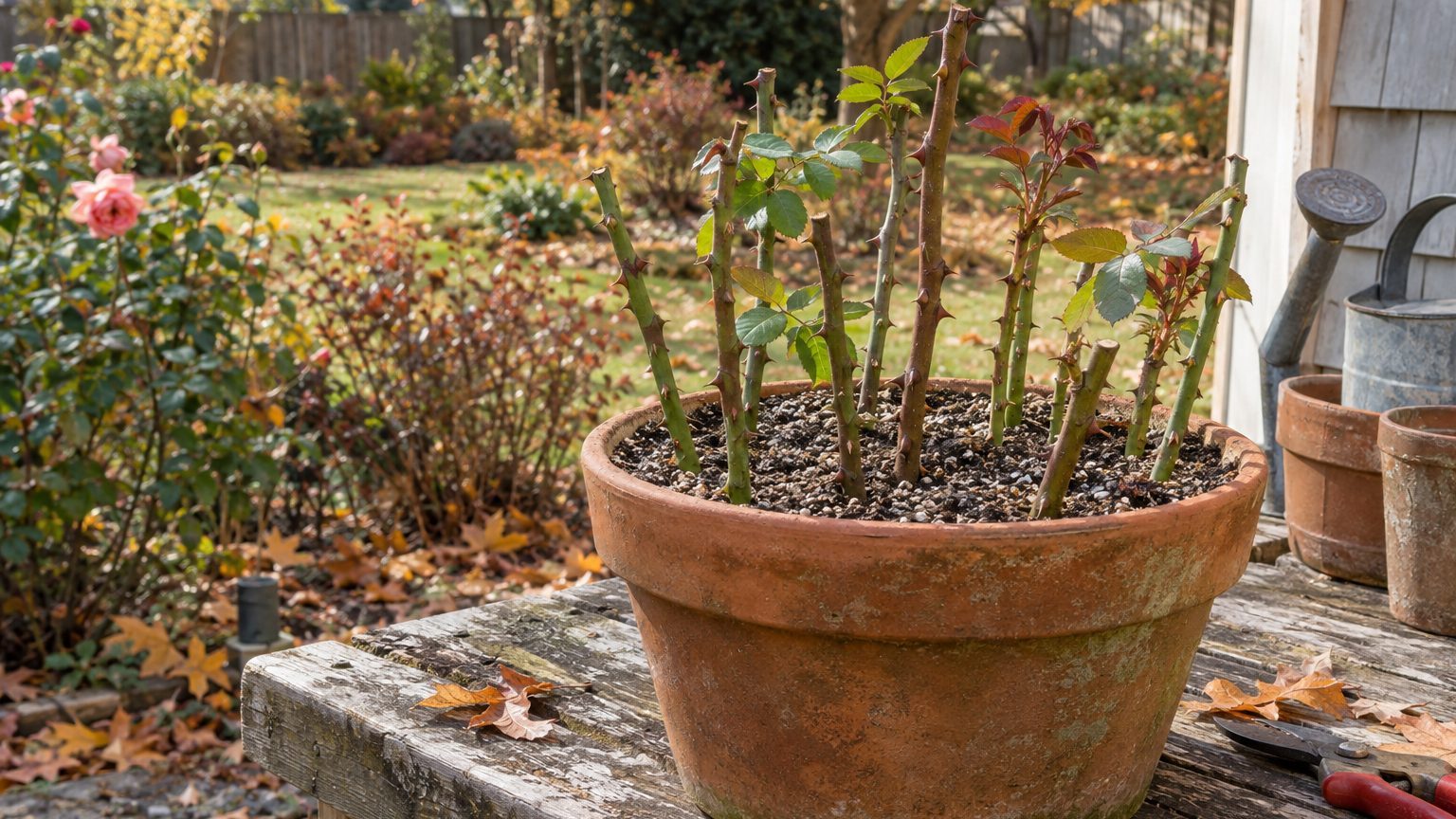
Cut a firm, partly mature stem from the rose you want to copy, strip the lower leaves, set it in a loose mix, and keep it shaded and moist until roots form. Roots take approximately four weeks to develop. The young plant is ready for the landscape after roughly six months.

Rose variety and climate shift the details. In Iowa, semi-hardwood cuttings come from mature new growth in July and August. In North Carolina, cuttings can be taken at any time of year, but November through February gives the best success.

Where your garden sits changes the calendar, and the state selector under this section leads to the page for your state.

How to Take Rose Cuttings

How to Propagate Roses from Cuttings

Semi-hardwood cuttings come from stems that have firmed up but have not turned fully woody, and the work goes in a set order.

  1. Choose a shoot that has already bloomed and cut the flower back to the first five-leaflet leaf, so that the stem left behind is mature wood rather than soft tip growth. In Kentucky, that remaining stem makes a cutting 4 to 6 inches long.
  2. Use a sharp knife or pruning shears to avoid crushing the stem, and in North Carolina make the cut at a 45° angle. In North Carolina, a cutting from the growing tip is 6 to 8 inches long, while Washington aims for about 9 inches.
  3. Strip the leaves, but not the buds, from the part that will be buried, so that no foliage rots in the soil. Washington’s advice is to clear the lower 2/3 of the stem. A California propagation program leaves only the top two leaves.
  4. Dip the base of the cutting, including the bottom nodal area, in rooting hormone, so that roots have every chance to start where the stem was cut.
  5. Push the cutting into a loose mix of loam and sand, so that the base sits in a medium that holds moisture without packing down. In Washington, the mix goes down about 9 inches in a pot or a V-shaped trench.
  6. Set the pot or trench in a shady spot out of direct sun, because strong sun will cook a cutting that has no roots yet to feed it.

Arkansas advice is to cut stems in one foot sections, which leaves room to trim each cutting to length and to keep the buds that matter. Keep the mix moist and the shade steady, and confirm that roots have formed before moving the cutting.

Propagation by Rose Type

Roses do not all root alike. Some varieties strike readily from a summer cutting, while others do better when budded onto a vigorous rootstock, the way growers produce them commercially.

Rose Type What changes Why it matters
Most varieties In Iowa, semi-hardwood cuttings from mature new growth in July and August Wood that has firmed up in summer gives the cutting its footing
Hard-to-root varieties In Hawaii, not every rose roots from cuttings, and many are budded on vigorous rootstock A failed cutting may reflect the variety, and a budded plant may suit it better
Roses in hot climates without dormancy In Hawaii at sea level, research favors budding on a Rosa fortuniana rootstock Heat and the lack of dormancy are what these plants must withstand

Hybrid teas, shrub roses, climbers, old garden roses and rugosas are not sorted by rooting ability here, so judge each by how its own cuttings do. A failed batch may reflect the variety, the timing or the growing conditions, so a fresh attempt in the proper season is reasonable.

Rose Propagation Mistakes to Avoid

Rooting in a Glass of Water

Rooting in a Glass of Water — How to Propagate Roses from Cuttings

A jar on the windowsill looks tidy, but in Arkansas the advice is not to root roses in water because it does not produce as well. The cost is a weak or failed cutting after weeks of waiting.

Use the loam and sand mix instead, in a pot or trench, and keep it moist.

Putting Cuttings in Full Sun

Putting Cuttings in Full Sun — How to Propagate Roses from Cuttings

A cutting has no roots to replace the water its leaves lose. Arkansas gardeners are told that direct sunlight will cook the plants, which wipes out the whole batch.

Park the pot in shade and move it only once the cutting has rooted and shows new growth.

Stripping Buds with the Leaves

Cleaning the buried stem is right, but pulling the buds along with the leaves removes the points where new growth starts. The cutting may sit there with nothing to push out.

Take off the leaves on the lower part of the stem and leave every bud in place, then tuck that part into the mix.

When to Take Rose Cuttings in Your State

The trigger is the wood itself. In Iowa, take semi-hardwood cuttings from mature new growth in mid to late summer. In North Carolina, cuttings can be taken at any time of year, with the best success from November through February. A mild climate stretches the choices.

  • Each state page gives the cutting months for where you garden, so open it before the shears come out.
  • Look for shoots that have just finished blooming and mark them, so you can find them when your state’s months arrive.

Common Questions

Does Rooting Hormone Make Rose Cuttings Root Faster?

In Kentucky, roots develop in 10 to 20 days when the base of the cutting, including the bottom nodal area, is dipped in hormone before planting. Skipping the dip leaves rooting to the stem alone.

Can a Heat Mat Help Rose Cuttings Root?

Yes. Seed-starting heat mats supply bottom heat and can speed rooting. Keep the cuttings out of direct sunlight while the mat does its work.

Can Rose Viruses Spread Through Cuttings?

In California, the transmission of rose viruses happens when infected plant material is grafted onto healthy material, as in budding an infected scion onto a healthy rootstock. Experimental evidence indicates rose mosaic can also spread via root grafts, so use propagation material known to be free of viruses.

Rose Problems: Yellow Leaves, Dieback and Few Flowers

Rose Problems: Yellow Leaves, Dieback and Few Flowers

Yellow leaves, black canes and buds that never open can show up on any rose in any yard, and the cause is rarely the first one you suspect. Most rose problems trace back to soil, winter damage, disease or a care habit that is easy to change. Sorting out which one you face starts with what you see on the plant.

Why Are Your Roses Struggling?

Roses struggle for the same few reasons across the country: stress from soil that does not suit them, winter damage to the canes, a disease working through the plant, or care that is off in timing. What varies is how much each one matters for your plant.

Whether a rose repeats or blooms once changes how a problem looks. Repeat bloomers set flowers on new wood, so a setback often shows up as a slow season. Once-bloomers carry flowers on last year’s wood, so winter damage can mean no flowers at all. Climate shifts the odds from there.

The state selector just below this section leads to the page for your state.

How to Diagnose a Rose Problem

Rose Problems: Yellow Leaves, Dieback and Few Flowers

Work from what you can see to what is likely behind it, and compare the visible clues before you settle on a cause.

  1. Look at where the yellow shows up and what the soil is like, because leaves turning yellowish-white can mean the plant cannot reach iron when the soil is strongly alkaline. In Montana, soil near pH 8.0 causes this yellowing, so a soil test comes before any treatment.
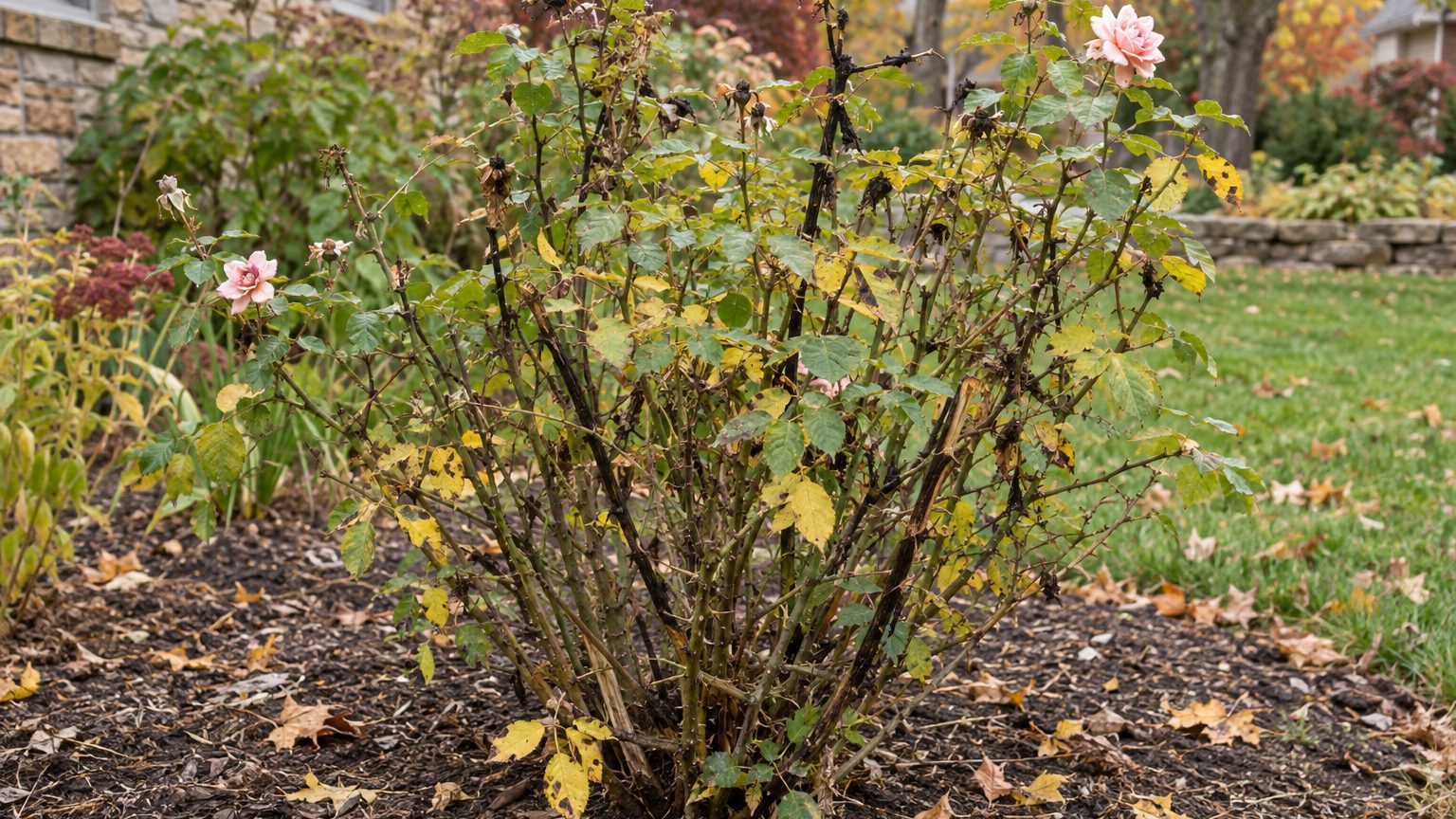
  2. Cut into a dark or shriveled cane and look at the center, since a live cane is white and plump while a dead one is brown and withered. Keep cutting back until you reach white, so the dead wood stops dragging down the rest of the plant.
  3. Check the canes for sunken, damaged patches when leaves drop early, because in Illinois a fungal disease can strip bushes almost bare by early fall and leave dieback and cankers behind. Bare stems alone do not identify the cause, so look for cankers and other clues before drawing a conclusion.
  4. Watch the buds and the new growth together. Flowers that fail to form properly or drop early, paired with odd reddish growth, point toward rose rosette disease, as described in Maryland. Many cultivars normally have reddish new leaves, so look for other symptoms before drawing a conclusion.
  5. Keep checking over the season rather than judging once, because a diseased plant may show only a few symptoms early on. In Kentucky, symptoms of rose rosette typically appear 1 to 6 months after infection, which means a clean-looking rose is not yet cleared.

If the signs line up with rosette or with a virus, take a cane and a leaf cluster to your county extension office for confirmation before pulling the plant. A wrong guess costs you a healthy rose or leaves a sick one beside its neighbors.

Rose Problems by Symptom

Few flowers is the symptom that most depends on the type of rose, because the wood that carries the bloom differs. Repeat bloomers may flower again on new wood after pruning, but their recovery depends on the plant’s condition. Once-bloomers can lose the whole show.

Dead canes and dieback also play out differently depending on how the plant grows and how cold the winter was.

Rose Type What changes Why it matters
Repeat-blooming roses Flowers form on new wood Cutting out dead canes still leaves room for new flowers
Once-blooming roses Flowers form on last year’s wood Early spring pruning or winter dieback removes the season’s flowers, so prune after bloom
Shrub and carpet roses Cold winters kill wood, as in Ohio Dead wood has to come out before the plant can refill

Hybrid teas, climbers, old garden roses and rugosas follow the same checks. What matters for each is whether it repeats or blooms once, so find that out before you prune away a year of flowers.

Rose Care Mistakes That Cause Problems

Sweating Roots in Plastic Bags

Sweating Roots in Plastic Bags — Rose Problems: Yellow Leaves, Dieback and Few Flowers

Bare-root roses are often kept moist before planting, a step called sweating. In Illinois, the advice is to skip plastic bags for it. Trapped moisture with no air can rot canes and roots before the plant ever reaches the soil. Use a damp, breathable medium instead.

Giving Up Too Soon

A new rose that looks bare after planting is not necessarily dying. In Alaska, it often takes 6-8 weeks to tell whether a bush will make it. Pulling it early throws away a plant that may only be settling in. Keep the root zone moist and wait.

Spraying in Hot Afternoons

Disease and insect sprays applied in strong heat can burn leaves. In Kansas, when temperatures reach the 90’s, spraying is delayed until the weather moderates or done in the early morning. Cooler hours let the leaves dry and spare them stress on top of what the heat already does.

Rose Problems in Your State

Rose problems are handled when the plant tells you it is time, not by the calendar alone. For repeat bloomers, swelling buds and the end of hard freezes help set the pruning window; once-bloomers wait until after flowering, and dormant canes are otherwise best left mostly alone.

  • Your state’s page gives the months for pruning, planting and protection in your climate, so check it before you cut.
  • Go back to it when new growth starts, since the signs on the plant and the months for your state work together.

Common Questions

Can a Rose Look Healthy and Still Be Sick?

Yes. In Florida, plants infected with rose mosaic virus may look quite healthy for much of the year. Long-term weakness and visible symptoms can eventually make infected stock unmarketable.

Does a Weakened Rose Bounce Back?

Not always fully. In North Carolina, the advice is that a weakened rose might never reach its potential, will have more trouble fending off disease and pests, and may suffer tissue damage in warmer temperatures. Healthy growing conditions matter more than a late rescue.

How Hard Should You Cut Back Winter-Damaged Roses?

Cut to live wood. In Ohio, shrub and carpet roses trimmed in early April showed a lot of dead wood after a cold winter, and some had to come back to about six inches. Prune once-blooming roses after they flower, not in spring.

When to Plant Roses: Bare-Root and Container Dates

When to Plant Roses: Bare-Root and Container Dates

Bare-root roses show up in garden centers as bundles of bare canes in late winter, while potted roses already carry leaves and buds by spring. When to plant roses depends on which of those you bring home and on how hard your winters hit. Dormant plants go in while cold still holds. Container plants wait for settled weather.

When Is the Best Time to Plant Roses?

Across the country, bare-root roses go into the ground while they are still dormant, from late winter to early spring, as soon as the soil can be worked. Container roses have more leeway and can be planted once the worst of the cold has passed.

Several factors move that window earlier or later:

  • Whether the plant is bare-root or potted
  • Whether the plant is dormant or actively growing
  • How cold and how long winter runs where you live

Mild-winter places plant early. In Georgia, roses are set out in February. In Kansas, container roses wait until after May 1. Use your state’s rose page to find the planting window for your climate.

How to Plant a Rose Bush

When to Plant Roses: Bare-Root and Container Dates

The order of the work matters more than speed, because each step protects the roots or the graft before the next one covers them.

  1. Choose a spot with plenty of sun and room to spread, so the leaves dry quickly and the plant has air around it. In Arizona, at least 6 hours of sunlight a day is the guide.
  2. Soak bare-root roses in a bucket of water before planting, so the dry canes and roots take up moisture before they go into the soil.
  3. Dig a hole wide enough for the roots to spread without bending, so they grow outward instead of circling. In Washington, a hole 24 inches wide is generally adequate, and it should be no deeper than the distance from the bud union to the base of the roots.
  4. Build a small mound of soil in the hole and drape the roots over it, so they fan out evenly and the plant sits at the depth you want. In Kansas, the roots are spread over a mound with the bud union 1 to 2 inches below soil level.
  5. Trim the canes back to an outward-facing bud eye, so new growth heads away from the center and the plant stays open to air. In Arizona, canes are trimmed to 8 to 10 inches.
  6. Backfill, firm the soil gently and water well, so no air pockets are left around the roots.

Depth of the graft depends on winter. In Georgia, the graft union sits 1 inch above the soil. In Iowa, the knob belongs 2 to 4 inches below the surface to protect it from the cold. In the colder parts of Washington, in zones 7 and below, the graft goes 1 to 2 inches below the soil. Container roses follow the same steps, with the root ball loosened a little and the planting date set by your last frost. In Kansas, that means after May 1.

Planting Time by Rose Type

Roses that repeat their bloom flower on new wood, and roses that bloom once flower on last year’s wood. Bloom habit affects pruning, but it does not set the planting date.

Spacing and hole size still vary by rose type.

Rose Type What changes Why it matters
Hybrid teas, floribundas, grandifloras Spaced 2.5 to 3 feet apart in Oregon Air moves between plants and leaves dry faster
Climbers Tops cut back to 12 to 15 inches in Alabama A smaller top is easier for new roots to support
Miniatures Spaced about 12 inches apart in Florida Compact plants need less room
Modern roses Set 12 to 18 inches from a wall in Arizona The gap keeps air circulating behind the plant
Shrub roses Hole at least 12 inches deep in Montana The roots need space to spread without bending

For old garden roses and rugosas, use the planting window recommended for your climate and root condition. Check how each one blooms before you cut it back. Prune a once-blooming rose just after flowering, not in spring, so you do not remove the wood that carries its flowers.

Rose Planting Mistakes to Avoid

Setting the Graft Too Shallow

Setting the Graft Too Shallow — When to Plant Roses: Bare-Root and Container Dates

A graft left near the surface in a cold climate is exposed to freeze damage. In Kansas, the graft sits 2 to 4 inches below the top of the hole for that reason. Set the depth for your winters, not for the plant tag, and mound soil over the union if the ground freezes hard.

Crowding the Plants

Crowding the Plants — When to Plant Roses: Bare-Root and Container Dates

Roses packed tightly trap damp air around the leaves and compete for light. In Illinois, a general rule of thumb is about 24 inches apart, or about two-thirds of the expected height. Measure the spacing from the mature size on the tag, not from the small plant in your hands.

Digging Too Deep

A hole dug deeper than the roots need lets loose soil settle, and the plant sinks below the depth you set. In Washington, the hole should be no deeper than the distance from the bud union to the base of the roots. Dig to that depth, then firm the bottom before setting the plant.

When to Plant Roses in Your State

Let the plant tell you. Bare-root roses go in while they are dormant, before the buds swell. Container roses go in once frost has passed and the soil has warmed enough to work.

  • Your state’s page gives the months for bare-root roses, so check it before the plants arrive.
  • The same page gives the container window, so you know when potted roses can safely go out.
  • Once you have the months, dig the hole on a workable day and have it ready before the roses are unwrapped.

Common Questions

Can You Plant a Rose in Summer?

A container rose can go in after spring, since it arrives with roots in soil. Plant it with the same care, water it regularly and watch it closely in hot spells, because a young root system dries out fast. Bare-root roses do not suit summer planting, because they are sold dormant.

How Much Sun Does a Rose Need?

In Arizona, the guide is at least 6 hours of sunlight a day. Morning sun is helpful because it dries the leaves early, and a spot with open air around it suits the plant better than a corner walled in on every side.

What If Bare-Root Roses Arrive Before the Ground Is Ready?

Keep the roots from drying out and the plants in a cool, sheltered place until the soil can be worked. If planting is delayed for long, a temporary trench of moist soil holds the roots until you can set the roses in their permanent spot.

Rose Pests, Season by Season: How to Spot and Stop Them

Rose Pests, Season by Season: How to Spot and Stop Them

Fine webbing under a leaf, neat round holes along a petal edge, a cluster of soft insects on a new bud: roses show pest trouble early, if you know where to look. Which insects and mites turn up depends on the season and the weather, and so does the right response. Regular checks make it easier to respond while pest damage is still limited.

Which Insects Damage Roses, and When?

Rose pests follow the rose’s growth. Some pests appear with tender spring growth, while others become active under different weather conditions. Pest timing varies with climate, so match your checks to local conditions and the signs on the plant.

Timing shifts with the climate and the kind of rose. In California, summer heat cuts aphid numbers, while in Florida hot, dry weather favors spider mites. A repeat-blooming rose keeps pushing new growth, so there is fresh growth to check for longer than on a rose with a single flush.

Use your state’s rose page for pest guidance suited to your area.

How to Find and Control Rose Pests

Rose Pests, Season by Season: How to Spot and Stop Them

Start by inspecting the plant, then choose a response for the pest or damage you find.

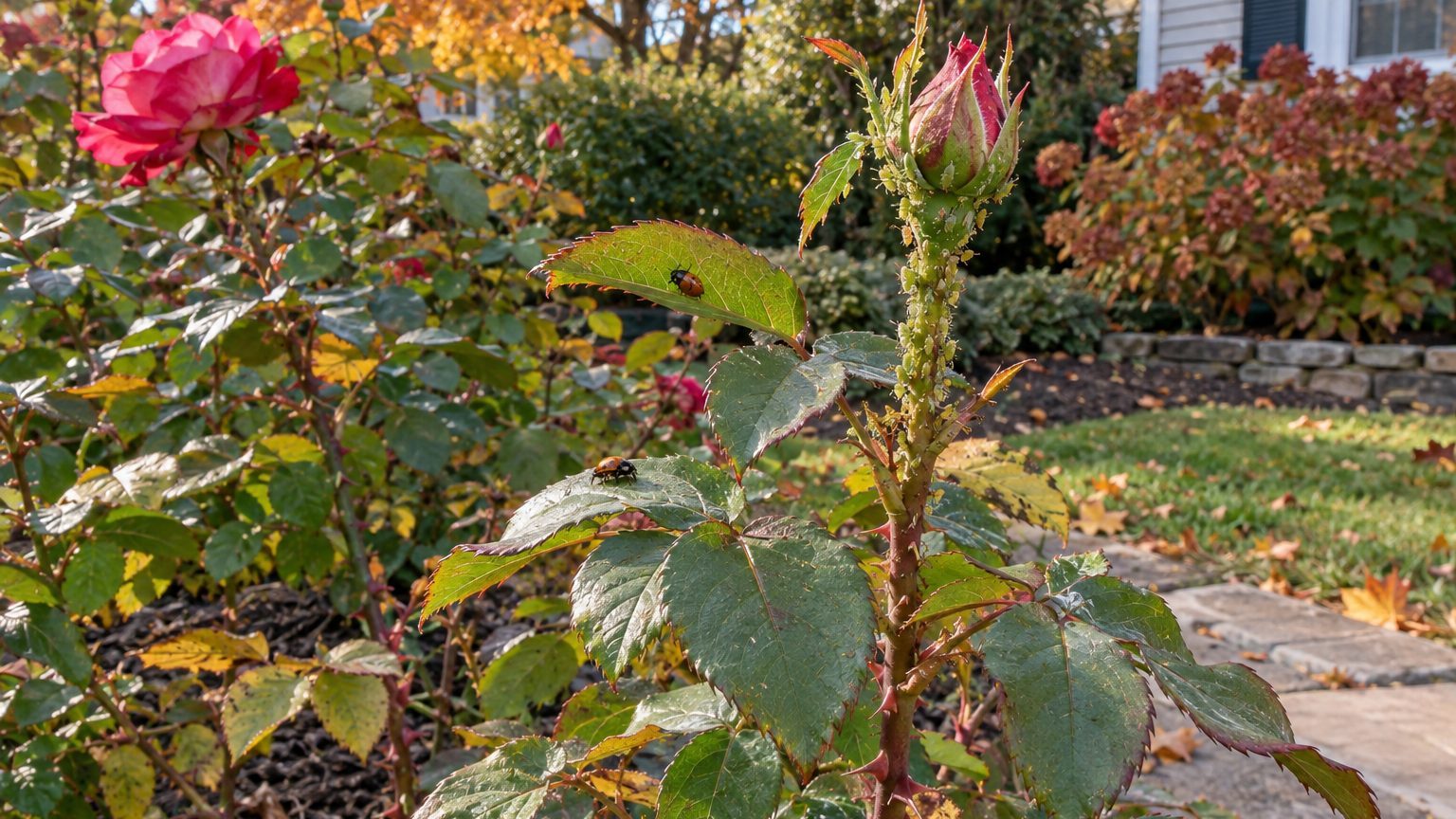
  1. Turn leaves over in hot, dry weather and look for fine webbing and discolored leaves, because spider mites are too small to see unaided and these are the signs they leave behind.
  2. Check buds and tender shoots in spring for clusters of soft insects, since in California aphids are a major problem for about 6 weeks in spring and early summer before high summer temperatures reduce their numbers.
  3. Spray the underside of the leaves with a forceful stream from the hose, which knocks mites off the plant, and in Illinois the advice is to repeat it every 2-3 days.
  4. In Florida, a solution of 1 tablespoon liquid dishwashing soap to 1 quart water can be used to control mites.
  5. Look along leaf edges for neat circular holes, because in Iowa holes 1/2 inch or less across point to leafcutter bees rather than a caterpillar or beetle, helping you avoid an unnecessary treatment.
  6. Keep checking leaves through summer and into fall, since in Ohio the damage from rose sawflies starts in spring and only ends with the first frost.

Florida advice for mites is the same forceful spray 3 or 4 times a week, a heavier routine than the Illinois one. Start with a forceful water spray before moving to another control.

Rose Pests by Season

Whether a rose repeat-blooms or flowers once changes how long there is fresh growth to watch. That, more than the shape of the plant, sets the rhythm of your pest checks.

Rose Type What changes Why it matters
Repeat-blooming New shoots and buds keep coming after the first flush Aphids, mites and leaf chewers have fresh growth to find, so checks continue through the season
Once-blooming One flush of flowers on last year’s wood Spring buds and leaves are the first place to look, then leaf undersides as summer heats up

For any rose, begin by matching the damage to the part of the plant where it appears. For any of them, the weather you have had lately tells you more about what to look for than the label on the tag.

Rose Pest Control Mistakes to Avoid

Spraying Once and Stopping

A single treatment seldom ends a mite problem, and the survivors rebuild on the same leaves. Only repeat a treatment when its directions call for it, and follow those directions until the infestation is controlled. Keep checking the plant until the infestation is controlled.

Waiting to See the Mites

Waiting to See the Mites — Rose Pests, Season by Season: How to Spot and Stop Them

Spider mites are the size of dust particles and need a microscope (more than 40X) to see, according to Tennessee advice. If you wait for a visible bug, leaves are already damaged. Look for discolored leaves together with fine webbing on the underside instead.

Mites also move. In Tennessee, once temperatures reach the mid-80s they release from the plant and float on air currents, so a clean rose can be reinfested after a hot spell. Check again then.

Misreading Round Holes

Misreading Round Holes — Rose Pests, Season by Season: How to Spot and Stop Them

Circular holes cut from the edge of a leaf or flower, 1/2 inch or less across, are the work of leafcutter bees in Iowa. Spraying for a caterpillar or beetle that is not there costs time and treats the wrong problem. Look at the shape of the hole and where it starts before you reach for anything.

Rose Pests in Your State

The sign that starts pest checks is the rose itself: buds swelling in spring once the frost has passed. The sign that ends them is dormancy, when leaves drop and growth stops. The months for each state are on the page for that state.

  • Your state’s page gives the months when pest checks begin and end where you live, so open it before the buds swell in spring.
  • It also shows how the season runs in your climate, which is worth a look before hot, dry weather arrives.

Common Questions

How Can You Recognize Flower Thrips on Roses?

Flower thrips are tiny, winged insects, barely bigger than a speck of dust, so they are easy to miss with a quick glance. Look closely inside the open flowers, where they gather, and do not rely on spotting them from a distance.

What Does a Rose Weevil Look Like?

The adult is black with a red back and a long snout, and about 8 mm long. The red back and the snout together set it apart from the other beetles you might see on the canes and buds.

Do Lights Keep Rose Beetles Away?

Some rose growers in Hawaii believe electric lights above the bushes for the first 5 or 6 hours of darkness help repel rose beetles. It is a belief among growers, so treat it as something to try in a small area before relying on it.

When to Fertilize Roses, and When to Stop

When to Fertilize Roses, and When to Stop

Rose canes turn a glossy red as new leaves unfold in spring, and that flush of growth is the cue to feed. A rose that needs nutrients may show weak growth and fewer flowers. When to fertilize roses depends on that first growth and on the late-summer slowdown that tells you to stop.

When Should You Fertilize Roses?

Feed roses after new growth begins, then follow the feeding and cutoff schedule for your climate. Climate moves both ends of that window, and so does the type of rose.

Warm regions start earlier and quit later, while cold ones wait for buds to swell and stop sooner so the canes can harden before frost. Repeat-blooming roses keep making flowers and take regular feedings. Once-blooming types do their work in one spring flush.

Use your state’s rose page to find the feeding window for your climate.

How to Fertilize Roses

When to Fertilize Roses, and When to Stop

The order matters here, because each step sets up the next one, from the soil to the last feeding of the year.

  1. Check the soil before buying anything, because roses do best in slightly acidic ground with a pH of 6.0 – 6.5 in Maryland guidance, and a test tells you whether feeding alone will be enough.
  2. Hold off until new growth appears, since feeding a dormant plant wastes the fertilizer, and in Oregon the first feeding goes on when new shoots are 4 inches long.
  3. Measure the dose instead of guessing, and follow the fertilizer label because products differ.
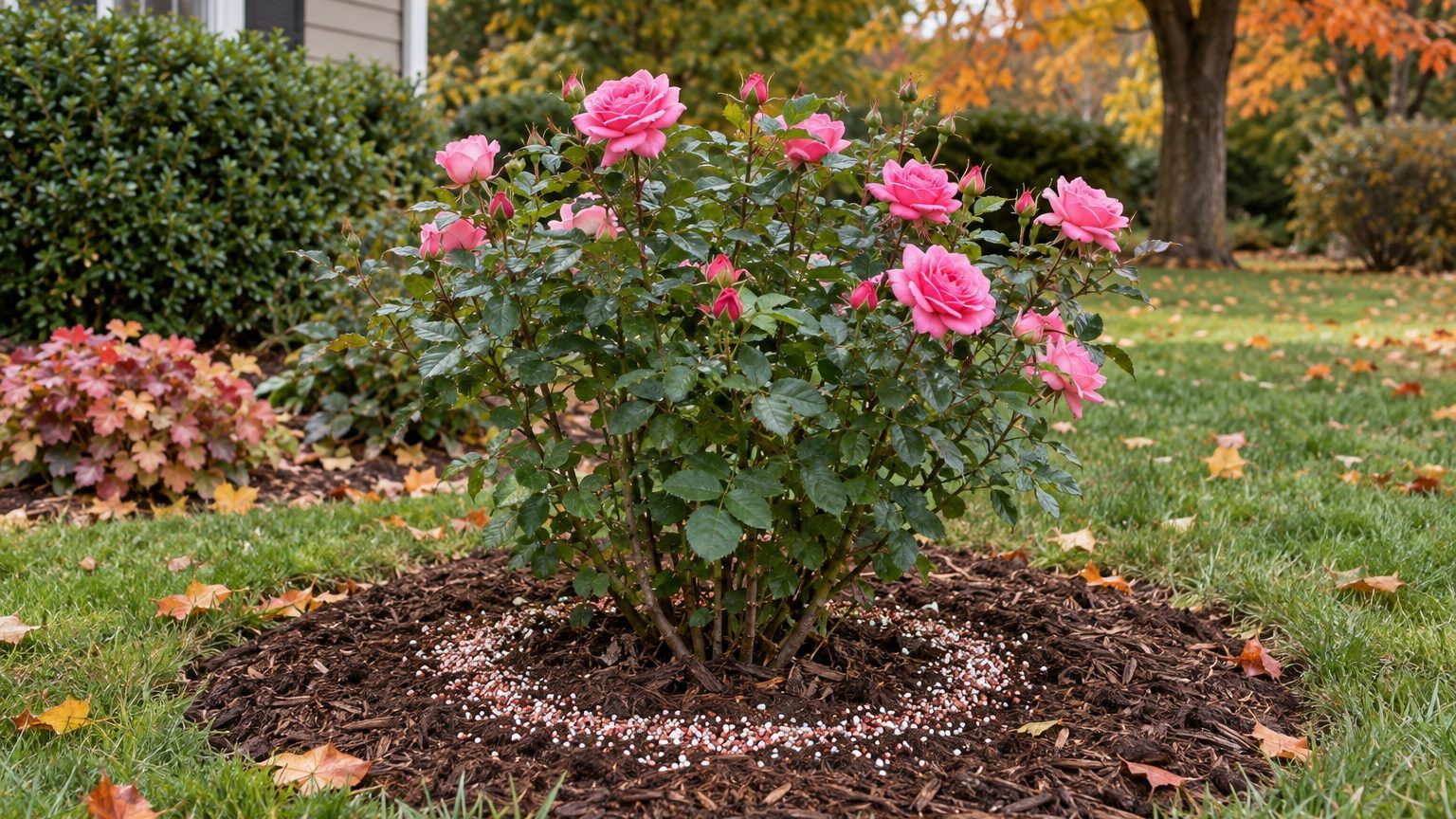
  4. In Illinois, spread the fertilizer in a band that begins six inches from the crown, keeping the granules away from the base of the stems.
  5. Repeat on a steady schedule through the season, since a rose that keeps blooming keeps using nutrients, and Colorado guidance suggests every 4 to 6 weeks.
  6. Stop feeding on time, because late fertilizer encourages soft, succulent growth that frost damages, and in Colorado the last feeding falls on August 15.

In Illinois, the band reaches out to about 18 inches from the crown. The stop date shifts with the climate, and in Oregon feeding ends in late August or early September as the roses begin to go dormant. A rose planted this year is handled differently, as the next section explains.

Fertilizer Timing by Rose Type

Type changes the pace more than the principle. A rose that blooms repeatedly draws on its reserves again and again, so it gets fed more often than one that flowers once and rests.

Local guidance gives specifics for a few groups, and the rest follow the general schedule.

Rose Type What changes Why it matters
Hybrid roses (Wyoming) Feeding starts after growth begins in late May and repeats every 2 weeks Frequent feeding gives these roses the best results in a short season
Shrub roses (Montana) Feeding begins the year after planting with a complete fertilizer, applied at a modest yearly rate spread across the bed according to its size A new shrub spends its first season settling in, so it waits
Newly planted roses (Arizona) A balanced fertilizer goes on after the first bloom, then every 6 weeks The first bloom shows the plant is established enough to use it

For climbing, old garden and rugosa roses, follow local feeding guidance for your climate. For a once-blooming rose, follow the local feeding schedule rather than using the end of bloom as a universal cue. If you grow a mix, follow the appropriate local schedule for each rose.

Rose Fertilizing Mistakes to Avoid

Feeding into Late Summer

Fertilizer after midsummer prompts a late flush of tender shoots that have no time to harden. Frost then kills the tips and can set the plant back. In Iowa the cutoff is July 31, so mark it on the calendar and put the fertilizer away.

Copying Another Region’s Schedule

A schedule from a warm, long-season state does not suit a cold one. In California, young plantings get nitrogen at the rate of 1 pound per 1,000 square feet in spring and fall. Oregon guidance instead feeds every 6 to 8 weeks through the growing season. Use the plan written for your climate and adjust it to how the plant looks.

Feeding Newly Planted Roses Too Soon

Feeding Newly Planted Roses Too Soon — When to Fertilize Roses, and When to Stop

Fresh roots are tender, and a bush still recovering from transplanting cannot use much. Oklahoma advice is to feed around April 1 or four to six weeks after spring planting. Arizona advice is to wait for the first bloom. The safe course in either place is to let the plant leaf out and settle before the first feeding.

When to Fertilize Roses in Your State

Watch the plant before you look at the calendar. Swelling buds and the first new leaves after the last hard frost signal the start. Slowing growth and the approach of dormancy signal the end.

  • Each state’s page gives its months for the first feeding, so check it in late winter, before the buds swell.
  • The same page gives the stop date, which is worth a look in midsummer, before you reach for another bag.

Common Questions

Do Roses Need a Second Feeding After the Spring Bloom?

In Illinois, roses benefit from another application around June 15 or at the end of the spring bloom period. In New Mexico, feed when new growth reaches 4 to 6 inches and again when the first blossoms have faded.

How Much Should You Feed Roses Without a Soil Test?

In Georgia, the general advice without a test is three tablespoons per plant each month from March through September, using a fertilizer made for roses or shrubs. A soil test lets you cut back or adjust.

Can You Fertilize Roses in Midsummer?

In Oklahoma, high-nitrogen fertilizer should not go on after July 15 unless the rose is quite hardy and will be thoroughly irrigated. A plant that is stressed or dry is better left alone.

Rose Diseases: Black Spot, Powdery Mildew and Rust

Rose Diseases: Black Spot, Powdery Mildew and Rust

Dark spots on the lower leaves, a pale film on new shoots, a rose that drops foliage while the plants beside it stay green: these turn up in rose beds every growing season. Most trace back to a few fungal diseases, and they spread when the weather turns mild and damp. Knowing which is which, and when to act, keeps the plant blooming.

How Do You Recognize a Rose Disease?

Look at the leaves first, because the pattern of the damage tells you more than any single spot. Black spot leaves dark patches, powdery mildew coats young growth in white, and rust shows orange pustules under the leaves. How often each appears depends on climate, rose type, and whether the plant keeps making new growth.

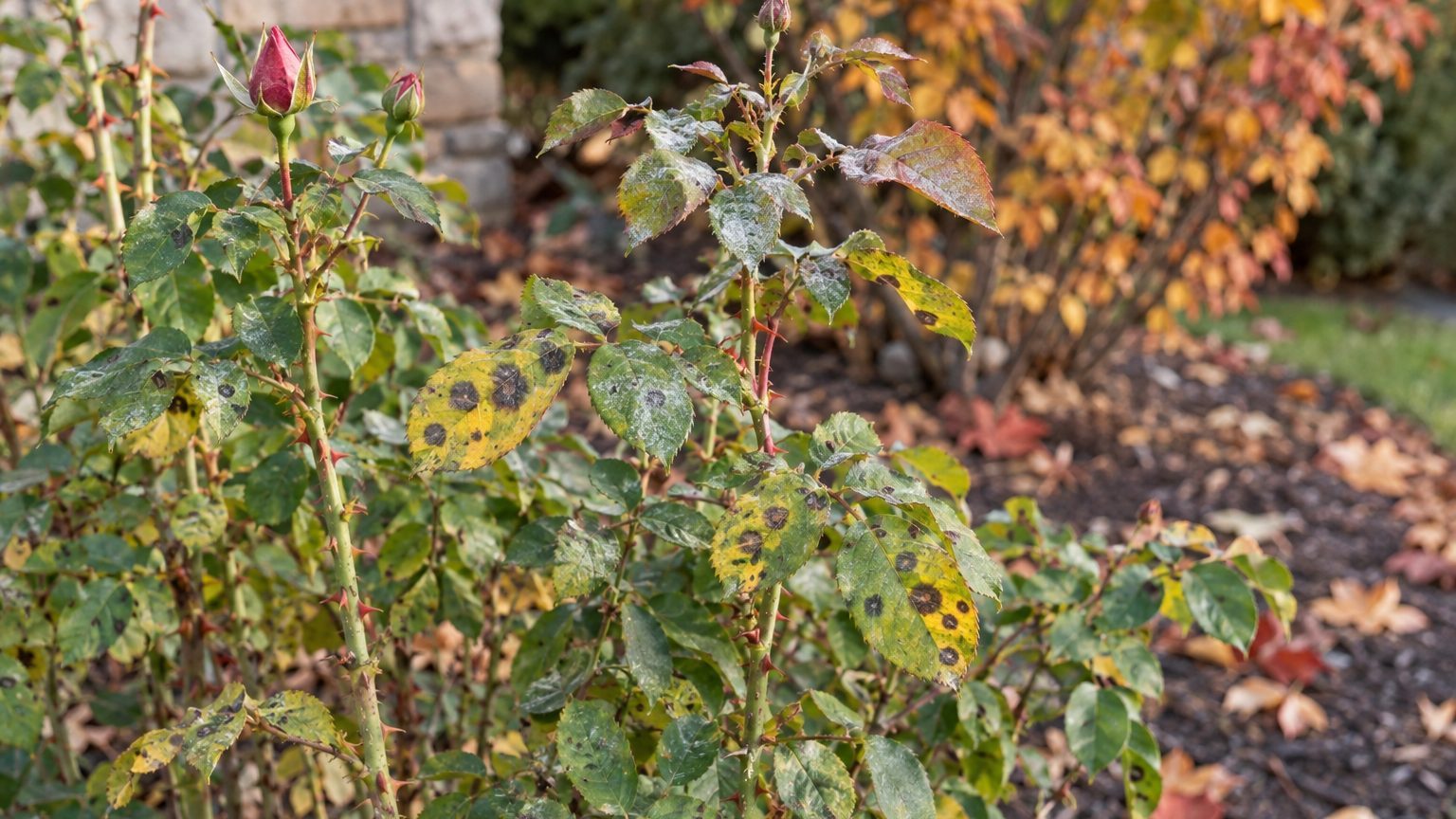
Black spot has a recognizable pattern. In Maine, the spots can reach 1/2 inch across and typically have fringed borders. A fringed edge on a dark spot, together with yellowing leaves that drop early, points to black spot rather than a plain leaf burn.

Weather decides how fast it moves. In Florida, 64°F is the optimal temperature for black spot, so mild, damp stretches are when to inspect closely. The state selector just below this section leads to the page for your state.

How to Treat Rose Diseases

Rose Diseases: Black Spot, Powdery Mildew and Rust

Disease control on roses starts with cleanup and runs through timed sprays, and each gesture protects the next.

  1. Remove all debris from the previous season before you uncover roses in spring, as Kansas growers are advised, so that spores on old leaves and canes are not waiting beside the new growth.
  2. In Illinois, one way to disinfect pruner blades is to dip them in a 10 percent bleach-and-water solution for 60 seconds.
  3. In Kansas, start spraying a fungicide once spring growth begins so new leaves are protected as they open. In Kansas, the spray is repeated every 7-14 days, depending on how severe the infection is and how well the treatment works.
  4. Choose a fungicide that will not burn foliage when hot weather arrives, so the leaves are not damaged while you protect them. In Kansas, that switch comes when daily temperatures routinely exceed 85 F.
  5. In California, skip oil sprays on water-stressed plants or within two weeks of a sulfur spray; water a stressed rose before considering an oil treatment.

Label directions set the final word on rates and intervals, and they can differ from the ranges above. Repeat applications are routine, not a sign that the first spray failed.

Rose Diseases by Symptom

Symptoms sort the diseases better than the calendar does. Fringed dark spots on leaves suggest black spot, white powder on new shoots suggests powdery mildew, and orange pustules underneath suggest rust. Confirm the pattern by checking where on the plant it started.

Disease What changes Why it matters
Black spot Dark spots with fringed borders appear on leaves Yellowing leaves may drop early
Powdery mildew White powder coats new shoots Mild weather and changing humidity can favor it

Check the pattern on leaves, stems, and new growth before cutting out diseased wood. Cleanup and spray timing matter regardless of rose type.

Rose Disease Mistakes to Avoid

Waiting for Spots Before Spraying

Waiting for Spots Before Spraying — Rose Diseases: Black Spot, Powdery Mildew and Rust

In Florida, symptoms begin to appear three to 16 days after infection, so the first spots mean the fungus is already inside the leaf. In California, fungicides generally prevent infections rather than clear them, which makes timing critical.

In Kansas, begin protection when spring growth starts and repeat it regularly.

Covering Roses Too Early

Covering Roses Too Early — Rose Diseases: Black Spot, Powdery Mildew and Rust

In Illinois, the advice is not to cover roses too early in the fall. Wrapping canes while the plant is still growing and the weather is mild holds them in the damp, mild conditions fungi favor.

Wait until the rose is dormant, then cover it.

Replanting in the Same Soil

In New Mexico, soil where diseased plants grew should be left idle for at least 3 years before replanting. A new rose set into that soil meets the same problem from the first leaf.

Plant the replacement in a different bed, or leave the old spot empty and clear.

Rose Diseases in Your State

The sign to act is on the plant, not the date. In Kansas, spring growth signals cleanup and protective spraying; in Illinois, avoid covering roses too early in fall.

  • Each state’s page carries its own months for spring cleanup and the first sprays, so check it when buds begin to swell.
  • It also gives the months for covering roses, so check it once growth has stopped for the season.

Common Questions

What Does Rose Rosette Look Like?

In Texas, typical signs include abnormal reddening of leaves and stems, unusual rubbery thorns, deformed leaves, and witches’ broom, where multiple stems grow out of one node and bunch together. Fungal spots sit on the leaf surface, while rosette changes the shape of the stems and thorns.

Does Hot Weather Stop Powdery Mildew?

In Alabama, frequent rains and temperatures above 80 degrees inhibit it. In South Carolina, it can occur almost anytime in the growing season when temperatures are mild (70 to 80 °F) and the humidity is high at night and low during the day.

What Weather Brings Downy Mildew and Cercospora Leaf Spot?

In Tennessee, downy mildew develops best in cool temperatures from 40 F to 74 F. It also needs high humidity, above 85 percent. Cercospora leaf spot commonly occurs in hot, humid weather above 85 F.

Growing Roses in Containers: Pot Size, Soil and Water

Growing Roses in Containers: Pot Size, Soil and Water

A rose in a container sits close enough to the back door to check on every morning, and it asks for things a bed rose does not: a roomy pot, a mix that drains, and water on a steadier schedule. Growing roses in pots comes down to the container, the soil and the watering, along with a plan for winter.

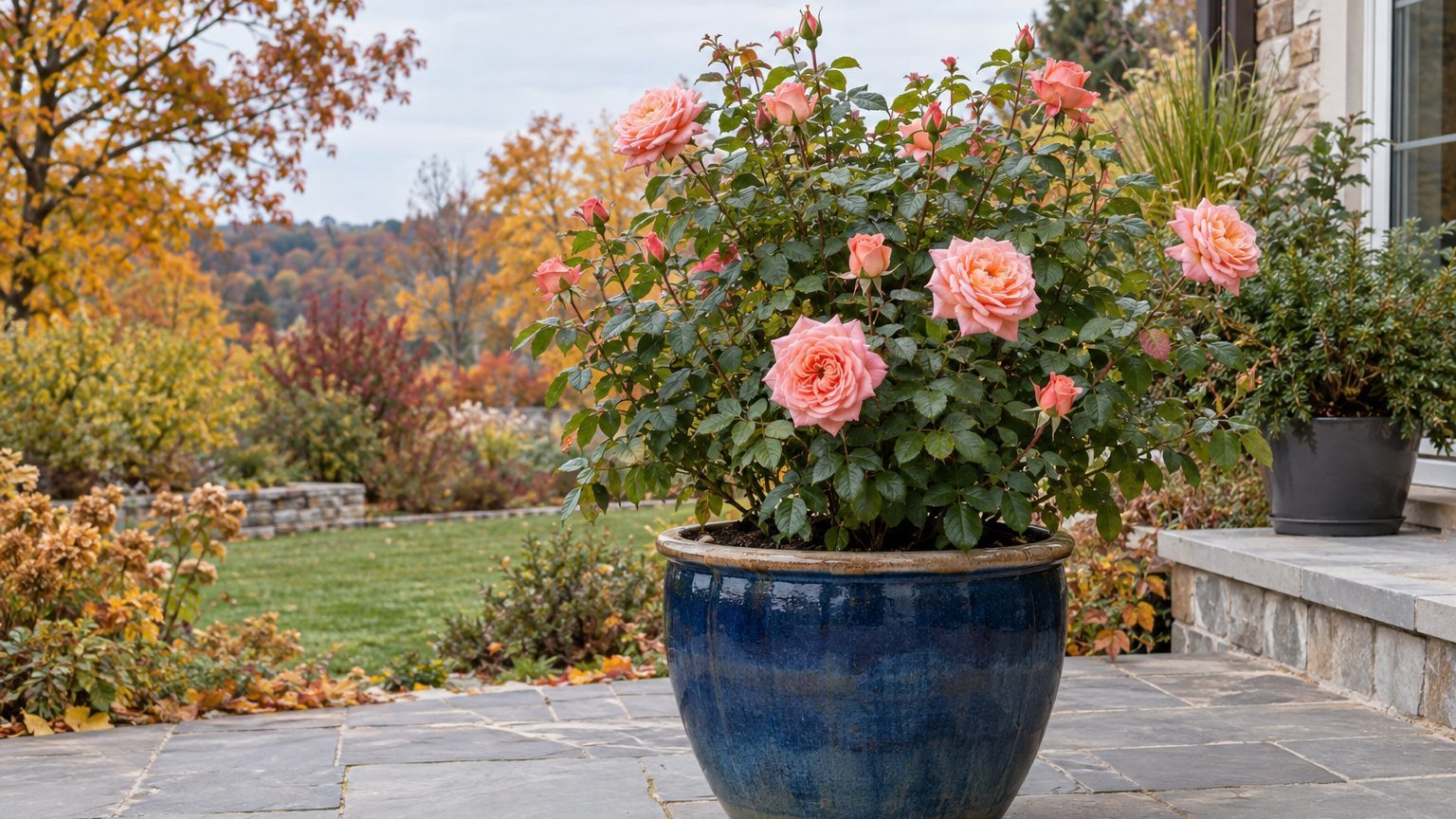
Can You Grow Roses in Pots?

Yes, roses in pots do well across the country, as long as the container is big enough and drains freely. What changes from place to place is mostly the winter. Where freezes are hard, a potted rose needs protection that a rose in the ground gets from the soil around it.

The type of rose matters too. Compact roses such as miniatures work well in pots, while taller shrubs and climbers need larger containers. Repeat-blooming roses flower on new wood, and once-blooming roses flower on last year’s wood, which changes how you prune them.

The state selector just below this section leads to the page for your state, where the local timing is laid out.

How to Grow Roses in Containers

Growing Roses in Containers: Pot Size, Soil and Water

Start with the pot and work upward, because the container is hard to change once the rose is planted.

  1. Choose a pot at least 18 inches across, the minimum West Virginia growers are advised to use, so the roots have room to spread instead of crowding the sides.
  2. Check the depth as well, since the same West Virginia advice calls for 24 inches, which gives the roots space to grow down.
  3. Drill drainage holes if the pot has none. For a barrel-size container in Washington, drill five 3/8-inch holes in the side very near the bottom so water can drain.
  4. Fill the pot with a loam-based mix and work in compost or well-rotted manure, so the mix holds moisture and still carries nutrients to the roots.
  5. Loosen the roots before planting. In Illinois, extension advice warns that a rose bought late in the season may have roots that have filled the pot and tangled, and untangling them keeps them from circling forever.
  6. Water deeply after planting and keep up with it. In Arizona, container roses are watered as often as once a day in warm temperatures, because a pot dries out far faster than a bed.

In New Mexico, potted roses can go in throughout the growing season. In New Mexico, extension advice adds that these plants need special attention to get through the first summer, which usually means checking the soil moisture often rather than trusting the last watering.

Container Roses by Rose Type

Size is the first thing that separates one container rose from another. A compact plant can fit a smaller pot than a large shrub or climber.

Winter handling follows from the type as well, since small plants in pots lose the insulation that soil would give them.

Rose Type What changes Why it matters
Miniature Smaller bush, foliage and blooms, from 10 to 24 inches tall Fits a compact pot, and in Arkansas it can stay outside all winter with a little extra protection
Larger miniature and patio A full cubic foot of soil is better (Kentucky) A bigger plant needs more root room to stay steady between waterings

Hybrid tea, shrub, climbing, old garden and rugosa roses all grow in containers too, but they reach larger sizes, so they need the roomier pots described above. Check the mature size on the plant tag before choosing a container. Once-blooming types such as many old garden roses carry their flowers on last year’s wood, so heavy cutting back takes away the next bloom.

Container Rose Mistakes to Avoid

Pot Too Small

Pot Too Small — Growing Roses in Containers: Pot Size, Soil and Water

A cramped pot gives the roots little room, and the soil dries out quickly, so the rose struggles between waterings. In Washington, an appropriate container size is 22 inches wide by 16 inches high. Move up to a larger pot rather than waiting for the rose to decline.

Roots Left Circling

Roots Left Circling — Growing Roses in Containers: Pot Size, Soil and Water

In Illinois, a rose bought late in the season may have roots that fill the nursery pot and tangle. In Illinois, extension advice notes that roots left this way may keep growing in circles and never spread out. Loosen them with your fingers at planting so they head outward into the new mix.

Bare Pots in Winter

Soil in a pot freezes through from the sides, which roots in the ground rarely face. In Pennsylvania, extension advice is to wrap the whole container, along with several inches above the rim, in multiple layers of big-bubble wrap. Do it once the plant is dormant and before the ground freezes. In Iowa, a storage area for a potted rose should hold steady in the 30s and lower 40s°F.

Container Roses in Your State

The sign to act on is the rose itself. In Pennsylvania, protect a potted rose once it is dormant and before the ground freezes.

  • The page for your state gives the months for potting up and planting, so check it before you buy a pot or mix.
  • The same page covers the months for winter protection, so read it before the first hard freeze and gather your wrap or storage space early.

Common Questions

Do You Fertilize a Potted Rose in Winter?

In Iowa, the advice for a miniature rose overwintered in a pot is a dilute fertilizer solution every 2 to 4 weeks through the fall and winter months. Keep it dilute, since the plant is growing slowly in those months.

Can You Leave a Miniature Rose Outside in Winter?

In Arkansas, extension advice says a miniature rose should do fine outside all winter as long as you give it a little extra protection. In colder states, plan for more protection than that.

Can You Bury a Potted Rose for Winter?

In Iowa, the method is to dig a hole, set the pot in and cover the canes with soil. The soil should reach 6 to 8 inches over the rose canes. Add the soil after the plant has gone dormant.

The almanac, state by state. Every date on this site comes from a state’s own frost facts and its extension service’s calendar — and says where it comes from.