Skip to content

Floppy Tulip Stems: Causes and How to Fix It

Floppy Tulip Stems: Causes and How to Fix It

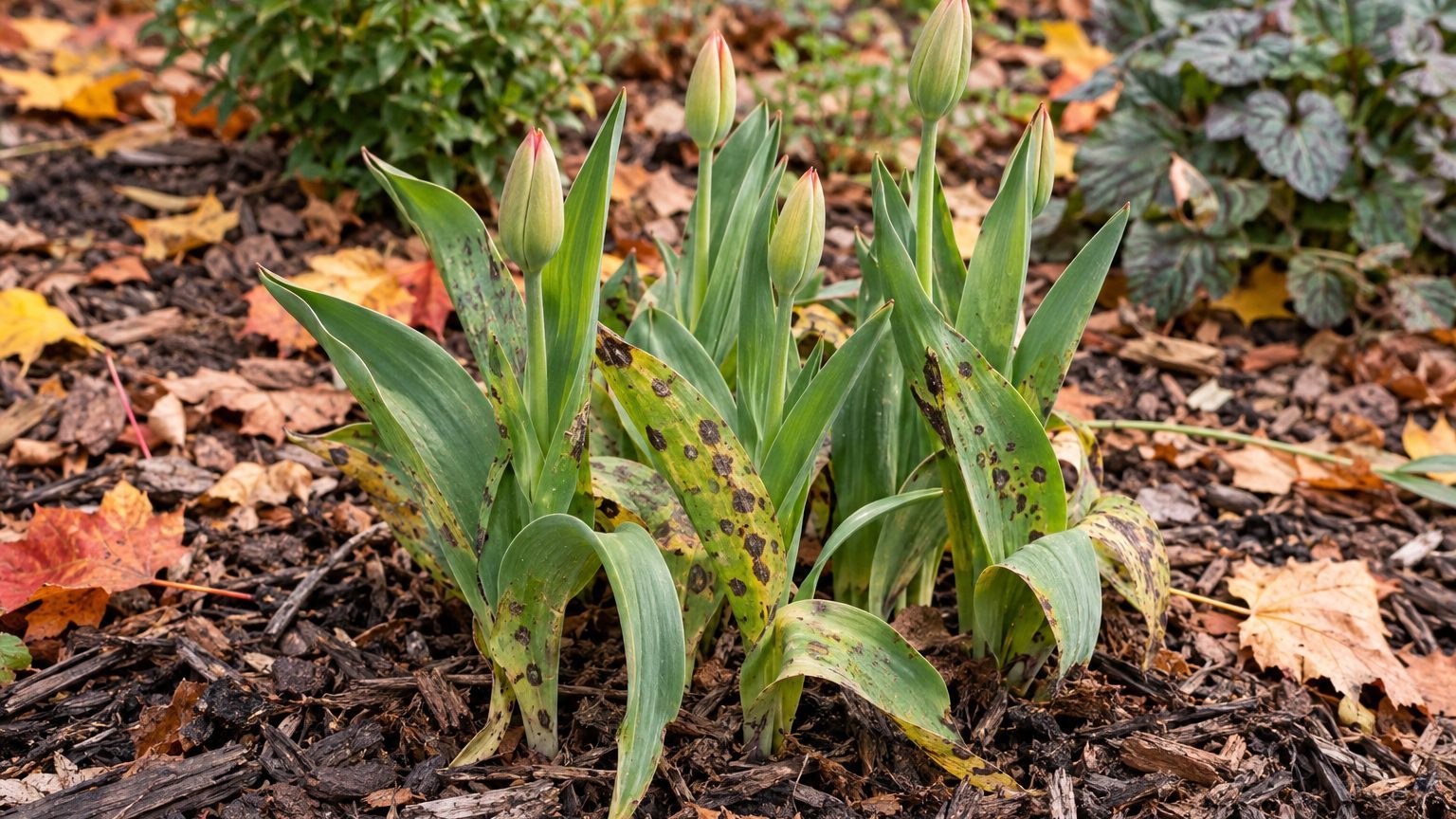
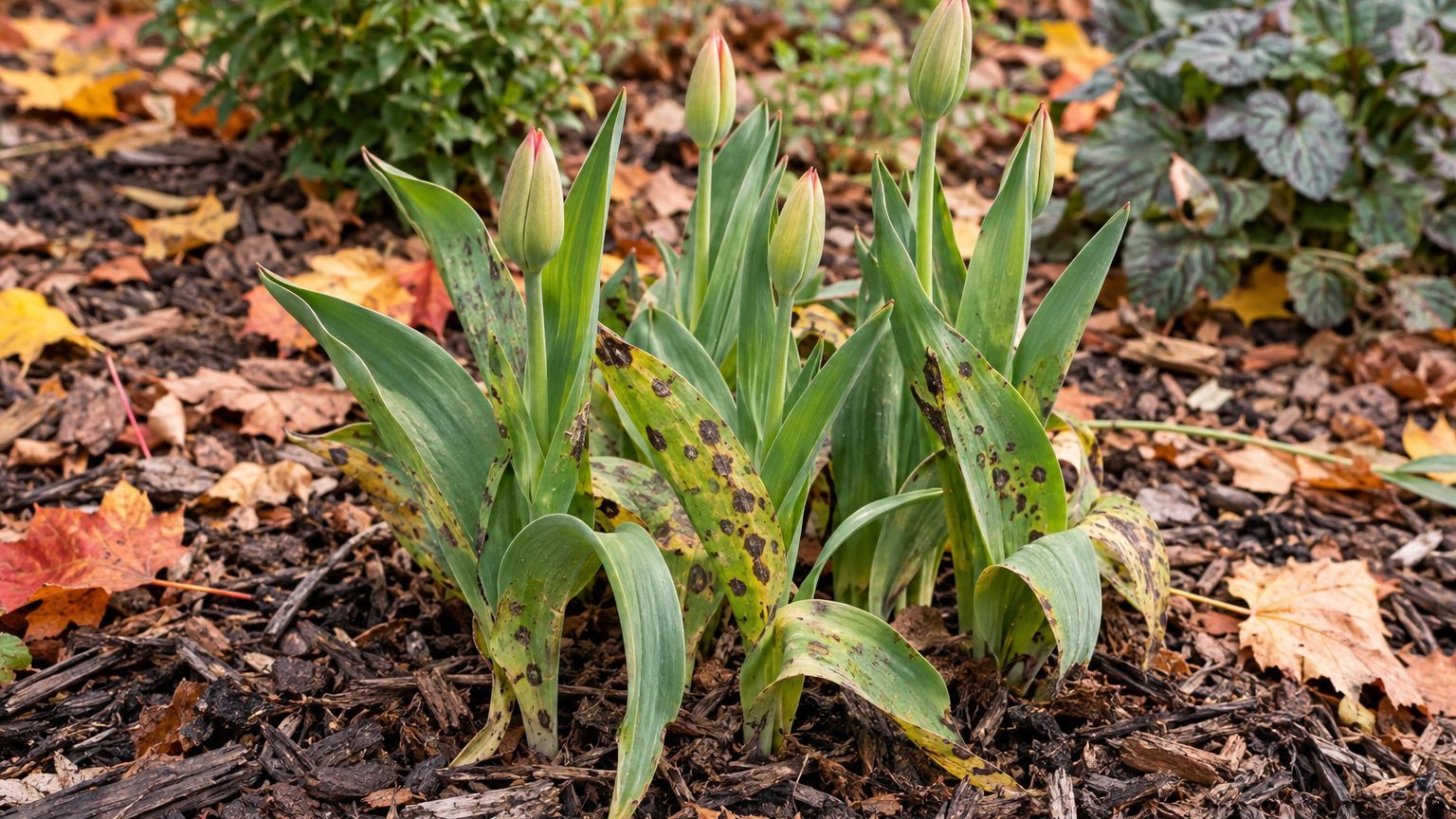
Tulip leaves that sprawl across the bed in spring, broad and lax, with no flower rising from the middle, are a common sight. It is the mark of a bulb running low on stored food. The cause is usually in how the bulb was treated after last year’s bloom, and it can be corrected.

Floppy Tulip Stems: What You See

A weak tulip clump looks different from a healthy one well before any flower should appear.

  • Large, floppy leaves come up from the bulb, but no flower bud forms in the center of the plant.
  • The leaves look oversized and soft, and they lean outward or lie on the soil instead of standing upright.
  • The color is usually a normal green, so the plant looks healthy at a glance even though it is not flowering.
  • The problem shows in the spring growing season, when neighboring tulips are sending up buds.
  • Clumps that bloomed well in earlier years may now send up only leaves, often in the same spot year after year.

Look at the whole bed rather than one plant, because weak bulbs tend to cluster where conditions are the same.

Floppy Tulip Stems or Something Else?

Not every drooping tulip is a weak bulb. Timing and the condition of the leaves usually separate a real problem from normal plant behavior.

Leaves that flop after the flowers are finished, and a stalk that carries a swollen pod, are both common sights in the yard.

Looks like How to tell them apart
Natural dieback after bloom Leaves turn yellow and fall over after the flowers have faded, and the plant had flowered earlier that same season.
Spent flowers left on the stalk A swollen seed pod sits at the top of a stalk that leans, and the leaves are still green around its base.

A stem bent by heavy rain or wind is another look-alike. It carries a flower or bud, which a weak bulb never produces.

What Causes Floppy Tulip Stems, and Where It Is Worst

A weak bulb is the cause. The leaves are the bulb’s kitchen, and whatever interrupts that food-making leaves the bulb too small to flower. Seed pod formation takes much of the food the foliage manufactures, and cutting the leaves too soon cuts off the supply.

Site matters as much as care. In Iowa, tulips do best in a spot with at least 6 hours of direct sun per day and well-drained soil. A shady corner or a spot where water lingers weakens bulbs year after year.

Beds under maturing trees, low spots that stay wet after rain, and borders beside a lawn that gets mowed over tulip leaves tend to show it first.

How to Treat Floppy Tulip Stems

You cannot make a weak bulb flower this season, but you can help it rebuild. Work in this order.

  1. Snip off spent flowers promptly after the petals drop, so that the plant does not spend its food on seed pods.
  2. Leave the leaves in place until they turn yellow and die back naturally, so that they keep feeding the bulb.
  3. Check the bed for sun and drainage while the leaves are still up, so that you know whether the site is the problem.
  4. Dig the clumps once the foliage has died back if the site is too shady or too wet, so that you can move them without cutting into green leaves.
  5. Replant the bulbs in the fall in a sunny, well-drained bed, in the ground as soon as it can be dug, so that the roots can settle before winter cold arrives.

Whether a fertilizer helps, and which products are approved where you live, is a question for your state’s extension service or a local master gardener group.

How to Prevent Floppy Tulip Stems Coming Back

A little planning around the seasons keeps bulbs well fed and keeps leaf-only clumps from showing up again.

  • In early spring, note which clumps send up only leaves, so you know which ones to move later.
  • As the flowers fade in mid to late spring, remove them before pods form on the stalks.
  • While the leaves are still green, keep mowers, edgers and string trimmers well away from them.
  • Once the foliage has yellowed and pulled away easily, tidy it up and dig any clumps that sat in shade or soggy soil.
  • In fall, plant the moved bulbs and any new ones in a sunny bed that drains well, since they need winter cold to flower.

A bed set up this way usually keeps its bulbs in bloom longer than one left to chance.

Where This Comes From

The care steps here reflect university extension guidance, including advice written for Iowa. Check your own state’s extension service for timing and local conditions where you garden.

Common Questions

Will Floppy Tulips with No Flowers Bloom Again?

They can, if the bulb gets enough sun and its leaves are left to work. Recovery is not guaranteed, and a bulb that stays leaf-only after a season of better care may be worth replacing.

Should You Tie Up Floppy Tulip Leaves to Tidy the Bed?

No. Tying or bending the leaves cuts down the light they catch. If the sprawl bothers you, plant something low and leafy nearby to cover it as the foliage fades.

Do Tulip Bulbs Need Cold to Flower?

Yes. Tulips planted in fall need winter cold to set flowers, and a bulb that gets cold but little food will still produce leaves without a bloom.
Daffodils Not Blooming: Causes and How to Fix It

Daffodils Not Blooming: Causes and How to Fix It

You see green daffodil leaves push up in early spring, thick and healthy, and then no flowers follow. It happens in yards everywhere, and the bulb is rarely dead. A bulb that skips blooming has usually run short on stored food, and the reasons trace back to light, leaf care, crowding, drainage, or the bulb itself.

Daffodils Not Blooming: What You See

The clearest sign is a clump that leafs out normally but never sends up flower stalks, though a few variations point to different trouble.

  • Green leaves come up on schedule, but no flower stalks rise from the center of the clump.
  • Buds do form, then turn brown and papery before they open.
  • Flowers still appear, but they are smaller than in earlier years, and the clump looks packed with leaves.
  • Only a few blooms show on a patch that once put on a full display.
  • Newly planted bulbs produce leaves and nothing else in their first spring.

Where the clump sits matters as much as the symptom, so notice whether it grows in shade, in a wet spot, or among turf and other plants.

Daffodils Not Blooming or Something Else?

Some problems look like a bloom failure but have a different cause. Browned buds and a rotting bulb both end the season without open flowers, yet they call for different fixes than a bulb that is simply underfed.

Looks like How to tell them apart
Disease on the buds Buds formed but turned brown, often after a stretch of rough weather, instead of never forming at all.
Bulb rot from wet soil Clumps in poorly drained ground weaken fast and stop flowering after the first year, and the bulbs feel soft when dug.

Young bulbs are a third look-alike. Some suppliers sell bulbs a year or more away from their best flowering, so a skipped first spring from a fresh purchase may only mean the bulb needs time in the ground.

What Causes Daffodils Not Blooming, and Where It Is Worst

A daffodil blooms only if it stored enough food in the bulb the year before. Anything that limits that storage can cost you flowers: too little sun, leaves removed too early, crowding, poor drainage, too little fertilizer, or too much nitrogen. Virus and competition with other plants can add to it.

Light is a common culprit under trees and beside buildings. Daffodils tolerate fair amounts of shade, but in Missouri the guidance is at least five hours of sunlight a day for the bulb to build up and flower year after year. Turf and groundcover that crowd the clump compete for the same food and water.

Weather and soil change the picture by region. In Washington, early extreme heat in spring can stress the plants, and in South Carolina bulbs may rot where soil stays wet for long stretches. Cold winters are rarely the issue when bulbs went in deep enough, and planting too shallowly is itself a cause of sparse flowers.

How to Treat Daffodils Not Blooming

Work through the likely causes in the order that gives the quickest payoff for next spring.

  1. Note how much sun the clump gets, so that you know whether shade is the real problem and whether the bulbs should move to a brighter spot.
  2. Leave the leaves alone after flowering until they are withered, dried, and brown, so that they keep feeding the bulb for next year’s growth.
  3. Dig and divide clumps once the foliage has died back and the flowers have shrunk, so that each bulb has room and a share of the soil’s nutrients.
  4. Replant at a good depth in well-drained soil, since bulbs set too shallowly bloom sparsely and bulbs in wet ground rot.
  5. Feed the bed modestly if it has gone without fertilizer, and avoid heavy nitrogen, which pushes leaves at the expense of flowers.

Recovery takes patience. Bulbs that were stored without enough winter chilling will likely flower normally the following spring if they stay in the ground to establish, and their leaves should still be left to wither on their own. For fertilizer type and rates that suit your soil, your state’s cooperative extension service can advise.

How to Prevent Daffodils Not Blooming Coming Back

A few habits tied to the seasons keep bulbs fed and flowering.

  • In spring after the flowers fade, leave the foliage standing. In Iowa, daffodil leaves typically last four to six weeks after bloom while they make food, and in Missouri they should stay on for about eight weeks.
  • Through late spring, mow around the clump and keep the blade off the leaves until they turn brown, especially where daffodils grow in or beside turf.
  • When the leaves have withered completely, tidy them away and mark clumps that bloomed poorly so you can divide them.
  • In fall, plant any bulbs you buy that same season, setting them deep enough in a sunny, well-drained spot.
  • Each year in early spring, check that nearby plants are not shading or crowding the bed.

Buying from a reliable supplier also helps, since younger bulbs take longer to hit their stride.

Where This Comes From

These recommendations come from university extension guidance on spring bulbs, with place-specific notes kept to the states where they were written.

Timing and soil advice vary, so check with your state’s cooperative extension service for what suits your yard.

Common Questions

Will Daffodils Bloom the First Spring After Planting?

Not always. Bulbs stored somewhere without enough winter chilling often skip flowers, which is typical, and younger bulbs may be a year or more from their best. Leave them in the ground and they will likely flower normally next spring.

Can a Cold Winter Keep Daffodils from Blooming?

Cold alone should not be the problem if the bulbs were planted deep enough. Daffodils also need winter chilling to flower, so a hard winter is not what to blame when buds fail.

Why Did the Buds Turn Brown Before Opening?

Browned buds can come from disease that was made worse by weather. Look at drainage and crowding too, and clear away spent growth once the leaves have died back naturally.

Bulbs Coming Up Too Early: Causes and How to Fix It

Bulbs Coming Up Too Early: Causes and How to Fix It

Green leaf tips pushing through the mulch in late winter, long before the garden looks ready for them, send many gardeners straight to the forecast. Tulips, crocus and daffodils sometimes wake during a mild spell and start growing ahead of schedule. The sprouting itself is usually harmless, and the spot where the bulbs sit tells you most of what you need to know.

Bulbs Coming Up Too Early: What You See

The picture is easy to spot once you know where to look, and it tends to repeat from year to year in the same places.

  • Green foliage shows above the soil in late winter or early spring, while the rest of the yard still looks dormant.
  • The early leaves cluster along a south or west wall, or on a south-facing slope, rather than scattered evenly across the bed.
  • Bulbs planted tight against the foundation of the house are up well ahead of those out in the open lawn.
  • Flower buds sometimes appear along with the leaves after a stretch of warm weather.
  • When cold returns, growth slows and the buds are the tender part, with damage possible if temperatures drop well below freezing.

Firm, green leaves are a good sign, because the foliage itself is quite cold-hardy.

Bulbs Coming Up Too Early or Something Else?

A few look-alikes get mistaken for a bulb problem. The plant is fine in each case, but the cause and the right response differ.

Checking the leaves first, then the location, separates them quickly.

Looks like How to tell them apart
Frost-damaged flower buds Leaves look healthy, but the buds themselves were hit after a night of hard freezing temperatures, so the damage sits in the bud rather than the foliage.
Normal early bloom in a warm microclimate Bulbs by a building or in a sunny spot flower ahead of those out in the yard or in shade, so the timing difference follows the placement.

A difference of weeks between neighboring beds is rarely a sign of trouble. It usually reflects how much warmth each spot holds.

What Causes Bulbs Coming Up Too Early, and Where It Is Worst

The trigger is warm weather in late winter or early spring. Bulbs respond to warm weather, so a mild stretch can start leaves and even flower buds before the season has truly turned.

Site decides how strongly that happens. Early emergence is often seen on south or west exposures. In Colorado, bulbs planted near a foundation, especially on south or west sides, or on a south-facing slope, are the ones most susceptible to early emergence and freeze injury.

Region plays a part too, since local weather and microclimates shift bloom timing. In Indiana, southern areas of the Midwest can be 3-4 weeks ahead of northern areas, so early growth that looks alarming in one yard is routine in another farther south.

How to Treat Bulbs Coming Up Too Early

Treatment is mostly restraint, with a little protection kept ready for the occasional cold night.

  1. Leave the foliage alone, because it is quite cold-hardy and does not need rescuing from a cool spell.
  2. Check the overnight forecast regularly, so that you know when a hard frost is coming.
  3. Cover the bulbs on unusually cold nights, since in Colorado a hard frost is the point at which covering is advised.
  4. Remove the covers in the morning, so that the leaves get light and the soil can warm again.
  5. Note which beds sprouted first, so you can adjust where you plant new bulbs in the fall.

Never cut or tie green leaves, even if they look ragged after a cold snap.

How to Prevent Bulbs Coming Up Too Early Coming Back

Prevention follows the calendar and begins with where the bulbs go into the ground.

  • In fall, when planting new bulbs, avoid foundations and south-facing exposures.
  • After the ground has frozen in fall, mulch existing plantings on susceptible sites. In Colorado, that means a six-inch layer of organic material such as straw or shredded leaves.
  • In late winter, keep a cover or extra mulch within reach, so a hard frost does not catch emerged buds unprepared.
  • In spring, once the flowers fade, let the foliage yellow naturally before you tidy the bed.

Planting out in the yard or in partly shaded beds, rather than beside a sunny wall, also tends to delay bloom.

Where This Comes From

The guidance here draws on university extension advice written for Colorado and Indiana. Frost dates and bulb timing vary widely from place to place, so confirm local details with your own state’s extension service.

Common Questions

Do Bulbs Come Up Sooner in a City than in the Country?

Often they do. Urban areas tend to be warmer than rural ones, and even certain areas of a single garden can be warmer than others.

Does Snow Help Bulbs That Have Already Sprouted?

Yes. Snow is a great insulator and may protect hardy flowers from frosty temperatures, so a blanket of it over young leaves is welcome rather than a worry.

Can Tulips, Crocus and Daffodils Handle Frost Once They Are Up?

In Colorado, spring bulbs such as these tolerate a light frost, or temperatures of 29 degrees Fahrenheit and above. Colder nights call for covering, as described above.

Hydrangea Yellow Leaves With Green Veins: Causes and How to Fix It

Hydrangea Yellow Leaves With Green Veins: Causes and How to Fix It

Yellow leaves with dark green veins point most often to a plant that cannot pull a mineral out of the soil, not to a lack of water or a disease. Soil pH is the usual suspect. Check what has been added to the bed and get a soil test before you buy any treatment.

Hydrangea Yellow Leaves With Green Veins: What You See

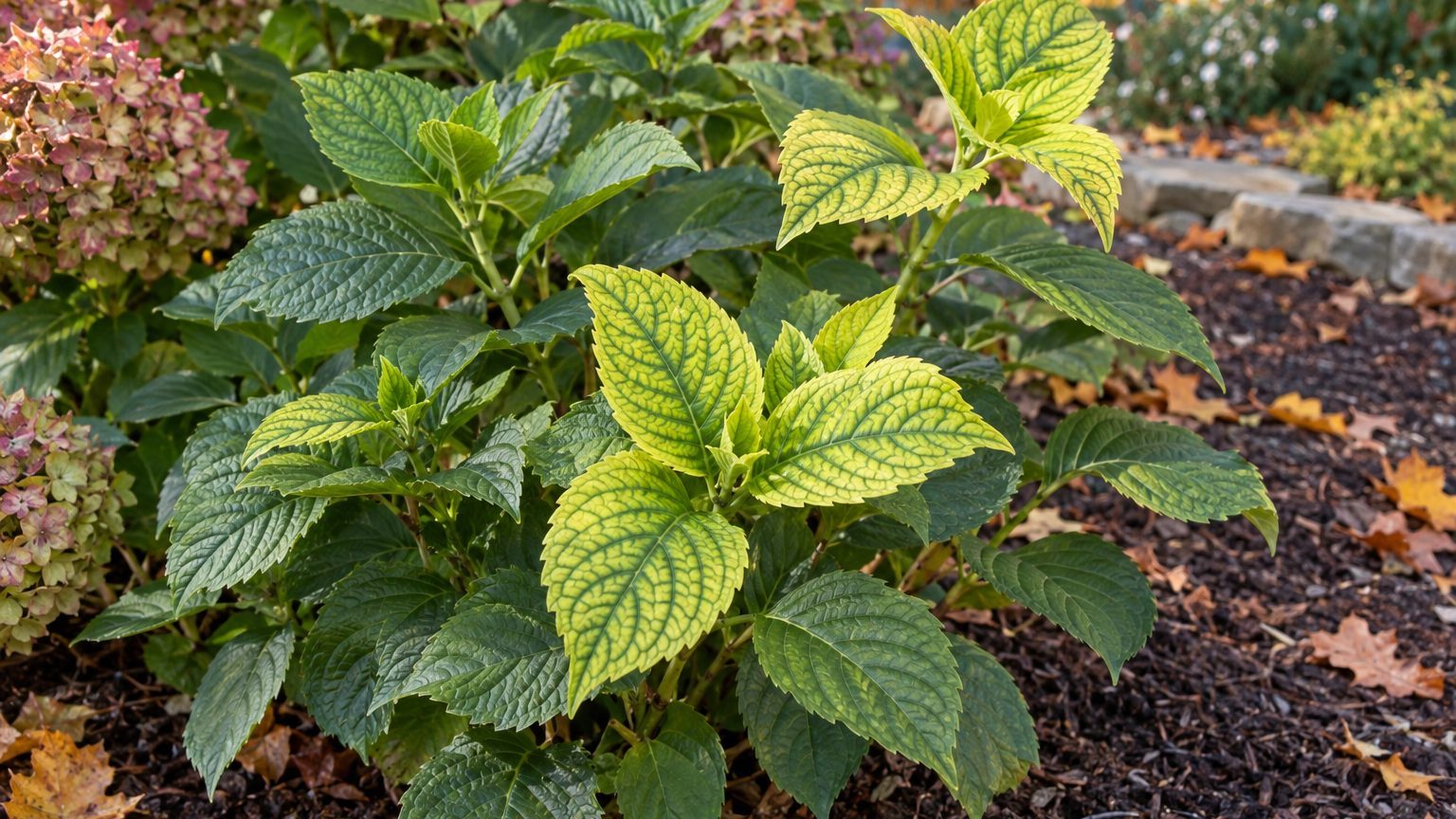
Hydrangea Yellow Leaves With Green Veins on a hydrangea

The NC State Extension Gardener Plant Toolbox rates growth as rapid for bigleaf and panicle types, and that pace is when the pattern shows most clearly. These are the signs to look for:

  • Leaf blades turn pale yellow or lime while the veins stay dark green, like a green net on yellow cloth.
  • The youngest leaves at the shoot tips often go first, and older leaves lower down stay greener.
  • It appears in the growing season, when the shrub is making new leaves fast.
  • Severe cases bring brown edges and small, sparse blooms.
  • One shrub may be affected, or every plant sharing the same soil.

A plant with this pattern is usually still alive and growing. The trouble is that it cannot use what the soil holds.

Hydrangea Yellow Leaves With Green Veins or Something Else?

Yellow leaves have a long list of causes, and the green veins narrow it fast. The NC State Extension Gardener Plant Toolbox names leaf spot, bacterial wilt and powdery mildew as hydrangea diseases. It calls aphids, scales, nematodes and mites rarely a problem.

Look closely at one leaf before reaching for anything. Whether the green stays inside the veins or breaks into spots, powder or webbing is the sign that decides.

Looks like The sign that tells them apart
Leaf spot: yellow patches on the blade Spots with their own edges, scattered across the leaf, instead of a clean green net along the veins
Powdery mildew: dull, pale leaves A white-gray powder on the surface that rubs off on a finger
Mites: faded, yellowing leaves Fine stippling on top and tiny specks or webbing on the underside

Crisp brown margins are a separate problem, covered in Hydrangea Leaves Turning Brown: Causes and How to Fix It. Blooms lost after a cold snap belong to Hydrangea Frost Damage: Causes and How to Fix It. The rest of the family sits in Hydrangea Problems.

What Causes Hydrangea Yellow Leaves With Green Veins, and Where It Is Worst

The NC State Extension Gardener Plant Toolbox lists hydrangea soil pH from acid, below 6.0, to alkaline, above 8.0. The higher the pH climbs, the harder it is for roots to reach certain minerals. That is why the pattern tracks soil more than weather:

  • Great Lakes and the North (Michigan, Minnesota, Wisconsin): panicle and smooth types dominate, and trouble usually follows lime added to lawns or beds.
  • The South (Georgia, Texas, the Carolinas): bigleaf is the common type, and yellowing shows up where the soil sits on the alkaline side.
  • Plains and Mountain West (Kansas, Nebraska, Colorado): soils there often run alkaline, and panicle, the only type that takes full sun well, is the usual choice.
  • Anywhere a bed borders lawn care (any state): lime makes soil more alkaline, and high-phosphorus fertilizer locks aluminium up in the soil.

Your zone and hydrangea type change the details, so your state’s page in this series gives the local picture.

How to Treat Hydrangea Yellow Leaves With Green Veins

Start this week with looking, not buying. The NC State Extension Gardener Plant Toolbox puts acid soil below 6.0 and alkaline soil above 8.0, so the number on a soil test matters more than any guess.

  1. Name your type: write down whether it is bigleaf, mountain, panicle, smooth, oakleaf or climbing, since only bigleaf and mountain change flower color with pH.
  2. Compare new leaves with old ones: a green net on yellow tissue at the shoot tips confirms you are chasing a soil problem.
  3. Stop lime and high-phosphorus feed: lime raises pH, and high-phosphorus fertilizer locks aluminium up in the soil.
  4. Send a soil sample to your state extension service: read the pH against the 6.0 and 8.0 lines, then ask what is approved in your state to correct it.
  5. Mulch and keep water steady: bigleaf and panicle are shallow-rooted and benefit from mulch.

Skip kitchen remedies. The source says coffee grounds or citrus peel can acidify soil enough to turn flowers blue, but the pH shift is very small. What the plant needs is available aluminium, which acidity releases. Judge progress by new growth, since leaves already yellow rarely recover.

How to Prevent Hydrangea Yellow Leaves With Green Veins Coming Back

The NC State Extension Gardener Plant Toolbox rates hydrangea maintenance as low, which means prevention is mostly restraint, timed to the year.

  • Late winter to early spring: send a soil sample before you feed anything, so you know the pH you are working with.
  • Spring: lay mulch over the roots, since bigleaf and panicle are both shallow-rooted.
  • Summer: water steadily in dry spells, because rapid growth in bigleaf and panicle needs a constant supply.
  • Late summer: check that your lawn program is not sending lime or high-phosphorus fertilizer into the hydrangea bed.
  • Fall and winter: cut hollow stems back to 12 to 24 inches and leave them standing for native bees, which nest in them.

Type and zone move these dates, so your state’s page sets the calendar for your yard.

Where this comes from

Hardiness ranges, soil pH limits, growth rates and the disease and pest lists come from the NC State Extension Gardener Plant Toolbox entry for Hydrangea. The diagnostic signs in the comparison table are general field cues, not extension figures.

Soil, lime rules and approved treatments differ from state to state. Confirm your test results and options with your state’s extension service before you change anything.

Common questions

Will the yellow leaves turn green again?

Leaves turning yellow between green veins

Rarely. Leaves that have yellowed usually stay that way, so watch the new growth. Fresh leaves coming in greener are the sign your fix is working.

Does this mean my hydrangea will change color?

Only if it is bigleaf or mountain. Those types go blue below about pH 5.5, pink above about pH 6.5 and purple in between. Panicle, smooth, oakleaf and climbing types do not shift color with soil.

Should I add fertilizer to green up the leaves?

Choose carefully. High-phosphorus fertilizer locks aluminium up in the soil, which pushes blue flowers toward pink. Get a soil test first and ask your extension service what suits your soil.

Hydrangea Wilting in the Heat: Causes and How to Fix It

Hydrangea Wilting in the Heat: Causes and How to Fix It

Hydrangea wilting in the heat usually means the plant is losing water faster than its shallow roots can supply it. Deep watering at the base, mulch and shade from afternoon sun fix most cases.

Which type you grow changes the answer. Bigleaf wants shade by afternoon, while panicle is the one hydrangea that takes full sun well.

Hydrangea Wilting in the Heat: What You See

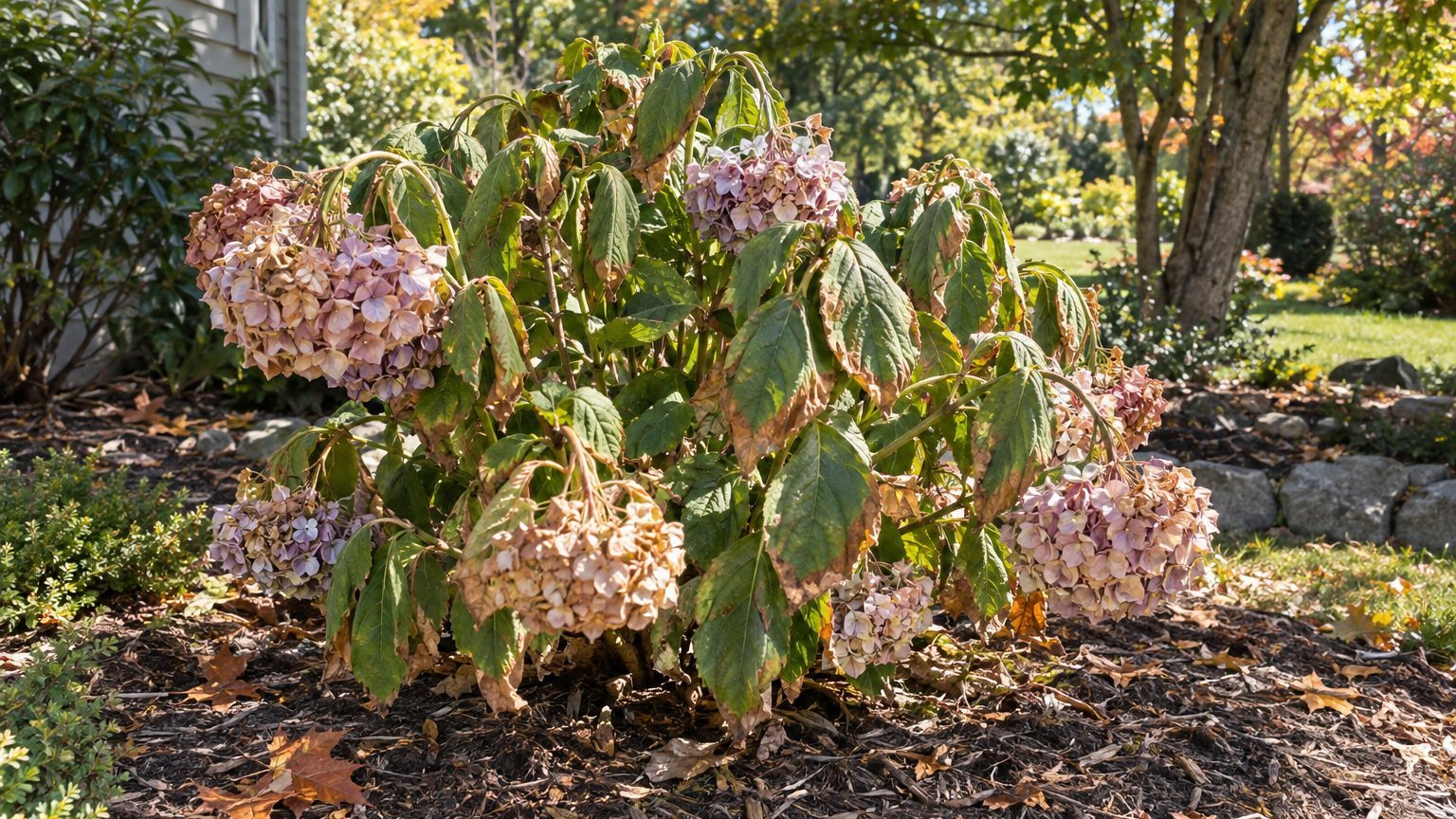
Hydrangea Wilting in the Heat on a hydrangea

The NC State Extension Gardener Plant Toolbox puts bigleaf hydrangea at 3-6 feet tall and wide, and a plant that size shows heat stress in a few clear ways:

  • Leaves hang limp from the stems, most often from midday through late afternoon.
  • Flower heads sag or nod, and the round mop-head or flat lacecap blooms look too heavy for their stems.
  • Leaf edges turn crisp and brown, with tan patches on the side facing the afternoon sun.
  • The plant looks fine at first light, then slumps again as the sun climbs.
  • It shows up in a hot spell from early summer into early fall, and the soil under the plant is dry.

Panicle can droop the same way because it is shallow-rooted too, though it is the type built for full sun.

Hydrangea Wilting in the Heat or Something Else?

A limp hydrangea is not always a thirsty one. A few other problems droop leaves in summer, and each leaves its own trail.

The NC State Extension Gardener Plant Toolbox names bacterial wilt among the diseases of hydrangea and calls aphids, scales, nematodes and mites rarely a problem. Check the plant at dawn, because the morning tells the story better than the afternoon.

Looks like The sign that tells them apart
Bacterial wilt Leaves stay limp at dawn even after a deep soaking the day before.
Soggy roots The soil stays wet and heavy around the roots while the leaves droop.
Sun scorch Crisp tan patches on sun-facing leaves that remain after the plant perks up at night.

Spring cold that blackens new growth is a different problem, covered in Hydrangea Frost Damage: Causes and How to Fix It. The other kinds of trouble are on their own pages, starting from Hydrangea Problems.

What Causes Hydrangea Wilting in the Heat, and Where It Is Worst

Bigleaf and panicle are both shallow-rooted, says the NC State Extension Gardener Plant Toolbox, and a 3-6 foot bigleaf in afternoon sun loses water through its leaves faster than roots near the surface can replace it.

  • Great Lakes and the North (Michigan, Minnesota, Wisconsin): panicle at 3a to 8b is the only hydrangea that takes full sun well, and smooth is the hardiest of the genus, so bigleaf is the type that needs afternoon shade.
  • The South (Georgia, Texas, the Carolinas): bigleaf is listed at 6a to 11b, so it grows here, but it wants dappled sun or shade, and thin mulch over shallow roots shows quickly in a hot spell.
  • Plains and Mountain West (Kansas, Colorado, Utah): sand is one of the three soils the source lists with clay and loam, and a shallow-rooted plant in fast-draining sand is the first to run dry.

Zone and type settle the rest, so the page for your state gives the answer that fits your yard.

How to Treat Hydrangea Wilting in the Heat

The NC State Extension Gardener Plant Toolbox asks that bigleaf be protected from afternoon sun, so the first week is about water at the roots and shade on the leaves.

  1. Water deeply at the base: soak the soil in the early morning until the ground under the mulch is moist, not just the surface, and keep the water off the leaves.
  2. Shade the afternoon side: hang shade cloth or set up a patio umbrella on the west side of a bigleaf, while a panicle in full sun needs water and mulch instead.
  3. Mulch the root zone: both bigleaf and panicle are shallow-rooted and benefit from mulch, so spread it wide and keep it off the stems.
  4. Check again at dawn: upright leaves mean the plant only outran the sun, and limp ones mean drainage needs a look before any more water goes on.
  5. Hold the pruners: bigleaf forms its buds the previous summer, so hard cuts in a heat spell risk next year’s flowers.
  6. Call the county extension office: if the plant stays limp at dawn with good drainage, they can confirm bacterial wilt and tell you what is approved in your state.

Skip fertilizer until the plant stands up on its own. A stressed hydrangea needs water, not a push.

How to Prevent Hydrangea Wilting in the Heat Coming Back

Prevention follows the calendar, and most of it happens before the first hot week arrives.

  • At planting: give bigleaf dappled sun or shade away from the afternoon sun, and save full-sun spots for panicle.
  • Early spring: spread mulch over the roots, since the NC State Extension Gardener Plant Toolbox lists both bigleaf and panicle as shallow-rooted plants that benefit from it.
  • Late spring: start deep, slow watering at the base before the heat builds, so roots reach down instead of staying near the surface.
  • Midsummer: check the soil during every hot spell and go easy on feeding, because heavy feeding pushes leaf over bloom, the pattern in Hydrangea Big Leaves No Flowers: Causes and How to Fix It.
  • Late summer: leave bigleaf alone once your state’s pruning cutoff passes, because next year’s buds are forming now.
  • Fall: top up the mulch so the shallow roots go into winter covered.

Your state page gives the exact dates for pruning and mulching in your zone.

Where this comes from

The types, zone ranges, root habit and disease list here come from the NC State Extension Gardener Plant Toolbox entry for Hydrangea.

Check timing, watering rules and any treatment with your state’s cooperative extension service. They know what applies in your soil and climate.

Common questions

Will a wilted hydrangea recover on its own overnight?

Often, yes. Heat-wilted leaves usually stand back up by dawn once the sun is off and the soil is moist. Leaves still limp at dawn after a deep watering point to drainage or one of the look-alikes above.

Should I cut off wilted leaves or stems?

No. The leaves shade the crown and roots. Bigleaf also forms its buds the previous summer, so cutting during a heat spell can cost you next year’s flowers.

Which hydrangea handles full sun best?

Panicle, the only hydrangea the NC State Extension Gardener Plant Toolbox says takes full sun well. Bigleaf wants dappled sun, partial shade or deep shade, with protection from afternoon sun.

Leggy Hydrangea: Causes and How to Fix It

Leggy Hydrangea: Causes and How to Fix It

A leggy hydrangea has long, thin stems, few leaves and a sparse crown. The cause is usually too little light, or a cut made at the wrong time for that type.

Dates belong to your state page.

Leggy Hydrangea: What You See

The NC State Extension Gardener Plant Toolbox lists bigleaf hydrangea at 3 to 6 feet tall and wide, so density and spacing tell you more than height alone.

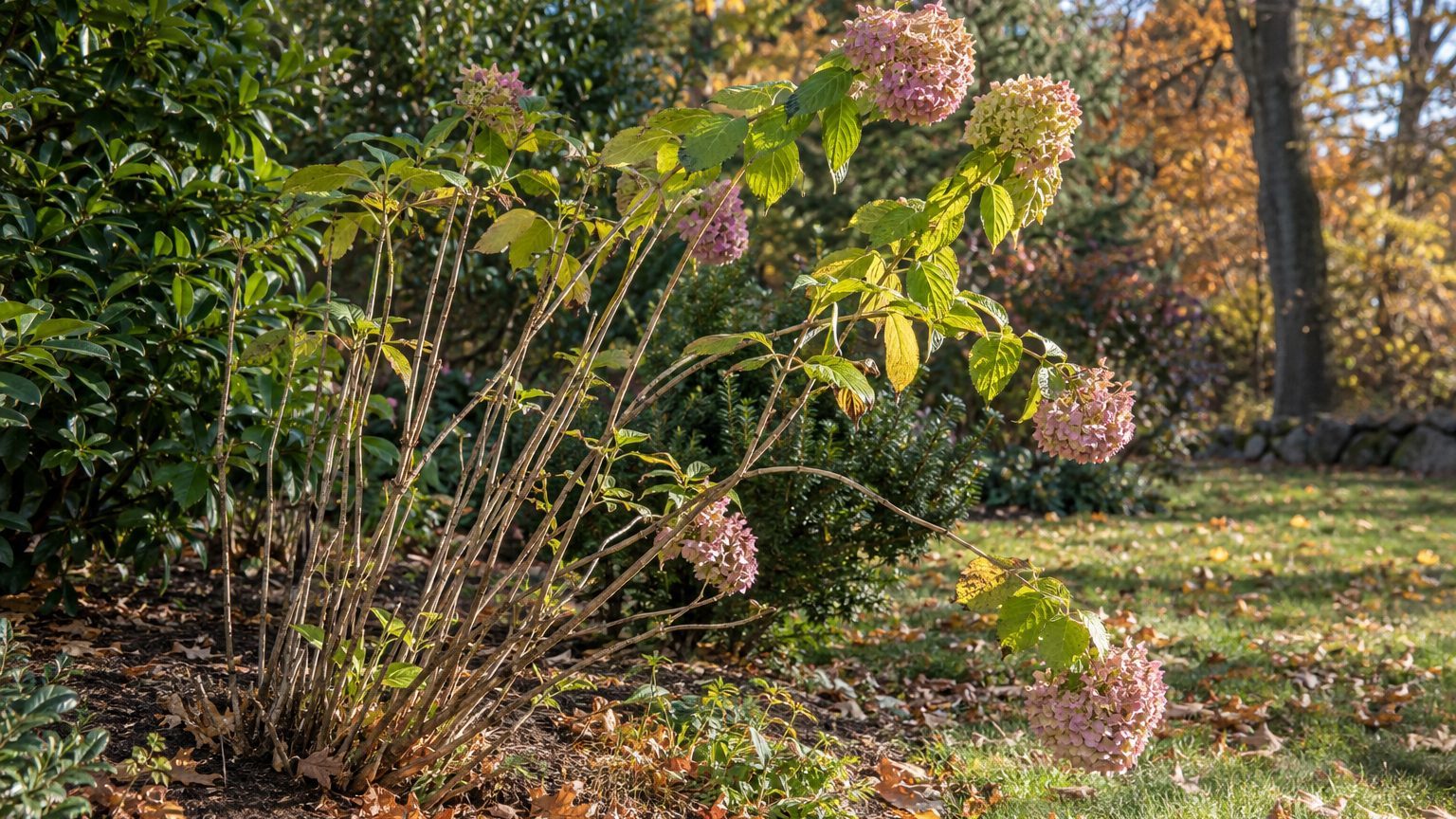
  • Long, pencil-thin stems with leaves bunched at the tips
  • Bare lower stems, with the green growth pushed up and away from the base
  • Stems leaning hard to one side, toward the light
  • Few or small flower heads that bow the stem to the ground
  • An open crown you can see through from the side
  • Most obvious in summer once the heads open, and again in winter when the bare framework shows

The sign that matters most is healthy green leaves spaced too far apart. Browning edges or spotting point to a different problem.

Leggy Hydrangea or Something Else?

Height alone proves little. The NC State Extension Gardener Plant Toolbox gives panicle hydrangea 8 to 25 feet, so a healthy one can look tall and open without any fault.

Bare stems after a hard winter or a spring cut are another lookalike. Check the tips and buds before you decide anything is wrong.

Looks like The sign that tells them apart
A tall, open panicle Stiff, thick stems with full leaves along their length, and a size that sits inside 8 to 25 feet
A sprawling climbing hydrangea Aerial rootlets clinging to the surface, growth of 15 feet and more, and very slow flowering
Bare-tipped bigleaf Buds formed the previous summer on last year’s wood are missing, taken by late frost or a spring prune

Deer browsing also strips tips, and hydrangeas are browsed. Look for ragged, torn ends instead of clean growth. The smooth, oakleaf and mountain kinds are on their own pages, and the rest of the family is on Hydrangea Problems.

What Causes Leggy Hydrangea, and Where It Is Worst

The NC State Extension Gardener Plant Toolbox calls panicle the only hydrangea that takes full sun well. That points to the first cause: stems in shade stretch toward light, and fast growers stretch fastest. Pruning at the wrong season is the second cause, since a spring cut on an old-wood type removes buds.

  • Great Lakes and the North (Michigan, Minnesota, Wisconsin): panicle and smooth suit the cold, but bigleaf loses buds to late frost, and the bare stems left behind read as leggy.
  • The South (Georgia, Texas, the Carolinas): bigleaf needs protection from afternoon sun, so gardeners tuck it into shade, where rapid growth turns into a long reach.
  • Wooded lots in the East and Midwest (Pennsylvania, Ohio, New York): bigleaf accepts partial or deep shade, but the deeper the shade, the longer the stems reach.

Your state page has the pruning window and zone verdict for your type, which this national page leaves out.

How to Treat Leggy Hydrangea

A cut on the wrong type can cost a season of flowers, so this week’s work goes in this order.

  1. Name the type: bigleaf, mountain, panicle, smooth, oakleaf and climbing behave differently, and old wood versus new wood decides every cut after this.
  2. Check the light: bigleaf wants dappled sun with protection from afternoon sun, and only panicle takes full sun well, so a mismatch explains the stretch.
  3. Hold the pruners on old-wood types: panicle can be cut back hard in late winter, but bigleaf flowers on last year’s wood, so a spring prune removes the flowers. With fall here, most plants should simply wait.
  4. Fix the site if light is the cause: thin overhead branches now, and mark any plant to move while it is dormant.
  5. Tidy dead stems: the NC State Extension Gardener Plant Toolbox says native bees nest in dead hollow stems, so cut them to 12 to 24 inches and leave them standing until they disintegrate.

I skip products here, since your state extension service knows what is approved locally. Browning leaves are a separate job, covered in Hydrangea Leaves Turning Brown: Causes and How to Fix It. A plant that will not grow at all is on Hydrangea Not Growing: Causes and How to Fix It.

How to Prevent Leggy Hydrangea Coming Back

The NC State Extension Gardener Plant Toolbox rates hydrangea maintenance as low, with growth from medium to rapid, so a few well-timed gestures do the work.

  • Dormancy: the one safe window to move a plant, roots undisturbed.
  • Planting: match the type to the site, panicle for full sun and bigleaf for dappled light with afternoon shade.
  • Late winter: cut panicle back hard, since it flowers on the current season’s growth.
  • Right after bloom: prune old-wood types then, never in spring, and stop at the deadline on your state page.
  • Spring: lay mulch over the roots, because bigleaf and panicle are both shallow-rooted.
  • Summer: keep shallow roots from drying out, and watch for deer.
  • Fall: leave old-wood types uncut so the wood can ripen its buds.

Skip the light step and no pruning schedule will hold the shape.

Where this comes from

Plant types, sizes, sun needs and pruning behavior here come from the NC State Extension Gardener Plant Toolbox entry for Hydrangea. The signs and fixes for legginess are general horticultural practice built on those facts.

Pruning windows, zone verdicts and approved products vary by state. Confirm them with your state’s cooperative extension service before you cut.

Common questions

Can I cut a leggy hydrangea back hard?

Can I cut a hydrangea back hard to make it bloom?

Only some types. Panicle flowers on the current season’s growth and can be cut back hard in late winter. Bigleaf flowers on last year’s wood, so a hard cut removes the flowers.

Will more fertilizer shorten the stems?

No. The one feeding effect the source documents is color. High-phosphorus fertilizer locks up aluminum and pushes blue bigleaf flowers toward pink. Panicle, smooth, oakleaf and climbing types do not change color with soil pH.

Will a leggy hydrangea still flower?

It depends on the type. Bigleaf buds form the previous summer, so lost tips mean lost flowers. Climbing hydrangea is very slow to start flowering, even when healthy.

Hydrangea Not Growing: Causes and How to Fix It

Hydrangea Not Growing: Causes and How to Fix It

A hydrangea that sits still is usually the wrong type for its spot. It may be a bigleaf that lost its buds to cold or an early cut, or a shallow-rooted shrub short on moisture or light. Genus hardiness runs across USDA zones 3a through 9b.

That range is wide, so the fix changes with the type. Identify the type first, then match the symptom.

Hydrangea Not Growing: What You See

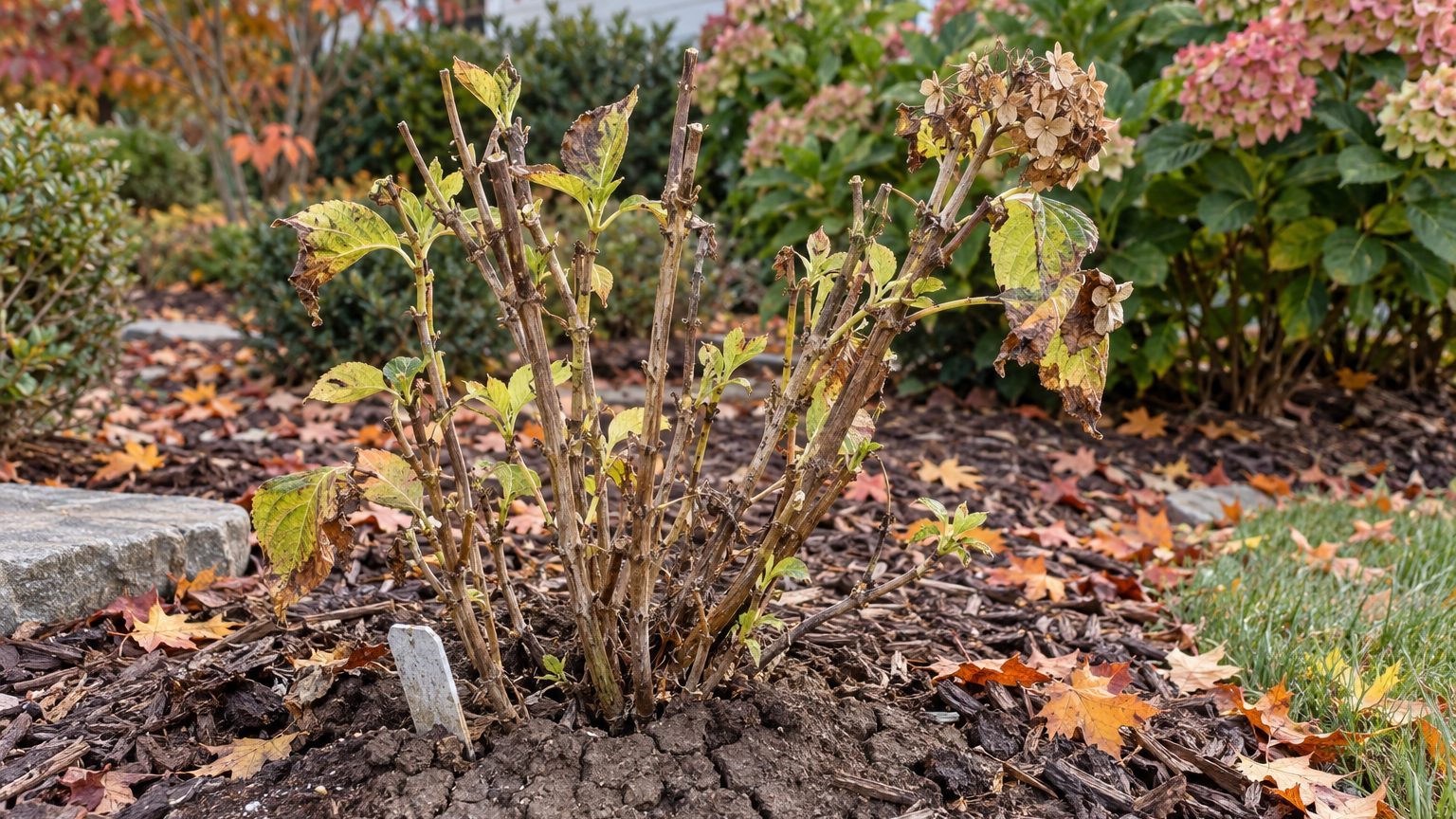
Hydrangea Not Growing on a hydrangea

NC State Extension Gardener Plant Toolbox rates growth as medium for the genus and rapid for bigleaf and panicle, so a plant that stalls stands out fast.

  • Bare stems long after neighboring shrubs have leafed out.
  • Shoots that stall short, carrying small, pale leaves.
  • A shrub no taller than the day it was planted, a full season later.
  • Leaves that droop and crisp at the edges while the soil around the roots runs dry.
  • Healthy green leaves but no flowers on a bigleaf or mountain type.
  • Torn tips and missing leaves wherever deer can reach.

The last two matter because bigleaf sets its buds the previous summer on last year’s wood, so a frost or a spring cut can leave a leafy plant with nothing to bloom.

Hydrangea Not Growing or Something Else?

Several problems pass for a stalled plant. NC State Extension Gardener Plant Toolbox says climbing hydrangea reaches 15 feet and more, yet is very slow to start flowering, so a young vine that looks idle may be behaving normally.

One test settles most cases: scratch the bark, then look at where the damage sits. Living tissue, a clinging habit or a pattern on the leaves each point somewhere different.

Looks like The sign that tells them apart
Dead stems on a bigleaf after winter Scratched bark is brown and dry along the stem, and no leaf buds swell.
A climbing hydrangea that sits still Aerial rootlets grip the wall or trunk and the leaves look healthy.
Deer browsing Stems end in ragged tips and leaves are missing only at browsing height.
Leaf disease Spotted leaves point to leaf spot, and a white powdery film to powdery mildew.

Yellow leaves with green veins are a different fault, covered in Hydrangea Yellow Leaves With Green Veins: Causes and How to Fix It. Thin stems stretching toward light have their own page, Leggy Hydrangea: Causes and How to Fix It.

What Causes Hydrangea Not Growing, and Where It Is Worst

The usual cause is a mismatch between type and place. NC State Extension Gardener Plant Toolbox lists bigleaf at 6a-11b and panicle at 3a-8b, with smooth as the hardiest of the genus.

  • Great Lakes and the North (Michigan, Minnesota, Wisconsin): panicle and smooth suit the cold, and the source calls panicle “a good substitute for the mop-head hydrangea in areas where that species is not winter hardy.”
  • Northeast and Mid-Atlantic (New York, Pennsylvania, Virginia): a late frost after growth starts removes the flower buds on bigleaf, while mountain hydrangea buds take that frost better.
  • The South (Georgia, Texas, the Carolinas): afternoon sun is the risk for bigleaf, which wants dappled sun or shade, and its shallow roots dry fast without mulch.
  • Plains and Mountain West (Nebraska, Colorado, Utah): smooth is the safest pick, and since the source accepts soil pH from below 6.0 to above 8.0, alkaline ground changes bloom color more than it stops growth.

Your state’s page on this site gives the pruning window and zone check for your reference city, which this national page cannot.

How to Treat Hydrangea Not Growing

Work through these this week and stop at the step that explains what you see.

  1. Name the type: NC State Extension Gardener Plant Toolbox puts bigleaf at 3-6 feet tall and wide and panicle at 8-25 feet, so mature size, leaf shape and bloom form narrow it down.
  2. Scratch the bark on several stems: cut dead wood back to living green, and leave live stems alone on old-wood types, since they carry the coming flowers.
  3. Fix the light: bigleaf wants dappled sun or shade with protection from afternoon sun, while panicle is the only type that takes full sun well.
  4. Mulch the shallow roots and water when the soil beneath feels dry, because bigleaf and panicle both root near the surface.
  5. Check leaves and tips for leaf spot, powdery mildew or deer browsing, and ask your state extension office what is registered before spraying anything.

Then give it time. Growth is medium to rapid and maintenance low, so a plant with living wood and suitable light needs little more. High-phosphorus fertilizer locks up aluminum and pushes blue bigleaf flowers toward pink, so skip it if blue matters.

How to Prevent Hydrangea Not Growing Coming Back

NC State Extension Gardener Plant Toolbox lists the genus at USDA zones 3a through 9b, and the type decides where in that range you sit, so prevention starts before the plant goes in the ground.

  • Before buying: match the type to your zone, and lean toward panicle or smooth where winters are hard.
  • At planting: give bigleaf dappled sun and panicle full sun.
  • Late winter: cut panicle back hard, since it flowers on the current season’s growth.
  • Right after bloom: prune old-wood types then and not in spring, because spring cuts remove the flowers.
  • Late spring: refresh the mulch over the shallow roots.
  • Cleanup: cut dead hollow stems to 12-24 inches and leave them standing until they disintegrate, since native bees nest in them.

Exact windows depend on your city, and each state page spells them out.

Where this comes from

Every type, zone, light and soil detail here comes from the NC State Extension Gardener Plant Toolbox entry for Hydrangea. Nothing beyond it is stated as fact here.

Confirm timing and treatments with your state’s extension service, which knows local conditions and what is registered. More sheets sit under Hydrangea Problems.

Common questions

How do I know a bare hydrangea is dead?

Stems dead to the ground by fall

Scratch the bark on several stems. Green underneath means the stem is alive, even if it has no leaves yet. Brown and dry all the way along means dead wood, which you can cut back to the first living bud.

Will coffee grounds help my hydrangea?

They do not fix growth. The source says grounds can turn flowers blue, but the pH shift is very small. What bigleaf and mountain types need is available aluminum, which acidity releases. Panicle, smooth, oakleaf and climbing types never change color with pH.

Are cut hydrangea stems a risk to pets?

Only bigleaf is documented as toxic, and only if large quantities are eaten. Symptoms include nausea, stomach pain, vomiting and sweating. The bark, flowers, leaves and stems all carry the compounds, and cats, dogs and horses are affected too.

Hydrangea Not Blooming: Causes and How to Fix It

Hydrangea Not Blooming: Causes and How to Fix It

Hydrangea not blooming usually means the flower buds were lost, not that the plant is sick. Bigleaf, mountain, oakleaf and climbing types set buds on last year’s wood, so a late frost or a spring prune can wipe out a whole season.

Panicle and smooth types flower on new growth and rarely fail that way. Knowing which one you own decides the fix.

Hydrangea Not Blooming: What You See

Hydrangea Not Blooming on a hydrangea

The NC State Extension Gardener Plant Toolbox lists the genus across USDA zones 3a through 9b, and what you see on a bloomless plant depends on the type you planted.

  • Healthy green leaves all summer, but not one flower bud where blooms should be.
  • Buds that swelled in spring, then turned brown or black after a late frost.
  • Freshly cut stem ends on a bigleaf, with new shoots below but no flowers, after a spring prune.
  • A tall, floppy shrub in deep shade, all leaf and no bloom.
  • A climbing hydrangea with a thick, healthy vine and no flowers, several seasons after planting.

Each sign points to a different cause, so match yours before you pick up the shears.

Hydrangea Not Blooming or Something Else?

The NC State Extension Gardener Plant Toolbox puts the color switch at blue below about pH 5.5, pink above about pH 6.5, and purple in between. That is a color story, not a bloom story, and it applies to bigleaf and mountain only.

Three other situations get mistaken for a failed season. Each has a sign that settles it.

Looks like The sign that tells them apart
Blooms that came in pink, not blue Only bigleaf and mountain follow soil pH, and pink means a reading above about 6.5. Panicle, smooth, oakleaf and climbing never shift with the soil.
Flowers that aged to green, cream or pink Panicle, smooth, oakleaf and climbing turn these shades as the season ages, whatever the soil. The bloom is there, just past its peak.
Blue flowers sliding toward pink after feeding High-phosphorus fertilizer locks aluminum up in the soil. The color moves while the flower count holds.
Buds killed by a late frost Bigleaf forms buds the previous summer, so old stems carry dead buds. A panicle nearby, flowering on the current season’s growth, is not affected the same way.

Deer browsing, leaf spot, bacterial wilt and powdery mildew are covered in Hydrangea Problems.

What Causes Hydrangea Not Blooming, and Where It Is Worst

The NC State Extension Gardener Plant Toolbox lists bigleaf at USDA 6a to 11b and says its buds form the previous summer, so a late frost or a spring prune removes the flowers.

  • Great Lakes and the North (Michigan, Minnesota, Wisconsin): panicle, listed at 3a to 8b, and smooth, the hardiest of the genus, flower on new wood, while bigleaf’s old-wood buds are the ones at risk.
  • Mid-Atlantic and Ohio Valley (Ohio, Kentucky, Virginia): bigleaf is in range here, so a late frost after spring growth is the risk to watch, and mountain buds take that frost better.
  • The South (Georgia, Texas, the Carolinas): bigleaf is listed up to 11b, so the questions are afternoon sun, which the source says to avoid, and pruning at the wrong time.
  • Plains and Mountain West (Nebraska, Colorado, Utah): panicle is the only hydrangea that takes full sun well, and the source calls it “a good substitute for the mop-head hydrangea in areas where that species is not winter hardy.”

Your state’s page in this series gives the zone verdict and the pruning window for your reference city. Shade and heavy feeding cause a separate kind of failure, covered in Leggy Hydrangea: Causes and How to Fix It and Hydrangea Big Leaves No Flowers: Causes and How to Fix It.

How to Treat Hydrangea Not Blooming

Start with the type, because the right cut for one hydrangea is the wrong cut for another.

  1. Identify the type: sort it into bigleaf, mountain, oakleaf and climbing (old wood) or panicle and smooth (new wood) before doing anything else.
  2. Stop spring pruning on old-wood types: their buds formed the previous summer, so remove only dead wood once new growth shows which stems survived.
  3. Cut panicle hard in late winter: the NC State Extension Gardener Plant Toolbox says it flowers on the current season’s growth, so a hard cut costs no flowers.
  4. Match the light to the type: bigleaf wants dappled sun or shade with protection from afternoon sun, while panicle wants full sun.
  5. Mulch the shallow roots: bigleaf and panicle both root near the surface, and both benefit from mulch and good drainage.
  6. Give a climbing plant time: climbing hydrangea is very slow to start flowering, so patience beats the shovel.

Buds lost this year stay lost, so the payoff comes next season. Bigleaf is documented as toxic to people, cats, dogs and horses only if large quantities are eaten, so keep clippings out of grazing reach.

How to Prevent Hydrangea Not Blooming Coming Back

The NC State Extension Gardener Plant Toolbox rates maintenance as low and growth as medium to rapid, so the calendar is short and mostly about restraint.

  • Late winter: cut panicle back hard, since it blooms on the current season’s growth.
  • Early spring: leave bigleaf, mountain, oakleaf and climbing plants uncut apart from dead wood.
  • Spring feeding: skip high-phosphorus fertilizer on blue bigleaf and mountain, because it locks up aluminum and pushes flowers toward pink.
  • Just after bloom: prune bigleaf soon after the flowers fade, well before the cutoff on your state’s page.
  • Summer: refresh mulch over the shallow roots and keep drainage good.
  • Fall and winter: on panicle and smooth, cut hollow stems to 12 to 24 inches and leave them standing until they disintegrate, since native bees nest in them.

Planting each type in the light it prefers removes the cause behind most repeat failures.

Where this comes from

The NC State Extension Gardener Plant Toolbox entry for Hydrangea gives hardiness, bloom habit and color by type. Its figures apply to the genus as a whole.

Zones, pruning windows and approved pest controls vary from place to place. Check them with your state’s extension service before you act.

Common questions

Why is my bigleaf hydrangea green and healthy but not flowering?

No flowers on a healthy bigleaf

Bigleaf flowers on last year’s wood, and its buds form the previous summer. A late frost or a spring prune removes them while leaving the leaves untouched, which is why the plant looks fine but stays bare.

Will coffee grounds make my hydrangea bloom blue?

Coffee grounds do not affect blooming, and the pH shift they cause is very small. The source mentions coffee grounds and citrus peel as a popular belief for turning flowers blue.

What moves the color is available aluminum, which acidity releases. Aluminum sulfate acidifies the soil and lime does the opposite. This applies to bigleaf and mountain only.

Which hydrangea is the safest bet in a cold yard?

Smooth is the hardiest of the genus, and panicle is listed at 3a to 8b. Both flower on new wood, so a hard winter or a late frost does not remove their flowers the way it can with bigleaf.

Hydrangea Leaves Turning Brown: Causes and How to Fix It

Hydrangea Leaves Turning Brown: Causes and How to Fix It

Brown leaf edges, spots or dried-out tops on a hydrangea usually trace back to one of four things: afternoon sun on a plant that wants shade, shallow roots running dry, frost on buds and young growth, or a leaf disease such as leaf spot. Which one you have depends on where the browning sits and on the type, because bigleaf, panicle and oakleaf do not want the same things.

Hydrangea Leaves Turning Brown: What You See

Hydrangea Leaves Turning Brown on a hydrangea

Browning shows up in a handful of distinct patterns, and the NC State Extension Gardener Plant Toolbox names leaf spot among the diseases that mark hydrangea foliage.

  • Crisp, tan-brown edges on the leaves that face the afternoon sun.
  • Brown spots scattered across the leaf blade, sometimes merging into patches.
  • Papery, dried-out leaves at the top of the plant after a stretch of midsummer heat.
  • Blackened buds and new shoots in spring, right after a late cold snap.
  • Ragged, dried edges with torn bites, usually at deer height.

Timing matters as much as color. Wine-red autumn foliage on an oakleaf hydrangea is normal, so judge the pattern against the calendar before you worry.

Hydrangea Leaves Turning Brown or Something Else?

Brown is where several problems end up, and not all of them start with the plant. The NC State Extension Gardener Plant Toolbox lists deer as a damage agent, and hydrangeas do get browsed, so a chewed look deserves a close inspection.

Check the shape of the damage before you reach for a hose or a sprayer. The pattern on the leaf usually settles the question faster than guessing at the cause.

Looks like The sign that tells them apart
Scorched, limp leaves in a heat spell Leaves droop by afternoon and stand back up by evening or after a deep watering. True browning does not reverse.
Fading, tan-yellow leaves Veins stay green while the tissue between them turns yellow, then tan.
Dried, ragged leaf edges Bites are torn and uneven, with tissue missing rather than dried in place.

Limp leaves that perk up by evening are covered in Hydrangea Wilting in the Heat: Causes and How to Fix It.

Yellow tissue between green veins has its own sheet, Hydrangea Yellow Leaves With Green Veins: Causes and How to Fix It. The other look-alikes sit together under Hydrangea Problems.

What Causes Hydrangea Leaves Turning Brown, and Where It Is Worst

The NC State Extension Gardener Plant Toolbox rates bigleaf at USDA 6a to 11b and panicle at 3a to 8b, and most browning comes from a mismatch between type and place: bigleaf in hot sun, shallow roots drying out, or frost catching buds.

  • Great Lakes and the North (Michigan, Minnesota, Wisconsin): bigleaf starts at zone 6a, so across much of this region frost-blackened buds and shoots are the likelier culprit. Panicle and smooth hydrangeas are the sturdier picks.
  • Northeast and Mid-Atlantic (New York, Pennsylvania, Virginia): zones straddle the bigleaf line, so a late frost after buds swell can brown old-wood growth. The source calls panicle a good substitute for the mop-head hydrangea where that species is not winter hardy.
  • The South (Georgia, Texas, the Carolinas): heat and afternoon sun scorch leaf edges on bigleaf, which needs protection from afternoon sun. Panicle is the only type that takes full sun well, and shallow roots on both dry out fast without mulch.

Your state’s page gives the zone and the calendar for where you garden, and the right answer changes with both type and zone.

How to Treat Hydrangea Leaves Turning Brown

The NC State Extension Gardener Plant Toolbox gives bigleaf 3 to 6 feet in height and width and asks for dappled sun, so this week’s job is matching that picture to what is growing in your yard.

  1. Name the type: bigleaf, panicle, smooth, oakleaf, mountain and climbing hydrangeas need different care, and every step below shifts with the answer.
  2. Read where the browning sits: edges on the sun side point to scorch, scattered spots point to leaf spot, and blackened tips after a cold snap point to frost.
  3. Cut the afternoon sun on bigleaf: shade cloth or a better-placed planting does more than extra water, while panicle is the one type that handles full sun.
  4. Water at the base and mulch: bigleaf and panicle are shallow-rooted, so mulch holds moisture where the roots sit, and the ground should drain well even if occasional wetness is fine.
  5. Pick off badly spotted leaves: bag them for the trash instead of the compost pile, and keep water off the foliage.
  6. Leave the stems alone: bigleaf, oakleaf, mountain and climbing types flower on old wood, so cutting away brown growth to tidy up can take next year’s flowers with it.

For anything that looks like leaf spot, powdery mildew or rust, ask your county extension office what is registered in your state before buying a spray. I am not naming a product here, on purpose.

How to Prevent Hydrangea Leaves Turning Brown Coming Back

The NC State Extension Gardener Plant Toolbox puts the genus at USDA zones 3a through 9b, but it depends entirely on the type, so prevention begins with matching type to zone and then follows the season.

  • Late winter: cut panicle back hard, since it flowers on the current season’s growth, and leave old-wood types alone.
  • Early spring: lay mulch over the shallow root zone before the first hot stretch arrives.
  • Late spring: shade bigleaf from afternoon sun, or move it, once the frost risk in your area has passed.
  • Summer: water at the base during dry spells, in the morning, so leaves dry quickly.
  • Late summer: rake up fallen spotted leaves so disease has less to overwinter on.
  • Autumn and winter: leave hollow stems standing, cut to 12 to 24 inches when you do tidy, so native bees can nest in them.

Pruning dates for old-wood types vary by state, so take those from your state page.

Where this comes from

Type, zone, sun and disease details here come from the NC State Extension Gardener Plant Toolbox entry for Hydrangea.

Local conditions change the answer, so check the timing and any treatment with your state’s cooperative extension service. They know what is registered and what works in your county.

Common questions

Is a hydrangea with brown leaves dying?

Leaf edges browned in midsummer

Usually not. Scratch a stem with a thumbnail, and green tissue underneath means the wood is alive. Leaves can brown and drop while buds and roots stay sound.

Does soil pH turn hydrangea leaves brown?

Soil pH moves flower color, and only on bigleaf and mountain hydrangeas. Blue shows below about pH 5.5 and pink above about pH 6.5. Panicle, smooth, oakleaf and climbing types do not change with pH at all.

Are the brown leaves a risk to pets?

Only H. macrophylla is documented as toxic, and only when large quantities are eaten, with nausea, stomach pain, vomiting and sweating. The concern extends to cats, dogs and horses. Fallen browned leaves carry the same compounds as green ones, so rake them up if animals roam your yard.

Hydrangea Frost Damage: Causes and How to Fix It

Hydrangea Frost Damage: Causes and How to Fix It

A late frost rarely kills a hydrangea. It burns the new leaves and, on types that flower on last year’s wood, can wipe out the season’s blooms.

Your type decides how much you lose, and your zone decides how often it happens. Bigleaf pays the highest price. Hydrangea Problems covers the other troubles.

Hydrangea Frost Damage: What You See

Hydrangea Frost Damage on a hydrangea

The NC State Extension Gardener Plant Toolbox puts bigleaf hydrangea at USDA 6a to 11b, and it is the type that shows frost injury most, because its flower buds form the previous summer.

  • Shoot tips and soft new leaves turn dark brown or black within a day or two of a cold night in spring.
  • Leaves that had just unfurled go limp, then dry to a papery crisp.
  • Stems leaf out normally but carry no flower buds at the tips, so the plant stays green and never blooms.
  • Canes look dead from the tips downward while fresh shoots push from the base.
  • Late-forming flowers open small, twisted or brown at the edges.

Panicle and smooth hydrangeas can lose leaves the same way but still flower, since they bloom on the current season’s growth.

Hydrangea Frost Damage or Something Else?

Frost gets blamed for damage it did not cause. The NC State Extension Gardener Plant Toolbox lists deer, leaf spot and, on panicle, bud blight among the troubles hydrangeas meet. A spring prune also strips flowers from bigleaf as surely as a frost does.

The tell is pattern. Frost hits the newest, most exposed growth all at once after one cold night. The look-alikes follow a cut line, a browsing height or individual leaf spots.

Look-alike Looks like The sign that tells them apart
Spring pruning Healthy green stems with no flower buds Stem tips end in a clean cut, and the leaves are undamaged
Deer browsing Missing shoot tips and buds Stems look torn or chewed, and the damage stops at one height
Leaf spot Brown patches on leaves Distinct spots on otherwise healthy leaves, not whole tips blackening together

A plant that droops on hot afternoons is another matter, covered in Hydrangea Wilting in the Heat: Causes and How to Fix It. The other problems are on their own pages.

What Causes Hydrangea Frost Damage, and Where It Is Worst

A late frost hits after buds have formed on last year’s wood, and the NC State Extension Gardener Plant Toolbox rates the genus at USDA 3a through 9b, though the answer depends entirely on the type.

  • Great Lakes and the North (Michigan, Minnesota, Wisconsin): panicle and smooth, which flower on new growth, cope best, and the source calls panicle “a good substitute for the mop-head hydrangea in areas where that species is not winter hardy”.
  • Northeast and Mid-Atlantic (New York, Pennsylvania, Maryland): bigleaf grows here, but a hard cold snap after leaf-out costs it flower buds.
  • The South (Georgia, Texas, the Carolinas): bigleaf sits well inside its range, so the risk is a warm spell that starts growth before one last cold night.

Your state’s page in this series gives the zone and timing for its reference city.

How to Treat Hydrangea Frost Damage

This week the job is to read the damage, not to cut it away.

  1. Name your type: bigleaf, mountain, oakleaf and climbing flower on old wood, while panicle and smooth flower on new wood.
  2. Wait for new growth: leave burned stems alone until leaves show where living wood ends, because pruning an old-wood type in spring removes flowers.
  3. Cut only what stays dead: trim back to living tissue, and remember panicle takes a hard cut because it flowers on current growth.
  4. Leave some hollow stems: the NC State Extension Gardener Plant Toolbox says native bees nest in dead hollow stems, so cut them to 12 to 24 inches and leave them standing.
  5. Water and mulch the roots: bigleaf and panicle are both shallow-rooted and benefit from mulch, so keep the soil evenly moist.

If the plant leafs out but never flowers, see Hydrangea Not Blooming: Causes and How to Fix It. For anything to spray or feed, ask your state extension service what is registered locally.

How to Prevent Hydrangea Frost Damage Coming Back

Prevention follows the calendar, and the NC State Extension Gardener Plant Toolbox lists panicle at USDA 3a to 8b against 6a to 11b for bigleaf.

  • Summer, right after bloom: prune old-wood types then, so the next buds form undisturbed.
  • Late fall: mulch the shallow roots and leave the canes of old-wood types intact.
  • Late winter: cut panicle back hard, since it blooms on new growth, and check your state page for timing.
  • Early spring: watch the forecast and cover plants with a sheet or frost cloth on nights that threaten a freeze.
  • Planting time: in cold-edge yards, choose panicle or smooth, the hardiest of the genus, or mountain, whose buds take late frost better than bigleaf.

Covering the plant for one night costs almost nothing, and it can save a whole season of flowers.

Where this comes from

The plant types, hardiness ranges and flowering habits here come from the NC State Extension Gardener Plant Toolbox, Hydrangea entry.

Timing and zones vary by state and city. Check with your state’s extension service before you cut, spray or plant.

Common questions

Will my hydrangea bloom after a late frost?

Buds browned by a late frost

It depends on the type. Bigleaf and lacecap flower on last year’s wood, so a late frost can remove the blooms. Panicle and smooth flower on current growth and usually still bloom.

Is a frost-damaged hydrangea dead?

Usually not. Brown tips and blackened leaves look grim, but buds lower down or at the base often survive. Wait for new leaves before cutting anything.

Which hydrangea handles cold best?

The NC State Extension Gardener Plant Toolbox calls smooth hydrangea the hardiest of the genus, and rates panicle at USDA 3a to 8b. Mountain hydrangea buds also take late frost better than bigleaf.

The almanac, state by state. Every date on this site comes from a state’s own frost facts and its extension service’s calendar — and says where it comes from.