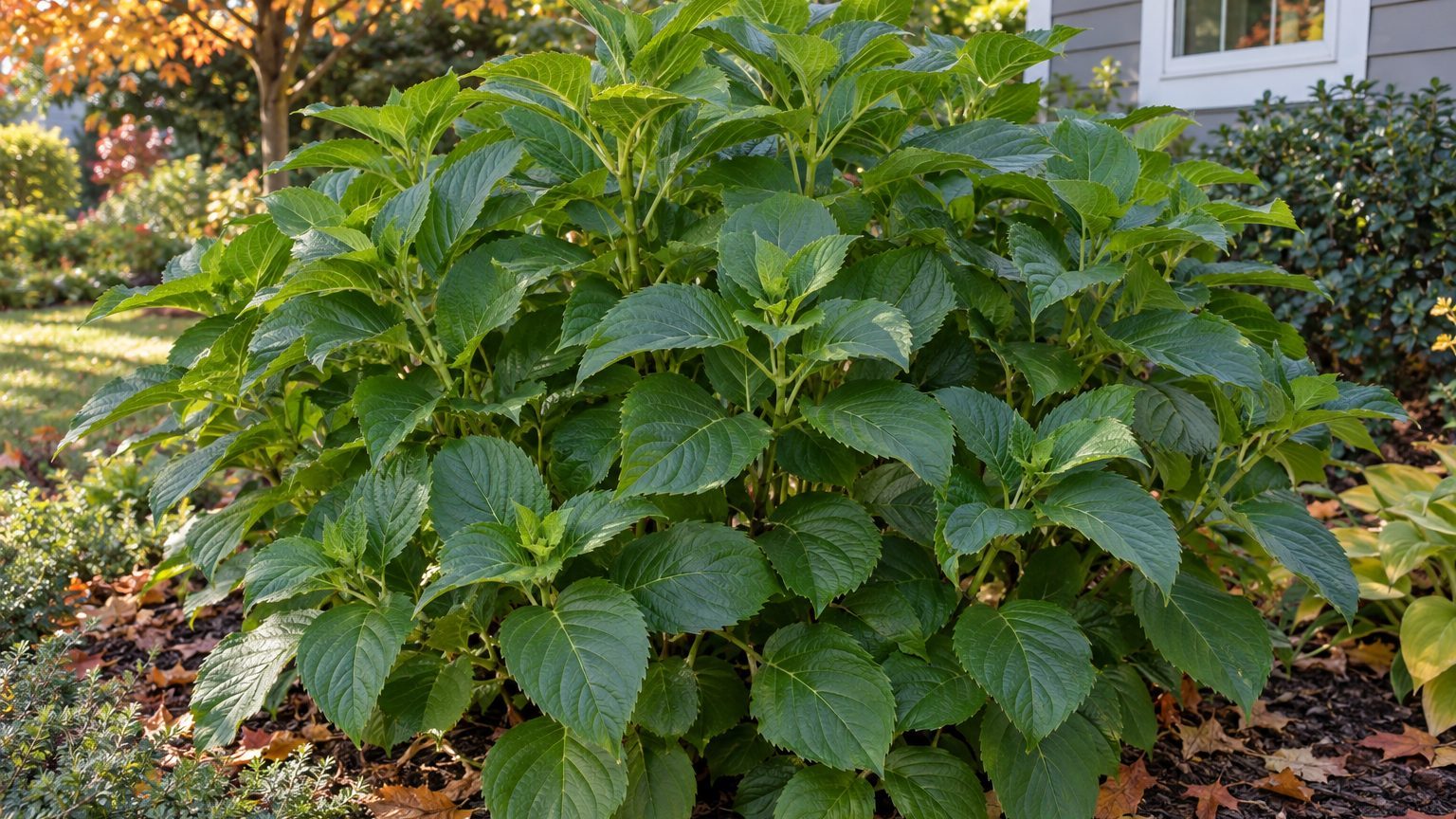
A bigleaf hydrangea that grows huge, healthy leaves and never flowers has usually lost its flower buds, not its vigor. Bigleaf sets buds on last year’s wood, so a late frost or a spring prune removes the whole show. The right fix depends on your type and your zone, and the steps below sort that out.
Hydrangea Big Leaves No Flowers: What You See

The NC State Extension Gardener Plant Toolbox puts bigleaf, mop-head and lacecap (Hydrangea macrophylla) at 3 to 6 feet tall and wide, and a plant that size with no blooms shows the same handful of signs.
- Broad, healthy green leaves, with no spotting or yellowing to explain the missing flowers.
- Stems that carry leaves right to the tip, with no flower cluster forming there.
- Shoots that were cut in spring and regrew as leafy growth only.
- A plant that bloomed in earlier years and stopped after a hard late frost.
- A mop-head or lacecap tag, the kinds that bloom on old wood.
The detail that decides everything is timing: the buds form the previous summer, so what you see now was settled a season ago.
Hydrangea Big Leaves No Flowers or Something Else?
Not every leafy, flowerless hydrangea is a bigleaf that lost its buds. The NC State Extension Gardener Plant Toolbox lists climbing hydrangea at 15 feet and more, and calls it very slow to start flowering.
Two other cases mimic the problem, and each has a sign you can check in a minute. If the plant is stunted as well as bare, start with Hydrangea Not Growing: Causes and How to Fix It instead.
| Looks like | The sign that tells them apart |
|---|---|
| A young climbing hydrangea, all leaves | Aerial rootlets cling to the wall or trunk, and the plant runs 15 feet and more. |
| A bushy panicle hydrangea with no bloom after a hard cut | It grows 8 to 25 feet and flowers on the current season’s growth, so a hard late-winter cut does not remove its flowers. |
| A bigleaf, mop-head or lacecap that lost its buds | Cut stem ends show a spring prune, or a late frost arrived after buds formed the previous summer. |
The other kinds, smooth, oakleaf and mountain, are on their own pages. Oakleaf and mountain flower on old wood like bigleaf, while smooth flowers on new wood.
What Causes Hydrangea Big Leaves No Flowers, and Where It Is Worst
The cause is almost always lost buds. Bigleaf forms them the previous summer, so a late frost or a spring prune removes the flowers before they open.
The NC State Extension Gardener Plant Toolbox lists bigleaf at USDA 6a to 11b and panicle at 3a to 8b, and that gap shapes where the problem bites hardest.
- Great Lakes and the North (Michigan, Minnesota, Wisconsin): panicle and smooth suit the cold, and the source calls panicle “a good substitute for the mop-head hydrangea in areas where that species is not winter hardy.”
- The South (Georgia, Texas, the Carolinas): bigleaf’s range reaches 11b, so cold is rarely the limit, and afternoon sun and spring pruning matter more.
- Northeast and Mid-Atlantic (New York, Pennsylvania, Virginia): the risk is a late frost that arrives after the buds are already formed.
- Interior West (Colorado, Utah, Nevada): alkaline soil pushes flowers toward pink above about pH 6.5, so a bare plant points back to buds, not soil.
Your state’s page on this site gives the zone verdict and pruning window for your city, and Hydrangea Not Blooming: Causes and How to Fix It covers the after-winter version of this problem.
How to Treat Hydrangea Big Leaves No Flowers
Start with the plant’s type, then work outward, because the right move for a bigleaf is the wrong one for a panicle.
- Confirm the type: bigleaf, mop-head and lacecap bloom on last year’s wood, while panicle blooms on the current season’s growth.
- Put the pruners away on old-wood types: a spring prune removes the flowers, and only panicle takes a hard cut in late winter.
- Shade the afternoon: bigleaf wants dappled sun or partial to deep shade, protected from afternoon sun.
- Mulch the shallow roots: bigleaf and panicle are both shallow-rooted, and both benefit from mulch.
- Check for browsing: hydrangeas are browsed by deer, so do not count on resistance.
- Switch if winters are too cold: the NC State Extension Gardener Plant Toolbox lists panicle at 3a to 8b against 6a to 11b for bigleaf, and calls panicle a good substitute where bigleaf is not winter hardy.
Buds set this summer are the ones that open next year, so the payoff comes a season later. For fertilizer or spray questions, your state extension service knows what is registered where you live.
How to Prevent Hydrangea Big Leaves No Flowers Coming Back
The calendar does most of the work, and the dates come from your type and your zone.
- Late winter: cut panicle back hard, and leave every old-wood type uncut.
- Early spring: watch the frost forecast, since a late frost removes the flowers on bigleaf.
- Spring: refresh the mulch over the shallow roots.
- Summer: prune old-wood types only ahead of the cutoff on your state page.
- Late summer: leave the stems alone, because next year’s buds are forming now.
- Fall and winter: the NC State Extension Gardener Plant Toolbox says dead hollow stems can be cut to 12 to 24 inches and left standing until they disintegrate, since native bees nest in them.
Your state page turns these seasons into dates for your city.
Where this comes from
The NC State Extension Gardener Plant Toolbox entry for Hydrangea covers hardiness, bloom wood, sun and pruning by type. Every range here comes from that entry.
Extension offices differ by state, so confirm pruning dates and your zone with yours before you cut anything. More causes and fixes for the family are collected under Hydrangea Problems.
Common questions
Why is my hydrangea all leaves and no flowers?
For a bigleaf, mop-head or lacecap, lost buds are the usual reason. The buds form the previous summer on last year’s wood, so a late frost or a spring prune takes the flowers. A panicle flowers on the current season’s growth and behaves differently.
Can I cut a hydrangea back hard to make it bloom?

Only a panicle, which flowers on the current season’s growth and can be cut back hard in late winter. Bigleaf, oakleaf, mountain and climbing types bloom on old wood, so a hard cut removes their flowers.
Are bigleaf hydrangea leaves poisonous to pets?
Bigleaf is the only hydrangea documented as toxic, and only if large quantities are eaten. The bark, flowers, leaves and stems carry cyanogenic glycosides, and effects include nausea, stomach pain, vomiting and sweating. Cats, dogs and horses are affected too.