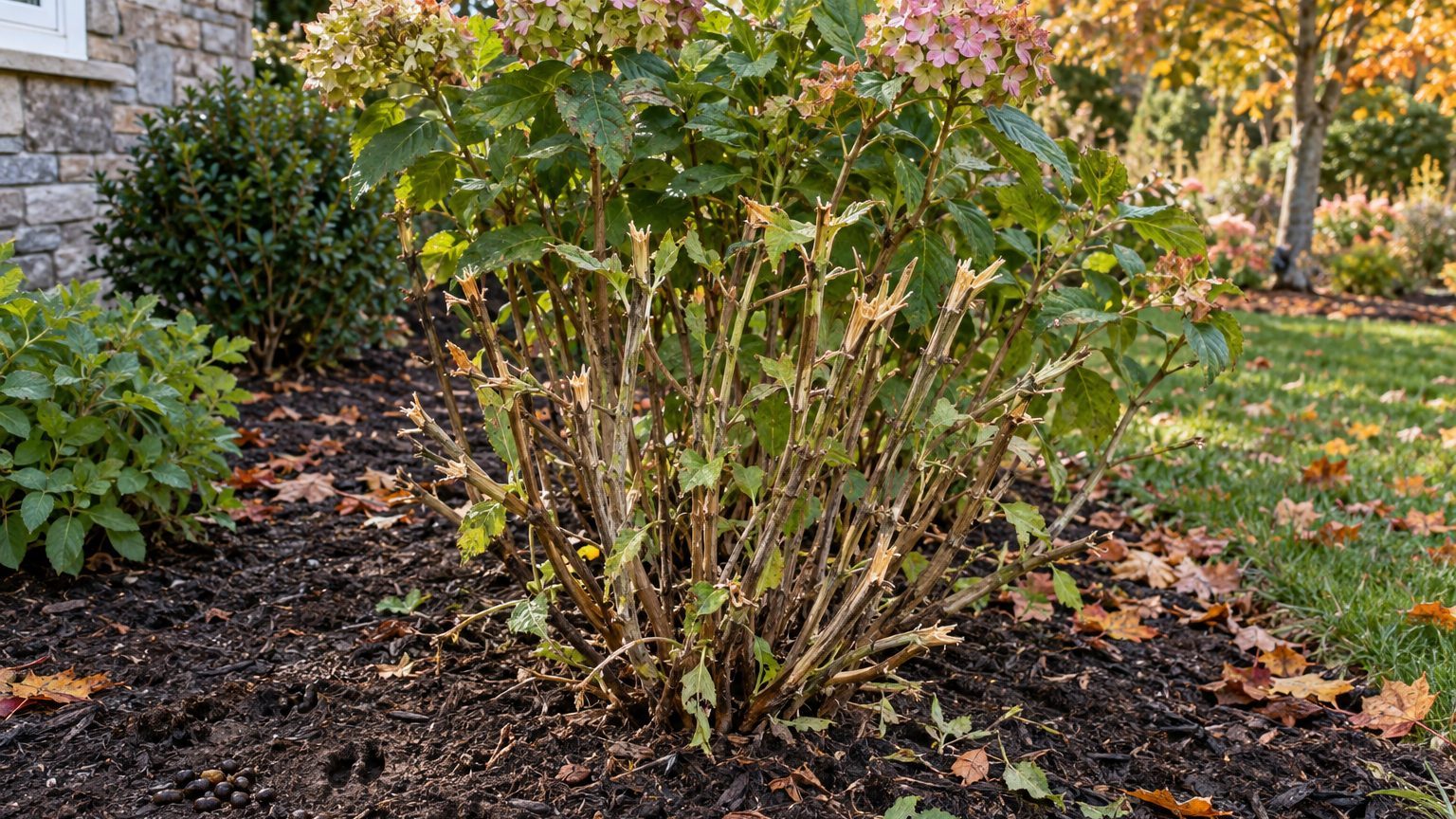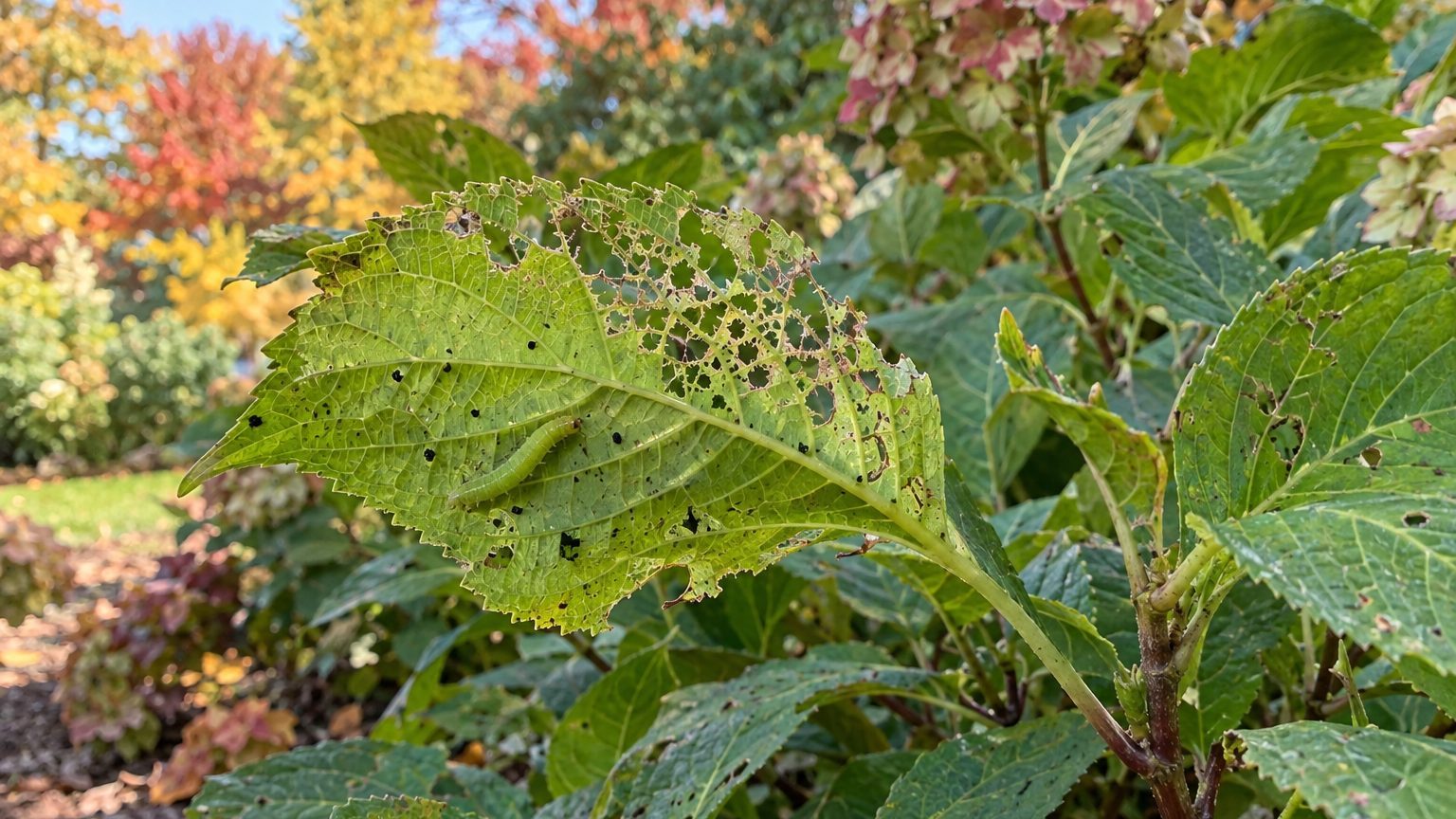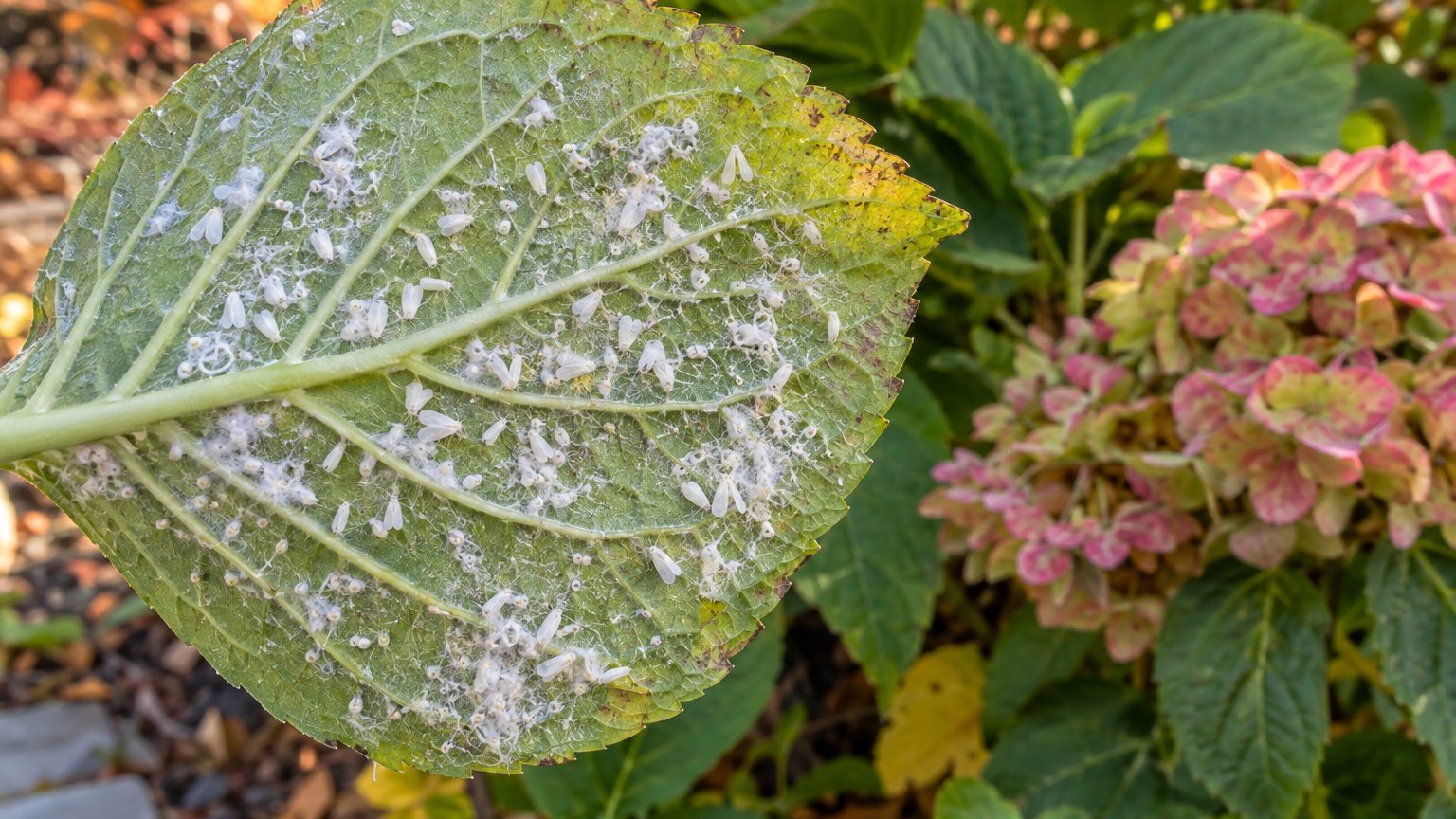
Giant whitefly on hydrangeas shows up as white waxy fluff and sticky leaves on the underside of the foliage. The fix starts with a hose and a hand lens, not a spray can.
Giant Whitefly: What You See

Start by turning leaves over, because that is where the insect lives and where the evidence piles up.
- White, waxy fluff on the undersides of leaves, often in curling strands or spirals.
- Small white winged adults that lift off in a cloud when you brush a branch.
- Shiny, sticky leaf surfaces from honeydew, sometimes with a black sooty film on top.
- Dull or yellowing leaves on the most heavily infested branches.
- Ants or wasps working the foliage, drawn by the sugary residue.
The NC State Extension Gardener Plant Toolbox names aphids, scales, nematodes and mites as rarely a problem on hydrangeas and gives no calendar for giant whitefly, so watch from spring growth through autumn and ask your extension office for local timing.
Giant Whitefly or Something Else?
White fuzz on a hydrangea is not always whitefly. Three look-alikes cause most of the confusion, and each gives itself away through one sign you can check in under a minute.
Use a thumb, a toothpick and a hand lens. Photograph what you find before touching anything else, since a clear image is the most useful thing to send to an extension office.
| Looks like | The sign that tells them apart |
|---|---|
| Powdery mildew | A white coat on the top of the leaf that rubs off like flour, with no insects and no stickiness underneath. |
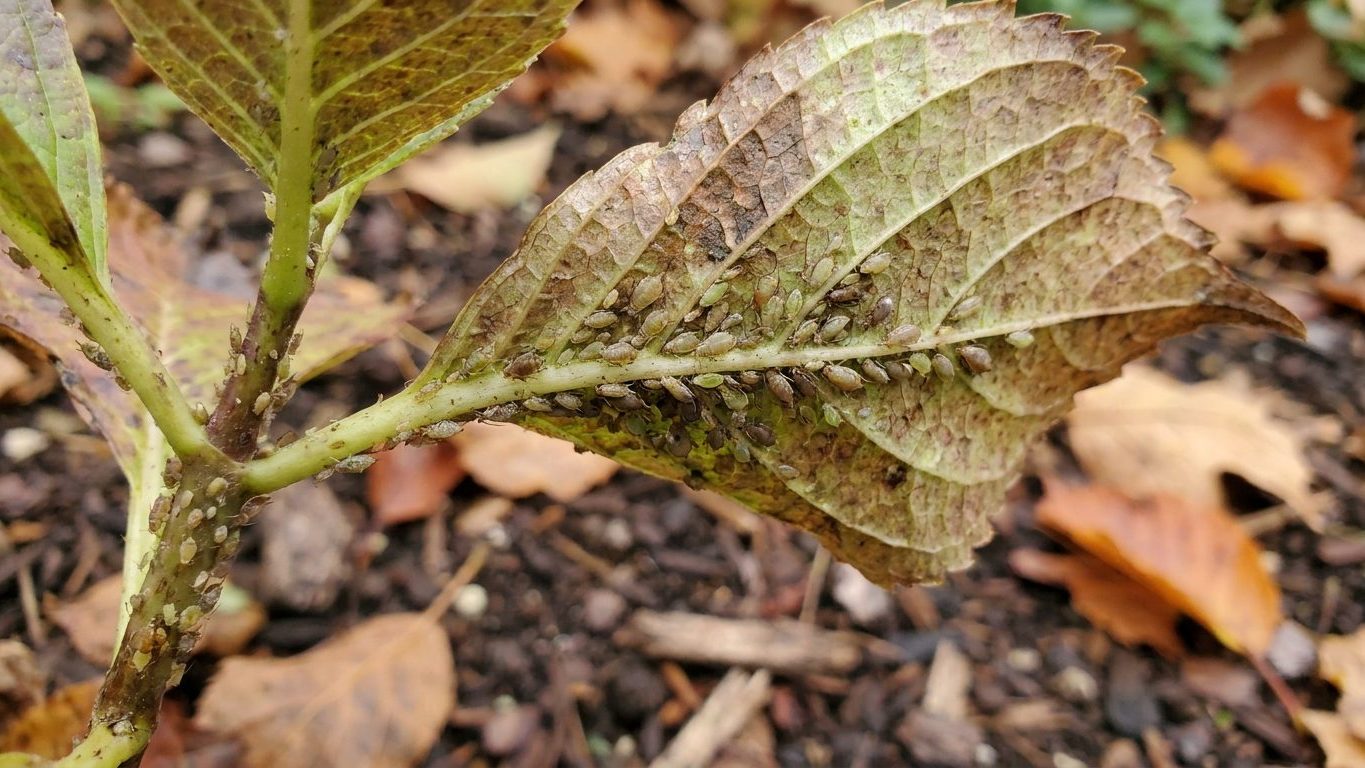
| Aphids | Soft, pear-shaped bodies packed on tender shoot tips, with no wax spirals on the leaf underside. |
| Scales | Small bumps on stems and leaf veins that stay put when you poke them, while whitefly adults fly off. |
The NC State Extension Gardener Plant Toolbox lists all three among what hydrangeas can get, along with mites, which leave fine stippling and webbing rather than wax. The other kinds of trouble are on their own pages: Hydrangea Pests, Root-Knot Nematodes on Hydrangeas and Hydrangea Leaftier on Hydrangeas.
What Causes Giant Whitefly, and Where It Is Worst
The cause is the insect itself, arriving on wind or on nursery plants, not your watering or your soil. The NC State Extension Gardener Plant Toolbox gives the hydrangea genus zones 3a through 9b, and what you grow depends entirely on the type, so the useful question is where your type sits.
The source does not map this insect, and I won’t invent a map. What I can say is that it favors mild winters, so the regions below are ordered by how much I would worry.
- Great Lakes and the North (Michigan, Minnesota, Wisconsin): panicle, rated 3a to 8b, and smooth hydrangeas dominate. Hard winters make this the region where I would worry least, but still check the leaf undersides.
- The South (Georgia, Texas, the Carolinas): bigleaf is rated 6a to 11b, so mop-head and lacecap plants sit in mild-winter country. Start scouting here in spring.
- Warm coast and desert (California, Arizona, Florida): the top of the bigleaf range, zones up to 11b. Your state extension office knows the local pest history far better than any national page.
Your state’s page on this site carries the pruning window and zone verdict for your type, which this national page deliberately leaves out.
How to Treat Giant Whitefly
Work in this order this week, and stop at the first step that solves the problem.
- Confirm the ID: photograph the leaf undersides and send the image or a bagged sample to your state extension office, since look-alikes need different handling.
- Rinse the undersides: a firm stream of water knocks off wax, honeydew and adults, and you can repeat it as often as needed.
- Remove badly infested leaves only: bigleaf carries flower buds formed the previous summer, per the NC State Extension Gardener Plant Toolbox, so take leaves, not stems, unless your type is panicle or smooth.
- Bag the debris: seal removed leaves in a trash bag rather than the compost pile.
- Ask what is registered: your state extension service alone knows which products are legal and suited to hydrangeas where you live, so I name none here. Follow the label.
- Recheck weekly: flip the same three leaves on the same three branches and note whether the fluff is returning.
Skip anything that promises a one-shot cure. A plant that rarely suffers pest trouble usually needs patience and clean-up, not chemistry.
How to Prevent Giant Whitefly Coming Back
Prevention here is calendar work, and the NC State Extension Gardener Plant Toolbox notes that panicle flowers on the current season’s growth, so it tolerates a hard cut in late winter.
- Late winter: cut back panicle and smooth hydrangeas, which flower on new wood, and clear fallen leaves beneath them.
- Cutting back stems: leave hollow stems standing at 12 to 24 inches, because native bees nest in them.
- Spring: check the undersides of new leaves every week as growth flushes.
- Summer: keep mulch over the roots of bigleaf and panicle, both shallow-rooted, and water at the base, not overhead.
- Autumn: rake and bag leaves from around the plant before winter.
Old-wood types, such as bigleaf, get no spring haircut, so time their pruning by your state page.
Where this comes from
The plant types, zones and pest list here come from the NC State Extension Gardener Plant Toolbox entry for hydrangea. That source does not describe giant whitefly, so the identification signs above are general field observations.
Check anything specific, from timing to legal products, with your state’s extension service before you act. They know your zone, your type and what is showing up in your county.
Common questions
Does giant whitefly kill hydrangeas?
The source does not document it as a hydrangea killer and calls pests on the genus rarely a problem. A heavy infestation can still leave leaves sticky and dull, so treat it early and monitor.
Can I prune out infested growth?
It depends on the type. Panicle and smooth flower on new wood and forgive a cut, while bigleaf and other old-wood types carry next year’s buds. Remove leaves first, and check your state page before cutting stems.
My leaves are sticky but I see no insects. What else could it be?
Sticky leaves point to honeydew, and aphids and scales, both named by the source, produce it too. Check stems and new tips with a hand lens, and send a photo to your extension office.