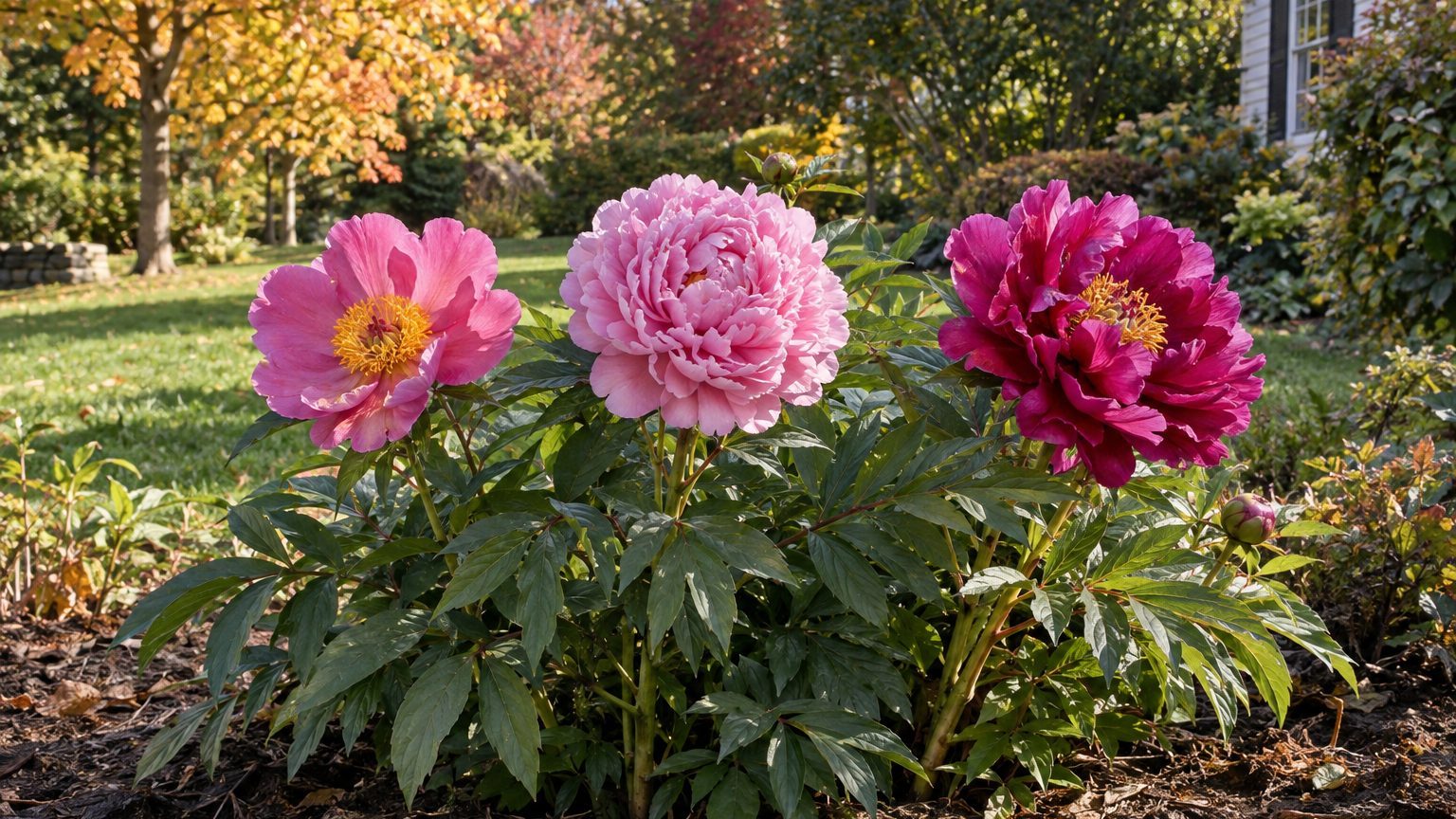
An established peony that comes back loaded with buds after a brutal prairie winter is a dependable plant for a North Dakota yard. Herbaceous garden peonies and intersectional (Itoh) peonies fit the state’s cold well, while tree peonies need more protection.
Best Peonies to Grow in North Dakota

Herbaceous garden peonies and intersectional peonies are easy choices here because these plants die back to the ground each fall and send up fresh growth in spring. Peonies also need a cold winter rest to flower, and North Dakota supplies it, with USDA hardiness zones running from 3a to 4b across the state. Tree peonies can work, but only with help.
Herbaceous Garden Peony

The herbaceous garden peony descends from the Chinese peony (Paeonia lactiflora) and the common peony (P. officinalis). Hundreds of cultivars came from those two species, so there is plenty to choose from.
Each fall the plant dies back to the ground, leaving the crown near the soil surface through the cold. Cut it back after frost has killed the foliage.
Intersectional Peony

Also called the Itoh, this is a hybrid of the garden peony and the tree peony. It has the same culture as the herbaceous type, dying back each fall and returning in spring, which makes it among the easiest to grow.
If you want something a little different from the classic garden peony without taking on a woody shrub, this is the one to look at.
Tree Peony
Tree peonies, mostly derived from P. suffruticosa, are generally not as hardy as the other types. In a cold state like this one, plant them in a protected site or mulch them over the winter.
A tree peony keeps its woody stems, so it is never cut back to the ground the way an herbaceous peony is. Treat it as a gamble worth taking only where you can offer shelter.
Choosing a Disease-Resistant Cultivar
Varieties differ somewhat in disease susceptibility. The variety ‘Avalanche’ is reportedly especially susceptible to Phytophthora, so ask a nursery about a cultivar’s track record before you buy.
Phytophthora rarely develops in light, sandy soils, which is a useful point if your yard drains fast.
North Dakota — the year and the numbers
- State
- North Dakota
- USDA zones
- 3a-4b
- Last spring frost
- May 4 to May 15
- First fall frost
- September 25 to October 5
- Annual rain
- 24 in
- Lawn zone
- cool-season
- Source
- NOAA NCEI U.S. Climate Normals 1991-2020, 32F freeze probabilities · Fargo
How to Choose a Peony for a North Dakota Garden
Your own yard helps narrow the choice before you open a catalog. Think about how cold the winter gets where you live, how much time you want to spend, and how much room the plant will have once it matures.
Because peonies need a cold winter rest to bloom, a North Dakota winter is an advantage rather than a worry for the hardy types.
| Your situation | What suits it in North Dakota | Why |
|---|---|---|
| Very cold winter | Herbaceous garden peony | It dies back to the ground each fall and regrows in spring, and the cold rest helps it flower. |
| Little time to spend | Herbaceous or intersectional peony | Herbaceous and intersectional peonies are among the easiest to grow and share the same simple yearly routine. |
| Damp, humid summer | A cultivar known to resist disease, in light sandy soil if you have it | Varieties differ in disease susceptibility, and Phytophthora rarely develops in light, sandy soils. |
| Exposed, windy site | Herbaceous peony rather than tree peony | Tree peonies are less hardy and need a protected site or winter mulch. |
| Want something different | Intersectional (Itoh) peony | It blends garden and tree peony parentage yet grows like the herbaceous type. |
Tree peonies belong on the list only if you have a sheltered corner and are willing to mulch them. Whatever you pick, a newly planted or transplanted peony may not bloom the first spring, so give it time.
Which Peonies Suit Different Parts of North Dakota
The state spans a range of winter cold, so choose a peony type that suits the conditions in your yard.
- Northern North Dakota: Herbaceous and intersectional peonies are easy to grow because they die back fully each fall. Tree peonies need a protected site or winter mulch.
- Southern North Dakota: Intersectional peonies are easy to grow, while tree peonies still need a protected site or winter mulch.
- Red River Valley: Ask a local nursery about disease susceptibility before choosing a cultivar.
Check your own county’s conditions before choosing, since local microclimates shift from yard to yard.
Peony Buying Mistakes to Avoid in North Dakota
Choosing a Tree Peony Without Shelter
Tree peonies are generally not as hardy as other types, so an unprotected one can suffer through a North Dakota winter. Cold damage can set back a woody plant that took time to establish.
Plant it in a protected site and mulch it over winter, or choose an herbaceous or intersectional peony instead.
Planting Too Deep
A peony planted too deep may bloom poorly or not come up at all. That leaves you waiting on a plant that may never bloom well.
Keep the eyes near the soil surface when you set the root. Plant or divide in September to early October, so the roots settle before the ground freezes.
Ignoring Disease Susceptibility
Buying a showy cultivar without checking its disease record can leave you with a plant that struggles in a wet summer. Selecting less susceptible planting stock may be possible, so ask the nursery.
Pick a cultivar with a good record, and if your soil is heavy, consider a lighter, sandier planting spot.
Where to Get Peony Advice in North Dakota
Local help fits your soil and weather better than general advice. NDSU Extension and your county extension office can answer questions about cultivars and planting.
- Visit your county extension office in late summer for planting advice before the September to early October window.
- Ask about disease-resistant cultivars and soil conditions before you buy.
- Call again in October or November if you are unsure when to cut your peonies back after a hard freeze.
Common Questions
When Do Peonies Bloom in North Dakota?
Bloom usually falls in June, and it can run into early July depending on the variety and the year.
When Should You Cut Back Peonies in North Dakota?
Herbaceous peonies are cut back in October or November, after a hard freeze has killed the foliage. Cut the stems down to within a couple of inches of the ground and destroy the debris rather than composting it.
Can You Get Bigger Peony Flowers?
For bigger peony flowers, de-bud several branches.