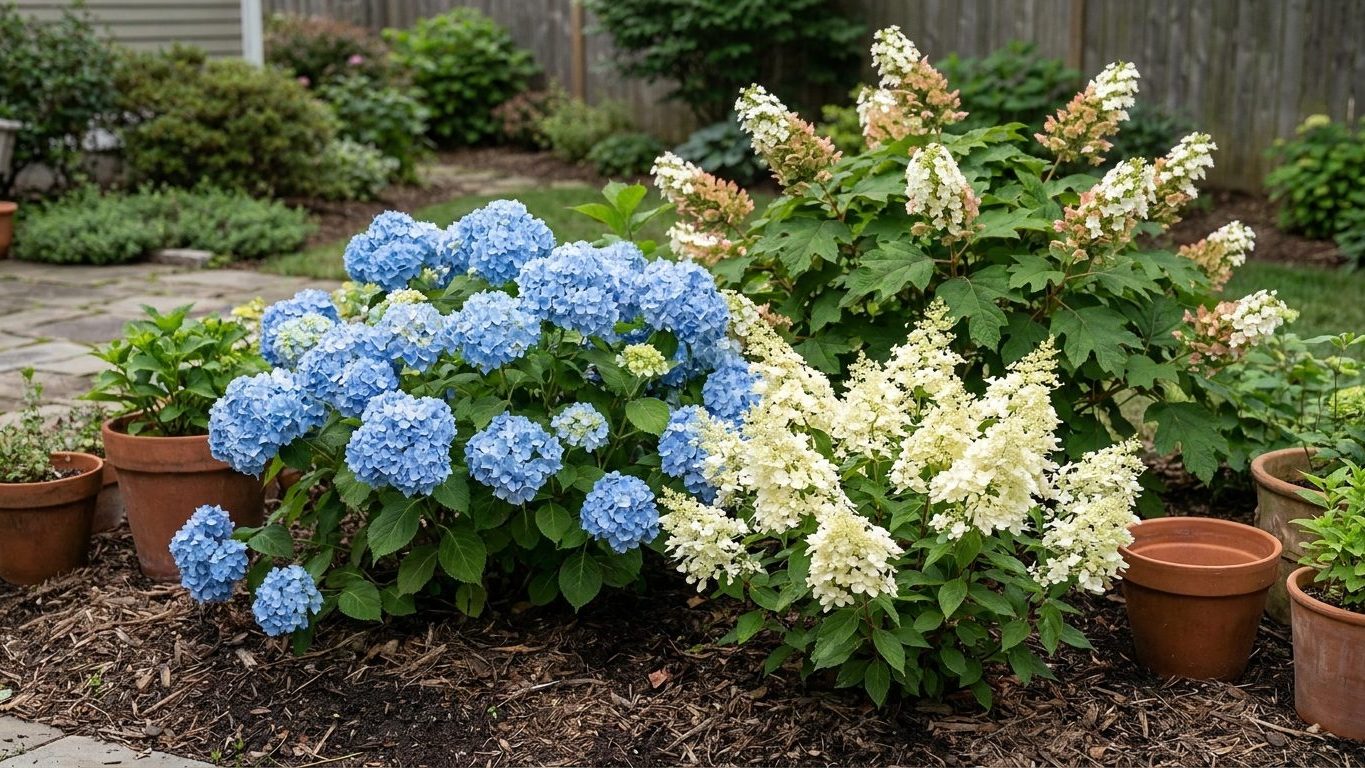
Panicle and smooth hydrangeas are the safest picks for a Kansas yard, since both push through harsh winters and dry summer wind better than the bigleaf types in nursery displays. Near Topeka, where the state’s frost data is tracked, the most reliable blooms come from varieties that flower on new wood, not old.
Hydrangeas that grow well in Kansas: The Short Answer
The USDA Plant Hardiness Zone Map puts Kansas across zone 5b to 7a, a spread wide enough that a shrub thriving in the southeast corner can struggle near the Nebraska line.
Near Topeka, where the state’s frost records are kept, the last spring freeze falls between April 4 and April 18 and the first fall freeze arrives between October 23 and November 2, so the season a hydrangea gets to work with runs a little over six months.
Panicle Hydrangea

Hydrangea paniculata blooms on new wood, so a hard Kansas winter that kills stems back to the ground still leaves flowers by midsummer. It shrugs off wind and full sun better than any other type on this list, which matters on the open, treeless lots common across the state.
Smooth Hydrangea

Hydrangea arborescens is native to parts of the Midwest and handles the cold snaps and humidity swings of a Kansas summer without much fuss. Cultivars bred for stronger stems hold up better in wind and rain than the older varieties, which tend to flop after a heavy downpour.
Oakleaf Hydrangea

Hydrangea quercifolia brings fall color and peeling bark that most other hydrangeas lack, and it takes the heat well once established. Its flower buds form on old wood, though, so a late freeze in the colder pockets of the state can erase a season’s blooms while leaving the shrub itself fine.
Mountain Hydrangea

Hydrangea serrata is a smaller, more cold tolerant cousin of the bigleaf type, and some cultivars rebloom on new growth after a rough winter. It still prefers afternoon shade, which is easy to give on a shaded patio but harder to find in an open, south-facing bed.
Bigleaf Hydrangea

Hydrangea macrophylla is the shrub most people picture when they hear the word hydrangea, with its mophead blooms, but it sets flower buds on old wood that rarely survives a Kansas winter intact. Gardeners who grow it here usually treat the blooms as a bonus, not a guarantee.
Climbing Hydrangea

Hydrangea anomala subsp. petiolaris is the riskiest pick on this list, since it needs years to establish before it flowers and prefers a sheltered, partly shaded wall. In an exposed Kansas yard with full winter wind, it often survives without ever covering itself in bloom.
Kansas — the year and the numbers
- State
- Kansas
- USDA zones
- 5b-7a
- Last spring frost
- April 4 to April 18
- First fall frost
- October 23 to November 2
- Annual rain
- 34 in
- Lawn zone
- transition-season
- Source
- NOAA NCEI 1991-2020 Climate Normals, 32F freeze probabilities · Wichita
How to Work Out the Dates for Your Own Yard
The Topeka frost window is a starting point, not a rule, so work backward from it before planting or pruning anything.
- Start from the last spring freeze: NOAA NCEI Climate Normals puts the Topeka window at April 4 to April 18, and a shaded, low-lying yard nearby can run a week or two later.
- Hold new plants past that date: this state’s calendar lists April, May, August, and September as planting months, so wait until freeze risk has passed before a panicle or smooth hydrangea goes in the ground.
- Check the stems in early spring: scratch a small patch of bark, and green underneath means the wood survived, brown means it’s time to cut back to the ground.
- Prune bigleaf types only in June or July: cutting earlier removes the old wood the buds still need, and this state’s calendar reserves that window for exactly this reason.
- Feed in March, May, or July: those are the three fertilizing months this state’s calendar allows, and skipping the July feeding leaves a shrub thin heading into fall.
A panicle hydrangea planted in April usually flowers that same summer, since new wood doesn’t need a mild winter to bloom. A bigleaf hydrangea planted the same week may sit two or three winters without a single flower, because its buds freeze before they open.
Kansas North to South: How the Dates Shift
The hardiness range named above is not one climate across Kansas, and moving from the northeast corner to the west changes both the frost window and how much winter protection a hydrangea needs.
- Northeast Kansas (Topeka, Kansas City, Lawrence): the coldest corner of the state’s hydrangea range, where panicle and smooth types hold up best and bigleaf varieties need the most winter mulch.
- South Central Kansas (Wichita, Hutchinson, Newton): freezes arrive later in fall and let up earlier in spring, giving a young shrub a slightly longer stretch to establish before its first hard freeze.
- Western Kansas (Dodge City, Garden City, Hays): drier air and stronger wind mean even the toughest panicle hydrangeas need a sheltered spot and more frequent watering than the same shrub gets further east.
Whichever part of the state a yard sits in, the safest approach is to treat the Topeka figures as a baseline and adjust a week or two based on how the neighborhood has behaved in past winters.
Mistakes Kansas Punishes
Three mistakes show up again and again in Kansas yards, and each one has a simple fix.
Pruning bigleaf hydrangea before June
Cutting back a bigleaf shrub in fall or early spring removes the very buds it needs to bloom, since this type sets flowers on old wood. This state’s calendar reserves pruning for June and July, after winter damage is visible and the plant has shown what it still has to work with.
Planting in an open, west-facing bed
Kansas wind and afternoon sun together stress a hydrangea faster than either does alone, scorching leaves and drying soil out between waterings. A spot with morning sun and afternoon shade, or the shelter of a fence, keeps the same shrub healthier through a July heat spell.
Skipping winter mulch on young shrubs
A hydrangea planted its first fall has roots too shallow to handle the swing between the Topeka area’s freeze and thaw cycles without help. A few inches of shredded leaves or bark over the root zone before the ground locks up protects a shrub through its first hard winter.
Kansas Extension Offices and County Contacts
The zone and frost figures above are a starting point, and Kansas State Research and Extension keeps county-level advice that goes further than any reference-city number can.
- Your state page: the frost dates and the pruning window for Kansas in one place.
- The month-by-month calendar: when to plant, fertilize, and prune a hydrangea here across the growing season.
- What goes wrong here: the pests and problems this state sees most often on hydrangeas.
Call the county office before treating any of these figures as a hard rule for a specific address.
Common questions
Which hydrangea blooms every year in Kansas?
Panicle and smooth hydrangeas bloom on new wood, so they flower reliably even after a hard winter kills the top growth back to the ground, unlike bigleaf types that depend on old wood surviving.
Can bigleaf hydrangeas survive Kansas winters?
They often survive as a plant while losing that year’s flower buds to cold, which is why so many Kansas bigleaf hydrangeas grow lush and green but rarely bloom without extra winter protection.
When should I plant a new hydrangea in Kansas?
This state’s calendar lists April, May, August, and September as planting months, giving the roots time to settle before summer heat or winter cold sets in.