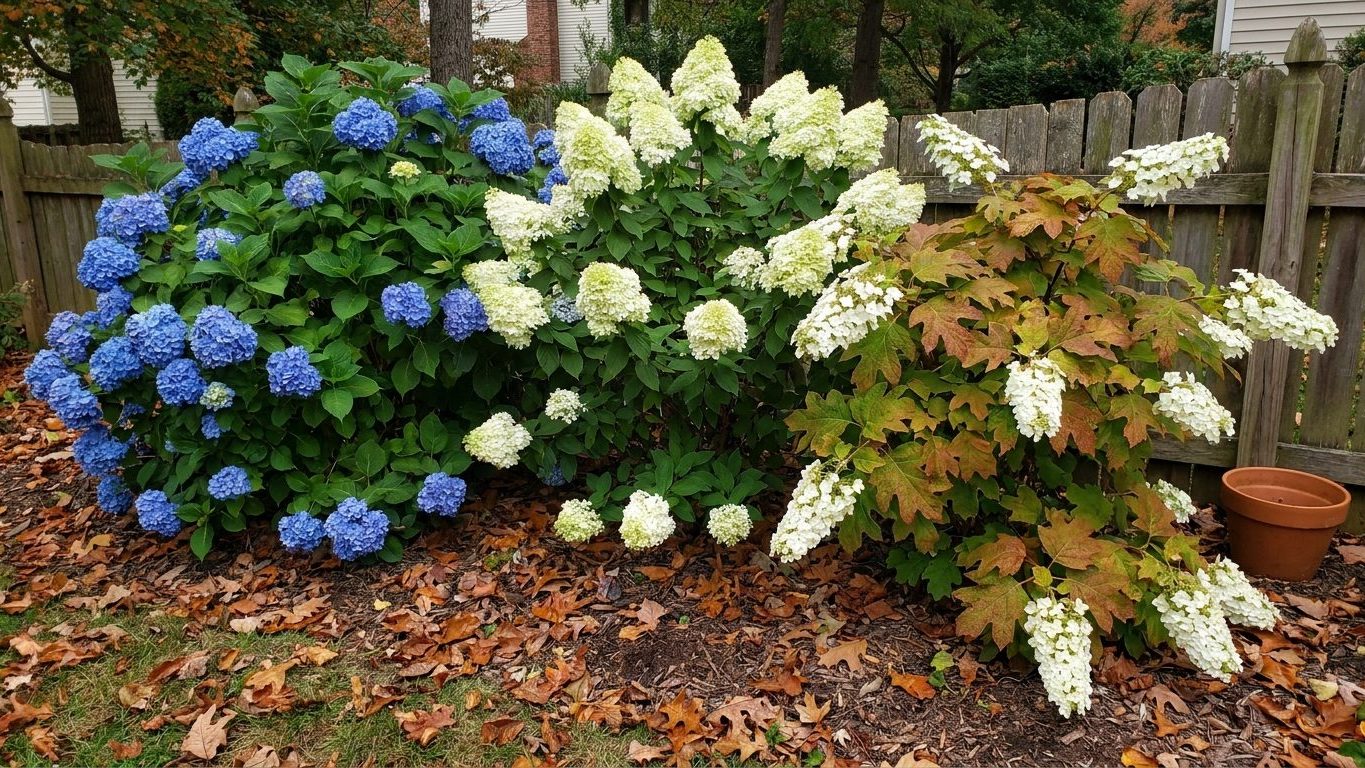
Smooth, panicle, and oakleaf hydrangea handle Missouri’s freeze-thaw winters and Ozark summer humidity with the least fuss, while mophead bigleaf and climbing hydrangea need real babying to make it through a hard Kansas City winter without losing a season’s blooms. Six varieties make the safe-to-risky list below.
Hydrangeas that grow well in Missouri: The Short Answer
The USDA Plant Hardiness Zone Map puts Missouri at 5b to 7b, a spread wide enough that a shrub thriving near the Bootheel can struggle sixty miles north of Kansas City. That range decides which of these six hydrangeas shrug off a Missouri winter and which ones gamble every year they’re in the ground.
Smooth hydrangea

Hydrangea arborescens is native to the Ozarks and blooms on new wood each year, so even a hard winter that kills the top growth back to the ground still leaves a full flush of flowers by midsummer. It tolerates Missouri’s clay soil without complaint.
Panicle hydrangea

Hydrangea paniculata sets its flower buds on new wood too, which means Missouri’s coldest nights near Kansas City can’t erase a season’s blooms. It also handles more direct sun than most hydrangeas, an advantage against the state’s exposed summer afternoons.
Oakleaf hydrangea

Hydrangea quercifolia comes from woodlands just south and east of Missouri, so its tolerance for heavy summer humidity and dappled shade fits the Ozarks well. Its buds form on old wood, which makes it a notch riskier in the state’s colder northern counties.
Reblooming bigleaf hydrangea

Varieties bred to flower on both old and new wood give Missouri gardeners a second chance after a rough winter strips the first set of buds. They still need a spot sheltered from Kansas City’s harshest wind to bloom reliably every year.
Mophead bigleaf hydrangea

Hydrangea macrophylla blooms mostly on old wood, so a freeze that dips into the coldest end of Missouri’s range can wipe out a season’s color while the shrub itself survives fine. It does best in the state’s southern third, well away from Kansas City.
Climbing hydrangea

Hydrangea anomala subsp. petiolaris takes years to establish before it flowers at all, and a young plant’s first winters are its most vulnerable in Missouri’s colder pockets. It needs a sturdy structure and patience, which makes it the riskiest bet here.
Missouri — the year and the numbers
- State
- Missouri
- USDA zones
- 5b-7b
- Last spring frost
- April 6 to April 20
- First fall frost
- October 18 to October 29
- Annual rain
- 39 in
- Lawn zone
- transition-season
- Source
- NOAA NCEI 1991-2020 Climate Normals, 32F freeze probabilities · Kansas City
How to Work Out the Dates for Your Own Yard
Matching a hydrangea to your yard in Missouri comes down to counting from your frost dates and being honest about where your property sits inside the state’s hardiness spread.
- Locate your zone inside the spread: NOAA NCEI 1991-2020 Climate Normals puts Kansas City’s last spring frost between April 6 and April 20, a window that shrinks the closer you get to the Ozarks.
- Watch your fall window too: the first fall frost lands between October 18 and October 29, which is how long a new-wood bloomer like panicle hydrangea has to finish its display.
- Test which wood carries the buds: a variety that blooms on old wood, like mophead bigleaf, risks losing its flowers to any freeze that slips inside that April window.
- Plant inside the state’s window: the calendar above lists April, May, August, and September as Missouri’s planting months, giving a new shrub mild weather on both sides.
- Prune bigleaf on schedule: the safe window for cutting back bigleaf hydrangea runs June and July, after the shrub has already set next year’s buds.
Smooth hydrangea overwinters fine in the coldest pocket near Kansas City because a late freeze only delays its new-wood blooms. Mophead bigleaf planted in that same spot often survives the winter but skips flowering, since the freeze took out the old-wood buds it needed.
Missouri North to South: How the Dates Shift
Missouri’s frost line does not fall evenly across the state, and that shift decides how far south a gardener needs to be before mophead bigleaf turns from a gamble into a safer bet.
- Northern Missouri and Kansas City (Kansas City, St. Joseph, Chillicothe): sits at the cold edge of the state’s 5b to 7b spread, where smooth and panicle hydrangea outlast bigleaf types most winters.
- Central Missouri (Columbia, Jefferson City, Sedalia): a middle ground where oakleaf hydrangea settles in well against a wall that blocks the worst of the winter wind.
- The Ozarks and southwest Missouri (Springfield, Branson, Joplin): milder winters push the zone warmer, giving reblooming bigleaf varieties a better shot at holding their old-wood buds.
- The Bootheel (Sikeston, Cape Girardeau, Poplar Bluff): the state’s warmest corner, near the top of the 7b range, where mophead bigleaf and climbing hydrangea come closest to a comfortable winter.
Check the state page for the frost dates and zone reading that apply to your own county before settling on a bigleaf variety.
Mistakes Missouri Punishes
Bigleaf bought for the wrong end of the state
National marketing rarely mentions Missouri’s 5b to 7b spread, so a mophead bought for a Kansas City yard often loses its buds every few winters. Stick to reblooming types, or shift to panicle and smooth hydrangea north of the Ozarks.
Pruning bigleaf after summer
Cutting bigleaf back in fall or winter removes the old wood carrying next year’s buds before the shrub ever gets to use them. The safe window is June and July, once this year’s blooms have faded and next year’s buds have already formed.
Full afternoon sun in Ozark humidity
Missouri’s summer combination of heat and humidity scorches hydrangea leaves fast, especially on bigleaf and oakleaf varieties left in unbroken afternoon sun. Morning sun with afternoon shade, on the east or north side of the house, keeps leaves from crisping by August.
Missouri Extension Offices and County Contacts
Missouri’s 5b to 7b hardiness spread is a starting point, not a verdict, and University of Missouri Extension tracks the county-level differences the map leaves out.
- Your state page: the frost dates and zone reading for where you live in Missouri.
- The calendar page: month by month planting, fertilizing, and pruning windows for hydrangeas here.
- What goes wrong here: the pests and problems specific to Missouri hydrangeas, and what actually fixes them.
Bring a soil test and a photo of your yard’s shade pattern to your county office before you buy the next shrub.
Common questions
Can mophead bigleaf hydrangea survive winter in Missouri?
It usually survives as a plant across most of the state, but its old-wood flower buds can freeze out in the colder third near Kansas City, leaving a healthy shrub with no blooms that year.
What is the safest hydrangea to plant near Kansas City?
Smooth and panicle hydrangea are the safest choices, since both bloom on new wood and recover their flowers even after a hard freeze kills back the top growth.
Do hydrangeas need shade in Missouri?
Most varieties do best with morning sun and afternoon shade, since Missouri’s summer humidity combined with full afternoon sun scorches leaves on bigleaf and oakleaf hydrangea especially fast.