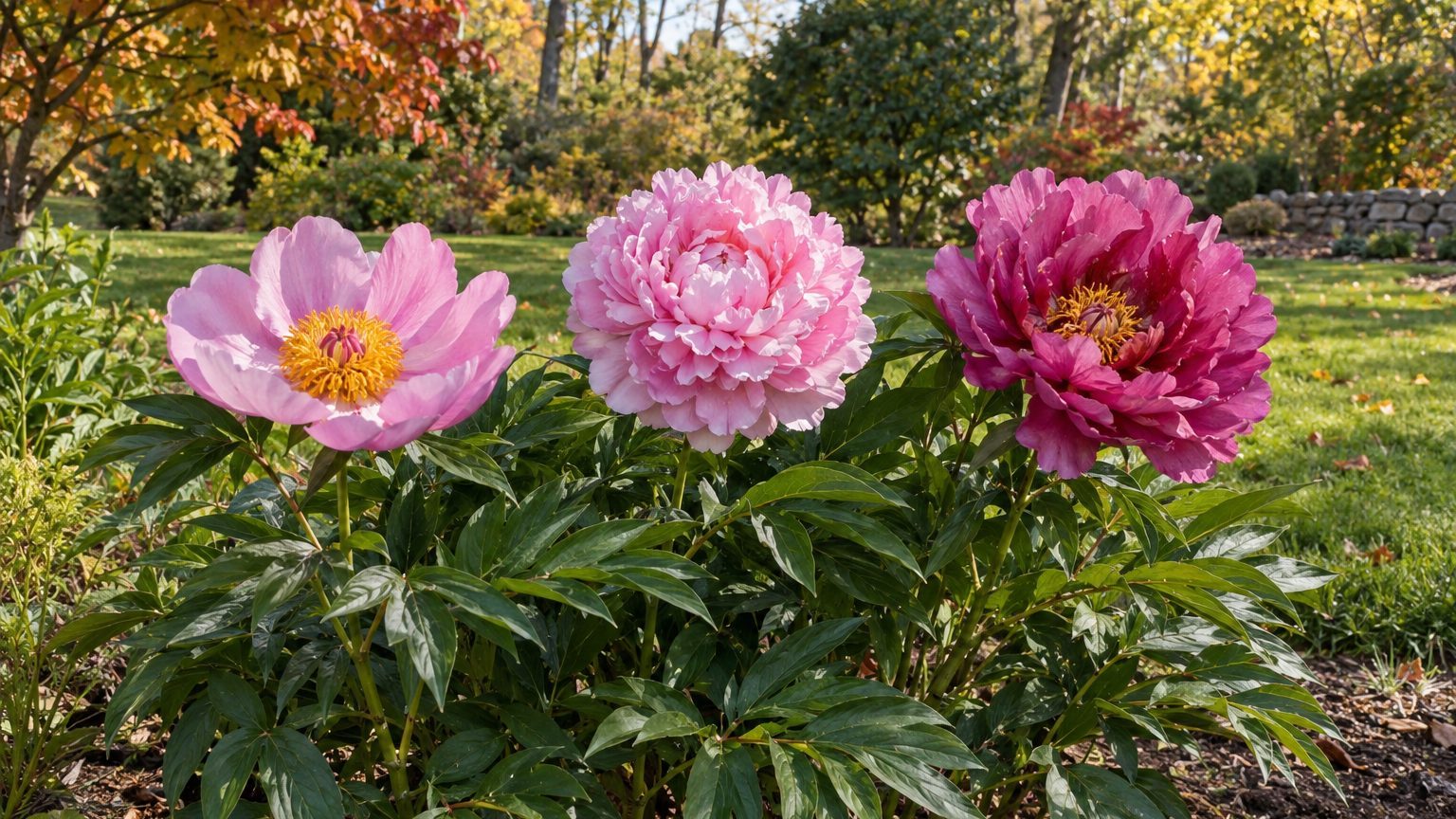
Peony stems push through the soil in spring, and by May the buds swell fat and heavy. Indiana gives these plants the cold winters they need to flower, so a good peony here is mostly a matter of picking the right type for your space and time. The choices are fewer than the catalogs make them look.
Best Peonies to Grow in Indiana

Herbaceous garden peonies, intersectional (Itoh) peonies and tree peonies all suit Indiana, with woodland peonies for shady corners. Peonies flower best where winters are cold, and Indiana, which spans USDA hardiness zones 5b to 7a, gives them that winter rest. The type you pick mostly decides how much care you give and how the plant looks.
Herbaceous Garden Peonies

This is a familiar border peony. The common garden peony (P. lactiflora) is the standard herbaceous form in home gardens, and it comes in many flower forms and colors.
Each fall it dies back to the ground and new growth returns in spring. That simple rhythm is why it is among the easiest to grow, and why it is the usual starting point.
Intersectional Peonies
Also called Itoh peonies, these are hybrids of the garden peony and the tree peony. They share the herbaceous routine: they die back to the ground each fall and emerge again in spring.
If you want something a little different from the standard border peony without taking on a woody shrub, this is the type to look at. Care is the same as for a garden peony.
Tree Peonies
Tree peonies (Paeonia suffruticosa) look like herbaceous peonies in flower, but they are deciduous shrubs. They go dormant over winter and renew growth each spring from woody stems.
Mature plants can grow 3 to 5 feet tall. Their woody branches carry the big flowers, so staking is not usually needed once the plant is established.
Woodland Peonies
The woodland peonies (P. japonica and P. obovata) suit shade gardeners. Most peonies want open light, so these are the ones to try under trees or along a north wall.
They give a shady yard a peony of its own rather than leaving that spot to hostas alone.
Fernleaf Peony
The fernleaf peony (P. tenuifolia) is noted for finely cut, fern-like foliage and crimson red flowers. It brings a different texture to a bed of broad-leaved perennials.
Another red option is P. officinalis, along with P. peregrina; these species are native to Europe and prized for their red flowers.
Indiana — the year and the numbers
- State
- Indiana
- USDA zones
- 5b-7a
- Last spring frost
- April 9 to April 21
- First fall frost
- October 21 to October 30
- Annual rain
- 44 in
- Lawn zone
- cool-season
- Source
- NOAA NCEI 1991-2020 Climate Normals, 32F freeze probabilities · Indianapolis
How to Choose a Peony for an Indiana Garden
Start with how much time you want to spend and what your yard looks like. Indiana winters supply the cold rest, so the winter question is mostly settled and the rest comes down to light, space and taste.
Then look at bloom timing. Early, mid-season and late cultivars can be mixed to stretch the flowering, with the season running May into June.
| Your situation | What suits it in Indiana | Why |
|---|---|---|
| Cold winters | Herbaceous garden peony | It dies back to the ground each fall and returns in spring, and it gets the cold rest it needs to flower |
| Little time to spend | Herbaceous or intersectional peony | Herbaceous and intersectional peonies are the easiest to grow and share the same culture |
| Dislike staking | Tree peony | Its woody branches support the large flowers once mature |
| Shady yard | Woodland peony | P. japonica and P. obovata are suited to shade gardeners |
| Want a long show | A mix of early, mid-season and late cultivars | Staggered bloom times extend the season |
| Want fine foliage | Fernleaf peony | Its finely cut leaves contrast with broad-leaved plants |
A tight bed deserves a look at adult size before you buy, since a mature tree peony reaches 3 to 5 feet tall.
Which Peonies Suit Different Parts of Indiana
Peony types are not divided by region in Indiana, but the climate shifts from north to south and can influence the choice.
- Northern Indiana: Winters here are colder than in the south, so the cold rest is no concern. Herbaceous and intersectional peonies fit comfortably, and spring growth starts later than farther south.
- Indianapolis and central Indiana: The last spring freeze usually falls between April 9 and April 21, and a late frost can still come after that. Watch the forecast as new shoots emerge.
- Southern Indiana: Spring comes earlier and autumn lingers longer than in the north. Shoots may emerge sooner than they do in northern Indiana, while winter still provides the cold rest peonies need.
Whatever your corner of the state, choose the type to match the light in your garden.
Peony Buying Mistakes to Avoid in Indiana
Planting Too Deep
A peony set too deep may bloom poorly or fail to come up at all. The eyes, the pink or red buds on the root, belong near the soil surface.
If a potted or bare-root plant arrives with its crown buried, lift it and reset it at the right depth rather than hoping it adjusts.
Cutting a Tree Peony to the Ground
A herbaceous peony is cut back after frost in fall (October, November), or in early spring. A tree peony is the opposite case, because it keeps its woody stems and is never cut back.
Chopping a tree peony down removes the wood that carries next year’s flowers. If you grow tree and herbaceous peonies, label them so the pruning habit does not carry between beds.
Buying a Pot Without Knowing Adult Size
A small potted peony tells you nothing about its mature height. A tree peony can grow 3 to 5 feet tall, which is far more than a young pot suggests.
Check the label, and space the plant for its adult size. Expect patience too: a newly planted or transplanted peony may not bloom the first spring.
Where to Get Peony Advice in Indiana
Local help turns general rules into decisions for your soil and your block. Purdue Extension runs a county office across the state, staffed to answer plant questions.
- The extension website carries publications on growing peonies in the Indiana landscape, handy to read before you buy.
- Your county extension office can help with a struggling plant, so bring a photo or a sample of the problem growth.
- Ask about peony varieties in your county before planting day in September or October.
Common Questions
When Do Peonies Bloom in Indiana?
Peonies flower from May into June. The exact week depends on the cultivar, so mixing early, mid-season and late types spreads the display across that window.
When Should You Plant or Divide Peonies in Indiana?
September is the usual choice, with October as the latest. Planting in early fall gives the roots time to settle in before winter arrives.
What Flower Forms Do Peonies Come In?
Peonies are classified by flower type, from Single to Full Double. A Single has five or more guard petals around many pollen-bearing stamens. A Japanese is a transition type between single and double, and an anemone type is similar. A Semi-double has no clear line between the guard petals and many of the petaloids, while a Full Double has stamens and carpels fully changed to petaloids.