Skip to content

Hydrangea Pests and Diseases in Texas

Hydrangea Pests and Diseases in Texas

Houston hydrangeas fight humidity as much as heat, and the two together decide which problem shows up first. Powdery mildew, Cercospora leaf spot, aphids, spider mites, root rot in clay, and iron chlorosis from alkaline soil make up the state’s short list, and matching one to your yard starts with the calendar rather than the symptom.

Hydrangea pests and diseases Texas: The Short Answer

USDA places Houston, the Gulf Coast reference city for hydrangea care here, in zones 6a to 10a on the USDA Plant Hardiness Zone Map, and that long frost-free stretch from December through February pushes hydrangea foliage into six months of humid growth where fungal disease outruns almost everything else.

The short answer: aphids, powdery mildew, Cercospora leaf spot, spider mites, root rot in heavy clay, and iron chlorosis from alkaline soil are the six problems that show up on Texas hydrangeas, in that rough order across the growing season.

Aphids clustered on new growth

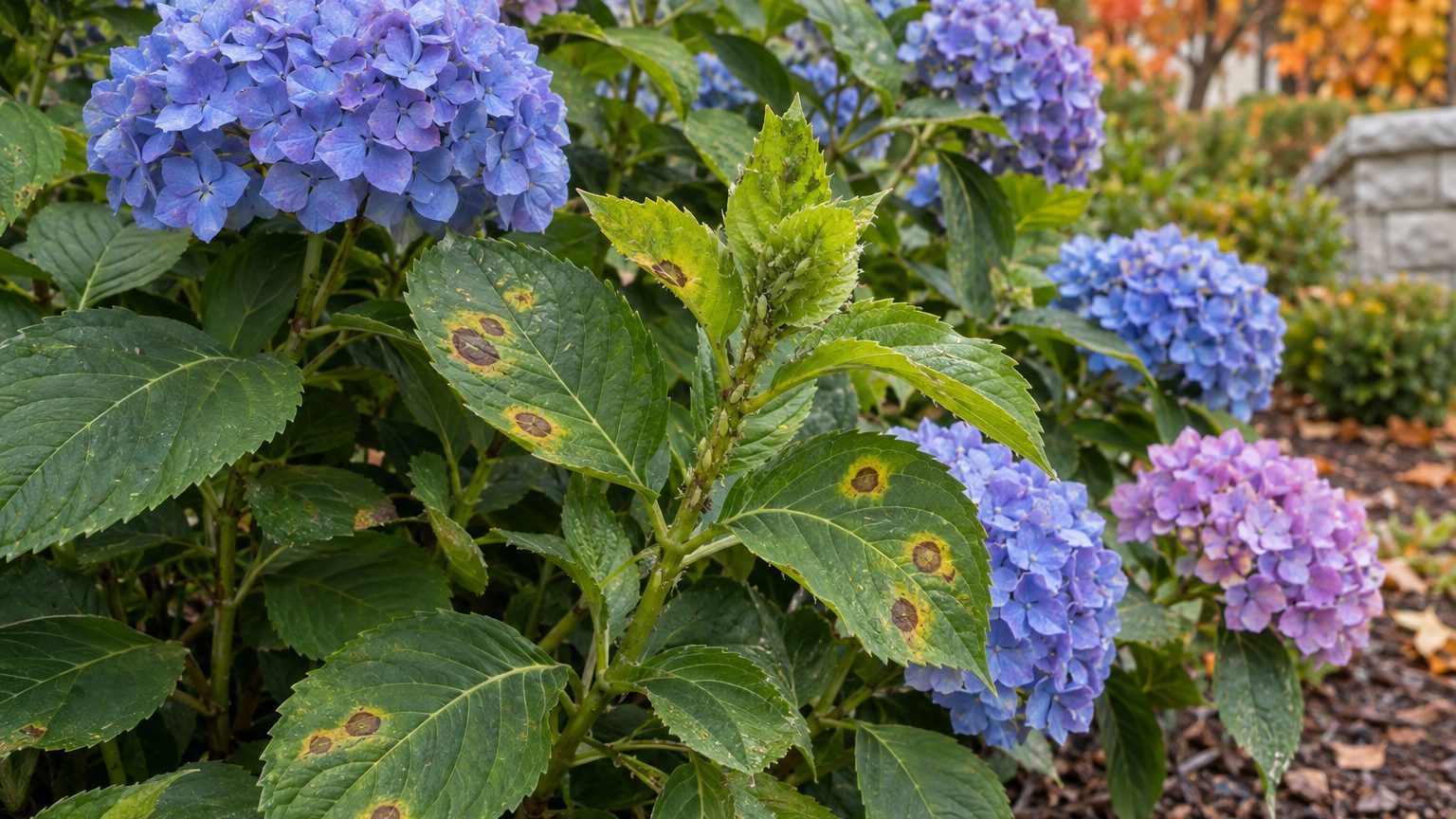
Small green or black insects cluster on tender stem tips and the undersides of new leaves, leaving a sticky residue that draws ants. A strong water spray knocks most of them off, and a weekly check during the February and March planting months catches an infestation before it spreads.

Powdery mildew on new leaves

White, dusty patches spread across leaves in spring when nights cool and days stay humid. It rarely kills the shrub but disfigures every leaf it touches. Water at the soil line instead of overhead, the same habit that keeps the June and July pruning cuts from picking up infection.

Cercospora leaf spot in early summer

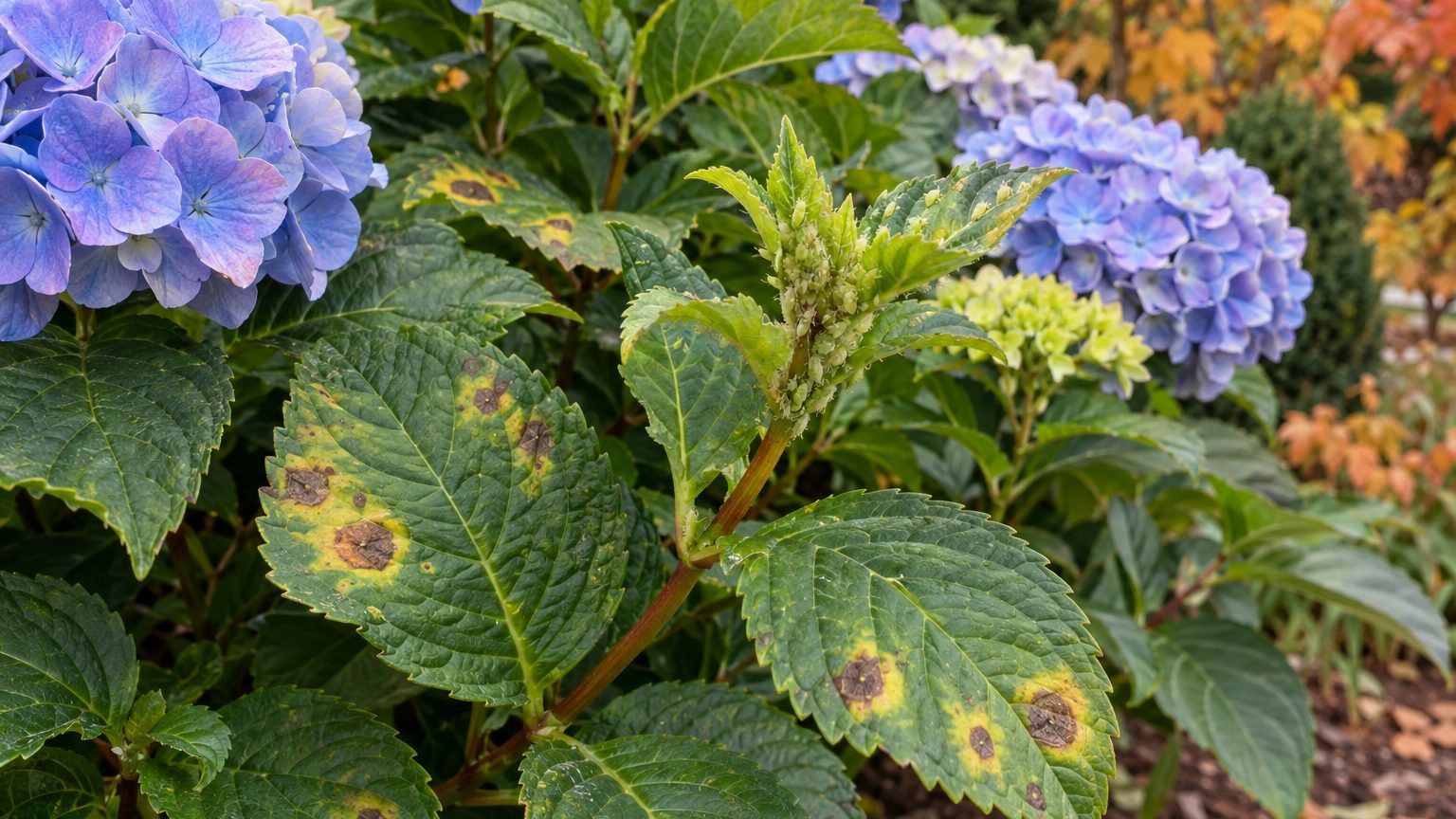
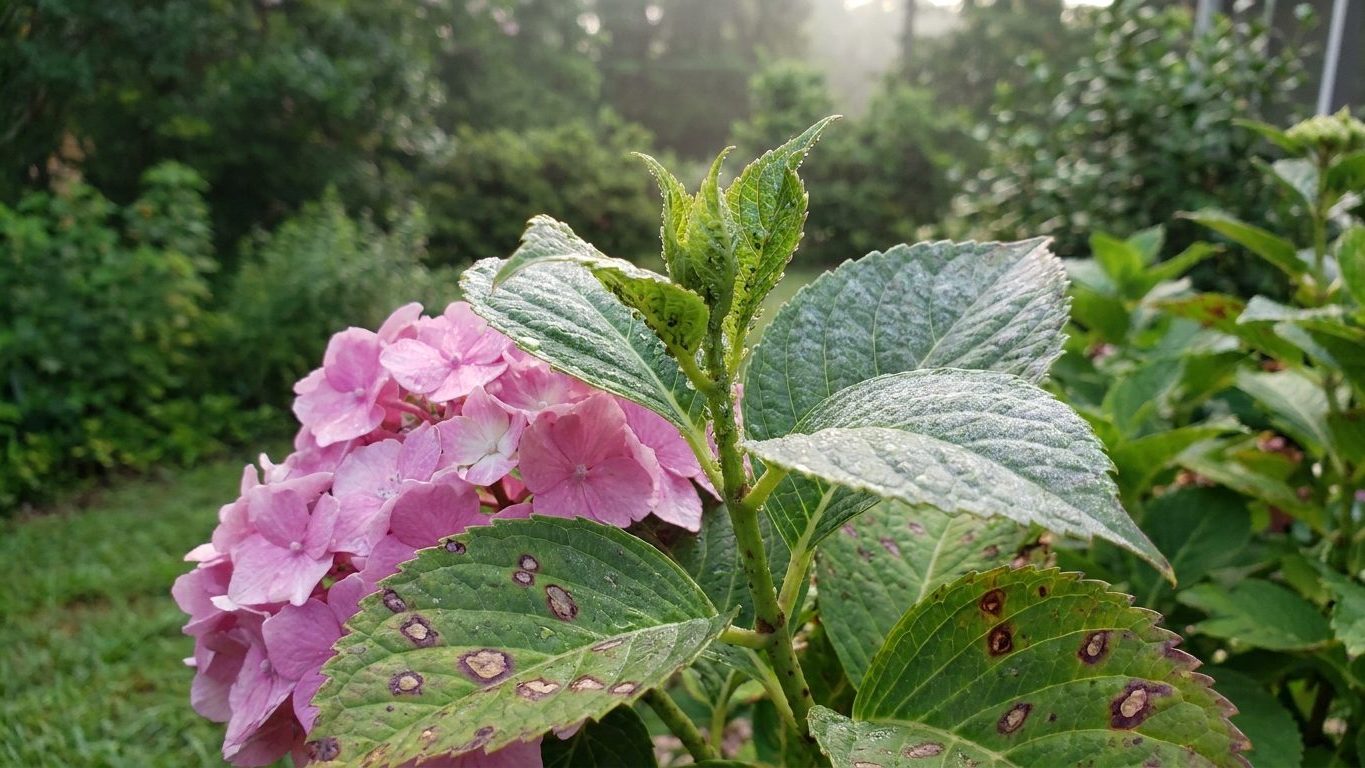
Brown spots ringed in purple or yellow appear on lower, older leaves first, then climb the plant as summer humidity builds. Left alone, it strips leaves by late summer. Remove and discard affected leaves rather than composting them, and fertilize on the March, May, July schedule so the plant can outgrow the damage.

Spider mites in dry summer heat

Spider mites in dry summer heat — Hydrangea Pests and Diseases in Texas

Leaves turn a dusty bronze and fine webbing shows up on the undersides once temperatures climb and rain slows. Mites thrive where dust collects on foliage, so a hard hose rinse every few days through the hottest stretch keeps populations from building past what a shrub can tolerate.

Root rot in heavy clay soil

Root rot in heavy clay soil — Hydrangea Pests and Diseases in Texas

Wilting despite wet soil, blackened roots, and a shrub that never quite recovers after a rainy stretch point to root rot rather than drought stress. Raised beds or amended planting holes drain the excess water that clay traps, and this is the one problem replanting in October or November helps most.

Iron chlorosis yellow leaves

Iron chlorosis yellow leaves — Hydrangea Pests and Diseases in Texas

Leaves turn yellow between dark green veins, usually on new growth first, when soil pH runs too high for the roots to pull iron. It is not a pest at all. A chelated iron drench or a shift to more acid-loving mulch corrects it faster than any spray on the leaves.

How to Work Out the Dates for Your Own Yard

Matching a pest or disease to the calendar starts with the same frost window that decides everything else in a Texas yard, and the countdown works backward from there.

  1. Mark the last spring frost: NOAA NCEI puts Houston’s window at February 4 to March 1, and that same stretch is when overwintering aphid eggs hatch on the first flush of tender new growth, so a pest check belongs on the same calendar page as the frost date.
  2. Plant inside the state’s windows: set new hydrangeas out in February, March, October, or November so roots establish in cool soil before either the humid disease season or a hard freeze tests a shallow root system.
  3. Fertilize on the March, May, July cycle: a plant fed on schedule pushes past Cercospora leaf spot faster than a hungry one, so skipping even one of these three dates leaves foliage exposed for weeks longer than it needs to be.
  4. Prune bigleaf types in June and July: this window sits right at the peak of powdery mildew season, so wipe shears with rubbing alcohol between cuts or the fungus travels from an infected branch to a healthy one on the same tool.
  5. Watch for the first fall frost: it lands December 1 to December 19 in Houston, and once that first hard freeze hits, aphid and mite populations collapse for the year, so late fall problems are almost always fungal, not insect.
  6. Recheck after heavy rain: saturated clay soil along the Gulf Coast is when root rot symptoms tend to appear, so a follow-up look after any storm catches it earlier than waiting for the next scheduled fertilizing date.

Run these same six checks against your own planting date, and within a season you will know whether a shrub is fighting mildew, mites, or a soil problem instead of guessing from one yellow leaf.

Texas North to South: How the Dates Shift

Texas stretches from the Panhandle down to the Rio Grande Valley, and that distance moves the pest and disease calendar in opposite directions from the Houston numbers used above.

  • Panhandle and North Texas (Amarillo, Lubbock, Dallas-Fort Worth): a harder, longer freeze cuts the fungal disease season short but adds real cold-damage risk to bigleaf flower buds that never see Houston’s mild winter.
  • Hill Country and Central Texas (Austin, San Antonio, Waco): drier air knocks back powdery mildew, but limestone-heavy alkaline soil makes iron chlorosis a bigger complaint here than fungal disease.
  • Gulf Coast (Houston, Galveston, Beaumont): the humid, nearly frost-free window described above makes this stretch the state’s fungal disease capital, mildew and leaf spot both.
  • South Texas and the Rio Grande Valley (Brownsville, McAllen, Laredo): frost is rare enough that foliage holds nearly all year, which stretches the aphid and spider mite season longer than anywhere else in the state.

Cross-check this pest list against the planting and pruning dates on the main Texas hydrangea guide before locking in a schedule for your own yard.

Mistakes Texas Punishes

Watering overhead in the evening

Wet leaves that stay wet overnight are exactly the humidity that powdery mildew and Cercospora leaf spot need to spread across a shrub. Switch to soaking the soil at the base in the morning instead, ideally on the same March, May, July schedule already set for fertilizing, so both chores happen together and leaves dry out before evening humidity returns.

Planting without amending alkaline soil

Skipping soil prep at planting time is the fastest route to iron chlorosis, since much of Texas soil runs too alkaline for roots to pull iron on their own. Work compost or elemental sulfur into the hole during the February, March, October, or November planting window rather than trying to treat yellow leaves after the shrub is already established.

Pruning bigleaf hydrangeas late

Cutting stems back after the June and July pruning window removes next year’s flower buds along with whatever fungal spores are already sitting on the plant, spreading both problems at once across the shrub. Hold pruning to that window and wipe shears with alcohol first, which handles the timing mistake and the disease risk in the same step.

Texas Extension Offices and County Contacts

The zone range and frost windows above are a starting point, not a diagnosis. The county office run by Texas A&M AgriLife Extension carries the rest, from a free soil pH test to identifying whatever is actually eating a leaf.

  • Your state page: the frost dates and the pruning window where you live.
  • Which ones hold up here: the bigleaf, panicle, oakleaf, and smooth varieties rated for Texas heat and soil.
  • Texas A&M AgriLife Extension: find the county office nearest you for a soil test or a pest sample drop-off.

Common questions

What is the most common hydrangea disease in Texas?

Powdery mildew and Cercospora leaf spot are the two fungal problems reported most often, both driven by the same humid stretch between the February planting window and the first fall frost in December.

Do Texas hydrangeas get spider mites?

Yes, especially in the driest, hottest weeks of summer when dust builds up on foliage. A hard rinse with the hose every few days through that stretch keeps populations down without reaching for a pesticide.

Why do my hydrangea leaves turn yellow in Texas?

Yellowing between the veins on new growth is almost always iron chlorosis from alkaline soil rather than a pest or fungus, and it responds faster to a chelated iron drench than to anything sprayed on the leaves themselves.
When to Prune Hydrangeas in Texas

When to Prune Hydrangeas in Texas

Houston sits at the mild end of Texas’s hydrangea calendar, with planting open in February, March, October, and November and bigleaf pruning held to June and July, right after bloom. Everywhere colder in the state shifts those same four planting months later in spring and earlier in fall.

When to prune hydrangeas in Texas: The Short Answer

NOAA NCEI 1991-2020 Climate Normals put Houston’s last spring frost at February 4 to March 1 and its first fall frost at December 1 to December 19, and the state calendar sets planting for February, March, October, and November, with bigleaf pruning held to June and July.

  • January: hydrangeas stay dormant well ahead of the spring frost window, so hold off on pruning and keep mulch stacked over the roots.
  • February: planting opens, though frost can still land as late as March 1, so gardeners near IAH lean toward the back half of the month.
  • March: planting continues and the year’s first fertilizer feeding lands here as new leaves push out.
  • April: no listed feeding or planting this month, just watch new growth and water deeply as roots establish.
  • May: the year’s second fertilizer feeding.
  • June: bigleaf pruning opens the moment the flowers fade.
  • July: pruning closes and the third fertilizer feeding of the year lands the same month.
  • August: no listed feeding, and Houston heat makes steady watering matter more than fertilizer.
  • September: a transition month, good for clearing spent blooms and planning the fall planting run.
  • October: fall planting opens, giving roots time to settle before the ground cools.
  • November: the last month to plant before the first frost arrives.
  • December: first frost lands between December 1 and December 19, and the shrub goes dormant for winter.

Every one of these dates slides earlier or later the farther a yard sits from the Gulf, which the regional breakdown below sorts out.

How to Work Out the Dates for Your Own Yard

Frost dates set the outer edges, and a few extra checks narrow them down to your actual property.

  1. Find your frost window: near Houston, NOAA NCEI 1991-2020 Climate Normals place the last spring frost between February 4 and March 1 and the first fall frost between December 1 and December 19.
  2. Check your USDA zone: the USDA Plant Hardiness Zone Map places Texas across 6a to 10a, so a Panhandle yard in the cold end needs hardier stock than a Houston yard near the warm end.
  3. Match the calendar to the zone: the state’s February, March, October, and November planting window works at the Gulf Coast end, but colder zones push spring planting later and fall planting earlier.
  4. Watch the soil, not just the sky: wait until night lows stop dipping toward freezing before digging, since ground cools and warms slower than air does.
  5. Confirm with the county office: Texas A&M AgriLife Extension keeps freeze records specific to each county, which settle any doubt the statewide range leaves open.

None of this replaces a local frost log. A neighbor’s hydrangea blooming three counties over doesn’t guarantee the same date on your side of the county line.

Texas North to South: How the Dates Shift

Texas stretches far enough north to south that no single planting date fits the whole state.

  • The Panhandle and North Texas (Amarillo, Lubbock, Dallas-Fort Worth): frost arrives weeks earlier in fall and lingers weeks longer in spring than it does near the Gulf, squeezing both planting windows toward the middle of the year.
  • Hill Country and Central Texas (Austin, San Antonio): elevation and distance from the coast split the difference, landing closer to the statewide February and March start than the coldest counties do.
  • Houston and the Gulf Coast (Houston, Galveston, Beaumont): the mildest frost window in the state lets planting start earliest in spring and stretch latest into fall.
  • South Texas and the Rio Grande Valley (Brownsville, McAllen, Laredo): frost is rare enough that some winters skip it, letting fall planting run later than anywhere else in the state.

Match your county to one of these anchor cities before locking in a date, and lean on your state guide for the finer local detail.

Mistakes Texas Punishes

No flowers on a healthy shrub

No flowers on a healthy shrub — When to Plant and Prune Hydrangeas in Texas

Pruning bigleaf hydrangeas outside the June and July window cuts off wood that already set next year’s buds. The shrub grows back green and leafy but skips bloom for a full season. Prune only right after the flowers fade, inside the state’s June to July stretch.

Leaves scorched by midafternoon

Full afternoon sun paired with Houston humidity turns hydrangea leaves brown at the edges by midsummer, even on shrubs planted at the right time of year. Morning sun with afternoon shade keeps the same variety green through the same season. Plant new shrubs on the east side of the house, not the west.

Treating the whole state like Houston

NOAA NCEI 1991-2020 Climate Normals put Houston’s last frost as late as March 1 and first frost as early as December 1, but the Panhandle freezes months earlier and later. Planting on Houston’s calendar in a colder county risks losing new growth to a frost the coast never sees.

Texas Extension Offices and County Contacts

Houston’s frost dates make a solid starting point, but Texas A&M AgriLife Extension holds the county-level freeze records and hydrangea guidance that settle the details a statewide range can’t.

  • Your state page: the frost dates and the pruning window where you live.
  • Your county’s AgriLife office: local soil, freeze history, and plant advice through Texas A&M AgriLife Extension.
  • Which ones hold up here: variety picks matched to Texas heat and cold.

Common questions

Can I plant hydrangeas in a Texas summer?

No. Summer heat stresses new roots before they establish. Stick to the state’s February, March, October, and November planting window instead.

When do I prune bigleaf hydrangeas in Texas?

June and July, right after bloom. Pruning outside that window removes the wood that already set next year’s flower buds.

Does the Houston frost date apply to all of Texas?

No. It only reflects the Gulf Coast end of the state’s 6a to 10a range. Colder counties inland and to the north freeze earlier in fall and later in spring.

Hydrangeas That Grow Well in Tennessee

Hydrangeas That Grow Well in Tennessee

Panicle, smooth, and oakleaf hydrangeas grow well across nearly every Tennessee yard, from the Cumberland Plateau to the Mississippi bottomlands near Memphis. Bigleaf and mountain hydrangeas can work too, but their flower buds sit closer to the edge of what a Tennessee winter and a late spring frost allow. The safest bets bloom on new wood, the riskiest ones gamble on buds surviving a freeze that arrives most years in early April.

Hydrangeas that grow well in Tennessee: The Short Answer

USDA Plant Hardiness Zone Map 2023 places Tennessee between zone 5b and 8a, with Nashville, the reference city for the state’s frost data, sitting inside that range rather than at either edge. Panicle, smooth, and oakleaf hydrangeas grow well anywhere in that spread, while bigleaf, mountain, and climbing hydrangeas narrow their odds as the zone number drops toward 5b on the Cumberland Plateau.

Panicle hydrangea

Panicle hydrangea — Hydrangeas That Grow Well in Tennessee

Hydrangea paniculata blooms on new wood, so a late frost between March 31 and April 12 cannot cost it a season of flowers. It handles Tennessee summers, including the humidity around Memphis, and shrugs off cold winters on the Cumberland Plateau. This is the shrub to plant if you want blooms without watching the forecast.

Smooth hydrangea

Smooth hydrangea — Hydrangeas That Grow Well in Tennessee

Hydrangea arborescens, native to Tennessee’s own hillsides, tolerates the coldest pockets of the state without protection and reblooms on new wood after a hard prune. It wilts in afternoon sun during a West Tennessee August but recovers by evening. Few hydrangeas ask so little of a Tennessee yard.

Oakleaf hydrangea

Oakleaf hydrangea — Hydrangeas That Grow Well in Tennessee

Hydrangea quercifolia is native to the Southeast and holds up across the full 5b to 8a range, tolerating both Cumberland Plateau winters and Middle Tennessee heat. It blooms mostly on old wood, but its buds are hardier than a bigleaf’s, so a typical winter rarely erases the show. Fall color is a bonus few new-wood bloomers offer.

Climbing hydrangea

Climbing hydrangea — Hydrangeas That Grow Well in Tennessee

Hydrangea anomala subsp. petiolaris tolerates the same 5b to 8a spread and climbs brick or a pergola without much fuss once established. It takes two or three seasons to root in before it flowers, which tests patience more than it tests hardiness. Give it that time and it holds up to Tennessee’s freeze-thaw winters.

Mountain hydrangea

Mountain hydrangea — Hydrangeas That Grow Well in Tennessee

Hydrangea serrata carries flower buds that survive cold better than a true bigleaf’s, but it still blooms mostly on old wood exposed to whatever arrives after the last frost window closes. In Middle Tennessee it usually comes through fine. In colder pockets of East Tennessee it can lose a season of blooms to a late snap.

Bigleaf hydrangea

Bigleaf hydrangea — Hydrangeas That Grow Well in Tennessee

Hydrangea macrophylla is the riskiest name on this list in Tennessee, because its old wood flower buds sit exposed through winter and a frost landing anywhere in the March 31 to April 12 window can strip a season’s blooms even though the plant itself survives. It performs best in the milder pockets near Memphis and struggles more on the Cumberland Plateau.

How to Work Out the Dates for Your Own Yard

Finding your own hydrangea calendar starts with the same numbers used above, but applied to your street rather than the whole state.

  1. Find your zone inside the 5b to 8a range: the USDA Plant Hardiness Zone Map 2023 sets that spread for Tennessee, and a yard on the Cumberland Plateau reads colder than one near Memphis.
  2. Mark the last spring frost window: count on March 31 to April 12 passing before you trust a new hydrangea outdoors without cover.
  3. Match the plant window: set panicle, smooth, or oakleaf hydrangeas into the ground in March, April, August, or September, when soil is workable and heat hasn’t peaked.
  4. Hold pruning until early summer: cut bigleaf hydrangeas back only in June or July, once new growth shows which stems actually flowered.
  5. Feed on the state schedule: fertilize in March, May, or July, never later, so new growth has time to harden before fall.
  6. Watch the first fall frost window: October 28 to November 8 is when tender new growth on a bigleaf can still get caught, while a panicle planted the same week shrugs it off.

Panicle hydrangea passes this test twice over. It blooms on new wood, so the spring frost window never touches its flowers, and it tolerates the cold end of the state’s zone range.

Bigleaf hydrangea fails the same test on the Cumberland Plateau. Its old wood buds sit through a winter colder than the variety was bred to expect, and a late frost finishes the job.

Tennessee North to South: How the Dates Shift

Elevation and river valleys move these dates more than latitude does inside Tennessee’s own borders.

  • East Tennessee and the Cumberland Plateau (higher elevation, cooler pockets): frost lingers later into spring and arrives earlier in fall than the state average suggests, which raises bigleaf and mountain hydrangea bud loss above what the valleys see.
  • Middle Tennessee around Nashville (the reference city for the state’s frost data): dates track closest to the ranges cited above, since the monitoring station sits here.
  • West Tennessee near Memphis and the Mississippi River bottomlands (milder, lower elevation): the growing season stretches longer on both ends, giving bigleaf and mountain hydrangeas a better shot at keeping old wood buds through winter.

Check your own county against the state guide before trusting any of these ranges for a specific planting date.

Mistakes Tennessee Punishes

Pruning bigleaf hydrangea in fall

Bigleaf hydrangea sets next year’s flower buds on old wood as soon as it finishes blooming, so cutting it back in October or November removes the buds meant to open next June. Wait for the June or July window instead, once new growth shows which stems survived winter.

Fertilizing after midsummer

A feeding in August or September pushes soft new growth right before the first fall frost, which lands between October 28 and November 8 most years. That tender growth freezes back and weakens the shrub. Stick to March, May, and July, and stop there.

Planting bigleaf without wind shelter

A bigleaf hydrangea set in an open, windswept spot on the Cumberland Plateau loses more flower buds to winter than the same plant tucked against a house wall or a windbreak. The zone reads colder there than it does near Nashville. Plant against structure, or choose oakleaf instead.

Tennessee Extension Offices and County Contacts

Your county sits somewhere inside Tennessee’s 5b to 8a range, and that number is only a starting point for your yard. The University of Tennessee Institute of Agriculture Extension service and your county office turn it into a planting date that fits your soil and your slope.

  • Your state page: the frost dates and the pruning window for Tennessee, laid out month by month.
  • What goes wrong here: the pests and mistakes that actually show up in Tennessee hydrangea beds, and how to catch them early.
  • UT Extension: county agents who confirm your local zone and test your soil before you plant.

Common questions

Can bigleaf hydrangeas survive winter in Tennessee?

Yes in the milder parts of the 5b to 8a range near Memphis, but they risk losing flower buds in colder pockets like the Cumberland Plateau, where the same winter reads closer to zone 5b.

When should I plant new hydrangeas in Tennessee?

Stick to the state’s plant window: March, April, August, or September. Avoid the stretch around the last spring frost, March 31 to April 12, and the first fall frost, October 28 to November 8.

Which hydrangea blooms every year without fail in Tennessee?

Panicle hydrangea, since it flowers on new wood grown each spring rather than on wood that has to survive a Tennessee winter first.

Hydrangea Pests and Diseases in Tennessee

Hydrangea Pests and Diseases in Tennessee

Hydrangea trouble in Tennessee rarely arrives as a mystery insect or a rare disease. It arrives as a symptom on a leaf, and the date tells you most of what you need. Nashville’s frost windows set the frame for the whole season, from the first flush of leaves in spring to the last blooms of fall. Read the leaf against that calendar before you reach for a spray.

Hydrangea pests and diseases Tennessee: The Short Answer

In Nashville, NOAA NCEI 1991-2020 Climate Normals put the last spring frost at March 31 to April 12 and the first fall frost at October 28 to November 8. Between them, Tennessee hydrangeas show a short list of symptoms, and each one points to a habit you can change.

Blackened new growth in spring

A frost after buds break kills the soft tips, and the damage looks like disease but isn’t. Wait until Nashville’s March 31 to April 12 window has passed before you judge, then trim only clearly dead wood. Timing details sit in When to Plant and Prune Hydrangeas in Tennessee.

Curled, sticky, distorted leaves

Tiny sap-feeding insects gather on soft new growth and leave a sticky film. Check leaf undersides and rinse them off with a firm stream of water. Feed only in March, May and July, since surplus nitrogen pushes the tender growth they favor. The basics are in Hydrangeas in Tennessee.

Brown spots after wet weather

Fungal leaf spots spread when foliage stays wet in humid weather. Water at the soil line in the morning, open up crowded stems for airflow, and rake up spotted leaves in fall instead of leaving them beneath the shrub. Cleanup comes after Nashville’s first fall frost, October 28 to November 8.

White dusty coating on leaves

A powdery film means a fungus is thriving where air moves poorly and shade runs deep. Thin the center of the clump and skip overhead sprinklers. If the pattern returns every year, the site is the problem. Compare options in Hydrangeas That Grow Well in Tennessee.

Holes chewed in leaves

Many chewing insects feed after dark, so the culprit is rarely visible at noon. Go out at dusk with a flashlight, pick off what you find, and leave broad-spectrum sprays alone, since they also kill the predators keeping numbers down. A few ragged leaves are cosmetic.

Wilting despite moist soil

Roots sitting in soggy clay can’t take up water, so leaves droop even when the ground is wet. Test the soil with a finger before watering, improve drainage at planting, and set new shrubs in March, April, August or September. Site advice lives in Hydrangeas in Tennessee.

How to Work Out the Dates for Your Own Yard

Nashville is the reference city, and a short countdown from its frost windows plus a few quick checks will tell you which problem you actually have.

  1. Count back from the last spring frost: NOAA NCEI 1991-2020 Climate Normals put Nashville at March 31 to April 12, so subtracting two weeks gives March 17 to March 29, the stretch when early leaf growth is gambling on the weather.
  2. Count back from the first fall frost: it runs October 28 to November 8, so six weeks earlier gives September 16 to September 27, the tail end of the September planting window, when a new shrub still has time to root.
  3. Locate the damage on the plant: tips and new leaves point to frost or sap feeders, older lower leaves point to splashing water and wet foliage, and a drooping shrub points to roots. Blackened tips inside the spring window are frost until proven otherwise.
  4. Audit your own habits: compare what you did with the fertilizing months of March, May and July, and with how often the sprinkler hits the leaves. Extra feeding and wet foliage are the two habits you can change today.
  5. Photograph before you spray: shoot the whole shrub, then close-ups of a leaf top and underside, and note the date. A dated photo lets the county extension office narrow the cause without guessing.

Nashville is the reference, not the whole state. If you garden in East Tennessee or on the Cumberland Plateau, expect spring to arrive later, and shift the countdown to match.

Tennessee North to South: How the Dates Shift

Tennessee stretches from the Mississippi River to the Appalachians, and elevation and latitude push the same symptoms earlier or later across that distance.

  • East Tennessee (Knoxville, Johnson City, Gatlinburg): cooler than Nashville, with spring arriving later, so push every spring date back and watch for late frost on tips in mountain valleys.
  • The Cumberland Plateau (Crossville, Sewanee, Monteagle): higher ground runs cooler and later in spring, so frost damage is the first thing to rule out before blaming an insect.
  • Middle Tennessee (Nashville, Franklin, Murfreesboro): the reference area, where the dates above apply directly.
  • West Tennessee (Memphis, Jackson, Dyersburg): generally lower and warmer, so dates tend to run earlier and long humid summers make wet-foliage problems worth watching.

For the wider picture of where each region sits, start with Hydrangeas in Tennessee.

Mistakes Tennessee Punishes

Three errors show up again and again in Tennessee yards, and each has a cheaper alternative.

Fertilizing after July

NOAA NCEI 1991-2020 Climate Normals put Nashville’s first fall frost at October 28 to November 8, and late feeding pushes soft growth that frost then kills. Stop after the July round, since feeding runs March, May and July. Feeding basics are in Hydrangeas in Tennessee.

Pruning bigleaf at the wrong time

Cutting bigleaf in fall or early spring removes flower buds and invites frost-tender regrowth. Prune in June or July, once bloom is done, and limit other months to snipping dead wood. The full pruning window is in When to Plant and Prune Hydrangeas in Tennessee.

Using Nashville dates everywhere

Nashville’s dates fit Middle Tennessee, not the whole state. East Tennessee and the Cumberland Plateau run cooler and later in spring, so push your countdown later. Ask your county office to confirm, and compare plants in Hydrangeas That Grow Well in Tennessee.

Tennessee Extension Offices and County Contacts

The USDA NIFA Land-Grant University Extension directory lists the Tennessee extension service at utia.tennessee.edu/extension. Nashville’s dates are a starting point, and your county office knows the local soil and elevation.

  • Hydrangeas in Tennessee: the frost dates and the pruning window where you live.
  • Hydrangeas That Grow Well in Tennessee: which ones hold up here.
  • When to Plant and Prune Hydrangeas in Tennessee: the month-by-month gestures. Then send your dated photos to the county office before you spray anything.

Common questions

When is the last spring frost in Nashville?

NOAA NCEI 1991-2020 Climate Normals put it at March 31 to April 12. East Tennessee and the Cumberland Plateau run later, so check your own county before you trust the range.

When does the first fall frost arrive?

In Nashville it falls between October 28 and November 8. That is the signal to rake up spotted leaves, and the reason feeding should already have ended after July.

Who can identify a hydrangea problem in Tennessee?

Your county office of the Tennessee extension service, reached through utia.tennessee.edu/extension. Bring dated photos of the whole shrub and of a leaf top and underside.

When to Prune Hydrangeas in Tennessee

When to Prune Hydrangeas in Tennessee

Nashville gardeners get two real planting windows: March and April before the heat builds, then August and September once it breaks. Frost still lingers into early April here, so timing decides whether roots establish before summer stress hits. Pruning runs on its own calendar entirely, and getting it wrong costs a full season of bloom.

When to prune hydrangeas in Tennessee: The Short Answer

The twelve months break into distinct jobs, and confusing one for another is the most common way to lose a year of flowers.

  • January: shrubs sit fully dormant, well ahead of any spring frost risk. Leave dead flower heads on for winter insulation and do nothing else.
  • February: buds stay tucked against cold snaps this early. Resist any urge to prune bigleaf types now, since next year’s flowers are already set on old wood.
  • March: NOAA NCEI 1991-2020 Climate Normals puts Nashville’s last spring frost between March 31 and April 12, so early-month planting still risks a freeze. This is also a fertilize month, but wait for new roots to settle before feeding.
  • April: planting continues through the tail of frost risk, and by mid month the ground has usually cleared. New shrubs need weekly water through their first summer once in.
  • May: a second fertilize pass, timed to feed roots before summer heat arrives. Skip pruning entirely, since buds are swelling toward this season’s bloom.
  • June: bigleaf pruning opens here, right as spring flowers fade. Cut spent stems back to a strong bud pair within a few weeks of bloom drop.
  • July: the bigleaf pruning window closes this month, alongside a third fertilize pass. Cuts made later risk removing next year’s buds before they set.
  • August: fall planting opens, with soil still warm enough for roots to spread before cold arrives. Water new plantings deeply twice a week in the heat.
  • September: the second fall planting month, and often the easier one, as heat backs off. Roots get roughly six to eight weeks to settle before frost returns.
  • October: the first fall frost lands between October 28 and November 8, so finish any planting by the first week. Add mulch around the base once nights turn cold.
  • November: frost is essentially certain across the state now, and shrubs slide into dormancy. Mound extra mulch over the crown of young or marginal varieties.
  • December: nothing to do above ground, but a good month to plan next year’s planting sites. Order any new stock so it ships in time for the spring window.

The pattern holds all year: plant in the shoulder months, feed three times, and prune bigleaf types only in the narrow gap right after bloom. Miss that gap and next year’s flowers disappear along with the cut wood.

How to Work Out the Dates for Your Own Yard

Work backward from Nashville’s frost dates and the rest of the calendar falls into place on its own.

  1. Start from the last spring frost: NOAA NCEI 1991-2020 Climate Normals sets that window at March 31 to April 12 for Nashville, so treat early March as soil prep only, not planting.
  2. Count forward for planting: add two to four weeks once the freeze risk passes, which lands most safe planting in mid to late April.
  3. Mark the bloom drop for pruning: bigleaf hydrangeas set next year’s buds within weeks of losing this year’s flowers, which is why June and July are the only safe cuts.
  4. Count back from the first fall frost: with that window running October 28 to November 8, subtract six to eight weeks to find the last safe fall planting date, in early to mid September.
  5. Check your hardiness zone against the state range: USDA Plant Hardiness Zone Map places Tennessee at 5b to 8a, and a yard on the cold end needs extra mulch a warmer valley yard can skip.

None of these dates are fixed points. They mark the middle of a range, and a late cold snap or an early heat wave shifts them by a week in either direction.

Tennessee North to South: How the Dates Shift

Three geographic bands split the state, and elevation matters more here than raw distance north or south.

  • West Tennessee (Memphis, the Mississippi River bottomlands): the lowest, flattest ground in the state, generally first to clear frost in spring and last to see it return in fall.
  • East Tennessee and the Cumberland Plateau (Knoxville, Chattanooga’s higher ground, the plateau counties): cooler and slower to warm, which pushes both planting and the pruning window a bit later than the rest of the state.

None of that changes the order of the calendar, only how far to nudge it. The state guide sets the baseline, and a plateau yard should read it with a week or two of built-in caution.

Mistakes Tennessee Punishes

Pruning cuts off next year’s blooms

Pruning cuts off next year's blooms — When to Plant and Prune Hydrangeas in Tennessee

Bigleaf hydrangeas set their flower buds within weeks of finishing this year’s show, so any cut made in fall or early spring removes wood that was about to flower. Prune only in June and July, right after bloom, and skip every other month entirely.

Leaves scorched by August sun

Tennessee summers push afternoon temperatures well past what many hydrangea leaves tolerate in full exposure, and scorched brown edges are the result. Plant on the east or north side of the house, where morning sun reaches but the harshest afternoon light doesn’t.

Fall planting too close to frost

A shrub planted after the first week of October has little time to root before the first fall frost, which NOAA NCEI 1991-2020 Climate Normals puts between October 28 and November 8, and a shallow root system rarely survives winter. Finish fall planting in September instead.

Tennessee Extension Offices and County Contacts

The county office fills in what a statewide range can’t, since soil, drainage, and exposure vary block to block even within Nashville.

  • University of Tennessee Extension: local county agents answer specific soil and drainage questions a statewide guide can’t cover.
  • Your state page: the frost dates and the pruning window gathered in one place for Tennessee.
  • Request a soil test: ask the county office for one before the next planting window opens, since Tennessee’s clay soils often need amending first.

Common Questions

Can I plant hydrangeas in Tennessee in the fall?

Yes, August and September both work, as long as planting finishes with enough time before the first fall frost between October 28 and November 8 for roots to settle in.

What happens if I prune bigleaf hydrangeas outside of June and July?

The shrub typically survives, but next year’s flowers disappear, since bigleaf varieties set their buds on old wood within weeks of finishing this year’s bloom.

Does Tennessee’s hardiness zone range change when I should plant?

Not the calendar itself, but it changes how much winter protection a shrub needs, since a 5b yard on the Cumberland Plateau carries more cold risk than an 8a yard in the Nashville basin.

Hydrangeas That Grow Well in South Dakota

Hydrangeas That Grow Well in South Dakota

In South Dakota’s brief growing season, panicle and smooth hydrangeas are the two types that reliably bloom year after year, from Sioux Falls to the Black Hills. Bigleaf, mountain, and oakleaf hydrangeas can survive the winter here, but a late freeze or an early one often erases the flower buds before they open, leaving a green shrub with no color to show for it.

Hydrangeas that grow well in South Dakota: The Short Answer

The split between the hydrangeas that thrive here and the ones that sulk comes down to where the flower buds form. Some set next year’s blooms on fresh spring growth, safe from the freeze that Sioux Falls sees between April 29 and May 9, per NOAA NCEI 1991-2020 Climate Normals.

Others tuck their buds into last year’s wood over winter, and South Dakota’s cold snaps kill those buds more years than not. That mechanical difference decides almost everything below.

Panicle hydrangea

Panicle hydrangea — Hydrangeas That Grow Well in South Dakota

Hydrangea paniculata blooms on new wood, so it flowers reliably even after a rough South Dakota winter. It tolerates the wind and the clay soils found across the state better than any other type, and it takes full sun without scorching. This is the shrub to start with in Sioux Falls or Rapid City alike.

Smooth hydrangea

Smooth hydrangea — Hydrangeas That Grow Well in South Dakota

Hydrangea arborescens, the parent of the old ‘Annabelle’ type, also flowers on new wood and dies back to the ground without much consequence. It prefers a bit of afternoon shade and steady moisture, which makes it a better match for a sheltered east-facing bed than an open prairie lot.

Climbing hydrangea

Climbing hydrangea — Hydrangeas That Grow Well in South Dakota

Hydrangea anomala subsp. petiolaris survives South Dakota winters once established, clinging to brick or a sturdy trellis. It is slow, often taking several seasons to bloom, and a young plant needs a winter wrap for its first two years before its wood toughens up.

Bigleaf hydrangea

Bigleaf hydrangea — Hydrangeas That Grow Well in South Dakota

Hydrangea macrophylla sets its buds on old wood, and those buds rarely survive a South Dakota winter unprotected. Gardeners who grow it here often treat it like an annual for its foliage, or bury it under a thick mulch mound each fall and hope for the best.

Mountain hydrangea

Mountain hydrangea — Hydrangeas That Grow Well in South Dakota

Hydrangea serrata behaves like a smaller, tougher cousin of bigleaf, but it still blooms mostly on old wood. It can hold buds through a mild winter in a protected courtyard, though an open yard in most of the state strips them by spring.

Oakleaf hydrangea

Oakleaf hydrangea — Hydrangeas That Grow Well in South Dakota

Hydrangea quercifolia offers the best fall color of the group, but its flower buds are the least likely to survive here. Plant it for the leaves and the peeling winter bark, not for a guaranteed bloom, and give it the most sheltered corner of the yard.

How to Work Out the Dates for Your Own Yard

Working out your own planting and pruning dates starts with the frost window for your county, not a generic calendar. NOAA NCEI 1991-2020 Climate Normals puts Sioux Falls’ last spring frost at April 29 to May 9, with the first fall frost landing between September 24 and October 4.

  1. Wait for the last freeze to pass: don’t set a hydrangea in the ground until you’re past Sioux Falls’ April 29 to May 9 window, since a late freeze on fresh growth costs a season of bloom.
  2. Pick a planting month: the state’s own calendar keeps new hydrangeas going into the ground in April, May, July, or August, skipping the hottest weeks of June.
  3. Save pruning for June or July: wait until you can see which stems survived winter before cutting a bigleaf hydrangea back, since cutting earlier removes live buds.
  4. Feed on three rounds: fertilize in March, May, and July so the shrub isn’t pushing soft new growth right before the first fall frost arrives.
  5. Count backward from fall: stop pruning or heavy feeding within about six weeks of September 24, since new growth that hasn’t hardened off freezes first.

Run the panicle hydrangea through this method and it holds up at every step, blooming on new wood that shrugs off an early October frost. Run a bigleaf hydrangea through the same steps and it stalls at step three, since the old wood it needed for buds rarely survived winter in the first place.

South Dakota North to South: How the Dates Shift

The 3b-5b range USDA assigns South Dakota hides real swings between the Black Hills and the eastern river valleys, since elevation moves frost dates as much as latitude does.

  • The Black Hills and West River (Rapid City, Spearfish, Custer): elevation pushes both frost dates inward, so the safe planting window opens later in spring and closes earlier in fall than it does in Sioux Falls.
  • The James River Valley (Huron, Mitchell): flatter, more exposed ground means wind does as much damage as cold, so a windbreak matters more here than a few extra degrees of hardiness.
  • East River around Sioux Falls (Sioux Falls, Yankton, Vermillion): this is the mildest corner of the state.
  • The Northeast (Aberdeen, Watertown): closer to the North Dakota border, the growing season runs shorter on both ends, so gardeners here often plant on the late side of the April to August window.

Check the South Dakota hydrangea guide for the state-level frost table before picking a planting week off any of these regional notes.

Mistakes South Dakota Punishes

Pruning outside the June to July window

Cutting back a bigleaf hydrangea in spring or fall removes the stems that were about to carry, or just carried, that year’s buds. This state’s planting calendar keeps the cut to June and July, after winter damage is visible, so you remove only dead wood and leave live buds alone.

Skipping the fall mulch mound

A bare crown left uncovered through a South Dakota winter often kills the buds a bigleaf or mountain hydrangea was counting on for next year. Piling mulch over the base before Sioux Falls’ first fall frost, which NOAA NCEI 1991-2020 Climate Normals puts between September 24 and October 4, buys the crown real insulation.

Feeding past the July window

Fertilizing in August or later pushes soft new growth right as the season is closing, and that growth freezes before it hardens off. Sticking to the March, May, and July feeding rounds keeps the shrub’s energy going into roots and buds instead of foliage that won’t survive.

South Dakota Extension Offices and County Contacts

USDA NIFA’s Land-Grant Extension directory points to SDSU Extension as South Dakota’s contact for county-level answers, since a Sioux Falls-based frost date is only a starting point for the rest of the state.

  • Your state page: the South Dakota hydrangea guide holds the frost dates and the pruning window for the whole state in one place.
  • The month by month calendar: see which of March, May, and July still fit your fertilizing schedule this year.
  • What goes wrong here: the local pest and disease notes for hydrangeas growing in South Dakota conditions.

Call SDSU Extension or your county office before the ground freezes to confirm this year’s numbers.

Common Questions

Can bigleaf hydrangeas bloom reliably in South Dakota?

Not most years. Its flower buds form on old wood, and South Dakota’s winters kill that wood more often than not, so the shrub survives but skips its bloom.

What is the safest hydrangea for a South Dakota front yard?

Panicle hydrangea, since it flowers on new wood each year regardless of how hard the previous winter was.

When should I plant a new hydrangea in South Dakota?

Stick to the months in this state’s planting calendar, April, May, July, or August, and avoid the coldest and hottest weeks in between.

Hydrangea Pests and Diseases in South Dakota

Hydrangea Pests and Diseases in South Dakota

Hydrangeas in South Dakota seldom fall to a single villain. The usual pattern is a hard freeze or a wet stretch that weakens the shrub, then chewing insects or leaf fungus move in on the damage.

Reading the calendar first tells you which problem you actually have, and whether it calls for a spray, a pair of pruners, or just patience.

Hydrangea pests and diseases South Dakota: The Short Answer

Most trouble on South Dakota hydrangeas starts as weather injury, then invites insects and fungus into stressed tissue. NOAA NCEI 1991-2020 Climate Normals puts Sioux Falls between a last spring frost of April 29 to May 9 and a first fall frost of September 24 to October 4, so look there first.

Blackened buds after a late frost

Plump flower or leaf buds, normally green or colour-tipped, turned sooty black to dark brown. They look water-soaked at first, then shrivelled, dry an

A freeze after leaves open kills tender shoots and flower buds, and the dead tissue invites fungus. Cover shrubs with a sheet whenever the forecast shows 32°F in late April or May, then wait for new growth before cutting. Bigleaf pruning months are on When to Plant and Prune Hydrangeas in South Dakota.

Stems dead to the ground

Winter kills stems on shrubs rated for milder zones. The USDA Plant Hardiness Zone Map, built on average extreme winter lows, puts South Dakota at 3b to 5b, so the north runs colder. Choose names proven cold-hardy, listed on Hydrangeas That Grow Well in South Dakota.

Brown spots after wet weather

Leaves that stay wet, from evening sprinklers or crowded stems, favor fungal spots that spread by splashing water. Water at the base in the morning, thin crowded stems, and rake fallen leaves in autumn. Spots can also mean sun or frost, so confirm with your county office before spraying.

Ragged holes chewed in leaves

Holes along the leaf edge or through the blade point to chewing insects, often feeding after dark. Look under leaves at dusk, pick off what you find, and hold the spray until someone has named the insect. Damage on a few leaves rarely threatens a healthy, well-watered shrub.

Sticky leaves and curled tips

A tacky film on leaves and puckered new growth usually mean sap-feeding insects on the undersides. Knock them off with a firm stream of water every few days, then check again in a week. Persistent colonies deserve a sample for your extension office, which can name the insect and the right control.

Wilting in soggy soil

Wilting that water does not fix often means roots sitting in saturated clay. Ease off the hose, mulch to steady moisture, and move the shrub in the April, May, July or August planting months if the spot never drains. Start with Hydrangeas in South Dakota.

How to Work Out the Dates for Your Own Yard

NOAA NCEI 1991-2020 Climate Normals gives Sioux Falls a last spring frost of April 29 to May 9 and a first fall frost of September 24 to October 4, both measured at the airport, so both need shifting for a yard outside town.

  1. Shift the spring range: add one to two weeks to April 29 to May 9, and a yard outside town lands near May 6 to May 23.
  2. Pull the fall range earlier: take one to two weeks off September 24 to October 4, which gives roughly September 10 to September 27.
  3. Match the symptom to a window: black shoots in the days after the spring range point to frost, while holes or spots weeks later point to insects or fungus.
  4. Retrace your own last two weeks: bigleaf pruning belongs to June and July and feeding to March, May and July, so a decline right after a cut or a feeding has a different cause than one that appears unprompted.
  5. Bag a sample for the county office: cut a stem holding both damaged and healthy leaves, seal it in a bag, and let the extension staff name the culprit.

Late September sits at the tail of the shifted fall range, so an outlying yard may already have met its first frost. Pruning and planting details live on When to Plant and Prune Hydrangeas in South Dakota.

Two habits help most: keep a dated note of the first symptom, and photograph the underside of an affected leaf. A county agent can do far more with “first seen the week after the spring range ended” than with “it looks sick.”

South Dakota North to South: How the Dates Shift

The Sioux Falls figures anchor the state, and every other part of South Dakota moves them earlier or later.

  • The east (Sioux Falls, Brookings, Watertown): the airport dates apply best here, and wetter springs make leaf fungus a likelier trouble than winter loss.
  • The north (Aberdeen, Webster, Sisseton): colder winters push the last spring frost later and the first fall frost earlier, so dieback outranks insects.
  • The southeast corner (Yankton, Vermillion, Elk Point): typically a little milder than Sioux Falls, with frost dates that lean kinder.
  • The central prairie and river (Pierre, Chamberlain, Mobridge): dry wind and hot spells stress leaves, and stressed shrubs draw insects sooner.
  • The Black Hills and the west (Rapid City, Spearfish, Custer): elevation delays the last spring frost and hastens the first fall frost, and the higher the yard, the bigger the shift.

The rest of the picture, from soil to hardiness zone, sits on Hydrangeas in South Dakota.

Mistakes South Dakota Punishes

Three habits turn a manageable winter into a sick shrub.

Feeding after the July window

Soft growth from a late feeding meets the first fall frost, which NOAA NCEI 1991-2020 Climate Normals places at September 24 to October 4 in Sioux Falls. Fertilize in March, May and July, then stop. Months are on When to Plant and Prune Hydrangeas in South Dakota.

Pruning bigleaf at the wrong time

Cuts outside June and July can strip the flower buds bigleaf carries on old wood and leave open wounds before frost. Prune in those two months, and take out only dead or diseased stems before then. The overview is on Hydrangeas in South Dakota.

Buying by the tag alone

A tag written for milder regions ignores a South Dakota winter. Check the hardiness rating against your county, not the nursery’s home region, and buy names with a cold-country record. The list of suited names is on Hydrangeas That Grow Well in South Dakota.

South Dakota Extension Offices and County Contacts

The USDA NIFA Land-Grant University Extension directory points South Dakota to extension.sdstate.edu. Treat the Sioux Falls dates as a starting point, and let your county office, which knows local frost pockets and what is circulating that season, settle the rest.

  • Hydrangeas in South Dakota: the frost dates and growing basics where you live.
  • Hydrangeas That Grow Well in South Dakota: the names that hold up through a cold winter.
  • When to Plant and Prune Hydrangeas in South Dakota: the months for feeding, planting and cutting.

Before you spray anything, bag one affected stem and call your county office.

Common questions

When should I cover hydrangeas for frost?

Cover on any night forecast to reach 32°F. NOAA NCEI 1991-2020 Climate Normals puts the last spring frost in Sioux Falls at April 29 to May 9, and a yard outside town can run one to two weeks later. In fall the range is September 24 to October 4, earlier in a yard.

Should I spray as soon as I see spots?

No. Spots can come from frost, sun scorch, wet leaves or fungus, and a spray fits only one of those. Bag a stem with affected and healthy leaves and take it to your county office, reached through extension.sdstate.edu, before buying anything.

Do the Sioux Falls dates apply across the state?

Only as a starting point. The airport station reads kinder than most gardens, and elevation in the Black Hills and the colder north shift the dates further. Check with your county office for local frost timing before you schedule feeding or cutting.

When to Prune Hydrangeas in South Dakota

When to Prune Hydrangeas in South Dakota

Plant hydrangeas in South Dakota in April, May, July, or August, timed around the Sioux Falls area’s frost-free window. With hardiness zone 3b to 5b covering the state, the safest planting sits in May, after the average last frost, and again in early August, well ahead of the first fall freeze.

When to prune hydrangeas in South Dakota: The Short Answer

NOAA NCEI 1991-2020 Climate Normals for the Sioux Falls airport station put the last spring frost at April 29 to May 9 and the first fall frost at September 24 to October 4, and every date below counts back or forward from that window.

  • January: The ground stays frozen and hydrangeas sit fully dormant. Use these weeks to read up on varieties rated for zone 3b to 5b instead of touching the yard.
  • February: Nurseries start taking orders for spring stock. Reserve container-grown plants now so they arrive after the frost risk drops in May.
  • March: The first fertilize window opens for shrubs already in the ground. Frost is still likely this early, so hold off on any new planting.
  • April: Planting can begin, but frost still lingers into early May most years. Keep new transplants ready to cover on cold nights.
  • May: This is the safest planting month, since the last frost typically clears by May 9. It is also the second fertilize window of the season.
  • June: Pruning bigleaf hydrangeas starts now, once new growth shows which stems survived winter. Skip pruning on panicle or smooth types this month.
  • July: This is both a planting window and the last scheduled fertilize pass. Pruning on bigleaf types also wraps up by month’s end, before next year’s buds set.
  • August: The plant window stays open through this month, giving roots about six to eight weeks before the ground cools. Water deeply through any late-summer dry spell.
  • September: The first fall frost can arrive as early as September 24 in the Sioux Falls area. Stop planting and let any August transplants focus on rooting in.
  • October: Frost is typically in place statewide by October 4. Add a mulch layer at the base once the top growth blackens.
  • November: Shrubs are fully dormant and mulch should already be down. Avoid pruning now, since winter dieback will show which wood to cut come spring.
  • December: The yard needs nothing beyond checking that mulch hasn’t blown off. This is the slow month to plan next year’s spot for a new shrub.

These twelve windows come straight from the frost-date range and the fertilize-and-prune calendar for South Dakota. A yard outside Sioux Falls, especially at higher elevation or farther north, likely needs an extra week of margin on both ends.

How to Work Out the Dates for Your Own Yard

Working out your own hydrangea calendar starts with your own frost window, not the airport’s.

  1. Check your own frost window: Compare your county’s typical last frost to the Sioux Falls range that NOAA NCEI 1991-2020 Climate Normals puts at April 29 to May 9, since a rural yard or a low spot often runs a week or two later.
  2. Confirm your hardiness zone: The USDA Plant Hardiness Zone Map places South Dakota between zone 3b and 5b, so look up your own zip code before betting on a variety rated only to zone 6.
  3. Count back two weeks for hardening: Move any greenhouse-grown hydrangea outdoors into shade a couple weeks before its final planting date so it isn’t shocked by direct sun and wind.
  4. Watch new growth before pruning: Wait until stems leaf out in June to see which wood survived winter, then confine bigleaf pruning to June and July only.
  5. Count forward from the fall frost: Stop planting roughly six weeks before your local first fall frost, using the September 24 to October 4 window as the Sioux Falls benchmark, so roots have time to grip before the ground cools.

None of this replaces a look at your own thermometer. A yard tucked against a south-facing wall in town often runs warmer than an open field ten miles out, and that gap can move every date by a week in either direction.

South Dakota North to South: How the Dates Shift

Frost and hardiness both shift across South Dakota’s distances, and none of the shift is small enough to ignore.

  • The Black Hills and the far west (Rapid City, Spearfish, the higher Hills valleys): elevation cools nights, so the last frost tends to linger later into spring and the growing season runs shorter than the state average suggests.
  • The James River Valley and north central (Aberdeen, Huron, the open plains): winters run colder and more exposed, pushing hardy panicle and smooth types to the front of any planting list.
  • The Missouri River corridor and southeast (Sioux Falls, Yankton, Vermillion): the mildest corner of the state, closer to the upper end of the zone 3b to 5b range, with the widest planting and pruning margin.
  • The northeast tier near the North Dakota line (Sisseton, Webster): among the coldest ground in the state, where extra mulch and a shortened planting window matter more than anywhere else covered here.

The state-level guide lays out the zone map and the full frost picture in one place, worth a look before locking in a spot for a new shrub.

Mistakes South Dakota Punishes

Planting before the last frost clears

A warm stretch in mid-April tempts a lot of South Dakota gardeners into planting early, but the Sioux Falls area’s last frost can hold on until May 9. Tender new growth blackens overnight in a late freeze. Wait for the May window, or cover new transplants on any night below freezing.

Pruning bigleaf hydrangeas in fall

Bigleaf hydrangeas set next year’s flower buds on the current season’s wood, so a fall cleanup cut removes the blooms before they even form. Keep pruning to the June and July window instead, once new leaves show which stems survived winter. A shrub with no flowers most summers usually points back to this mistake.

Skipping winter mulch in a 3b to 5b yard

Zone 3b to 5b winters can freeze bigleaf hydrangea stems back to the ground even when the plant itself survives fine. Skipping a mulch layer at the base before the ground freezes in October leaves the crown exposed to that swing. A few inches of shredded leaves or bark, added once top growth blackens, covers the gap.

South Dakota Extension Offices and County Contacts

The state-level frost dates and hardiness zone are a starting point, not a finish line. South Dakota State University Extension and your county office track the local soil, wind, and years of yard-specific results that no statewide figure can capture.

  • Your state page: the full South Dakota hydrangea guide with the zone map and frost dates in one place.
  • Which ones hold up here: variety picks ranked from safest to riskiest for this state’s winters.
  • What goes wrong here: the pests and problems that show up on South Dakota hydrangeas through the season.

Common questions

Can I plant hydrangeas in South Dakota in the fall?

Fall planting is tighter here than in milder states. The calendar’s plant window closes in August, well before the Sioux Falls area’s first fall frost between September 24 and October 4, leaving too little time for roots to establish before the ground cools.

Which hydrangeas survive South Dakota winters best?

Panicle and smooth types generally shrug off zone 3b to 5b winters better than bigleaf varieties, since they flower on new wood and do not lose next year’s blooms to a hard freeze. The which-ones-hold-up-here guide ranks the full list for this state.

Do I need to prune hydrangeas every year in South Dakota?

Not every type needs annual pruning. Bigleaf hydrangeas benefit from the June and July window described above, but panicle and smooth types tolerate a light shaping in early spring instead and do not punish a skipped year the way bigleaf does.

Hydrangeas That Grow Well in South Carolina

Hydrangeas That Grow Well in South Carolina

Oakleaf, panicle, and smooth hydrangea handle South Carolina’s swing between Upstate frost and Lowcountry humidity better than any other type, and Columbia’s climate splits that range down the middle.

Bigleaf mophead varieties still grow here, just with more risk to their flower buds. The riskiest pick, climbing hydrangea, wants a cooler summer than most of the state offers.

Hydrangeas that grow well in South Carolina: The Short Answer

The USDA Plant Hardiness Zone Map puts South Carolina at 7a to 9a, with Columbia sitting mid-range in that span. Six hydrangea types settle into the state at that range, and their order runs from the toughest to the least dependable.

Oakleaf hydrangea

Oakleaf hydrangea — Hydrangeas That Grow Well in South Carolina

Native to the Southeast, oakleaf hydrangea handles Columbia’s humid summers and the occasional Upstate cold snap without complaint. Its cone-shaped blooms fade to tan through fall, and the plant tolerates part shade to full sun once established. It is the safest bet across the whole 7a to 9a range.

Panicle hydrangea

Panicle hydrangea — Hydrangeas That Grow Well in South Carolina

Panicle hydrangea blooms on new wood each spring, so a late frost that nips young growth still leaves a full flower show later in the season. It tolerates more direct sun than other types, which suits Midlands and Lowcountry yards. Winter cold rarely troubles it anywhere in the state.

Smooth hydrangea

Smooth hydrangea — Hydrangeas That Grow Well in South Carolina

Smooth hydrangea, the type behind the classic white ‘Annabelle’ look, is native to the eastern United States and shrugs off both frost and heat. It prefers a bit more water than oakleaf or panicle, especially through a Lowcountry August. Light shade helps it hold its blooms longer.

Bigleaf hydrangea

Bigleaf hydrangea — Hydrangeas That Grow Well in South Carolina

Bigleaf hydrangea is the classic mophead sold at every garden center in the state, and it grows well in Columbia and points south. Its flower buds form on old wood, so a hard late frost or a badly timed fall prune can erase a season’s blooms. It rewards a sheltered spot.

Mountain hydrangea

Mountain hydrangea — Hydrangeas That Grow Well in South Carolina

Mountain hydrangea, a close relative of bigleaf, sets some of its buds lower on the stem, so it recovers faster after a cold snap. It suits the Upstate better than the humid coast, where the plant can look ragged by late summer. Morning sun with afternoon shade works best.

Climbing hydrangea

Climbing hydrangea — Hydrangeas That Grow Well in South Carolina

Climbing hydrangea is the riskiest name on this list for South Carolina. It comes from a cooler, more humid native range and tends to sulk through a Lowcountry July, growing slowly and blooming sparsely. It has the best odds in the shaded, cooler pockets of the Upstate.

How to Work Out the Dates for Your Own Yard

NOAA NCEI’s 1991-2020 Climate Normals put Columbia’s last spring frost between February 28 and March 17, and that window is the anchor for every date below.

  1. Start from the frost window: treat anything planted before March 17 as exposed to a possible freeze, especially new growth on bigleaf hydrangea.
  2. Match it to the plant window: the state calendar opens for planting in February and March, then again in September and October, skipping the summer heat between.
  3. Pick a hardy type to start: panicle hydrangea sets buds on new wood, so it tolerates a mistimed planting far better than a bigleaf mophead.
  4. Weigh a riskier type against it: climbing hydrangea wants a cooler summer than Columbia offers, so it belongs in a shaded, elevated yard rather than a sunny Midlands lot.
  5. Hold bigleaf pruning to its own window: cut back only in June and July, after bloom, so next year’s buds have time to set before the first fall frost.
  6. Fold in fertilizer timing: feed in March, May, and July, matching root growth to the same stretch the calendar sets for planting and pruning.

Every date on this list bends around that one frost window, so a yard that runs warmer or colder than the Columbia station needs its own adjustment before any of it holds.

South Carolina North to South: How the Dates Shift

Elevation and distance from the coast move these dates in opposite directions across the state, even though the hardiness range covers all of it.

  • Upstate (Greenville, Spartanburg, the foothills): frost lingers longest here, tightening both ends of the window measured at Columbia, so mountain hydrangea and other cold-hardy types have an edge.
  • Midlands (Columbia, the Sandhills): the numbers above hold closest to this belt, since the reference station sits here.
  • Lowcountry and coast (Charleston, Beaufort): milder winters push the range toward its 9a edge, favoring heat-tolerant types like panicle and smooth hydrangea over a fussy bigleaf.

For the exact month-by-month dates tied to your part of the state, the South Carolina hydrangea calendar breaks the frost window down by task.

Mistakes South Carolina Punishes

Pruning bigleaf after its window closes

Cutting bigleaf hydrangea back in fall or winter removes buds already set on old wood for next spring. Prune only in June and July, right after bloom fades, so the plant has time to set new buds before the first frost arrives.

Planting outside the calendar windows

Setting a new hydrangea out in the heat of July skips the mid-March frost risk that NOAA NCEI’s Climate Normals track for Columbia, but it trades that risk for transplant stress in hot soil. Stick to February, March, September, or October instead.

Skipping afternoon shade near the coast

Full sun all day scorches bigleaf and mountain hydrangea leaves once Lowcountry humidity and heat combine in midsummer. Give afternoon shade south of the Midlands, and reserve full sun for panicle or smooth hydrangea, which tolerate it far better.

South Carolina Extension Offices and County Contacts

The 7a to 9a hardiness range is a statewide starting point, and a county’s soil, drainage, and shade decide the rest for any given yard.

  • South Carolina hydrangea calendar: the month-by-month planting, fertilizing, and pruning dates tied to the Columbia frost window.
  • What goes wrong with hydrangeas in South Carolina: the pests and problems that show up here, in the order they appear through the season.
  • Clemson Cooperative Extension: find your county office through the statewide directory and ask for a soil test before you plant.

Common questions

Which hydrangea is easiest to grow in South Carolina?

Oakleaf hydrangea is the most forgiving statewide, since it tolerates both Upstate cold snaps and Lowcountry humidity without much fuss once it’s established.

Do hydrangeas need full sun in South Carolina?

Most do better with morning sun and afternoon shade, especially south of the Midlands, where panicle and smooth hydrangea handle the extra light better than bigleaf types.

When should I prune bigleaf hydrangea in South Carolina?

Prune only in June and July, right after the blooms fade, since the plant sets next year’s buds on old wood soon after, and an earlier or later cut removes them.

Hydrangea Pests and Diseases in South Carolina

Hydrangea Pests and Diseases in South Carolina

South Carolina hydrangeas run into trouble from humidity more than cold: Cercospora leaf spot, powdery mildew, aphids, four-lined plant bugs, Japanese beetles and root rot in wet clay all show up somewhere between the Upstate and the coast. Charleston’s long frost-free season gives every one of them time to build before winter finally interrupts anything.

Hydrangea pests and diseases South Carolina: The Short Answer

Charleston’s frost-free stretch runs from the last spring frost, February 28 to March 17, to the first fall frost, November 20 to December 5, according to NOAA NCEI’s 1991-2020 Climate Normals for station USW00013880. That leaves close to nine months of open growing season, plenty of time for the pests and diseases below to build on a bigleaf hydrangea before frost finally slows them down.

Aphids on new growth

Aphids cluster on the soft tips of new growth right as March fertilizing kicks the plant into gear, leaving curled leaves and a sticky residue that turns black with sooty mold. A hard spray from the hose most mornings knocks the colony down before it needs anything stronger.

Four-lined plant bug damage

Small round sunken spots appear on young leaves in spring as nymphs feed for a few weeks, then the insects vanish by early summer and never come back that season. Damage looks alarming but stays cosmetic, so most yards need no spray at all.

Cercospora leaf spot

Purple-edged spots start on the lowest, oldest leaves by early summer once the humidity settles in, then climb the plant if foliage stays wet overnight from overhead watering. Watering at the soil line and clearing fallen leaves each fall keeps the fungus from overwintering.

Powdery mildew

A white, flour-like coating settles over leaves by midsummer wherever shade is heavy and air barely moves between plants, especially on shrubs packed close together. Thinning nearby growth for airflow and watering only in the morning stop most cases before they spread.

Japanese beetles

Japanese beetles — Hydrangea Pests and Diseases in South Carolina

Metallic green beetles show up in June and July and skeletonize leaves down to the veins, with the worst outbreaks following a wet spring. Handpicking beetles into soapy water each morning controls small populations without the broad insecticides that also kill pollinators.

Root rot in wet clay

Late summer storms saturate heavy clay, and roots sitting in that standing water suffocate and rot even while the top of the plant still looks green for a while. Wilting that doesn’t recover after rain, not drought, means raising the planting site or moving it out of that low corner.

How to Work Out the Dates for Your Own Yard

Two different problems can leave nearly identical yellow blotches on a hydrangea leaf, and sorting them out takes the same short walk a Clemson agent would do on a home visit.

  1. Rule out cold first: if damage appeared before Charleston’s last spring frost cleared, February 28 to March 17 per NOAA NCEI’s 1991-2020 Climate Normals, a cold snap is the likelier cause, not disease.
  2. Read the spot pattern: spots that start low and work upward point to Cercospora, while bleached patches only on the sun-facing side point to scorch, not fungus at all.
  3. Match the pest to the month: aphids only cluster on new spring growth, and skeletonized leaves in June or July mean Japanese beetles, not a disease.
  4. Check the stem at soil level: soft, dark tissue right where stem meets soil signals root rot, and no leaf spray will fix a problem that starts underground.
  5. Look at nearby drainage: a bed that stays soggy for days after ordinary rain makes both fungus and root rot far more likely than a one-off pest.

Once one of these five points to a clear answer, the fix is almost always the same handful of moves: water at the roots, keep the leaves dry overnight, and give the shrub room to breathe.

South Carolina North to South: How the Dates Shift

Zone numbers and frost windows are not the same from the Upstate to the coast, and that gap changes which problem shows up first each year.

  • Upstate (Greenville, Spartanburg, Oconee County): frost lifts several weeks later here than at the coast, delaying aphids and shortening the window Cercospora has to spread before fall.
  • Midlands (Columbia, Sumter, Aiken): heat and humidity build fastest inland, so powdery mildew and Japanese beetles tend to peak earliest in this belt.
  • Lowcountry and Coastal Plain (Charleston, Beaufort, Myrtle Beach): the ocean keeps nights milder, and peninsular Charleston runs milder still than the airport station behind the state’s frost data, stretching the fungal disease season longest of any part of the state.

None of that changes which pests exist in South Carolina, only how early they arrive and how long they stay, so the state hydrangea calendar is still the place to time any spray or prune around them.

Mistakes South Carolina Punishes

Watering hydrangeas at night

Evening watering leaves foliage wet through the warm, humid nights that settle over most of South Carolina, and that overnight moisture is exactly what Cercospora leaf spot and powdery mildew need to take hold. Switching to a morning soak at the soil line, not the leaves, removes the problem at its source.

Pruning outside the June or July window

Cutting back bigleaf hydrangeas outside the June or July pruning window removes next year’s flower buds along with any diseased wood, since those shrubs set buds on old growth soon after. Sticking to that two-month window protects both the bloom and the plant’s ability to seal off cuts before storm season.

Planting in a low, poorly drained corner

South Carolina’s clay holds water long after a storm, and a hydrangea in the yard’s lowest corner sits with wet roots for days, inviting root rot anywhere in the state’s USDA Plant Hardiness Zone Map range of 7a to 9a. Raising the bed avoids the problem instead of treating it later.

South Carolina Extension Offices and County Contacts

The 7a to 9a range covers everywhere from the mountains to the marsh, so it’s a starting point, not a diagnosis. Clemson Cooperative Extension and the county office nearest you can confirm what’s actually on a leaf sample or in a soil test.

  • Clemson Cooperative Extension: the statewide directory for county offices, master gardener hotlines, and free plant disease diagnosis.
  • Your state page: the frost dates and the pruning window where you live.
  • Which ones hold up here: the hydrangea types worth planting in South Carolina’s clay and humidity.

Start with a call or a leaf sample before spraying anything.

Common questions

What is the most common hydrangea disease in South Carolina?

Cercospora leaf spot shows up in the most yards, favored by the same humidity that makes summers here feel heavier than the thermometer suggests. It rarely kills a shrub outright but weakens it year after year if fallen leaves are left under the plant.

Do Japanese beetles kill hydrangeas?

Rarely on their own. They skeletonize leaves fast enough to look devastating in June and July, but a mature hydrangea usually pushes new growth back once the beetles move on by late summer.

Should I treat hydrangea leaf spot with fungicide?

Only after cultural fixes fail. Watering at the soil line, spacing plants for airflow, and clearing fallen leaves each fall solve most cases without a spray, and Clemson Cooperative Extension can confirm the exact fungus if spots keep spreading despite those changes.

The almanac, state by state. Every date on this site comes from a state’s own frost facts and its extension service’s calendar — and says where it comes from.