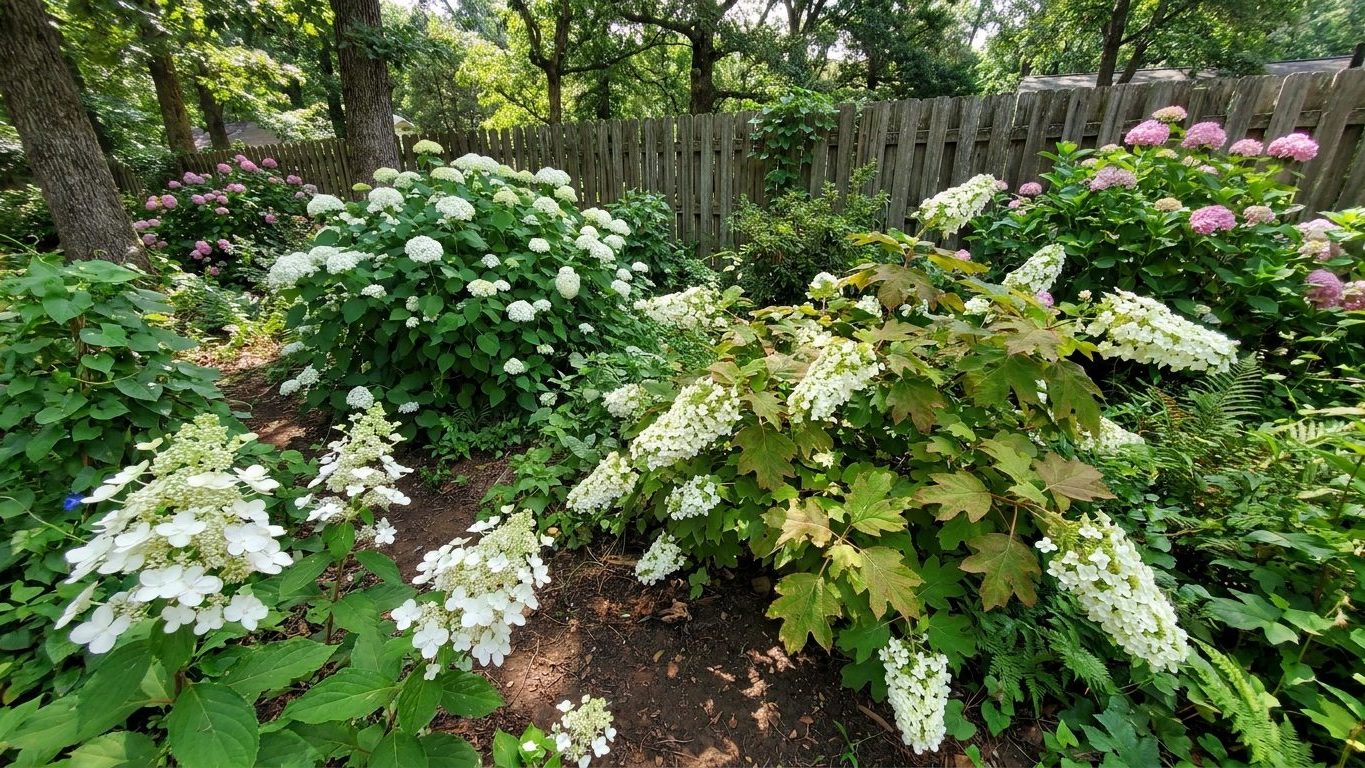
In South Dakota’s brief growing season, panicle and smooth hydrangeas are the two types that reliably bloom year after year, from Sioux Falls to the Black Hills. Bigleaf, mountain, and oakleaf hydrangeas can survive the winter here, but a late freeze or an early one often erases the flower buds before they open, leaving a green shrub with no color to show for it.
Hydrangeas that grow well in South Dakota: The Short Answer
The split between the hydrangeas that thrive here and the ones that sulk comes down to where the flower buds form. Some set next year’s blooms on fresh spring growth, safe from the freeze that Sioux Falls sees between April 29 and May 9, per NOAA NCEI 1991-2020 Climate Normals.
Others tuck their buds into last year’s wood over winter, and South Dakota’s cold snaps kill those buds more years than not. That mechanical difference decides almost everything below.
Panicle hydrangea

Hydrangea paniculata blooms on new wood, so it flowers reliably even after a rough South Dakota winter. It tolerates the wind and the clay soils found across the state better than any other type, and it takes full sun without scorching. This is the shrub to start with in Sioux Falls or Rapid City alike.
Smooth hydrangea

Hydrangea arborescens, the parent of the old ‘Annabelle’ type, also flowers on new wood and dies back to the ground without much consequence. It prefers a bit of afternoon shade and steady moisture, which makes it a better match for a sheltered east-facing bed than an open prairie lot.
Climbing hydrangea

Hydrangea anomala subsp. petiolaris survives South Dakota winters once established, clinging to brick or a sturdy trellis. It is slow, often taking several seasons to bloom, and a young plant needs a winter wrap for its first two years before its wood toughens up.
Bigleaf hydrangea

Hydrangea macrophylla sets its buds on old wood, and those buds rarely survive a South Dakota winter unprotected. Gardeners who grow it here often treat it like an annual for its foliage, or bury it under a thick mulch mound each fall and hope for the best.
Mountain hydrangea

Hydrangea serrata behaves like a smaller, tougher cousin of bigleaf, but it still blooms mostly on old wood. It can hold buds through a mild winter in a protected courtyard, though an open yard in most of the state strips them by spring.
Oakleaf hydrangea

Hydrangea quercifolia offers the best fall color of the group, but its flower buds are the least likely to survive here. Plant it for the leaves and the peeling winter bark, not for a guaranteed bloom, and give it the most sheltered corner of the yard.
South Dakota — the year and the numbers
- State
- South Dakota
- USDA zones
- 3b-5b
- Last spring frost
- April 29 to May 9
- First fall frost
- September 24 to October 4
- Annual rain
- 28 in
- Lawn zone
- cool-season
- Source
- NOAA NCEI 1991-2020 Climate Normals, 32F freeze probabilities · Sioux Falls
How to Work Out the Dates for Your Own Yard
Working out your own planting and pruning dates starts with the frost window for your county, not a generic calendar. NOAA NCEI 1991-2020 Climate Normals puts Sioux Falls’ last spring frost at April 29 to May 9, with the first fall frost landing between September 24 and October 4.
- Wait for the last freeze to pass: don’t set a hydrangea in the ground until you’re past Sioux Falls’ April 29 to May 9 window, since a late freeze on fresh growth costs a season of bloom.
- Pick a planting month: the state’s own calendar keeps new hydrangeas going into the ground in April, May, July, or August, skipping the hottest weeks of June.
- Save pruning for June or July: wait until you can see which stems survived winter before cutting a bigleaf hydrangea back, since cutting earlier removes live buds.
- Feed on three rounds: fertilize in March, May, and July so the shrub isn’t pushing soft new growth right before the first fall frost arrives.
- Count backward from fall: stop pruning or heavy feeding within about six weeks of September 24, since new growth that hasn’t hardened off freezes first.
Run the panicle hydrangea through this method and it holds up at every step, blooming on new wood that shrugs off an early October frost. Run a bigleaf hydrangea through the same steps and it stalls at step three, since the old wood it needed for buds rarely survived winter in the first place.
South Dakota North to South: How the Dates Shift
The 3b-5b range USDA assigns South Dakota hides real swings between the Black Hills and the eastern river valleys, since elevation moves frost dates as much as latitude does.
- The Black Hills and West River (Rapid City, Spearfish, Custer): elevation pushes both frost dates inward, so the safe planting window opens later in spring and closes earlier in fall than it does in Sioux Falls.
- The James River Valley (Huron, Mitchell): flatter, more exposed ground means wind does as much damage as cold, so a windbreak matters more here than a few extra degrees of hardiness.
- East River around Sioux Falls (Sioux Falls, Yankton, Vermillion): this is the mildest corner of the state.
- The Northeast (Aberdeen, Watertown): closer to the North Dakota border, the growing season runs shorter on both ends, so gardeners here often plant on the late side of the April to August window.
Check the South Dakota hydrangea guide for the state-level frost table before picking a planting week off any of these regional notes.
Mistakes South Dakota Punishes
Pruning outside the June to July window
Cutting back a bigleaf hydrangea in spring or fall removes the stems that were about to carry, or just carried, that year’s buds. This state’s planting calendar keeps the cut to June and July, after winter damage is visible, so you remove only dead wood and leave live buds alone.
Skipping the fall mulch mound
A bare crown left uncovered through a South Dakota winter often kills the buds a bigleaf or mountain hydrangea was counting on for next year. Piling mulch over the base before Sioux Falls’ first fall frost, which NOAA NCEI 1991-2020 Climate Normals puts between September 24 and October 4, buys the crown real insulation.
Feeding past the July window
Fertilizing in August or later pushes soft new growth right as the season is closing, and that growth freezes before it hardens off. Sticking to the March, May, and July feeding rounds keeps the shrub’s energy going into roots and buds instead of foliage that won’t survive.
South Dakota Extension Offices and County Contacts
USDA NIFA’s Land-Grant Extension directory points to SDSU Extension as South Dakota’s contact for county-level answers, since a Sioux Falls-based frost date is only a starting point for the rest of the state.
- Your state page: the South Dakota hydrangea guide holds the frost dates and the pruning window for the whole state in one place.
- The month by month calendar: see which of March, May, and July still fit your fertilizing schedule this year.
- What goes wrong here: the local pest and disease notes for hydrangeas growing in South Dakota conditions.
Call SDSU Extension or your county office before the ground freezes to confirm this year’s numbers.
Common Questions
Can bigleaf hydrangeas bloom reliably in South Dakota?
Not most years. Its flower buds form on old wood, and South Dakota’s winters kill that wood more often than not, so the shrub survives but skips its bloom.
What is the safest hydrangea for a South Dakota front yard?
Panicle hydrangea, since it flowers on new wood each year regardless of how hard the previous winter was.
When should I plant a new hydrangea in South Dakota?
Stick to the months in this state’s planting calendar, April, May, July, or August, and avoid the coldest and hottest weeks in between.