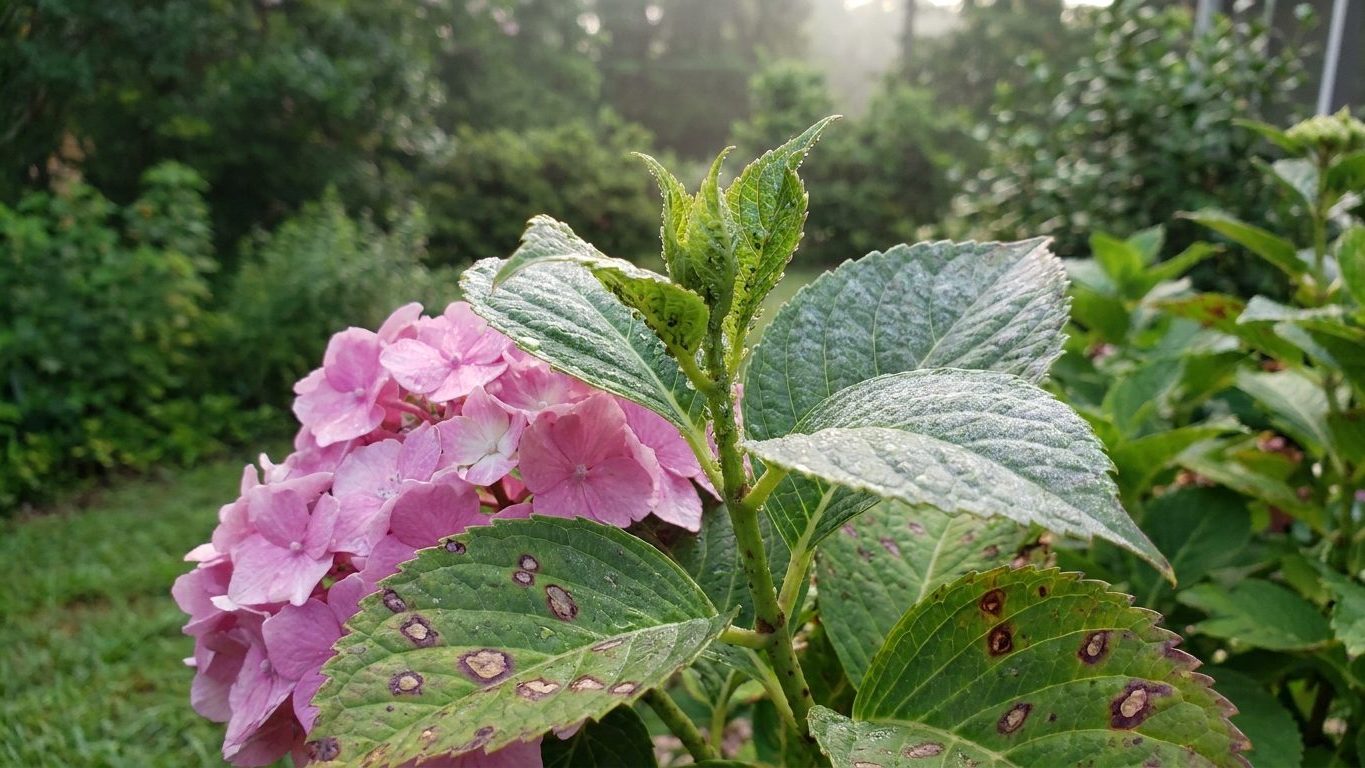
Houston hydrangeas fight humidity as much as heat, and the two together decide which problem shows up first. Powdery mildew, Cercospora leaf spot, aphids, spider mites, root rot in clay, and iron chlorosis from alkaline soil make up the state’s short list, and matching one to your yard starts with the calendar rather than the symptom.
Hydrangea pests and diseases Texas: The Short Answer
USDA places Houston, the Gulf Coast reference city for hydrangea care here, in zones 6a to 10a on the USDA Plant Hardiness Zone Map, and that long frost-free stretch from December through February pushes hydrangea foliage into six months of humid growth where fungal disease outruns almost everything else.
The short answer: aphids, powdery mildew, Cercospora leaf spot, spider mites, root rot in heavy clay, and iron chlorosis from alkaline soil are the six problems that show up on Texas hydrangeas, in that rough order across the growing season.
Aphids clustered on new growth
Small green or black insects cluster on tender stem tips and the undersides of new leaves, leaving a sticky residue that draws ants. A strong water spray knocks most of them off, and a weekly check during the February and March planting months catches an infestation before it spreads.
Powdery mildew on new leaves
White, dusty patches spread across leaves in spring when nights cool and days stay humid. It rarely kills the shrub but disfigures every leaf it touches. Water at the soil line instead of overhead, the same habit that keeps the June and July pruning cuts from picking up infection.
Cercospora leaf spot in early summer
Brown spots ringed in purple or yellow appear on lower, older leaves first, then climb the plant as summer humidity builds. Left alone, it strips leaves by late summer. Remove and discard affected leaves rather than composting them, and fertilize on the March, May, July schedule so the plant can outgrow the damage.
Spider mites in dry summer heat

Leaves turn a dusty bronze and fine webbing shows up on the undersides once temperatures climb and rain slows. Mites thrive where dust collects on foliage, so a hard hose rinse every few days through the hottest stretch keeps populations from building past what a shrub can tolerate.
Root rot in heavy clay soil

Wilting despite wet soil, blackened roots, and a shrub that never quite recovers after a rainy stretch point to root rot rather than drought stress. Raised beds or amended planting holes drain the excess water that clay traps, and this is the one problem replanting in October or November helps most.
Iron chlorosis yellow leaves

Leaves turn yellow between dark green veins, usually on new growth first, when soil pH runs too high for the roots to pull iron. It is not a pest at all. A chelated iron drench or a shift to more acid-loving mulch corrects it faster than any spray on the leaves.
Texas — the year and the numbers
- State
- Texas
- USDA zones
- 6a-10a
- Last spring frost
- February 4 to March 1
- First fall frost
- December 1 to December 19
- Annual rain
- 52 in
- Lawn zone
- warm-season
- Source
- NOAA NCEI 1991-2020 Climate Normals, 32F freeze probabilities · Houston
How to Work Out the Dates for Your Own Yard
Matching a pest or disease to the calendar starts with the same frost window that decides everything else in a Texas yard, and the countdown works backward from there.
- Mark the last spring frost: NOAA NCEI puts Houston’s window at February 4 to March 1, and that same stretch is when overwintering aphid eggs hatch on the first flush of tender new growth, so a pest check belongs on the same calendar page as the frost date.
- Plant inside the state’s windows: set new hydrangeas out in February, March, October, or November so roots establish in cool soil before either the humid disease season or a hard freeze tests a shallow root system.
- Fertilize on the March, May, July cycle: a plant fed on schedule pushes past Cercospora leaf spot faster than a hungry one, so skipping even one of these three dates leaves foliage exposed for weeks longer than it needs to be.
- Prune bigleaf types in June and July: this window sits right at the peak of powdery mildew season, so wipe shears with rubbing alcohol between cuts or the fungus travels from an infected branch to a healthy one on the same tool.
- Watch for the first fall frost: it lands December 1 to December 19 in Houston, and once that first hard freeze hits, aphid and mite populations collapse for the year, so late fall problems are almost always fungal, not insect.
- Recheck after heavy rain: saturated clay soil along the Gulf Coast is when root rot symptoms tend to appear, so a follow-up look after any storm catches it earlier than waiting for the next scheduled fertilizing date.
Run these same six checks against your own planting date, and within a season you will know whether a shrub is fighting mildew, mites, or a soil problem instead of guessing from one yellow leaf.
Texas North to South: How the Dates Shift
Texas stretches from the Panhandle down to the Rio Grande Valley, and that distance moves the pest and disease calendar in opposite directions from the Houston numbers used above.
- Panhandle and North Texas (Amarillo, Lubbock, Dallas-Fort Worth): a harder, longer freeze cuts the fungal disease season short but adds real cold-damage risk to bigleaf flower buds that never see Houston’s mild winter.
- Hill Country and Central Texas (Austin, San Antonio, Waco): drier air knocks back powdery mildew, but limestone-heavy alkaline soil makes iron chlorosis a bigger complaint here than fungal disease.
- Gulf Coast (Houston, Galveston, Beaumont): the humid, nearly frost-free window described above makes this stretch the state’s fungal disease capital, mildew and leaf spot both.
- South Texas and the Rio Grande Valley (Brownsville, McAllen, Laredo): frost is rare enough that foliage holds nearly all year, which stretches the aphid and spider mite season longer than anywhere else in the state.
Cross-check this pest list against the planting and pruning dates on the main Texas hydrangea guide before locking in a schedule for your own yard.
Mistakes Texas Punishes
Watering overhead in the evening
Wet leaves that stay wet overnight are exactly the humidity that powdery mildew and Cercospora leaf spot need to spread across a shrub. Switch to soaking the soil at the base in the morning instead, ideally on the same March, May, July schedule already set for fertilizing, so both chores happen together and leaves dry out before evening humidity returns.
Planting without amending alkaline soil
Skipping soil prep at planting time is the fastest route to iron chlorosis, since much of Texas soil runs too alkaline for roots to pull iron on their own. Work compost or elemental sulfur into the hole during the February, March, October, or November planting window rather than trying to treat yellow leaves after the shrub is already established.
Pruning bigleaf hydrangeas late
Cutting stems back after the June and July pruning window removes next year’s flower buds along with whatever fungal spores are already sitting on the plant, spreading both problems at once across the shrub. Hold pruning to that window and wipe shears with alcohol first, which handles the timing mistake and the disease risk in the same step.
Texas Extension Offices and County Contacts
The zone range and frost windows above are a starting point, not a diagnosis. The county office run by Texas A&M AgriLife Extension carries the rest, from a free soil pH test to identifying whatever is actually eating a leaf.
- Your state page: the frost dates and the pruning window where you live.
- Which ones hold up here: the bigleaf, panicle, oakleaf, and smooth varieties rated for Texas heat and soil.
- Texas A&M AgriLife Extension: find the county office nearest you for a soil test or a pest sample drop-off.
Common questions
What is the most common hydrangea disease in Texas?
Powdery mildew and Cercospora leaf spot are the two fungal problems reported most often, both driven by the same humid stretch between the February planting window and the first fall frost in December.
Do Texas hydrangeas get spider mites?
Yes, especially in the driest, hottest weeks of summer when dust builds up on foliage. A hard rinse with the hose every few days through that stretch keeps populations down without reaching for a pesticide.
Why do my hydrangea leaves turn yellow in Texas?
Yellowing between the veins on new growth is almost always iron chlorosis from alkaline soil rather than a pest or fungus, and it responds faster to a chelated iron drench than to anything sprayed on the leaves themselves.