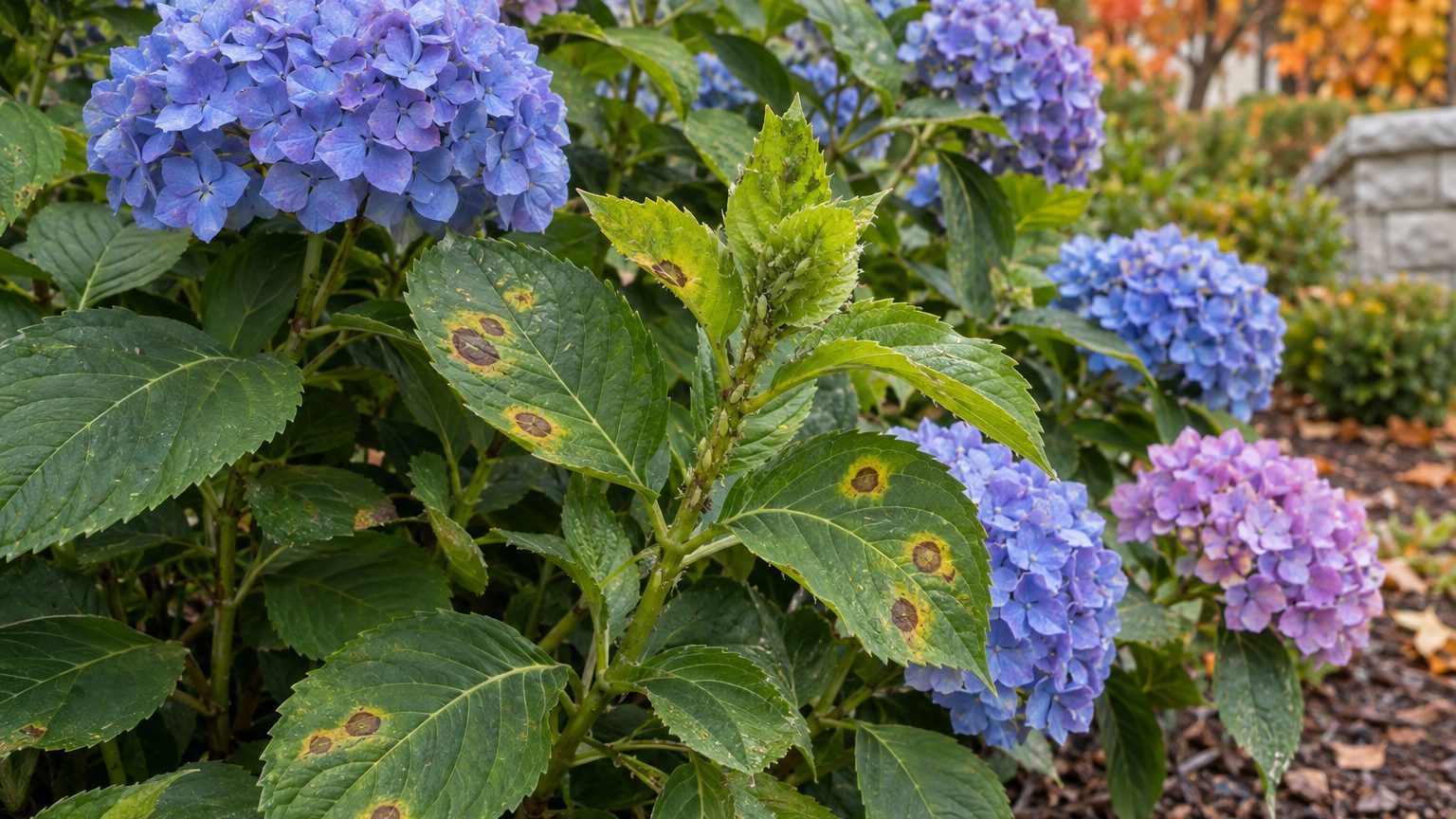
South Carolina hydrangeas run into trouble from humidity more than cold: Cercospora leaf spot, powdery mildew, aphids, four-lined plant bugs, Japanese beetles and root rot in wet clay all show up somewhere between the Upstate and the coast. Charleston’s long frost-free season gives every one of them time to build before winter finally interrupts anything.
Hydrangea pests and diseases South Carolina: The Short Answer
Charleston’s frost-free stretch runs from the last spring frost, February 28 to March 17, to the first fall frost, November 20 to December 5, according to NOAA NCEI’s 1991-2020 Climate Normals for station USW00013880. That leaves close to nine months of open growing season, plenty of time for the pests and diseases below to build on a bigleaf hydrangea before frost finally slows them down.
Aphids on new growth
Aphids cluster on the soft tips of new growth right as March fertilizing kicks the plant into gear, leaving curled leaves and a sticky residue that turns black with sooty mold. A hard spray from the hose most mornings knocks the colony down before it needs anything stronger.
Four-lined plant bug damage
Small round sunken spots appear on young leaves in spring as nymphs feed for a few weeks, then the insects vanish by early summer and never come back that season. Damage looks alarming but stays cosmetic, so most yards need no spray at all.
Cercospora leaf spot
Purple-edged spots start on the lowest, oldest leaves by early summer once the humidity settles in, then climb the plant if foliage stays wet overnight from overhead watering. Watering at the soil line and clearing fallen leaves each fall keeps the fungus from overwintering.
Powdery mildew
A white, flour-like coating settles over leaves by midsummer wherever shade is heavy and air barely moves between plants, especially on shrubs packed close together. Thinning nearby growth for airflow and watering only in the morning stop most cases before they spread.
Japanese beetles

Metallic green beetles show up in June and July and skeletonize leaves down to the veins, with the worst outbreaks following a wet spring. Handpicking beetles into soapy water each morning controls small populations without the broad insecticides that also kill pollinators.
Root rot in wet clay
Late summer storms saturate heavy clay, and roots sitting in that standing water suffocate and rot even while the top of the plant still looks green for a while. Wilting that doesn’t recover after rain, not drought, means raising the planting site or moving it out of that low corner.
South Carolina — the year and the numbers
- State
- South Carolina
- USDA zones
- 7a-9a
- Last spring frost
- February 28 to March 17
- First fall frost
- November 20 to December 5
- Annual rain
- 53 in
- Lawn zone
- warm-season
- Source
- NOAA NCEI 1991-2020 Climate Normals, 32F freeze probabilities · Charleston
How to Work Out the Dates for Your Own Yard
Two different problems can leave nearly identical yellow blotches on a hydrangea leaf, and sorting them out takes the same short walk a Clemson agent would do on a home visit.
- Rule out cold first: if damage appeared before Charleston’s last spring frost cleared, February 28 to March 17 per NOAA NCEI’s 1991-2020 Climate Normals, a cold snap is the likelier cause, not disease.
- Read the spot pattern: spots that start low and work upward point to Cercospora, while bleached patches only on the sun-facing side point to scorch, not fungus at all.
- Match the pest to the month: aphids only cluster on new spring growth, and skeletonized leaves in June or July mean Japanese beetles, not a disease.
- Check the stem at soil level: soft, dark tissue right where stem meets soil signals root rot, and no leaf spray will fix a problem that starts underground.
- Look at nearby drainage: a bed that stays soggy for days after ordinary rain makes both fungus and root rot far more likely than a one-off pest.
Once one of these five points to a clear answer, the fix is almost always the same handful of moves: water at the roots, keep the leaves dry overnight, and give the shrub room to breathe.
South Carolina North to South: How the Dates Shift
Zone numbers and frost windows are not the same from the Upstate to the coast, and that gap changes which problem shows up first each year.
- Upstate (Greenville, Spartanburg, Oconee County): frost lifts several weeks later here than at the coast, delaying aphids and shortening the window Cercospora has to spread before fall.
- Midlands (Columbia, Sumter, Aiken): heat and humidity build fastest inland, so powdery mildew and Japanese beetles tend to peak earliest in this belt.
- Lowcountry and Coastal Plain (Charleston, Beaufort, Myrtle Beach): the ocean keeps nights milder, and peninsular Charleston runs milder still than the airport station behind the state’s frost data, stretching the fungal disease season longest of any part of the state.
None of that changes which pests exist in South Carolina, only how early they arrive and how long they stay, so the state hydrangea calendar is still the place to time any spray or prune around them.
Mistakes South Carolina Punishes
Watering hydrangeas at night
Evening watering leaves foliage wet through the warm, humid nights that settle over most of South Carolina, and that overnight moisture is exactly what Cercospora leaf spot and powdery mildew need to take hold. Switching to a morning soak at the soil line, not the leaves, removes the problem at its source.
Pruning outside the June or July window
Cutting back bigleaf hydrangeas outside the June or July pruning window removes next year’s flower buds along with any diseased wood, since those shrubs set buds on old growth soon after. Sticking to that two-month window protects both the bloom and the plant’s ability to seal off cuts before storm season.
Planting in a low, poorly drained corner
South Carolina’s clay holds water long after a storm, and a hydrangea in the yard’s lowest corner sits with wet roots for days, inviting root rot anywhere in the state’s USDA Plant Hardiness Zone Map range of 7a to 9a. Raising the bed avoids the problem instead of treating it later.
South Carolina Extension Offices and County Contacts
The 7a to 9a range covers everywhere from the mountains to the marsh, so it’s a starting point, not a diagnosis. Clemson Cooperative Extension and the county office nearest you can confirm what’s actually on a leaf sample or in a soil test.
- Clemson Cooperative Extension: the statewide directory for county offices, master gardener hotlines, and free plant disease diagnosis.
- Your state page: the frost dates and the pruning window where you live.
- Which ones hold up here: the hydrangea types worth planting in South Carolina’s clay and humidity.
Start with a call or a leaf sample before spraying anything.
Common questions
What is the most common hydrangea disease in South Carolina?
Cercospora leaf spot shows up in the most yards, favored by the same humidity that makes summers here feel heavier than the thermometer suggests. It rarely kills a shrub outright but weakens it year after year if fallen leaves are left under the plant.
Do Japanese beetles kill hydrangeas?
Rarely on their own. They skeletonize leaves fast enough to look devastating in June and July, but a mature hydrangea usually pushes new growth back once the beetles move on by late summer.
Should I treat hydrangea leaf spot with fungicide?
Only after cultural fixes fail. Watering at the soil line, spacing plants for airflow, and clearing fallen leaves each fall solve most cases without a spray, and Clemson Cooperative Extension can confirm the exact fungus if spots keep spreading despite those changes.