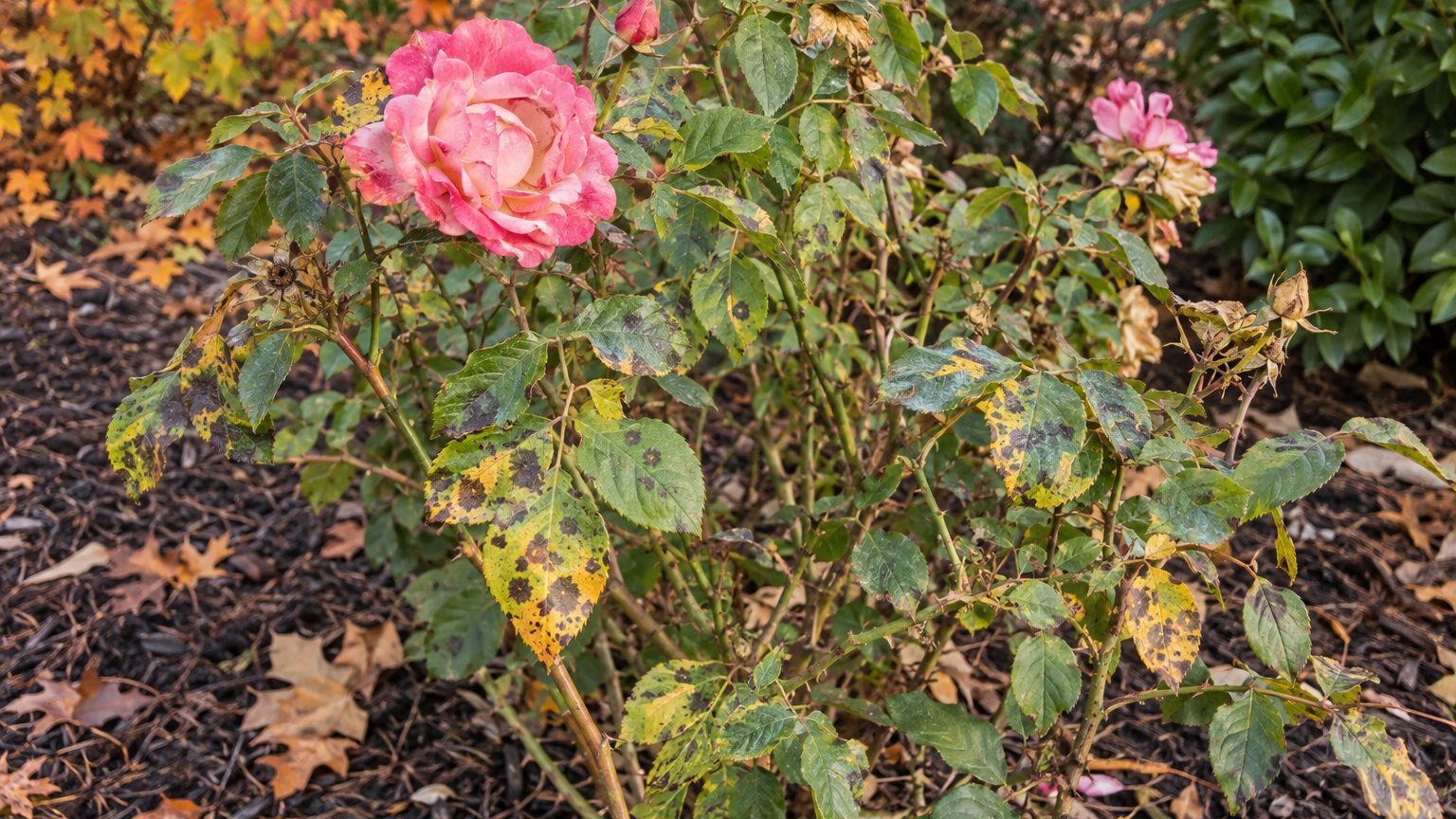
Skip to content

Rose Rosette Disease on Roses: Signs, Treatment and Prevention

Rose Rosette Disease on Roses: Signs, Treatment and Prevention

Rose canes that suddenly shoot out in a crowded, red, thorny tangle make any gardener stop and stare. That growth is the usual sign of rose rosette disease, a virus with no cure that spreads from rose to rose on tiny mites. Catching it early helps protect the roses growing nearby.

Rose Rosette Disease: What You See

Rose Rosette Disease on Roses: Signs, Treatment and Prevention

The symptoms vary a good deal from one rose to the next, so look for a combination of changes on new growth.

  • Clusters of thin, crowded shoots form a dense witches’ broom, a tight tuft that looks nothing like normal branching.
  • New growth turns red, and on a diseased plant that color stays as the leaf matures, while on a healthy rose it usually fades.
  • Stems grow thicker and more succulent than the rest of the plant, often with a reddened tip.
  • Thorns multiply wildly on the affected canes, and leaves come out distorted and misshapen.
  • On wild multiflora roses, leaves show a reddish-purple vein pattern and the shoots look bright red.

In South Carolina, check new growth in spring when it starts to push, because a rose may show only some signs early in the disease.

Rose Rosette Disease or Something Else?

Several other problems redden or twist rose growth. Pairing what you see with where it appears on the plant, or with diagnostic testing, helps you avoid removing a healthy rose or overlooking an infected one.

Looks like How to tell them apart
Herbicide damage Testing for the virus or checking for mites can help separate the two.
Nutrient deficiency Off-color leaves show up across the whole plant, while rosette signs sit on selected canes.
Normal red new growth Healthy young leaves are reddish at first, then the color fades as the leaf matures, while on diseased plants it stays.

If the pattern still leaves you unsure, your state’s extension service can arrange a test for the virus.

What Causes Rose Rosette Disease, and Where It Is Worst

The cause is the rose rosette virus, an Emaravirus. It travels on a microscopic eriophyid mite, the rose leaf curl mite, which feeds on the sap of tender stems and leaf stalks. Once the virus is in, it moves through the whole plant, roots included. Symptoms usually begin soon after the mite feeds.

The mites drift on the wind and can hitch a ride on clothing and equipment, and possibly on insects. Wild multiflora rose is highly susceptible and can be a source of the virus, so a neglected patch near your yard raises the risk.

Rose rosette disease affects both wild and ornamental roses. The virus can also pass through grafting, though it does not spread through sap on a pruner.

How to Treat Rose Rosette Disease

Because the disease cannot be treated and infected plants often die within one to two years, the work is removal, done carefully.

  1. Confirm the signs on new growth, so that you are not digging out a rose that only has herbicide drift or a nutrient problem.
  2. Remove the whole plant promptly, so that the mites on it do not move on to neighboring roses.
  3. Dig out all the roots, because the virus may persist in roots left in the soil even though it does not survive well in the soil itself.
  4. Bag the plant and roots before carrying them across the yard, since mites travel on the wind and on clothing.
  5. Clean your tools and change your clothes afterward, as a precaution, even though the disease does not appear to spread mechanically.
  6. Look over nearby roses and any wild multiflora roses close by, so that a source of the virus does not remain.

Your state’s extension service can tell you which mite controls are approved where you live, and whether to replant in the same bed.

How to Prevent Rose Rosette Disease Coming Back

Prevention follows the season, because the mites feed on tender new growth and symptoms show there first.

  • In South Carolina, inspect every rose closely in spring as new growth appears, because early signs are easiest to see on fresh shoots.
  • Keep checking new canes, and remove any plant that shows the red, crowded, thorny growth as soon as you are sure.
  • After each removal, disinfect pruning tools and wash your clothes before working near other roses.
  • Whenever you plant, keep new roses away from wild multiflora roses, and cut out those wild plants if they grow near your property.

Humans can also carry the virus through grafting and pruning, so be selective about where cuttings come from.

Where This Comes From

Check with your state’s extension service for local recommendations.

Common Questions

Can a Rose with Rose Rosette Disease Recover?

No. The disease eventually kills the infected plant, and the virus spreads through the roots and shoots, so cutting off the affected cane does not clear it.

Can You Spread Rose Rosette Disease with Pruners?

The virus is not sap-transmitted, but mites can travel on equipment, so clean tools after working on infected roses.

Does the Virus Stay in the Soil After You Remove a Rose?

The virus does not survive well in soil, but it can persist in roots left behind, so dig out every piece you can find.
Rose Mosaic on Roses: Signs, Treatment and Prevention

Rose Mosaic on Roses: Signs, Treatment and Prevention

Yellow squiggles, rings, or a faint net pattern on rose leaves often point to a virus, not a pest or a feeding problem. Rose mosaic is systemic, so it sits in the whole plant and cannot be trimmed away. What you can do is confirm it, protect the rose from added stress, and keep it from spreading to new plants.

Rose Mosaic: What You See

Rose Mosaic on Roses: Signs, Treatment and Prevention

Look at the leaves first, because that is where the pattern shows, and it can cover the whole plant or just a part of it.

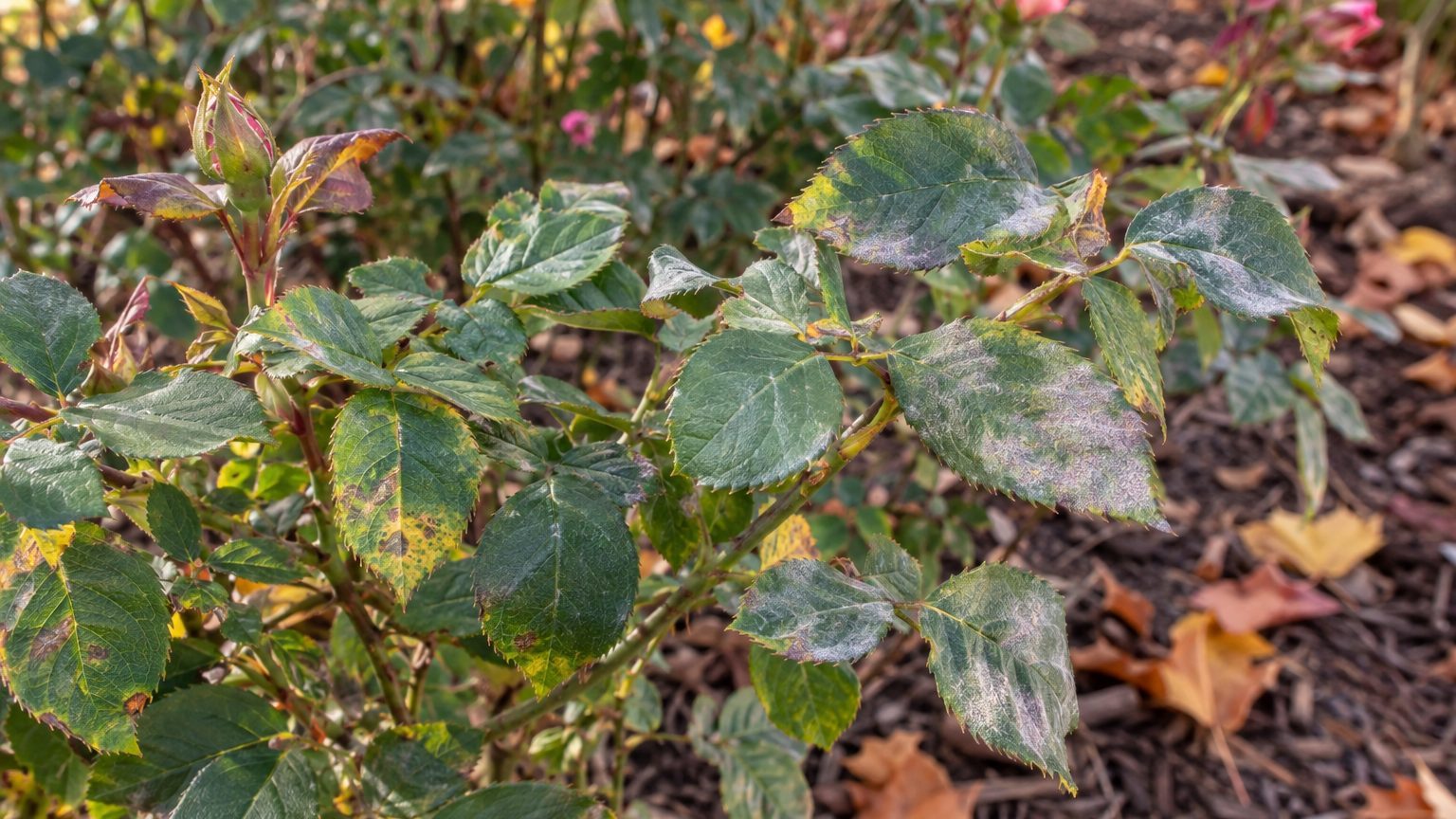
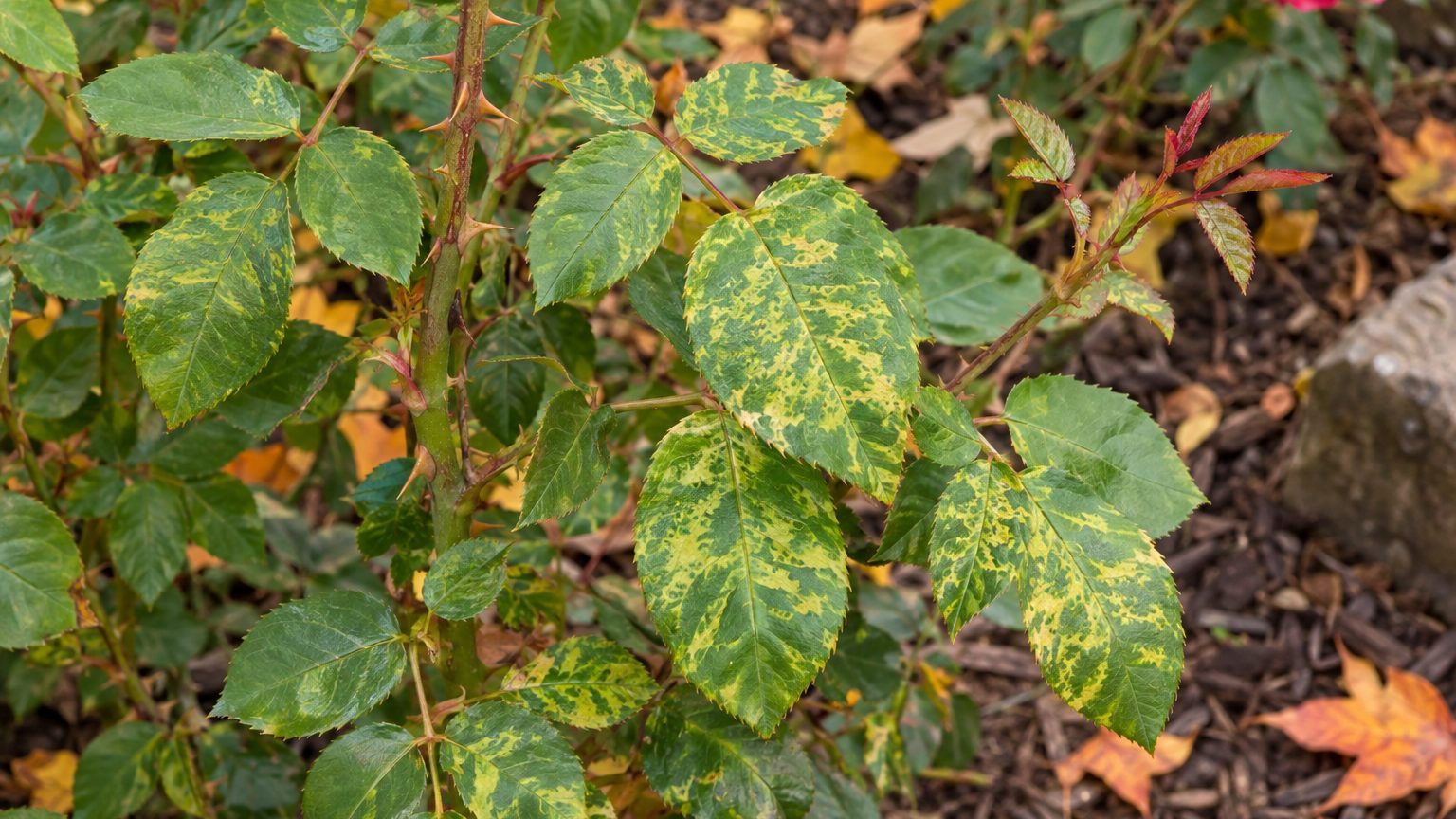
  • Irregular yellow or white lines, bands, ring spots, or blotches run across the leaf surface, and some are brownish.
  • Yellow wavy lines and mottles can appear on some varieties at some point in the growing season.
  • Some leaves show an oak-leaf pattern, a yellow net, or yellow banding along the veins.
  • In Washington and South Carolina, symptoms are usually seen in spring and may fade later, while in Kansas they start in late spring and stay through the growing season.
  • Plants may be somewhat stunted, with fewer or poorer flowers.

How strongly any of this shows depends on the variety and the time of year, so a rose that looked clean last summer can still be carrying the virus.

Rose Mosaic or Something Else?

Leaf patterns alone can mislead, since several problems put yellow on a rose. Pair what the leaf looks like with where it shows up on the plant and what the canes are doing.

Looks like How to tell them apart
Rose rosette disease, with odd leaves and distorted growth Rosette brings leaf trouble together with twisted, distorted canes, while mosaic is mostly yellow patterns on flat leaves and canes bend badly only in severe cases
Similar patterns from related viruses such as apple mosaic or arabis mosaic The same lines and rings can appear on the leaves, so appearance alone cannot separate them from the usual rose mosaic viruses

Yellowing from plain nutrient shortage or herbicide drift can also be mistaken for mosaic. Because other problems can yellow a rose, confirm the cause before taking action.

What Causes Rose Mosaic, and Where It Is Worst

A virus causes it, and more than one kind can do the job, including apple mosaic virus and Prunus necrotic ringspot virus. Rose mosaic virus itself has been linked with the Prunus necrotic ringspot virus. Related viruses in mixed infections can produce the same leaf patterns.

Roses are propagated by budding, grafting, and rooting cuttings, and that is how the virus travels from plant to plant. Insects and pruning tools do not spread it, though arabis mosaic virus can be carried by nematodes in the soil.

No region escapes it. The disease turns up wherever roses are grown, and it is fairly common in Kansas rose gardens. Its spread depends on infected propagation material, not on insects or pruning tools.

How to Treat Rose Mosaic

No treatment clears the virus from a rose, so the work is about confirming the problem and managing the plant you have.

  1. Confirm the diagnosis with your state extension service, so that you do not remove a rose that has a different, fixable problem.
  2. Leave the pruning shears out of it as a cure, because the virus is present throughout the plant and cutting off spotted leaves or stems will not remove it.
  3. Keep the rose watered through dry spells, so that a weakened plant is not pushed further by drought.
  4. Skip taking cuttings, buds, or grafts from it, so that the virus does not pass to new roses.
  5. Decide whether to keep or replace it, based on how weak it has become and how much the leaf patterns bother you.

A lightly affected rose may remain in the bed, but it can still carry the virus. If it is badly stunted or declining, replacing it with a healthy plant is the cleaner choice, and your extension office can say how to dispose of it locally.

How to Prevent Rose Mosaic Coming Back

Prevention happens before the rose goes into the ground, plus a few seasonal habits that keep infected plants from spreading the problem.

  • Before you buy a rose, ask the nursery where its stock comes from, since plants can carry the virus without showing it.
  • When new leaves open in spring, look over every rose for yellow lines and rings, because that is when symptoms are most evident in places like South Carolina and Washington.
  • In late spring, check again, since in Kansas the pattern starts showing then and can stay.
  • Whenever you plan to root cuttings or graft, do not take material from a rose suspected of infection.
  • Keep infected roses watered during dry weather, because they are more vulnerable to drought and cold injury.

Mark any suspect plant with a tag so you remember not to use it for propagation.

Where This Comes From

This sheet draws on university extension and government plant disease pages from Nebraska, Maryland, South Carolina, Kansas, Washington, and California. Rules and timing differ by state, so check with your state’s extension service before you act on a diagnosis.

Common Questions

Can a Rose Have Rose Mosaic Without Showing It?

Yes. Some infected plants stay symptomless, and roses infected during propagation may not show anything until after they are planted and start growing in the landscape.

Will Rose Mosaic Kill the Plant?

Effects range from no visible harm to distorted canes and, finally, plant death. An infected plant may be weakened, with less vigor and poorer flowers.

Does Rose Mosaic Make Roses More Likely to Suffer Winter Damage?

It can. Infected plants may be more sensitive to winter injury and to stresses such as drought, which is why a rose with mosaic deserves steady care through the year.

Powdery Mildew on Roses: Signs, Treatment and Prevention

Powdery Mildew on Roses: Signs, Treatment and Prevention

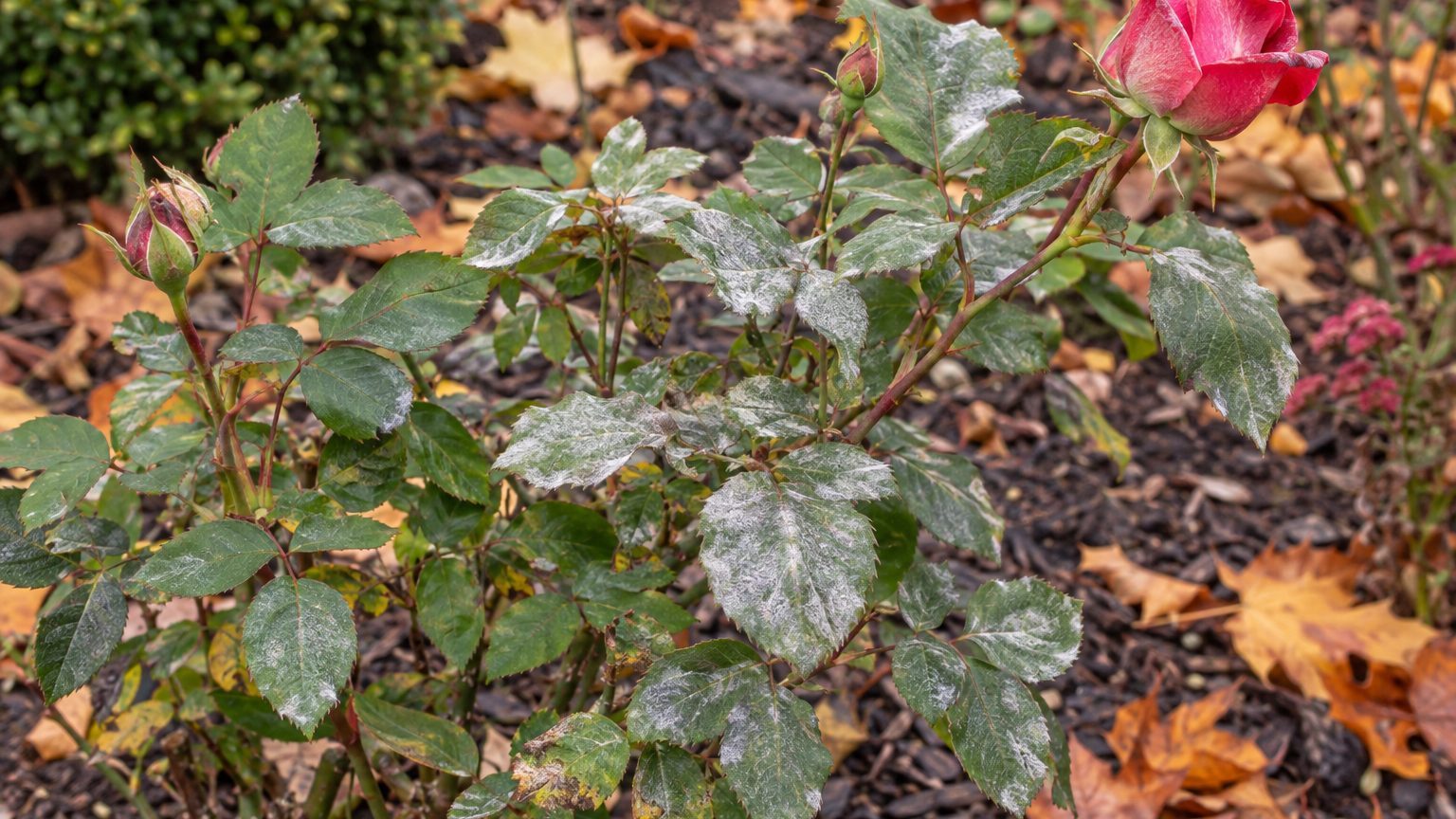
A white, dusty film on new rose leaves and buds is powdery mildew. It comes from a fungus that lives on the plant’s surface, spreads on the wind, and can be slowed with well-timed garden care.

Powdery Mildew: What You See

Powdery Mildew on Roses: Signs, Treatment and Prevention

Start with young growth, where powdery mildew attacks buds, shoots, flowers, and leaves.

  • Small, round, white powdery spots appear first, and they spread until they run together.
  • A grayish-white mat sits on the surface of young leaves, shoots and buds, and it can also coat the petals.
  • In Illinois, affected leaves may become stunted or curled, turn pale yellow, and drop early.
  • Flower buds may fail to open, and those that do can give poor-quality flowers.
  • Older patches turn mealy or felt-like and fade from gray to tan, and tiny black dots may show on leaves or stems.

Notice what is missing: there are no black blotches, which is what separates this problem from black spot.

Powdery Mildew or Something Else?

Different rose troubles leave pale or spotted foliage, so no clue is decisive by itself. Pair what the leaf looks like with where it appears and what the weather has been doing.

Downy mildew is a common look-alike because it also affects roses and has a similar name.

Looks like How to tell them apart
Downy mildew Starts as an oily spot on the leaf, in roses as in grapes, rather than a dry white powder on the surface.
Black spot Shows black blotches on the leaves, while powdery mildew is a white powder without those blotches.
Mildew from the vegetable patch Watermelon powdery mildew will not infect roses, though it hits cantaloupe and squash, so a mildewed squash plant nearby is not the source.

Because each powdery mildew fungus sticks to its own kind of plant, the white film on your squash and the film on your roses are separate problems.

What Causes Powdery Mildew, and Where It Is Worst

The cause is a fungus. In California, on roses it overwinters as strands inside plant buds or as small black fruiting bodies called chasmothecia, which release the spores that first infect plants in spring. In South Carolina, spore production begins once daytime temperatures climb above 60°F, and wind and splashing rain carry spores to new growth.

Weather sets the pace, and it differs by place. In South Carolina, it can appear almost anytime in the growing season when temperatures are mild, from 70 to 80 °F, with humid nights and drier days. In Oregon, it tends to arrive as the season moves into summer’s driest stretch, especially when dry days are followed by humid nights. In Utah, it generally shows up in late summer and early fall, when days are warm and nights are cool.

Shade makes it worse, as do cooler periods and heavy dews, which encourage spores to form and infect. Rose varieties differ greatly in how susceptible they are, so a bush that struggles every year may simply be a poor match for your yard.

How to Treat Powdery Mildew

Start with the plant itself, then bring in a spray only if your state’s guidance supports it.

  1. Clip off badly affected shoots and leaves, so that fewer spores are left to spread to healthy growth.
  2. Bag the clippings and send them out with the trash rather than composting, because spores travel by wind and can resettle on nearby plants.
  3. Thin crowded stems so sun reaches the center and air moves through, which lets foliage dry quickly after rain or irrigation.
  4. Water at the base of the plant and early in the day, so that leaves are not left damp through the humid night hours.
  5. Contact your state’s extension service to find out which fungicides are approved and labeled for roses where you live, so that you buy only what is legal and suited to your bush.

Cutting back does not cure leaves that are already coated, but it slows the spread to new growth. Check the bush regularly through the weeks when weather favors the fungus, since new shoots are the first to be hit.

How to Prevent Powdery Mildew Coming Back

Prevention follows the rose year, with each task timed to support the plant.

  • In Oregon, remove fallen leaves and diseased stems during late-winter cleanup so that overwintering spores have less to cling to.
  • Before spring growth, space or thin plants so sun penetrates and air circulates around every bush.
  • In California, begin watching new shoots and buds as the weather warms in spring, when the first spores are released.
  • Through summer, water at the soil line and avoid wetting leaves late in the day, so that foliage is dry before humid nights.
  • When you plant new roses, choose a sunny spot rather than shade, since shade favors the disease.

When adding a rose, ask your state extension service or a local nursery about varieties that do well in your area, because susceptibility varies so widely.

Where This Comes From

Confirm timing and product rules with your own state’s extension service, since conditions and approved treatments differ from place to place.

Common Questions

Can Powdery Mildew from Other Plants Spread to Roses?

Usually not. Each powdery mildew fungus affects specific kinds of plants, so mildew on cucurbits will not move to roses. Roses do share the disease with some other plants, including oak, sycamore, crape myrtle and euonymus, but the fungus on each stays tied to its own host.

Does Powdery Mildew Kill Roses?

The disease can be serious on woody plants like roses, where it attacks buds, shoots, flowers and leaves. The usual damage is distorted leaves, early leaf drop, and poor flowering.

Why Does Powdery Mildew Show Up When Leaves Are Dry?

Unlike many leaf diseases, it does not need a soaked leaf. Dry days followed by humid nights favor the disease; heavy dews also help spores form and infect, so dry-looking weather can still bring it on.

Downy Mildew on Roses: Signs, Treatment and Prevention

Downy Mildew on Roses: Signs, Treatment and Prevention

Turn a rose leaf over after a cool, damp spell and the underside may carry a pale, fuzzy bloom that the top never shows. That fuzz is the giveaway for downy mildew, a disease that blights leaves and canes and can strip a bush fast.

Downy Mildew: What You See

Downy Mildew on Roses: Signs, Treatment and Prevention

The signs start on the leaves and usually work upward from the oldest growth near the base of the bush.

  • Fluffy or fuzzy patches of spores form only on the lower leaf surfaces when humidity is high, and they look white, gray, brown or purplish.
  • Angular spots in purple, red or brown sit between the veins, and the larger veins box them into a square or angular shape.
  • Older leaves near the bottom of the plant are usually hit first, then they wither and turn brown as the disease climbs the stem.
  • Affected leaves turn yellow and drop, and heavy infections cause major leaf drop across the whole bush.
  • Petals and stems can show symptoms too, and infected parts may brown or bronze.

A hand lens helps, because the fuzzy patches look like tiny bunches of branched hairs.

Downy Mildew or Something Else?

Different rose problems leave spotted, yellowing leaves, so no clue is decisive by itself. Check the shape of the spot and look at the underside of the leaf before you decide.

Looks like How to tell them apart
Black spot Spots are round, while downy mildew lesions look angular or square because the pathogen stops at the veins. Look underneath for pale, felty patches.
Powdery mildew Powdery mildew typically produces visible growth on both sides of the leaves and on shoots and buds. Downy mildew shows pale, felty patches only on the undersides.
Nutrient deficiency or spray injury Early downy mildew symptoms can look like these. Hunt for angular spots between veins and fuzz on the leaf underside.

In California, under cool, moist conditions, the spores last only a short time, so the fuzz may be gone even while the disease is doing damage. The angular, vein-limited discoloration is the clue to trust when no spores show.

What Causes Downy Mildew, and Where It Is Worst

The cause is Peronospora sparsa, a fungus-like water mold that survives in plant debris or on infected plants. It is fairly host specific and does not infect other ornamentals. Some species are noted as seed borne or systemic, and some weeds can hold the pathogen as a reservoir.

Weather decides how bad it gets. In Illinois, the pathogen thrives in cool conditions from 60-70 degrees F when humidity is above 85%. Its distribution varies: it appears sporadically in some areas and predictably in others.

Roses in greenhouses and rose fields suffer most, and potted roses in nurseries have been plagued by it since the 1800s. Home gardens can see it too. It is far more likely to turn up at nurseries and garden centers, where roses sit in high humidity or get overhead watering, so inspect new plants before bringing them home.

How to Treat Downy Mildew

Work from the cleanup outward, and keep leaves dry while you do it.

  1. Inspect the undersides of leaves, starting low on the bush, so you know how far the disease has climbed.
  2. Pick off and bag infected leaves and cut out affected stems, because the pathogen survives in plant debris.
  3. Rake up fallen leaves beneath the bush, since dropped foliage keeps the pathogen close to the plant.
  4. Pull weeds around the bed, because some weed species act as reservoirs of inoculum.
  5. Water at the soil line and skip overhead sprinklers, so leaves dry quickly in the humidity the disease needs.
  6. Open up crowded growth with light thinning, so air moves through the bush and shortens the damp periods.

If the disease keeps returning, ask your state’s cooperative extension office which fungicides are registered in your state and when to apply them. Labels and approvals differ from place to place, so local advice beats a general rule.

How to Prevent Downy Mildew Coming Back

Prevention follows the seasons, because the disease favors cool, damp weather.

  • Clear last year’s leaves and debris from beneath the bushes, since the pathogen survives there.
  • When you buy roses in spring, check the undersides of leaves at the nursery and pass over plants with fuzz or angular spots.
  • During cool, damp weather, water at the base and early in the day so foliage dries fast.
  • During the growing season, keep weeds pulled around the bed, because some serve as reservoirs for the pathogen.
  • After leaves drop, rake and remove all fallen foliage instead of composting it.

Give each bush enough space that air can move between plants, which cuts the time leaves stay wet.

Common Questions

Can Downy Mildew Spread to Other Plants in the Garden?

Not easily. The pathogen that infects roses is specialized and does not infect other ornamentals, so your other shrubs and flowers are not at risk from it.

Why Can’t You See Any Fuzz on Leaves That Are Dropping?

In California, spores persist only briefly in cool, moist conditions, so the fuzz may vanish while damage continues. Look for angular purple, red or brown spots between the veins, plus yellowing leaves, to confirm.

Does Downy Mildew Kill Rose Bushes?

It can be highly destructive, causing major leaf drop on whole plants. Garden roses are less often affected than nursery and greenhouse stock, but major leaf drop still calls for prompt attention.

Where This Comes From

These details come from university extension plant disease guidance, with some points written for Maryland, Wisconsin, North Carolina, Illinois and California. Check with your own state’s cooperative extension office for local timing and approved treatments.

Crown Gall on Roses: Signs, Treatment and Prevention

Crown Gall on Roses: Signs, Treatment and Prevention

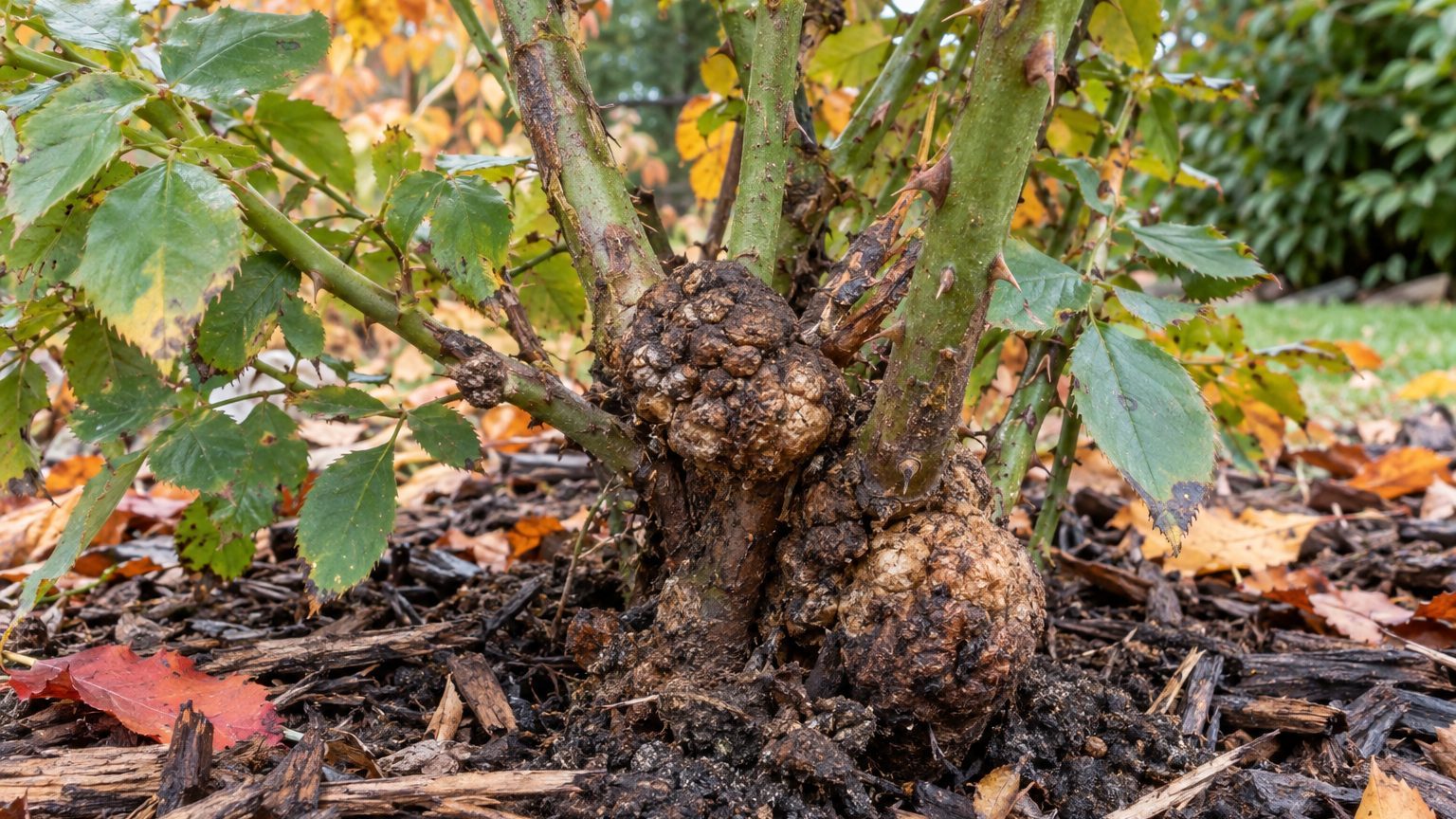
A hard, lumpy swelling at the base of a rose cane, right where it meets the soil, tends to turn up while you mulch in spring or tidy the bed in fall. That growth is usually crown gall, a bacterial disease of roses.

Crown Gall: What You See

Crown Gall on Roses: Signs, Treatment and Prevention

The clearest sign is a rough, rounded growth on the plant, and it helps to know how that growth changes with age.

  • Crown gall is solid throughout, unlike the hollow chambers of an insect gall.
  • A young gall is light tan or fleshy white, smooth, and somewhat spongy to the touch.
  • An older gall turns brown to black, hardens into a woody or corky lump, and often cracks and sloughs off in pieces.
  • Most sit at the soil line or at the graft union, but galls also form on roots, on canes, and on twigs well above the ground.
  • Size runs from less than an inch to several inches across.
  • Canes on an infected plant can look stunted and discolored.

Galls have also been reported at pruning sites, so check old cuts as well as the base.

Crown Gall or Something Else?

Lumps on a rose are not all crown gall. Insect galls are the usual confusion, and a healing swelling at a graft union or pruning cut can fool you too, since crown gall may appear in those same spots.

Location alone never settles it, so pair what you see on the outside with what you find inside.

Looks like How to tell them apart
Insect gall on a stem Crown gall is solid throughout, and an older one is dark and corky outside but light-colored inside.
Rough knob at the soil line Look at the surface and the age. Crown gall starts light tan or white and spongy, then darkens, hardens, and cracks.

If a swelling at a graft union or pruning cut still leaves you unsure, your state extension service can confirm what it is.

What Causes Crown Gall, and Where It Is Worst

A soil-dwelling bacterium, Agrobacterium tumefaciens, causes the disease. It occurs worldwide and attacks over 600 plant species in more than 90 plant families, so no region is clear of it. It is common in agricultural soils, and rose is named among the commonly infected plants in Illinois.

The bacterium is a weak pathogen and cannot simply walk in. It needs a natural opening or a fresh wound less than twenty-four hours old, on the crown, the roots, or the branches. Once inside, it passes some of its genetic material into the plant’s cells, which then build the gall. Water moving through infected soil can carry the bacteria along.

Roses are especially vulnerable because the disease is especially common in the rose family. Plants growing nearby can carry it too, including:

  • Cherry, apple, peach, pear, and plum
  • Raspberry and blackberry
  • Euonymus

A rose planted beside an infected plant from this list has more reason to be watched.

How to Treat Crown Gall

No gesture here promises a cure, so the aim is to confirm the problem, limit damage, and keep from spreading it.

  1. Do not cut into a swelling on a living rose just to identify it; the cut leaves a fresh wound.
  2. Check the crown, the roots if you can see them, and every cane, so you know how far the galls reach.
  3. Ask your state extension service whether cutting galls out of a cane is worth trying on your plant, since a fresh cut is itself a new wound.
  4. Remove the plant, roots included, if a gall circles the lower stem or main roots, because in Texas that kind of girdling is reported to kill the plant.
  5. Clean and sanitize pruning tools and spades after working near a gall before using them around healthy roses.
  6. Bag the removed canes or plant and keep them out of the compost, so the galls do not sit near healthy roots.

A young rose that was infected early may stay stunted and never grow properly, as reported in California. A stunted plant like that is often better replaced than nursed.

How to Prevent Crown Gall Coming Back

Because the bacterium only gets in through wounds, prevention comes down to when and how you cut and dig around your roses.

  • At planting time, look over the canes and roots for swellings and leave any gall-bearing rose at the nursery.
  • As buds swell, prune repeat-blooming roses with clean, careful cuts and keep each cut to what the plant needs.
  • Right after bloom, prune once-blooming roses the same careful way, since they flower on last year’s wood.
  • Through the growing season, keep spades, edgers, and weed trimmers away from the crown, so you do not open fresh wounds.
  • Check that runoff from a bed with a diseased plant does not flow toward your roses.
  • In fall cleanup, look at the base of every cane before you mulch, because a young gall is easier to spot.

Keeping roses away from infected neighbors in the yard helps protect them.

Where This Comes From

These notes draw on plant disease pages from university extension services and government sources in Illinois, Maine, South Carolina, Washington, California, and Texas.

Rules and timing vary from place to place, so confirm details with your own state’s extension service before you dig anything out.

Common Questions

Will a Rose with Crown Gall Die?

Not always. The galls disrupt the flow of water and nutrients up from the roots, which weakens and stunts the top of the plant. Death is the risk when a gall girdles the lower stem or main roots.

Can You Plant a New Rose Where an Infected One Grew?

Susceptible plants should not go into infested soil or next to infected plants. Rose is one of them, so choose a different spot or ask your extension service what to plant there.

Are Galls on the Canes as Serious as Galls at the Soil Line?

Galls higher up on twigs and branches come from the same bacterium and are just as much a sign of infection. Those at the base usually draw more attention because they sit on the crown and main roots. Either location deserves a close look and a call to your extension service.

Botrytis Blight on Roses: Signs, Treatment and Prevention

Botrytis Blight on Roses: Signs, Treatment and Prevention

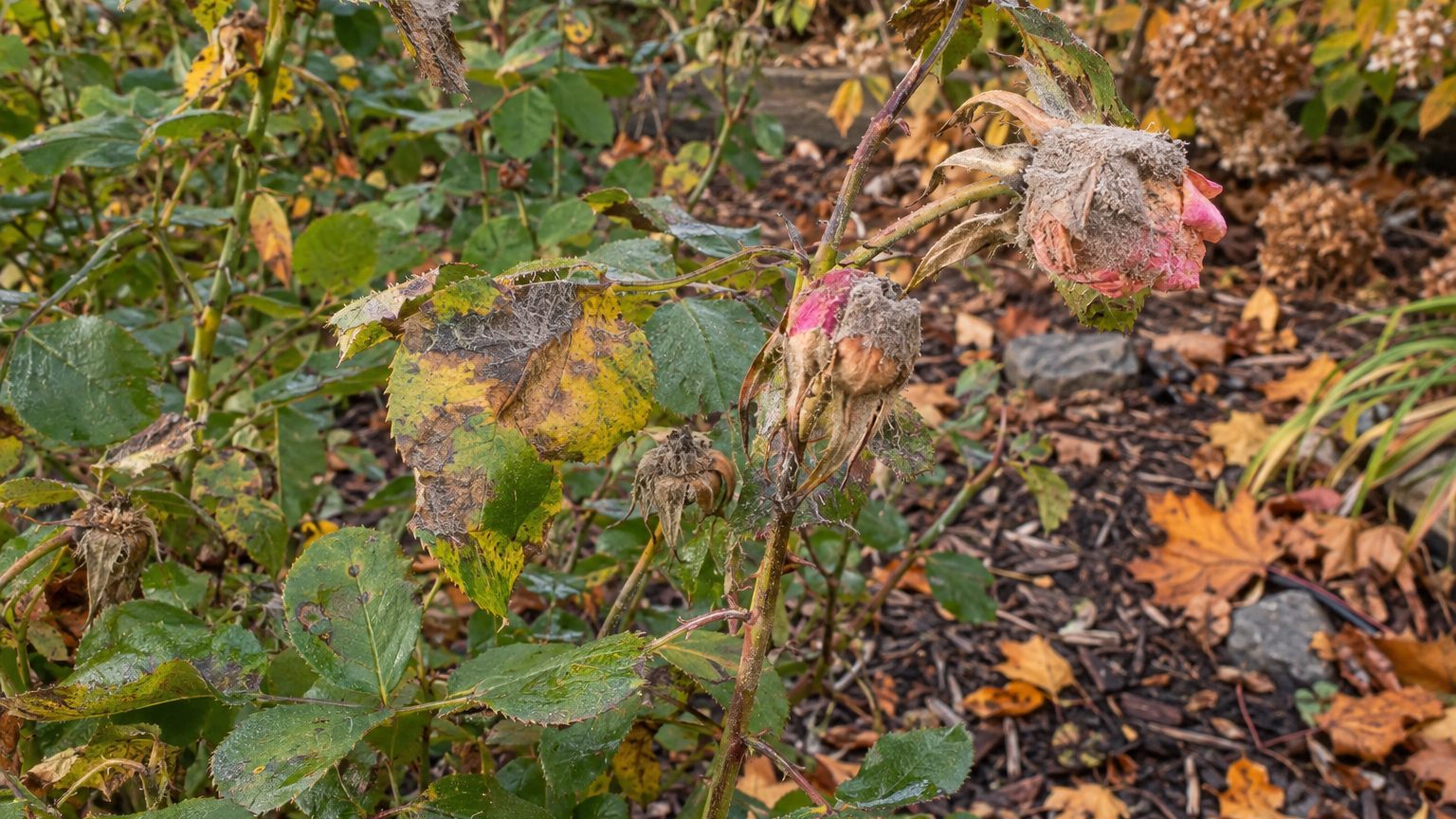
Rose buds that stay shut, then droop under a coat of gray fuzz after a spell of damp, cool weather, are the classic sign of botrytis blight. The fungus Botrytis cinerea causes it, and wet petals favor the disease.

Botrytis Blight: What You See

Botrytis Blight on Roses: Signs, Treatment and Prevention

The disease shows first on flowers and buds, and the gray fuzz is what sets it apart from other rose troubles.

  • Woolly gray-brown fungal growth covers decaying petals and buds, and it is easy to see in moist conditions.
  • Small, water-soaked lesions or light-colored spots with reddish halos appear on petals, then quickly spread into large, irregular blotches.
  • Buds fail to open and often droop, and infected flowers may turn completely brown.
  • Canes develop sunken, discolored cankers, with dieback that can run down the stem from the flower.
  • In Wisconsin, leaves have also shown dead, irregular patches that may have a bull’s-eye pattern.

A cane girdled by the fungus will wilt above the damage, so any drooping shoot deserves a closer look.

Botrytis Blight or Something Else?

Other rose problems can brown petals or kill buds, so check the fuzz, the affected plant part and the weather together. Pair what you see with where it appears and what the weather has been doing.

Looks like How to tell them apart
Buds that will not open from other causes Fungal infections such as botrytis can keep buds shut; botrytis also leaves gray-brown fuzz and blotched petals, especially in warmer temperatures.
Cane canker from another cause Botrytis cankers are sunken and discolored and trace back to a diseased flower or an old stub, with fuzzy gray mold on nearby dead tissue.
Leaf spots Botrytis leaf damage is irregular, dead and sometimes bull’s-eyed, and it comes with gray fuzz on nearby flowers or stems in damp weather.

Petals can also look bruised, with soft brown tips or sides, when botrytis is the cause. If the fuzz is missing, wait for moist weather and look again before deciding.

What Causes Botrytis Blight, and Where It Is Worst

The fungus Botrytis cinerea is the cause. It thrives in cool, wet, humid conditions, and it is most active when temperatures run 62 to 72 °F and the air stays moist. Anything that keeps petals wet for long stretches gives it room to work.

Condensation on flowers at moderate temperatures favors botrytis.

No one region owns this disease. It follows weather rather than a map and is more likely where plants are crowded or ground cover keeps humidity high.

How to Treat Botrytis Blight

Treatment is mostly cleanup, done in dry weather so you do not spread spores while the plant is wet.

  1. Remove infected buds and flowers as soon as you see them, so that the gray spores stop producing more.
  2. Cut diseased canes back to healthy tissue, so that cankers cannot keep moving down and girdle the stem.
  3. Take off stubs left after deadheading or harvest, because those stubs become infected and give the fungus a way into the cane.
  4. Bag the debris and dispose of it away from the garden, so that it cannot reinfect the plant.
  5. Open the plant up by thinning crowded growth, so that air moves through and petals dry quickly.
  6. Water at the soil, not over the blooms, so that buds are not wet for hours.

How to Prevent Botrytis Blight Coming Back

Prevention comes down to keeping humidity low around the plant, which you can do with timing and spacing across the season.

  • Prune crowded growth to open the bush and improve air circulation.
  • When planting, space roses so that neighboring plants do not crowd each other, which keeps the air circulating.
  • Through the growing season, water early in the day at the base, so foliage and buds dry quickly.
  • During bloom, snip spent flowers cleanly and remove the stub, because left-behind stubs are an entry point.
  • In cool, damp spells of spring and fall, check buds regularly and pull any that look soft or fuzzy.
  • In late fall, clear fallen petals and debris from beneath the plant, and thin out ground cover that holds moisture.

Reducing ground cover near the base is worth doing even if the plant looks healthy, since it lowers humidity right where blooms hang.

Where This Comes From

Botrytis blight comes from Botrytis cinerea, a fungus favored by high humidity. Cool, wet, overcast or very humid conditions favor the disease.

Common Questions

Can Botrytis Blight Kill a Rose Bush?

It mainly ruins flowers and buds, but it can also infect canes. Once the fungus girdles a cane, the shoot above it will wilt.

Why Do My Rose Buds Droop and Never Open?

Drooping buds that stay closed are a typical result of botrytis infection, especially when gray-brown fuzz appears on them. Check for fuzz and brown, blotched petals before blaming something else.

Does Gray Mold on Roses Spread to Other Plants?

Botrytis attacks many plants in landscapes, particularly in cool, wet, overcast or very humid conditions. Keeping nearby plants dry and clearing debris helps protect them too.

Black Spot on Roses: Signs, Treatment and Prevention

Black Spot on Roses: Signs, Treatment and Prevention

Dark blotches on rose leaves, ringed in yellow, usually show up when the weather turns warm and damp. Soon the lower leaves start dropping, and the bush looks thin by the time the blooms should be at their best. Black spot is a fungal disease of roses, and it can be slowed down once you know how it works.

Black Spot: What You See

Black Spot on Roses: Signs, Treatment and Prevention

The signs show up on the leaves first, and the pattern of dark lesions with yellow around them is what sets this disease apart.

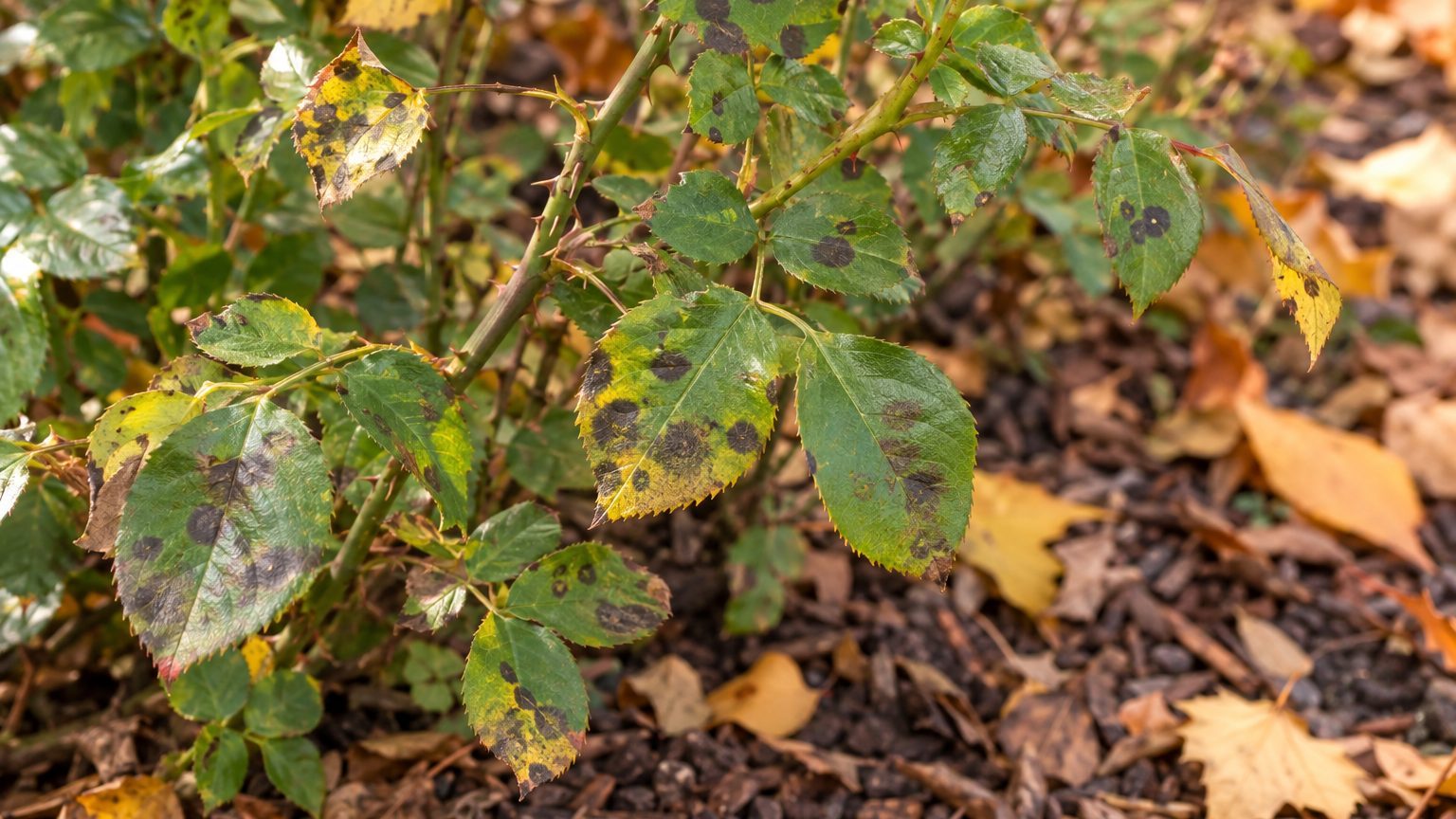
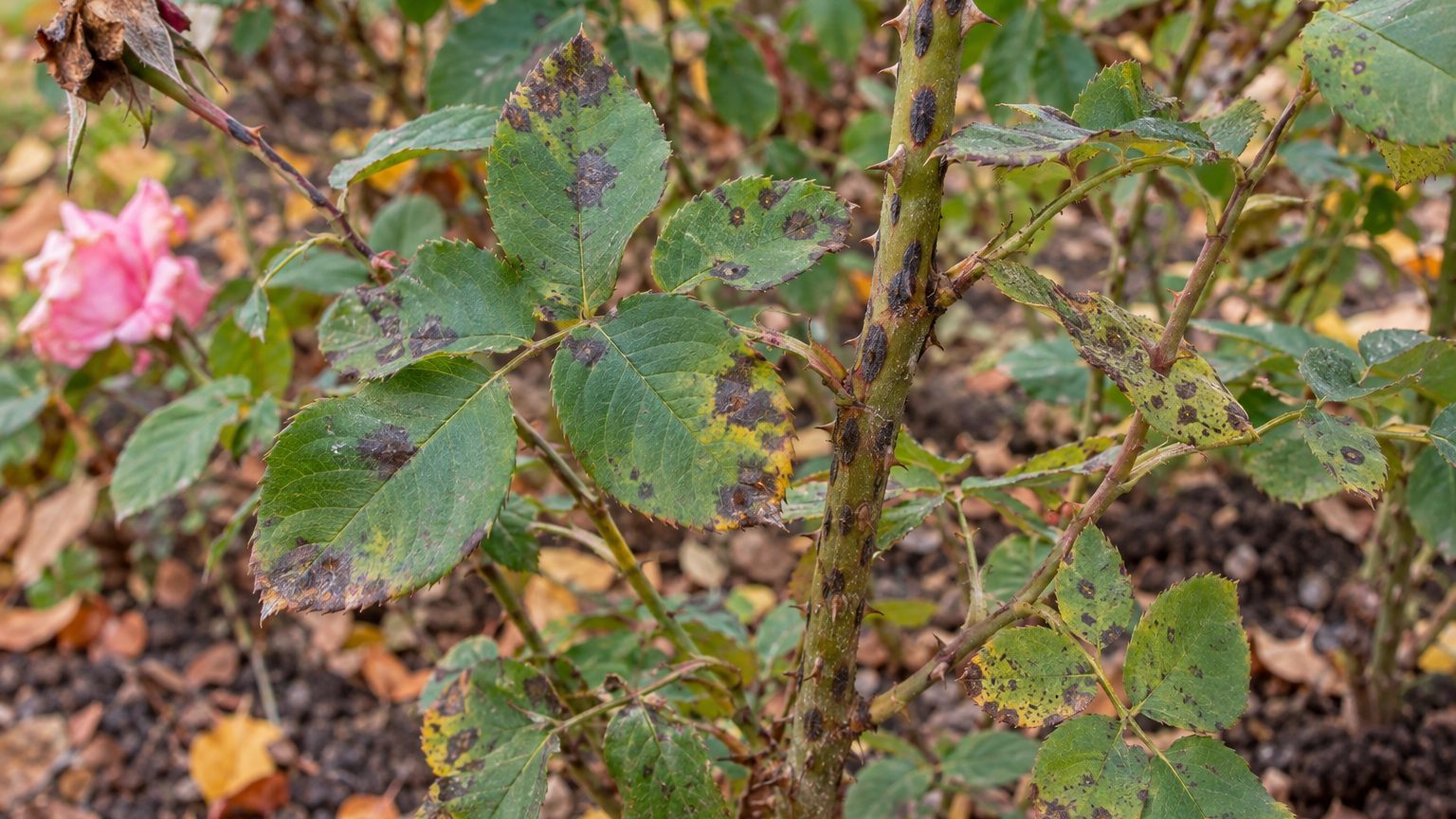
  • Dark lesions mark the leaves, and the tissue around each one often turns yellow.
  • Leaves are the part of the plant that suffers most, so the damage usually begins there.
  • Stipules, the small leaflike growths at the base of a leaf stalk, can carry spots too.
  • Pedicels, the slender stalks that hold the flowers, can be infected as well.
  • Spots can also turn up on peduncles, hips and sepals, so look at the flower parts, not only the foliage.
  • Severe leaf drop happens on the most susceptible roses, leaving bare, weakened canes.

A bush that loses its leaves loses the energy to bloom well, so spotted leaves deserve attention as soon as you see them.

Black Spot or Something Else?

Not every spotted or yellow rose leaf has black spot. Yellowing alone is common and has many causes, so it cannot identify black spot.

Look at where the color sits on the leaf and what else is going on around it. Check the lesion pattern and the rest of the plant before choosing a treatment.

Looks like How to tell them apart
Yellow leaves from poor feeding or watering Poor feeding or watering may cause yellowing without the dark, feathery-edged lesions typical of black spot.
Leaf damage from mites or other insects Tiny speckles or stippling show up, and a close look at the leaf underside with a hand lens turns up the pests themselves
Other leaf spot diseases Other leaf spot diseases can look similar, so check for black spot’s feathery margins and yellowing around lesions.

When the signs do not add up, get a diagnosis before choosing a treatment.

What Causes Black Spot, and Where It Is Worst

A fungus called Diplocarpon rosae causes black spot. It attacks only roses, so it will not jump to the other shrubs and flowers in the yard.

The infection cycle starts when rain or overhead sprinklers splash spores from infected leaves or canes left over from the previous season onto new growth. The spores must stay wet for several hours before they can get into the plant.

Conditions that favor the disease are warm and humid, with temperatures in the comfortable warm range that suits the fungus best. In South Dakota, leaf wetness of 6 hours or more favors black spot. Spores require at least 7 hours of wetness before they can germinate.

Black spot is found wherever roses are grown, so no region is free of it. Where warm, wet weather is common, it is considered the most serious rose disease.

How to Treat Black Spot

Treatment starts with cleanup and with changing how the bush gets wet. Work in this order.

  1. Pick off spotted leaves and bag them, so that the spores on them cannot be splashed onto healthy growth.
  2. Clear fallen leaves from the soil under the bush, since infected debris is where the next round of spores comes from.
  3. Water at the base of the plant and avoid wetting the leaves, because the fungus needs wet foliage to infect.
  4. Stay away from the plants when the foliage is wet, so that your hands and tools do not carry spores from leaf to leaf.
  5. Thin crowded stems to open the center of the bush, so that air can move through and leaves dry faster after rain or dew.

Once symptoms appear, black spot is hard to control. That is why protecting new growth matters as much as cleaning up the old.

How to Prevent Black Spot Coming Back

Prevention follows the season, because the spores wait on old leaves and canes until wet weather returns.

  • In early spring, rake out old leaves around the base and look over the canes for last season’s spots, since that is where the new infection cycle begins.
  • Before the weather warms and growth gets going, check the site. Give roses sun and keep large shrubs or trees from shading them.
  • As new leaves open, water at the soil line in the morning and switch off overhead sprinklers, so that spores are not splashed upward onto fresh growth.
  • Through the warm, humid stretch of summer, prune out crowded stems so that air keeps moving, and keep your hands off the plants when the leaves are wet.
  • When you feed the bush, skip high-nitrogen fertilizer. Fertilize only as a soil test indicates.
  • After the leaves drop in fall, rake them up and throw them out, so that infected debris does not sit under the bush all winter.

Removing infected debris and keeping leaves dry both help disrupt the infection cycle.

Where This Comes From

Black spot comes from fungal spores spread by rain or overhead irrigation from leaves or canes infected the previous season.

Common Questions

Can Black Spot Kill a Rose?

It can weaken one badly. Left unmanaged, black spot lowers the vigor and bloom of a rose, and it reduces the quality and life span of roses grown outdoors.

Can Black Spot Spread to Other Plants in the Yard?

No. The fungus is a parasite specific to roses, so your other shrubs and flowers are not at risk from it, though every rose nearby is.

Do Some Roses Never Get Black Spot?

Almost none escape. The disease affects nearly all rose cultivars worldwide, though the leaf loss is worst on the most susceptible ones.

Anthracnose on Roses: Signs, Treatment and Prevention

Anthracnose on Roses: Signs, Treatment and Prevention

Small dark spots on rose leaves in a wet spring, with centers that later drop out and leave tiny holes, point to anthracnose. The fungus slows the plant down and, left alone, can strip a bush of leaves. Catching it early and cleaning up around the bush keeps it manageable.

Anthracnose: What You See

Anthracnose on Roses: Signs, Treatment and Prevention

The leaf spots are the first thing you notice, and they change as they age.

  • Centers of the spots turn gray or white and fall out, leaving a shot-hole look, and the spot edges stay smooth.
  • Young spots start out red, or sometimes brown to purple.
  • Spots are dark purple to black, ringed by a narrow, dull-brown band.
  • Small fruiting bodies may show up in the middle of a spot before the center drops.
  • Similar spots form on the canes.

If the disease is left untreated, the leaf loss can become severe.

Anthracnose or Something Else?

Black spot is the usual confusion, since both put dark marks on rose leaves and the same control steps work on either. The difference is in what happens to the middle of each spot.

Check the edges and centers across the affected foliage before deciding.

Looks like How to tell them apart
Black spot on leaves Spots on black spot stay in place and often have fringed edges. Anthracnose spots are smooth edged, and the gray centers drop out.
Shot-hole damage from other causes Anthracnose holes follow gray or white centers with a dark red margin and sometimes tiny fruiting bodies in the middle. Holes without that earlier spot stage point elsewhere.

Spot anthracnose, the shot-hole form, tends to matter less unless the weather is very hot, too hot for black spot to thrive.

What Causes Anthracnose, and Where It Is Worst

A fungus called Elsinoe rosarum, formerly Sphaceloma rosarum, causes rose anthracnose. It lives on infected plant tissue, including cane spots, and moves to new growth when conditions suit it.

The disease spreads during extended wet weather when temperatures are moderate. Extended wet weather with moderate temperatures favors the disease.

Wet weather and moderate temperatures give the fungus its chance.

How to Treat Anthracnose

Treatment follows the same steps used against black spot, and you work from the plant outward.

  1. Remove spotted leaves and any fallen ones, so that fungus left on them cannot reinfect the bush.
  2. Cut out cane spots on affected stems, so that the fungus living there stops feeding new growth.
  3. Bag the debris and put it in the trash, because leaving it in a pile near the roses keeps the source close.
  4. Water at the base of the plant, so that leaves dry quickly and stay unfriendly to the fungus.
  5. Follow the black spot control routine, since those procedures also control anthracnose.
  6. If you use a pesticide, it must be labeled for black spot or anthracnose, whichever disease you are treating.

Black spot control procedures also control anthracnose, but the pesticide label must still match the disease being treated.

How to Prevent Anthracnose Coming Back

Good sanitation is an important part of prevention.

  • Check the canes for spots before leaves open and clear away any debris from last season.
  • As new leaves unfold, scan them regularly for the first red or purple spots, since early removal keeps the fungus from building.
  • During wet spells in spring, avoid overhead watering and give each bush room for air to move through.
  • Through summer, keep picking off spotted leaves and keep the ground beneath the bush clean.
  • Rake up every fallen leaf and discard it rather than composting it.

Keep infected leaves and cane spots out of the garden as part of good sanitation.

Where This Comes From

Rose anthracnose comes from the fungus Elsinoe rosarum, formerly Sphaceloma rosarum. It spreads during extended wet weather when temperatures are moderate.

Common Questions

Can a Rose Recover from Anthracnose?

Yes, when the leaf loss is caught early and the bush is cleaned up. Untreated, the disease can cause severe defoliation, which is hard on the plant.

Does Anthracnose Affect the Canes as Well as the Leaves?

It does. Spots similar to the leaf spots form on the canes, so check the stems along with the foliage.

Should You Use the Same Spray for Black Spot and Anthracnose?

Treatment is the same, but any pesticide must be labeled for black spot or anthracnose, whichever disease you are treating.

White Rot on Spring Bulbs: Signs, Treatment and Prevention

White Rot on Spring Bulbs: Signs, Treatment and Prevention

Bulbs that pull out of the soil with no resistance, their roots gone and their base wrapped in fuzzy white growth, are the classic picture of white rot in a spring bed. The disease lives in the soil, not the air, and once it settles in, it stays. Catching it early and keeping it from moving around the yard decides how much of the bed you save.

White Rot: What You See

Start at the base of the bulb, because that is where the disease announces itself, and work up to the leaves.

  • Bulbs are covered in black sclerotia (tiny fungal resting bodies) about the size of poppy seeds.
  • Early on, fluffy white growth wraps around the base of the bulb, and large dark brown spots can mark the bulb itself.
  • Roots rot away, so the plant lifts out of the ground with almost no effort.
  • The bulb scales turn semi-watery and soft, and white or pink fungal growth can show on them.
  • Leaves yellow and wilt, and the decay begins at the base, with the oldest leaves collapsing first.

Any of these on a bulb you dig up means it should not go back into the ground.

White Rot or Something Else?

Bulbs have plenty of ways to rot, and several of them look alike from the garden path. Yellow leaves and a soft bulb fit more than one problem, so look at where the damage sits and what the surface looks like.

Looks like How to tell them apart
A gray mold disease on leaves and petals Brown decay spreads over leaves and petals, and a brownish-gray powdery mold covers the surface. White rot starts at the base and roots instead, with fluffy white growth.
Nematode or bacterial rot Discolored patches and a soft, spongy bulb decay, but no black poppy-seed sclerotia and no fluffy white collar at the base.

Tulip and daffodil bulbs also suffer from basal rot, black slime, blue mold and crown rot (southern wilt). If the bulb shows none of the black sclerotia and no white growth at the base, one of these is the more likely cause, and your state extension office can help sort them out.

What Causes White Rot, and Where It Is Worst

A fungus called Sclerotium cepivorum causes it, a relative of the white mold fungi. It does not drift on the wind as airborne spores. It moves as threads of mycelium and as sclerotia, in soil carried on tools, boots and bulbs.

Those sclerotia can sit dormant in the soil until an allium grows nearby. The roots give off sulfur compounds, the fungus detects them, and it wakes up. That is why a bed can look healthy for seasons before trouble starts.

Moisture that suits good bulb growth suits the fungus too, so there is no dry or wet extreme to dodge. Excess nitrogen, phosphorous or organic matter in the bed also works against you. Wherever the fungus has been introduced, it is a problem.

How to Treat White Rot

Treatment is about removing what is infected and stopping the soil from traveling, because chemical controls have not been shown to work.

  1. Lift any plant that yellows early or wilts at the base, so that you can check the roots and bulb for black sclerotia and white growth.
  2. Remove and destroy infected plants, bulbs and the soil clinging to them, so that the fungus does not return to the bed or the compost pile.
  3. Handle remaining bulbs gently, because bruises give rot an easy way in.
  4. Wash tools, boots and wheelbarrow wheels after working in the affected spot, so that sclerotia are not carried to clean beds.
  5. Leave healthy neighbors in the ground, and let their leaves stay until they turn yellow, so that the bulbs can still feed themselves for next year.
  6. Ask your state extension office what, if anything, is approved locally before buying any treatment, because products and rules vary by state.

Be realistic about the timeline. The pathogen can persist in the soil for up to 40 years, so the aim is to keep it from spreading and to plant clean bulbs elsewhere or in rotated beds.

How to Prevent White Rot Coming Back

Prevention follows the gardening year, from the day you buy bulbs to the day the leaves fade.

  • In early fall, buy clean, disease-free bulbs and look each one over, because planting clean stock is a key step against this disease.
  • At planting time in fall, reject any bulb with white or pink fungus on it, and handle the rest carefully to avoid bruising.
  • When you prepare a bed in fall, go easy on nitrogen, phosphorous and organic matter, since heavy amounts favor the fungus.
  • Each year when you choose a spot, rotate the flower beds so that soil pathogens do not build up to high levels.
  • In late spring, leave the foliage until it turns yellow, and watch for early yellowing or wilting at the base while you do.

Keep a note of where affected plants stood, since that is the bed to rest from bulbs the following fall.

Where This Comes From

The details here come from university extension and government plant disease pages. Before you act on a rule or a product, confirm it with your state’s cooperative extension service, since soils and approvals differ from one place to the next.

Common Questions

When Do White Rot Symptoms Usually Show Up?

Plants can be infected at any stage of growth. In California, symptoms usually appear from mid-season to harvest, so the damage often shows after the bulbs have been growing for a while.

Why Did My Tulips Not Come Up, or Come Up Yellow or Reddish?

In Texas, tulips may fail to come up, or their leaves may turn yellow or reddish, stunt and die because the bulb has rotted. Dig one up and check the base and roots, since the same symptoms can come from other bulb rots.

How Much Infested Soil Does It Take to Cause a Problem?

Very little. Only 1 sclerotium per 10 liters of soil is enough to cause disease, and 10 to 20 sclerotia will cause upwards of 90% infestation. Flowers from infected bulbs also come up deformed, and the foliage dies early.

Tulip Fire on Spring Bulbs: Signs, Treatment and Prevention

Tulip Fire on Spring Bulbs: Signs, Treatment and Prevention

Tulip leaves that emerge twisted, or petals dotted with spots after a damp spell, are easy to spot when you walk the bed in spring. The usual cause is tulip fire, a fungal disease of tulips that attacks leaves, stems and flowers. A bed that has had it can be managed with a few steady habits, and most of them cost nothing.

Tulip Fire: What You See

Look first for burned-looking spots on leaves and flowers, then check the rest of the plant for these signs.

  • Spots on leaves and flowers often have dark borders that resemble burn injury.
  • On leaves, the patches are slightly sunken, yellow to light tan and ringed by a water-soaked area, which shows most on light-colored varieties.
  • Spots on colored petals look white, while spots on white petals look brown.
  • In Arkansas, leaves just emerging from the soil may be distorted and twisted, and they often wither.
  • In damp, overcast weather, damaged leaves, stems and flowers become covered with a fuzzy grey mat.

In Washington, severe infections can blight entire buds and blossoms.

Tulip Fire or Something Else?

Several ordinary problems leave brown or pale marks on tulips, so one odd spot proves little. Pair what you see with where it sits and what the weather has been doing.

Looks like How to tell them apart
Frost or hail injury: torn, blackened or scorched edges on leaves and petals Injury alone leaves clean damage. Tulip fire adds water-soaked rings around sunken spots and a grey fuzzy mat in damp weather. In Illinois, the disease commonly follows frost or hail damage.
Gray mold on another plant: fuzzy grey growth on soft tissue This fungus is specific to tulips and lilies, so grey mold on a shrub or perennial is a separate matter. Check whether the spotted plant is a tulip or lily and whether its leaves show spots.
Normal petal fading: browning petals at the end of bloom Fading petals are dead tissue. Tulip fire shows on young leaves and fresh petals that are still colored, with spots that have darker borders.

Because the fungus feeds first on dead or declining tissue, fading petals are often where trouble starts, even though the browning itself is normal.

What Causes Tulip Fire, and Where It Is Worst

A fungus called Botrytis tulipae causes the disease. It overwinters in soil, in affected bulbs and in diseased plant debris. Each spring, the usual starting point is a stunted, blighted plant grown from a diseased bulb that was planted by accident. In damp, overcast weather, a dense grayish mold forms on it and spreads to neighbors.

Cool, damp spring or summer weather favors the disease in Washington. In Illinois, cool, wet spring weather can lead to an almost complete loss of flowers if the disease is not controlled. It is also a common fungal disease of bulbs in the Northeast. The disease is the most common and serious one wherever tulips are grown, so no region is exempt.

Poor air movement helps it along, whether from crowded plantings, excessive weeds or a stagnant spot. In Illinois, spores have survived on the surface of moist soil at 50°F (10°C). They can stay there for up to six weeks. Petals that drop onto leaves can carry the infection further.

How to Treat Tulip Fire

Start with the plants themselves, then clean up the bed and change its conditions.

  1. Dig out stunted, twisted or blighted shoots, bulb included, so that the plants feeding the first spores are gone before the mold spreads.
  2. Pick off fallen petals lying on leaves, because decaying petals give the fungus a place to feed and spread.
  3. Bag diseased debris and put it in the trash instead of the compost pile, since the fungus overwinters in plant debris.
  4. Pull weeds and thin crowded clumps so air moves through the bed and foliage dries faster.
  5. Water at the soil rather than over the leaves, which keeps leaves from staying wet in cool weather.
  6. Ask your state’s cooperative extension office which fungicides are approved where you live, since labels and rules differ from state to state.

Leaves that still look healthy stay on the plant until they turn yellow, because they are feeding the bulb for next year.

How to Prevent Tulip Fire Coming Back

Prevention follows the year, from the planting bed in fall to the cleanup after the leaves fade.

  • In fall, plant in an open spot with good airflow, clear of weeds, and discard any bulb that looks diseased before it goes in the ground.
  • In early spring, check emerging shoots for twisted or stunted growth and pull them at once, since these plants spread the fungus to the rest.
  • During bloom, snip off spent flower heads before petals drop onto the leaves, and leave the foliage alone.
  • In cool, damp stretches of spring, keep weeds down regularly so air keeps moving around the plants.
  • Once the leaves have turned yellow, clear away the dead foliage and any debris so the fungus has nowhere to overwinter.

Doing this each year matters more than any single treatment, because the fungus lives on in the bed between seasons.

Where This Comes From

The details here come from university extension and government pages written for Washington, Illinois, Arkansas and the Northeast. Timing and weather patterns vary, so check with your state’s cooperative extension service for what applies in your yard.

Common Questions

Can Tulip Fire Spread to Other Plants in the Bed?

The fungus is specific to tulips and lilies, so other bulbs growing nearby are not its target.

Does Frost or Hail Make Tulip Fire Worse?

In Illinois, the disease commonly follows frost or hail injury, because damaged tissue gives the fungus an easy way in. After a late cold snap or a storm, look over the leaves closely for spots.

Can You Replant Tulips Where Tulip Fire Struck?

Tulips planted in contaminated soil within two years face considerable risk of infection. Move them to a fresh bed, and throw out any diseased bulbs instead of replanting them.

The almanac, state by state. Every date on this site comes from a state’s own frost facts and its extension service’s calendar — and says where it comes from.