Skip to content

Hydrangea Rust on Hydrangeas: Signs, Treatment and Prevention

Hydrangea Rust on Hydrangeas: Signs, Treatment and Prevention

Hydrangea rust is a fungal leaf disease. It shows up as yellow spots on top of the leaf and orange, powdery pustules underneath. It is mostly cosmetic, but a heavy attack can strip leaves early. The right response depends on your hydrangea type, because rust is tied most closely to panicle hydrangeas.

Hydrangea Rust: What You See

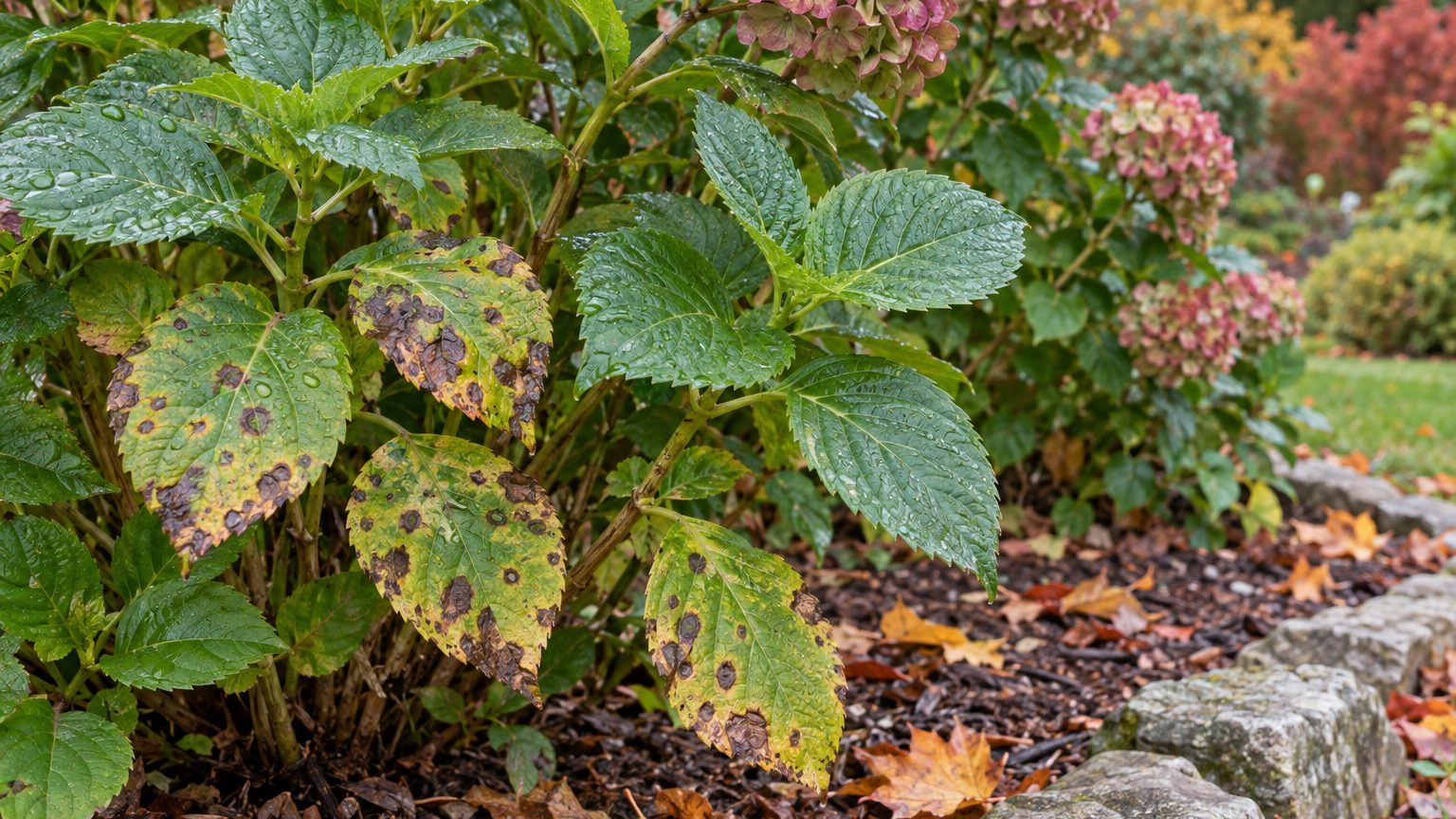
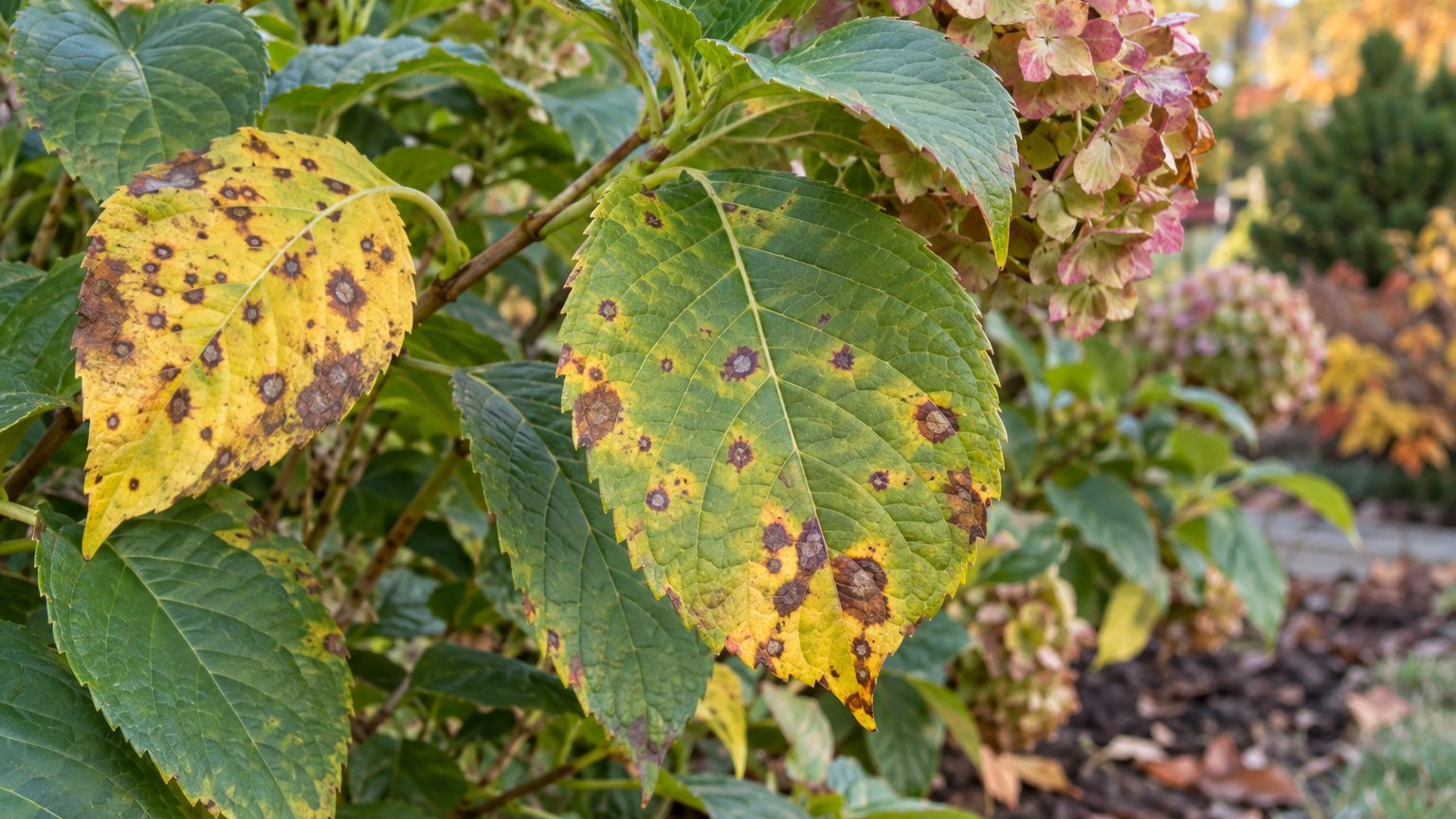
Hydrangea Rust on a hydrangea

NC State Extension Gardener Plant Toolbox lists rust among the diseases of panicle hydrangea (H. paniculata), so read the leaves on both faces before you decide anything.

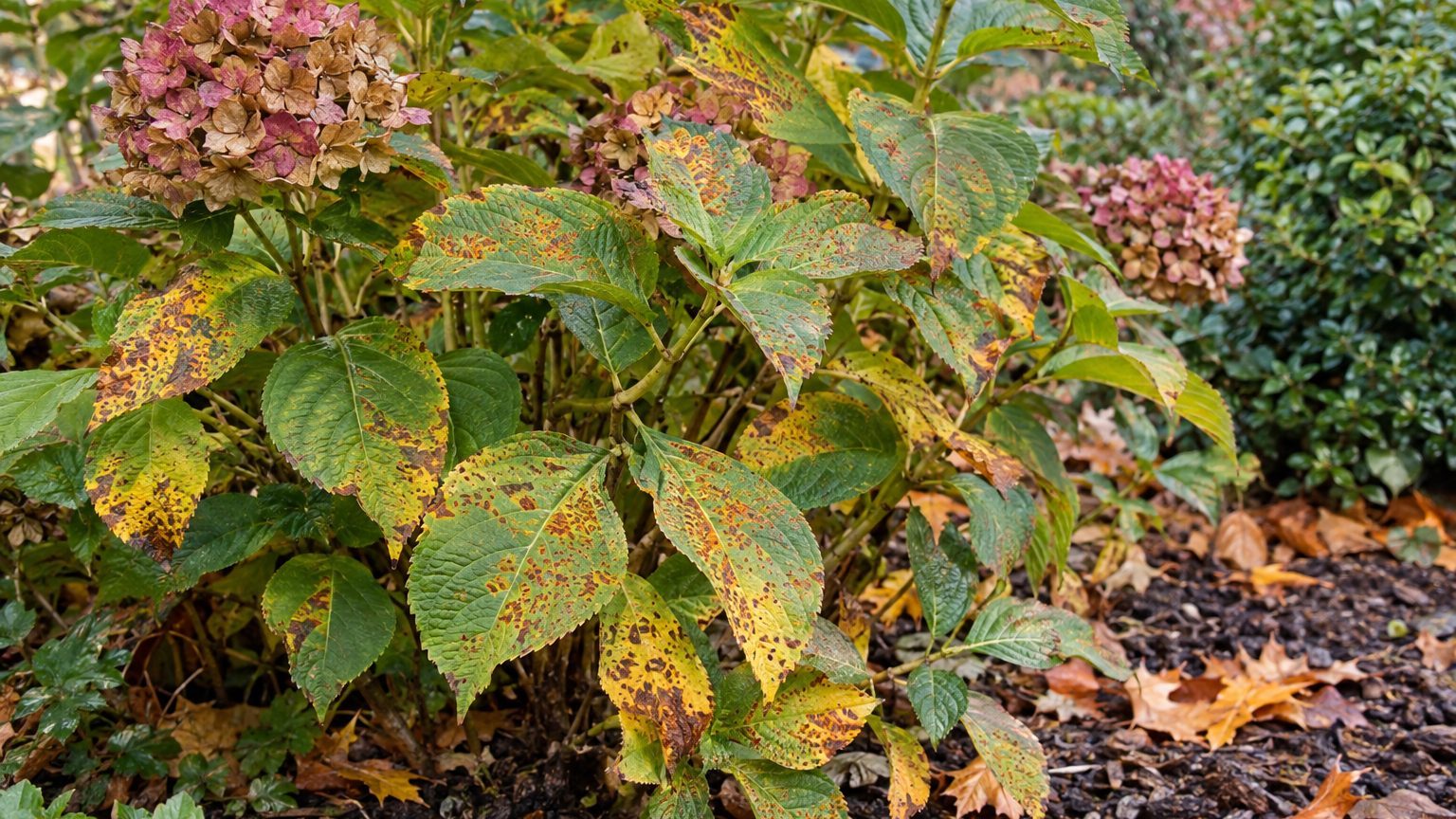
  • Yellow patches on the upper leaf surface, often small and angular.
  • Orange to rusty-brown pustules on the underside, sitting right behind each patch.
  • A fine orange powder that wipes onto a fingertip or a white tissue.
  • Leaves that curl, brown and drop early when the attack is heavy.
  • Symptoms that start on the lower, shaded, crowded leaves and climb from there.

The underside of the leaf is where the diagnosis is made, so flip a few leaves before you touch the pruners.

Hydrangea Rust or Something Else?

NC State Extension Gardener Plant Toolbox names three common leaf and stem problems on hydrangeas: leaf spot, bacterial wilt and powdery mildew. Two of them are easy to mistake for rust on a quick glance.

One test settles most cases. Rub the affected area and look at what comes off, then check which side of the leaf carries the damage.

Looks like The sign that tells them apart
Leaf spot: brown or tan blotches Spots with a defined edge and nothing powdery on the underside. Nothing rubs off.
Powdery mildew: dusty patches The powder is white to gray, not orange, and it sits on the upper leaf surface as often as underneath.

Rust is the one with orange dust under the leaf. Bacterial wilt and the other problems have their own pages, gathered on the Hydrangea Diseases hub.

What Causes Hydrangea Rust, and Where It Is Worst

NC State Extension Gardener Plant Toolbox lists rust on panicle hydrangea, a type hardy in USDA zones 3a to 8b. Rust is caused by a fungus whose spores spread on wind and splashing water, and it thrives where leaves stay wet.

The source does not map rust state by state, so this list follows the plants and the weather, not an invented outbreak map.

  • Great Lakes and the North (Michigan, Minnesota, Wisconsin): panicle is the hydrangea that survives the coldest winters here, so it is the type most likely to carry rust.
  • The South (Georgia, Texas, the Carolinas): long humid summers keep foliage damp, and both bigleaf and panicle are grown side by side.
  • Pacific Northwest (Oregon, Washington): mild, damp springs and falls give spores plenty of wet-leaf time.
  • Interior West and Plains (Colorado, Nebraska, Kansas): dry air helps, but sprinklers that wet the foliage can recreate the problem.

Your state page on this site gives the calendar and the varieties that suit your zone.

How to Treat Hydrangea Rust

NC State Extension Gardener Plant Toolbox rates hydrangea maintenance as low, so treatment is mostly clean-up and airflow. Work through it in this order this week.

  1. Confirm the type: check whether you grow panicle, bigleaf or another kind, because rust is the disease the source ties to panicle.
  2. Pick off spotted leaves: remove only the affected foliage and leave the stems, since bigleaf sets its flower buds on last year’s wood.
  3. Bag, don’t compost: put the leaves in the trash, along with any that have already fallen under the shrub.
  4. Water at the base: aim at the soil in the morning, so the leaves dry quickly. Both bigleaf and panicle are shallow-rooted and benefit from mulch.
  5. Open the canopy: thin crowded stems lightly so air moves through the center of the shrub.
  6. Ask your extension office: your state’s service alone knows which fungicides are registered locally, if you need one at all.

Skip anything that promises a cure in a day. Rust is slow, and steady sanitation does more than any single spray.

How to Prevent Hydrangea Rust Coming Back

NC State Extension Gardener Plant Toolbox gives bigleaf a mature size of 3 to 6 feet tall and wide, and panicle 8 to 25 feet, so spacing decisions start at planting. Then the year does the work.

  • Late winter: cut panicle hydrangeas back hard, since they bloom on the current season’s growth, and leave bigleaf alone.
  • Spring: lay mulch over the shallow roots to keep soil from splashing spores onto low leaves.
  • Summer: water at ground level in the morning and never with an overhead sprinkler in the evening.
  • Early fall: rake and bag fallen leaves before they can carry spores through winter.
  • After frost: cut dead hollow stems to 12 to 24 inches and leave them standing, which suits native bees that nest in them.
  • Any time: give new plants room for their mature width, so air can move between shrubs.

Deer browse hydrangeas, so a fence or a cage also keeps torn, stressed foliage out of the picture.

Where this comes from

The plant facts here come from the NC State Extension Gardener Plant Toolbox entry for hydrangea. It gives hardiness, blooming habit, size and the diseases named above.

Treatment products and timing vary by state. Check with your state’s extension service before you buy anything or schedule a cut.

Common questions

Does rust affect every hydrangea type?

The source lists rust specifically on panicle hydrangea. For the genus as a whole it names leaf spot, bacterial wilt and powdery mildew, so check the leaf underside before you name the problem.

Should I cut the whole shrub back to get rid of it?

Not without knowing your type. Panicle flowers on the current season’s growth, but bigleaf flowers on last year’s wood, so a hard cut can remove next summer’s blooms.

Which product should I buy?

None until your state extension office weighs in. Registered products differ from state to state, and sanitation and airflow come first anyway.
Powdery Mildew on Hydrangeas: Signs, Treatment and Prevention

Powdery Mildew on Hydrangeas: Signs, Treatment and Prevention

Powdery mildew on hydrangea shows as a white, flour-like film on the leaves, and it is usually a cosmetic problem long before it is a serious one.

Pick off the worst leaves, open up the airflow, and ask your state extension service what is registered locally before buying a spray. Which cuts are safe depends on your hydrangea type.

Powdery Mildew: What You See

Powdery Mildew on a hydrangea

The NC State Extension Gardener Plant Toolbox lists powdery mildew among the diseases of the genus, and in the yard it announces itself by sight first.

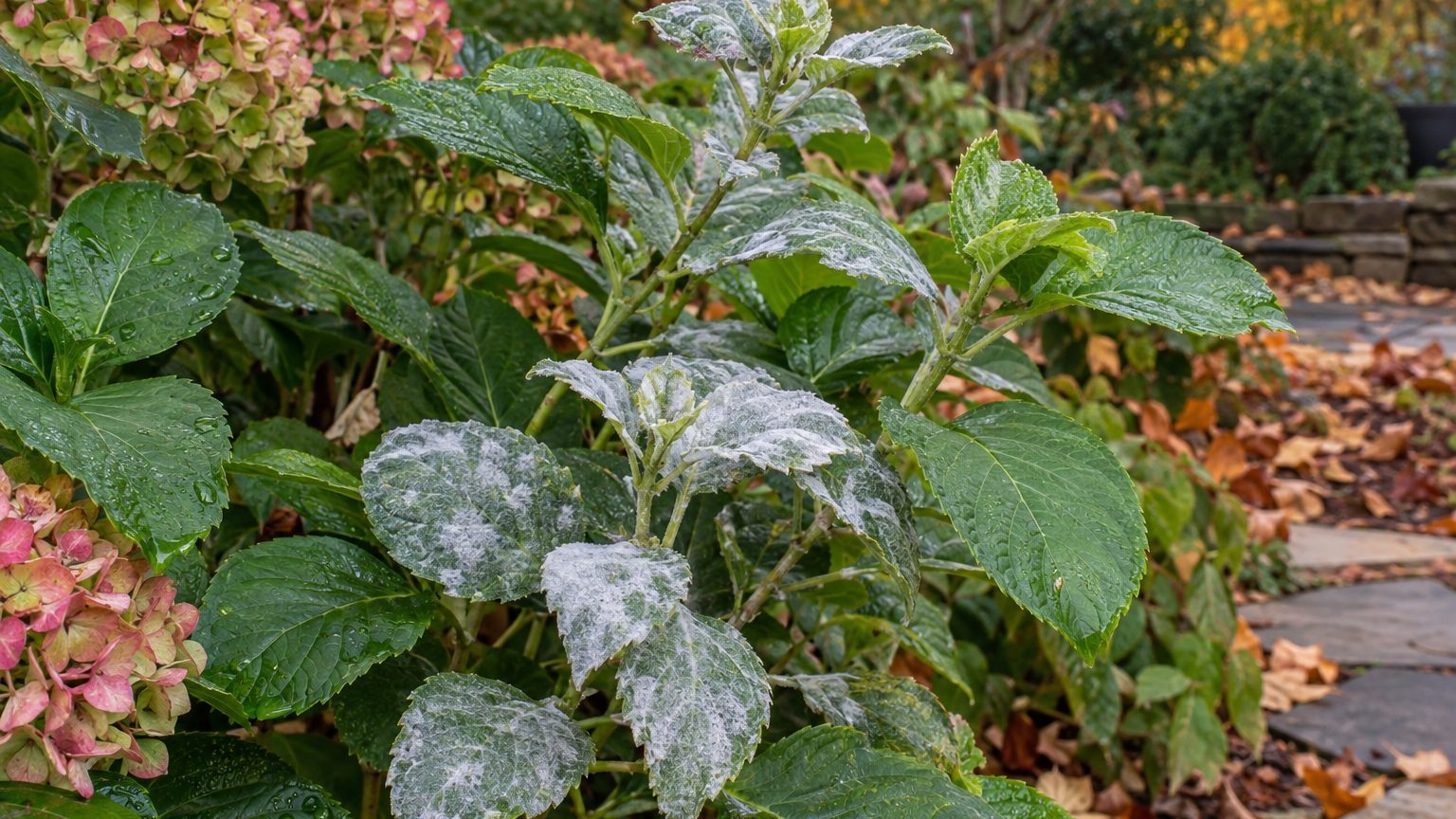
  • A white to gray, flour-like film on the top of leaves, often starting on shaded or inner growth.
  • Patches that spread and merge into a coating that smears off under a damp thumb.
  • Young leaves that curl, twist or stay small where the coating is heavy.
  • A dusty look on flower buds and sepals when the infection is bad.
  • Yellowing or browning leaves under the coating, most often from midsummer into fall.

The same coating turns up on bigleaf, panicle and the other types, so the leaf names the disease and only the type tells you how far you can cut.

Powdery Mildew or Something Else?

The NC State Extension Gardener Plant Toolbox names leaf spot, bacterial wilt and powdery mildew for the genus, and adds rust and bud blight on panicle. Three of those can pass for a dusty leaf at a glance.

One test sorts most of them: rub the spot with a damp thumb. A coating that smears off, with green tissue beneath, points to mildew. Anything that stays put is damage inside the leaf, which is a different disease.

Look-alike Looks like The sign that tells them apart
Rust (named on panicle) Dusty specks on the leaf The powder is orange, not white, and it usually sits on the underside of the leaf.
Leaf spot Blotched, discolored leaves The spots have a defined edge and nothing wipes off.
Bacterial wilt Limp, drooping shoots The leaves droop with no coating on them, even when the soil is moist.

Each of the first and last has its own sheet: Hydrangea Rust on Hydrangeas: Signs, Treatment and Prevention and Bacterial Wilt on Hydrangeas: Signs, Treatment and Prevention. Bud blight is covered separately.

What Causes Powdery Mildew, and Where It Is Worst

Powdery mildew is a fungus that settles where air stays still and stems crowd. The NC State Extension Gardener Plant Toolbox, which puts panicle at 3a to 8b and bigleaf at 6a to 11b, lists it for the genus but maps nothing, so I read regions by type.

  • Great Lakes and the North (Michigan, Minnesota, Wisconsin): panicle and smooth do the work here, so crowded stems on those two are the ones to watch.
  • Northeast and Mid-Atlantic (New York, Pennsylvania, Virginia): the mix widens to bigleaf, oakleaf and mountain, so check each type’s wood before you cut anything.
  • The South (Georgia, Texas, the Carolinas): bigleaf reaches up to zone 11b, and its dappled-to-deep-shade spots are the still corners where a fungus settles.
  • Plains and Mountain West (Colorado, Nebraska, Kansas): panicle, the only hydrangea that takes full sun well, suits open sites where air moves.

Your state’s page carries the zone, the type and the calendar for your yard, and the other sheets sit under Hydrangea Diseases.

How to Treat Powdery Mildew

Start with the type you own, because the NC State Extension Gardener Plant Toolbox splits hydrangeas by which wood carries the flowers, and that sets how much you can cut.

  1. Wipe one leaf: a chalky smear that lifts off under a damp thumb, with green tissue beneath, separates mildew from spotting.
  2. Bag the worst leaves: pick off heavily coated leaves and put them in the trash, not the compost pile, so the spores leave the yard.
  3. Thin by type: on panicle and smooth, which flower on new wood, take out a few crowded inner stems, but on bigleaf, oakleaf, mountain and climbing, remove leaves only.
  4. Water the soil, not the leaves: do it early in the day so the foliage is dry well before night.
  5. Call your county extension office: ask which fungicide, if any, is registered in your state, since that list changes by state and I won’t guess it.
  6. Recheck weekly: look at new growth and leaf undersides, and note whether the coating is spreading.

Bag the leaves, spare the stems. Cutting an old-wood hydrangea back hard to chase mildew can cost next year’s flowers, since bigleaf buds form the previous summer. A damaged leaf is the cheaper loss.

How to Prevent Powdery Mildew Coming Back

The calendar does most of the prevention, and it starts with roots, since the NC State Extension Gardener Plant Toolbox lists macrophylla and paniculata as shallow-rooted and says both benefit from mulch.

  • Late winter: on panicle, which flowers on the current season’s growth, thin a few crowded stems to open the center to air.
  • Spring planting: leave room for mature size, 3 to 6 feet tall and wide for bigleaf and 8 to 25 feet for panicle, and mulch over the shallow roots.
  • Summer watering: water at the base early in the day, and check inner stems and leaf undersides about once a week.
  • Late summer: leave bigleaf and other old-wood types uncut, because next year’s buds are forming now.
  • Autumn: rake up and bag fallen leaves from any plant that had mildew.
  • Winter: if you cut dead hollow stems, leave stubs 12 to 24 inches tall, where native bees nest.

Your state page sets the exact dates, and the type decides which of these steps apply to you.

Where this comes from

Hardiness ranges, wood types and the disease list come from the NC State Extension Gardener Plant Toolbox entry for Hydrangea. The symptom descriptions are general field guidance, not figures from that entry.

Treatment rules vary by state, so confirm what is registered and recommended with your state’s cooperative extension service before you spray anything. A county office can often help you confirm your hydrangea type from a photo of the leaf and bloom.

Common questions

Can powdery mildew kill a hydrangea?

It mostly disfigures leaves. A thick coating that spreads year after year is worth a call to your county extension office, which can rate the risk in your area.

Does my hydrangea type change how I treat it?

Yes. Panicle and smooth flower on new wood and tolerate thinning, while bigleaf, oakleaf, mountain and climbing carry buds on old wood, so heavy cutting can remove flowers.

Will it come back next year?

It can, whenever still air and crowded stems return. Late-winter thinning on panicle and a fall cleanup of fallen leaves are the two habits that work against it.

Leaf Spot on Hydrangeas: Signs, Treatment and Prevention

Leaf Spot on Hydrangeas: Signs, Treatment and Prevention

Leaf spot on hydrangeas is a leaf disease that thrives on wet foliage. Most cases get the same handling: pick off the spotted leaves, keep the rest dry, and clean up in fall.

The timing changes with the type you grow, since bigleaf, panicle and smooth hydrangeas differ in hardiness and pruning. Your zone and type settle the rest.

Leaf Spot: What You See

Leaf Spot on a hydrangea

The NC State Extension Gardener Plant Toolbox lists leaf spot among the diseases of hydrangea, and on the leaf it follows a fairly steady pattern.

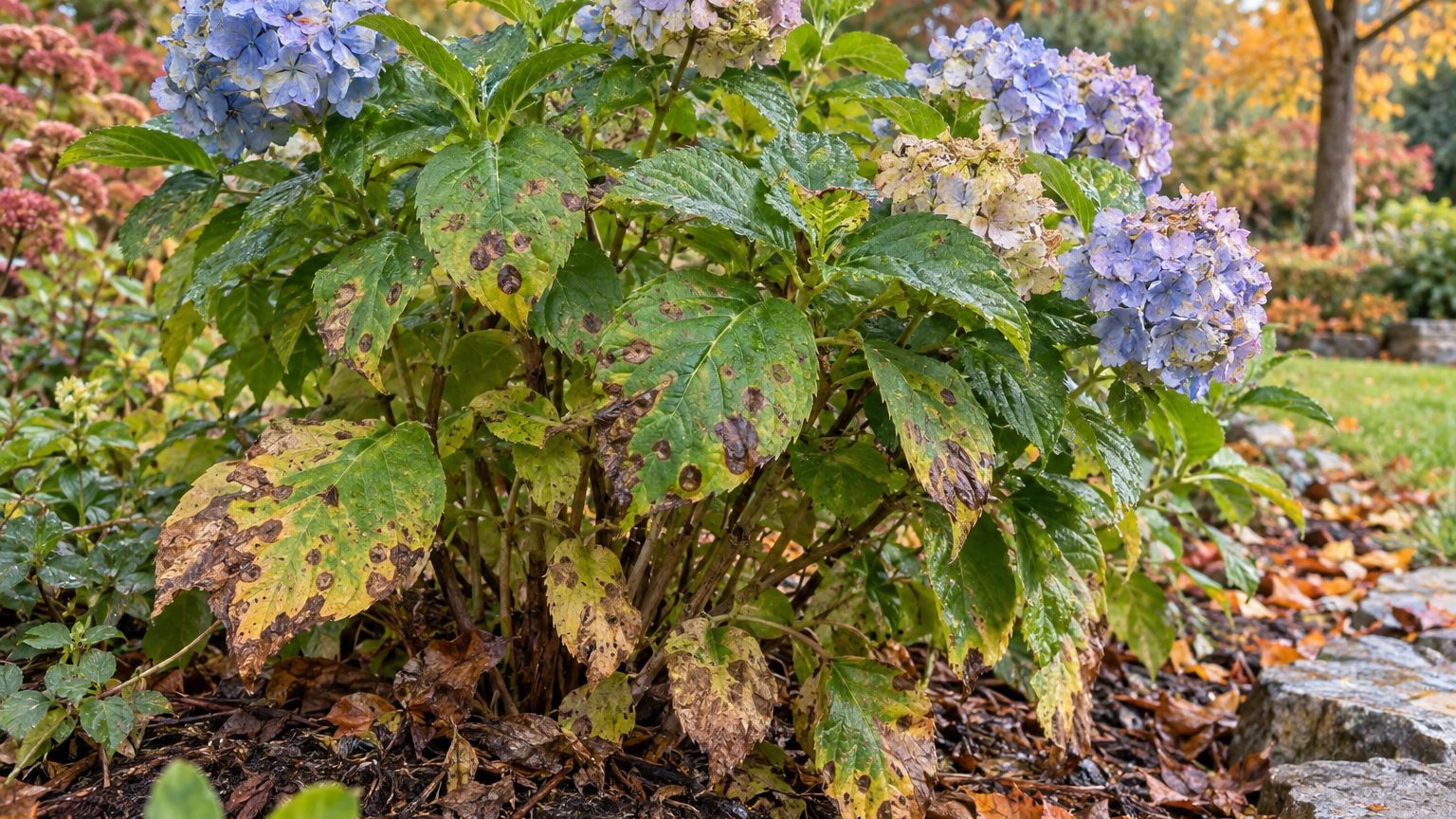
  • Round to irregular spots, tan, brown or purplish-brown, often with a darker rim or a yellow halo.
  • The lowest and innermost leaves are hit first, then the spotting climbs.
  • Spots appear in summer and carry into early fall, usually after rainy or humid spells.
  • Neighboring spots merge into blotches, and badly marked leaves yellow and drop early.
  • The leaf itself stays firm and does not droop.

One common form has its own sheet: Cercospora Leaf Spot on Hydrangeas: Signs, Treatment and Prevention.

Leaf Spot or Something Else?

Spotted leaves get blamed on one disease when several look alike from a few steps away. Up close, one test sorts most cases: touch the leaf, then turn it over.

The NC State Extension Gardener Plant Toolbox names leaf spot, bacterial wilt and powdery mildew for hydrangeas, and adds rust and bud blight for panicle. Three of those get mistaken for leaf spot most often.

Look-alike Looks like The sign that tells them apart
Powdery mildew A pale, dusty film over the leaf It wipes off with a thumb. Leaf spot marks sit in the leaf tissue and stay put.
Rust (listed for panicle) Orange to rust-colored freckles Turn the leaf over. Powdery orange pustules underneath separate it from plain spotting.
Bacterial wilt Browning, hanging leaves Whole shoots droop even when the soil is moist. Leaves with leaf spot stay firm.

Bud blight, listed for panicle, goes after the flower buds rather than the leaf blades. For the full lineup, see Hydrangea Diseases, and for the wilting case, Bacterial Wilt on Hydrangeas: Signs, Treatment and Prevention.

What Causes Leaf Spot, and Where It Is Worst

Leaf spot follows wet foliage, and the NC State Extension Gardener Plant Toolbox lists it for the whole genus with no regional map, while putting panicle at USDA 3a to 8b and bigleaf at 6a to 11b. What you grow tells you what your climate asks of it.

  • Great Lakes and the North (Michigan, Minnesota, Wisconsin): panicle and smooth, the hardiest types, dominate, and spotting follows cool, rainy stretches and crowded planting.
  • The South (Georgia, Texas, the Carolinas): bigleaf is common here, and warm, humid nights leave leaves damp for hours.
  • The Pacific Northwest (Washington, Oregon): a long wet spring keeps bigleaf foliage wet from the day it opens.
  • The dry interior West (Colorado, Utah, New Mexico): dry air helps, but overhead sprinklers wet leaves as surely as rain does.

The exact zone, type and calendar for your yard sit on your state page.

How to Treat Leaf Spot

Start this week, and start with the leaves. Nothing here needs a product.

  1. Pick off spotted leaves: the NC State Extension Gardener Plant Toolbox says bigleaf buds form the previous summer, so take leaves only and leave the stems alone.
  2. Bag the leaves and bin them: a compost pile that never gets hot keeps the problem in circulation.
  3. Water at the base in the morning: dry foliage by evening is the single change that matters most.
  4. Switch off overhead sprinklers: a drip line or a hose at the soil does the job without wetting the canopy.
  5. Mulch over the roots: both bigleaf and panicle are shallow-rooted and benefit from mulch, which also stops soil splashing onto low leaves.
  6. Ask your state extension service about fungicide: only they know what is registered where you live.

If new leaves keep spotting after the foliage has dried out, photograph a few leaves and send them to your county extension office. A wilting shoot is a different question, so check the table above first.

How to Prevent Leaf Spot Coming Back

The NC State Extension Gardener Plant Toolbox gives bigleaf 3 to 6 feet tall and wide, and that mature size is where prevention begins, since a crowded shrub never dries out.

  • Planting: leave room for the full width so air moves between shrubs.
  • Late winter: cut panicle back hard, since it flowers on the current season’s growth, and leave bigleaf uncut because it flowers on last year’s wood.
  • Spring, as leaves open: refresh the mulch over the shallow roots.
  • Growing season: water at the base in the morning and check the lowest leaves after every rainy spell.
  • Leaf drop: rake fallen leaves and bin them.
  • After leaf drop: cut dead hollow stems to 12 to 24 inches and leave them standing, since native bees nest in them.

Dates for each step depend on your zone and type, so use your state page.

Where this comes from

Type names, zone ranges, mature sizes and the disease list come from the NC State Extension Gardener Plant Toolbox entry for Hydrangea. That entry lists leaf spot without ranking severity or giving a regional map.

Symptom descriptions here are general and vary by type and region. Confirm anything local, especially products, with your state’s extension service.

Common questions

Will leaf spot kill my hydrangea?

The source rates hydrangea maintenance as low and lists leaf spot without calling it fatal. I would treat spotting as a leaf problem first, and get help if the shrub itself starts wilting.

Should I cut off the spotted stems?

Take leaves, not stems, on bigleaf, because its buds form the previous summer and a spring cut removes flowers. Panicle flowers on the current season’s growth and takes a hard cut in late winter.

Do I need a fungicide?

Not as a first step. Drier leaves, cleaner ground and better spacing come first, and your state extension service can tell you which products are registered where you live.

Cercospora Leaf Spot on Hydrangeas: Signs, Treatment and Prevention

Cercospora Leaf Spot on Hydrangeas: Signs, Treatment and Prevention

Cercospora leaf spot is a fungal disease that dots hydrangea leaves with small purple-brown spots, usually from midsummer on. It rarely kills the shrub, but it spoils the foliage and returns each year if fallen leaves stay under the plant. The fix is cleanup and dry leaves, not a spray bought on impulse.

Cercospora Leaf Spot: What You See

Cercospora Leaf Spot on a hydrangea

NC State Extension Gardener Plant Toolbox lists leaf spot among the diseases of the genus, and on the shrub it shows up in a few clear ways:

  • Small round spots, purple to brown, that pale to tan or gray in the center as they age
  • A yellow halo around many spots
  • Lower and inner leaves hit first, where the air stays stillest
  • Neighboring spots merging into blotches, then leaves yellowing and dropping early
  • Worst from midsummer into fall, after warm, wet weather

Bigleaf shows it most, since its broad, soft leaves hold water, but any type can carry it.

Cercospora Leaf Spot or Something Else?

NC State Extension Gardener Plant Toolbox lists powdery mildew next to leaf spot, and adds rust and bud blight on panicle. Several problems make a hydrangea leaf look sick, so judge by the sign that differs, not by the general look.

Pull a few affected leaves and compare them against the table. One feature settles most cases: whether the marks stay on the leaf blade with sharp edges.

Looks like The sign that tells them apart
Powdery mildew A white, dusty film that wipes off with a thumb, with no defined spots underneath
Anthracnose Spots that also mark the flower petals, not only the leaves (see Anthracnose on Hydrangeas: Signs, Treatment and Prevention)
Botrytis blight Gray, fuzzy mold on flowers and leaves in cool, damp weather (see Botrytis Blight on Hydrangeas: Signs, Treatment and Prevention)

The other kinds are on their own pages, gathered under Hydrangea Diseases.

What Causes Cercospora Leaf Spot, and Where It Is Worst

The fungus survives on fallen leaves and splashes onto new growth when foliage stays wet. NC State Extension Gardener Plant Toolbox puts panicle at USDA 3a to 8b and bigleaf at 6a to 11b, so what you grow and how long leaves stay damp vary a lot by region.

  • Great Lakes and the North (Michigan, Minnesota, Wisconsin): panicle and smooth are the usual choices, and cool, damp summer mornings keep their leaves wet for hours.
  • The Northeast (New York, Pennsylvania, Massachusetts): humid stretches and summer thunderstorms splash spores from soil and old leaves onto the lower foliage.
  • The South (Georgia, Texas, the Carolinas): bigleaf is at home here, and the long warm, humid season gives the fungus more weeks to spread.
  • The dry West (Arizona, Nevada, Utah): low humidity dries leaves fast, so trouble usually follows overhead sprinklers.

The source does not map this disease by state, so treat these as patterns to watch for. Your state’s page in this series gives the timing that fits your zone and type.

How to Treat Cercospora Leaf Spot

Work through these steps this week, in this order, and go easy on the plant.

  1. Pick off the worst leaves: take the heavily spotted ones, mostly low and inside, and bag them. Leave healthy top leaves so the shrub keeps feeding itself.
  2. Rake every fallen leaf: the fungus lives on them, so clear the ground under the shrub and put the leaves in the trash.
  3. Water at the soil, in the morning: aim the hose at the base and stop overhead sprinkling, so foliage dries before evening.
  4. Add a layer of mulch: NC State Extension Gardener Plant Toolbox notes that shallow-rooted bigleaf and panicle both benefit from it, and it also blocks soil splash onto low leaves.
  5. Do not prune hard now: bigleaf flowers on last year’s wood, so a big cut costs next year’s blooms. Panicle flowers on current growth and tolerates a hard cut in late winter.
  6. Ask your state extension service: it alone knows which fungicide is registered in your state, so I name none here.

Spots already on a leaf will not heal. The goal is protecting next year’s growth, and a mild case often needs only steps one through four.

How to Prevent Cercospora Leaf Spot Coming Back

NC State Extension Gardener Plant Toolbox says to cut dead hollow stems back to 12-24 inches and leave them standing for native bees, so the cleanup that matters for leaf spot is the leaves.

  • Late winter: cut panicle back hard if you like, and leave bigleaf uncut, since its buds formed last summer.
  • At planting: space by mature size, 3-6 feet tall and wide for bigleaf, so air moves between plants.
  • Leaf-out: refresh the mulch to hold soil splash down.
  • Summer: water at the base in the morning and check lower leaves every week.
  • Leaf drop: rake up spotted leaves as they fall and bag them.

Done every year, this breaks the cycle the fungus needs to start again.

Where this comes from

The plant details come from the NC State Extension Gardener Plant Toolbox entry for hydrangea. It names leaf spot as a disease of the genus but gives few specifics.

Symptom descriptions and cleanup steps are general horticultural practice. Check with your state’s cooperative extension service for what is registered and timed for your area.

Common questions

Will cercospora leaf spot kill my hydrangea?

Rarely. It mostly disfigures and weakens the leaves, and a shrub that loses many leaves early has less energy stored. Cleanup and dry foliage usually keep it in check.

Do I need a fungicide?

Not always. Start with removing leaves, watering at the base and mulching. If you want a product, ask your state extension service what is registered for hydrangea in your state.

Does the type of hydrangea matter?

It changes the cleanup timing. Bigleaf must not be cut hard in spring or summer, while panicle takes a hard cut in late winter. The disease itself can appear on any type.

Botrytis Blight on Hydrangeas: Signs, Treatment and Prevention

Botrytis Blight on Hydrangeas: Signs, Treatment and Prevention

Botrytis blight is gray mold. A fungus turns damaged or aging hydrangea flowers, buds and leaves to brown mush under a fuzzy gray coat, mostly in cool, damp, still weather.

The fix is cutting out the sick tissue on a dry day, moving air through the shrub and watering at the soil. Which cuts are safe depends on your hydrangea type and zone.

Botrytis Blight: What You See

Botrytis Blight on a hydrangea

NC State Extension Gardener Plant Toolbox lists leaf spot, bacterial wilt and powdery mildew on hydrangeas, plus rust and bud blight on panicle types. The gray mold pattern below is what gardeners call botrytis blight.

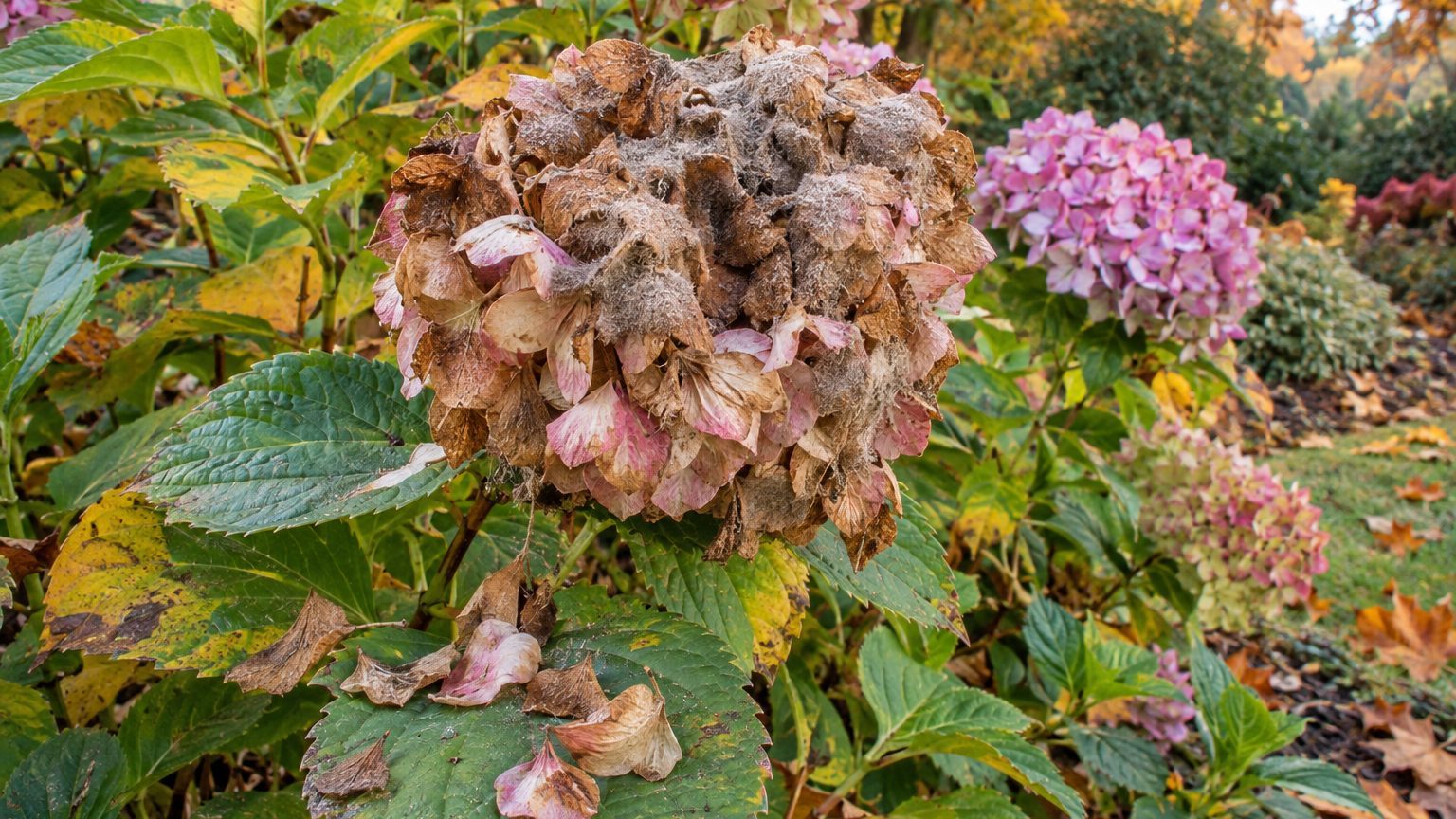
  • Fuzzy gray or tan mold coating flower heads, especially old blooms packed tight.
  • Brown, water-soaked blotches on petals that spread until the whole cluster turns papery.
  • Flower buds that brown and never open after a cool, wet spell.
  • Brown patches on leaves and soft stem tips that touch dead blooms.
  • A puff of gray dust when you brush an infected head on a dry day.

It appears as blooms open and again as they age, and foliage that stays wet overnight is the pattern to watch.

Botrytis Blight or Something Else?

Several hydrangea diseases leave brown marks, so where the damage sits matters more than its color. NC State Extension Gardener Plant Toolbox names leaf spot, powdery mildew and rust among them, with rust listed on panicle types.

Gray mold has a soft, fuzzy coat that puffs dust, and it favors flowers and buds. Run a dry finger over the spot and note the color of what comes off.

Looks like The sign that tells them apart
Leaf spot Spots with a defined edge that stay on the leaf blade and never grow a fuzzy gray coat.
Powdery mildew A white film that wipes off, not a gray one that puffs into dust.
Rust (panicle) Small orange or rusty pustules, mostly on the underside of the leaf.

The full leaf-spot picture is in Cercospora Leaf Spot on Hydrangeas: Signs, Treatment and Prevention. A shrub that wilts while its flowers look fine points to the roots, covered in Armillaria Root Rot on Hydrangeas: Signs, Treatment and Prevention. The rest sit in Hydrangea Diseases.

What Causes Botrytis Blight, and Where It Is Worst

The cause is a fungus that thrives where air is still and plant surfaces stay wet, and NC State Extension Gardener Plant Toolbox gives panicle hydrangea zones 3a to 8b and bigleaf 6a to 11b. It does not map this disease, so the regions below follow climate and type.

  • Great Lakes and the North (Michigan, Minnesota, Wisconsin): panicle and smooth types dominate, and cool, damp late-summer weather keeps old blooms wet.
  • The South (Georgia, Texas, the Carolinas): humid nights and dense shade planting hold moisture on bigleaf flowers.
  • Pacific Northwest (Washington, Oregon): long, wet springs and falls give the mold plenty of time.
  • Dry interior West (Arizona, Nevada): low humidity makes gray mold rare unless irrigation wets the blooms.

Your state’s page on this site sets the timing and the type advice for your zone.

How to Treat Botrytis Blight

Start this week, on a dry morning, and work in this order.

  1. Remove infected flowers and stem tips: cut just below the gray or brown tissue into healthy green, and bag everything.
  2. Cut no deeper on old-wood types: NC State Extension Gardener Plant Toolbox says bigleaf forms buds the previous summer, so hacking back removes next year’s flowers.
  3. Clean your pruners between cuts: wipe the blades so you do not carry spores from one stem to the next.
  4. Rake fallen petals and leaves: mold overwinters on debris, and it belongs in the trash, not the compost pile.
  5. Water at the base, in the morning: leaves and blooms should be dry well before evening.
  6. Ask your state extension service about fungicides: only it knows what is registered for hydrangeas where you live.

Panicle hydrangeas bloom on the current season’s growth, so they tolerate harder cutting than bigleaf. Confirm your type before you pick up the shears.

How to Prevent Botrytis Blight Coming Back

NC State Extension Gardener Plant Toolbox notes that bigleaf and panicle are both shallow-rooted and benefit from mulch, which is the first job of the year.

  • Early spring: lay mulch over the roots so rain does not splash spores from the soil onto low leaves.
  • Late winter, panicle and smooth types: cut back hard, since they flower on new wood, and open the center for air.
  • Bloom season: water at the soil line in the morning, never over the flowers.
  • Midsummer: pull weeds and thin crowded neighbors so air moves around the shrub.
  • After bloom and in fall: remove spent, moldy heads and clear the ground beneath.
  • After leaf drop: cut hollow stems to 12 to 24 inches, and leave healthy ones standing for nesting bees.

Bag any stem that carried mold, however tall you leave the rest.

Where this comes from

The plant facts here come from the NC State Extension Gardener Plant Toolbox, which lists bud blight on panicle hydrangea but does not describe gray mold symptoms. The symptom descriptions and steps reflect general horticultural practice.

Before you spray anything, check with your state’s extension service. It can confirm the diagnosis and tell you what is approved in your state.

Common questions

Will botrytis blight kill my hydrangea?

Gray mold, also called botrytis blight

It mostly ruins flowers, buds and soft new growth rather than the woody shrub. If the whole plant wilts while the blooms look fine, look at the roots instead.

Can I cut off blighted flowers on a bigleaf hydrangea?

Yes, but take only the infected head and a little stem. Bigleaf sets next year’s buds on old wood, so deep cuts cost you blooms.

Does my hydrangea type change the plan?

It does. Panicle flowers on new growth and takes hard late-winter cutting, while bigleaf, oakleaf, mountain and climbing types flower on old wood. Cleanup and airflow apply to all of them.

Bacterial Wilt on Hydrangeas: Signs, Treatment and Prevention

Bacterial Wilt on Hydrangeas: Signs, Treatment and Prevention

The practical answer is to confirm it, remove the plant and protect its neighbors. Your zone and the type of hydrangea you grow decide what goes back in that spot.

Bacterial Wilt: What You See

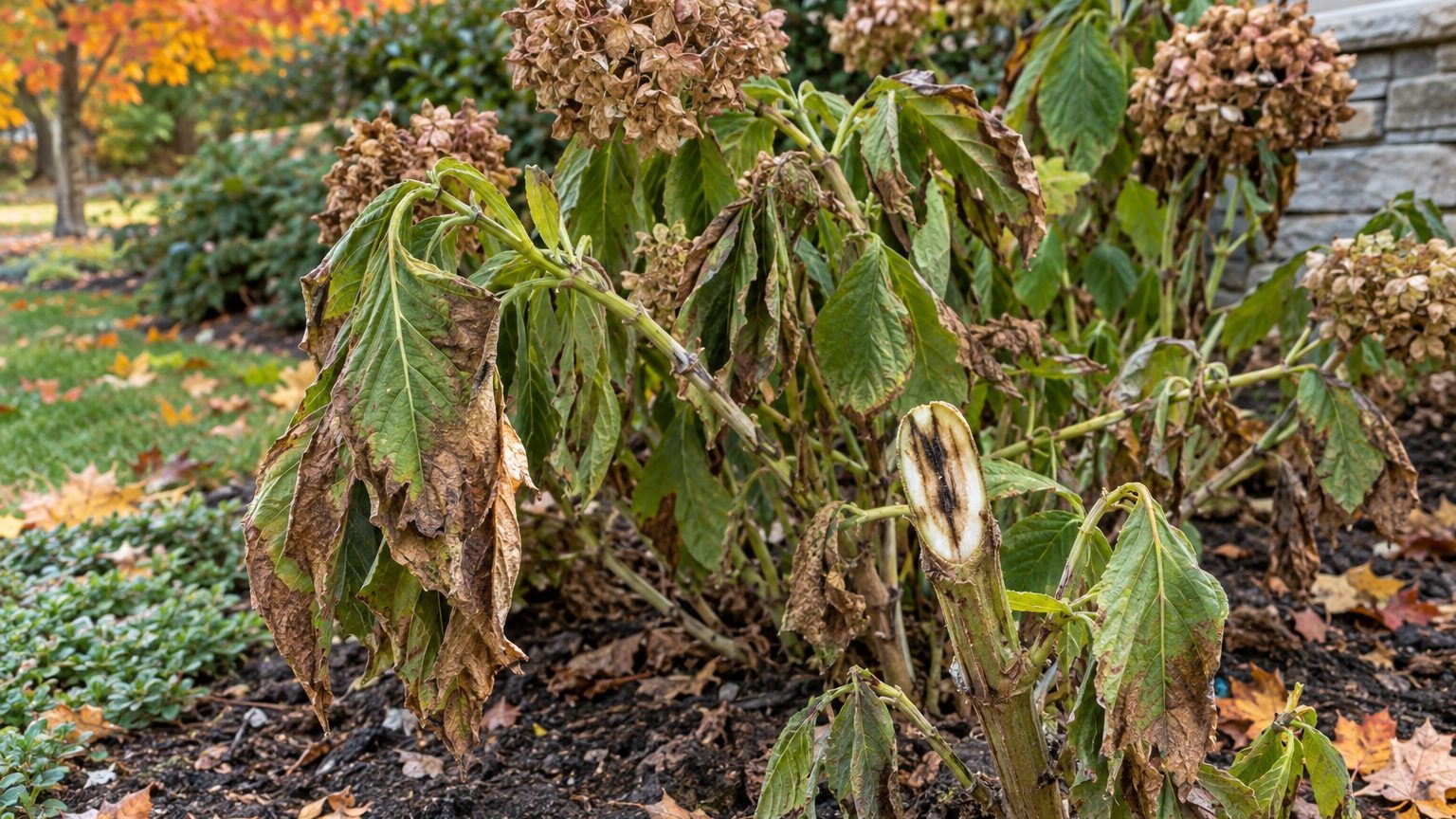
Bacterial Wilt on a hydrangea

The NC State Extension Gardener Plant Toolbox names bacterial wilt among hydrangea diseases, and what you notice first is a shrub that cannot keep its leaves supplied with water.

  • Leaves droop and hang limp, often on a few shoots before the whole shrub follows.
  • The wilting stays put after a deep watering, where plain thirst is gone by morning.
  • Leaves turn brown and dry at the edges, then across the blade, and cling to the stem.
  • Flower heads sag and dry out well before their season is over.
  • A cut stem shows dark or brown streaking inside the wood where it should look pale.

Bigleaf and panicle hydrangeas are both shallow-rooted, so a dry spell can imitate every sign above. That is why the test is whether the leaves stay limp after a deep watering, not how they look at 3 p.m.

Bacterial Wilt or Something Else?

Three problems get mistaken for this one more often than the real thing. The NC State Extension Gardener Plant Toolbox lists leaf spot and powdery mildew right next to bacterial wilt, and thirst needs no source at all.

Each has one sign that settles the question. You can check all three in a single slow walk around the shrub, with a finger for the soil and a look at the underside of a few leaves.

Looks like The sign that tells them apart
Leaf spot Spots with a defined edge sit on leaves that are otherwise firm and upright.
Powdery mildew A white, dusty coating wipes off on a fingertip, and the leaves are not limp.
Thirst or heat stress The plant stands back up by the next morning after a deep watering.

Leaf spot has a full sheet at Leaf Spot on Hydrangeas: Signs, Treatment and Prevention, and flower-head problems are covered in Botrytis Blight on Hydrangeas: Signs, Treatment and Prevention. The other kinds are on their own pages under Hydrangea Diseases.

What Causes Bacterial Wilt, and Where It Is Worst

Bacteria cause it. They move inside the plant’s water-carrying tissue and travel on dirty pruners, in splashing water and on cuttings taken from an infected plant.

The NC State Extension Gardener Plant Toolbox lists the genus at USDA zones 3a through 9b, yet it names bacterial wilt without saying which climate favors it. I won’t draw a map the source does not draw. What changes from region to region is the type of hydrangea at stake.

  • Great Lakes and the North (Michigan, Minnesota, Wisconsin): panicle, rated 3a to 8b, and smooth, the hardiest of the genus, are the shrubs most yards carry, so a loss here means replacing one hardy type with another.
  • The South (Georgia, Texas, the Carolinas): bigleaf, rated 6a to 11b, is at home here beside panicle and oakleaf, and its shallow roots dry out fast in summer heat, which muddies the diagnosis.
  • Northeast and Mid-Atlantic (New York, Pennsylvania, Virginia): bigleaf and panicle share the borders, and each needs its own replacement plan because bigleaf blooms on last year’s wood and panicle on the current season’s growth.

Your state’s page holds the zone verdict and the calendar that this national sheet cannot give.

How to Treat Bacterial Wilt

Work through these steps in order this week, before you decide anything about replacing the plant.

  1. Run the watering test: soak the root zone deeply in the evening and look again at first light, because a thirsty shrub recovers and one with bacterial wilt does not.
  2. Cut one wilted stem and look inside: use clean pruners and note any brown or dark streaking in the wood.
  3. Call your state extension office: it can confirm the diagnosis, and it alone knows what is registered for use in your state.
  4. Stop taking cuttings or layering from it: propagation by stem cutting or layering carries the problem straight into the new plant.
  5. Remove the whole plant, roots included: bag it for the trash and keep it out of the compost pile.
  6. Disinfect your tools and wash your boots: soil and sap on blades are how it reaches the next shrub, so follow your extension office’s advice on how to clean them.

I would hold off replanting in the same hole until extension says it is fine. When you do replant, match the type to your zone, since panicle and bigleaf differ by several zones.

How to Prevent Bacterial Wilt Coming Back

Prevention is mostly housekeeping, and it follows the shrub’s year.

  • Late winter: clean your pruners before cutting panicle or smooth hydrangeas, which bloom on the current season’s growth and take hard cutting back.
  • Planting time: buy healthy stock and reject any plant with dark streaks in the stems or limp leaves in the pot.
  • Spring: spread mulch over the shallow roots, and keep it pulled back from the stems.
  • Summer: water at the base in the morning so leaves stay dry, and never work among wet shrubs with pruners.
  • Autumn: rake up fallen leaves, and if you leave hollow stems standing for native bees, the NC State Extension Gardener Plant Toolbox says to cut them back to 12 to 24 inches.
  • Whenever you propagate: take cuttings or layers only from shrubs that have never wilted.

Clean tools do more than any product I can think of, and they cost nothing.

Where this comes from

The disease names, zone ranges and habits here come from the NC State Extension Gardener Plant Toolbox entry for Hydrangea. That source names bacterial wilt but gives no regional map for it.

Take a wilted stem or a photo to your state’s extension office before you dig anything up. They can confirm the diagnosis and tell you what applies in your zone.

Common questions

Can a hydrangea recover from bacterial wilt?

I would not count on it. A shrub that stays limp after a deep watering should be treated as infected until extension says otherwise, and the safe move is to remove it before it spreads.

Can I compost the infected plant?

I would not. Bag the plant, roots included, and put it in the trash so nothing carries the problem to healthy beds.

Which hydrangea should I plant instead?

That depends on your zone and how you want it to bloom. Panicle is rated 3a to 8b and bigleaf 6a to 11b, so check your state’s page for the type that fits, and see Hydrangea Diseases for the other problems to watch.

Armillaria Root Rot on Hydrangeas: Signs, Treatment and Prevention

Armillaria Root Rot on Hydrangeas: Signs, Treatment and Prevention

Armillaria root rot is a soil fungus that rots the roots and the bark at the base of a hydrangea, and once it has girdled the crown, no spray brings the shrub back. What you can do is confirm it, remove the plant, and change what goes in that spot.

Armillaria Root Rot: What You See

The disease works underground first, so the above-ground signs look like a thirsty plant that never recovers after watering.

  • Leaves yellow, droop or stay small on part of the shrub or all of it, often in summer heat while the soil is moist.
  • Stems die back branch by branch, and flowering thins out or stops.
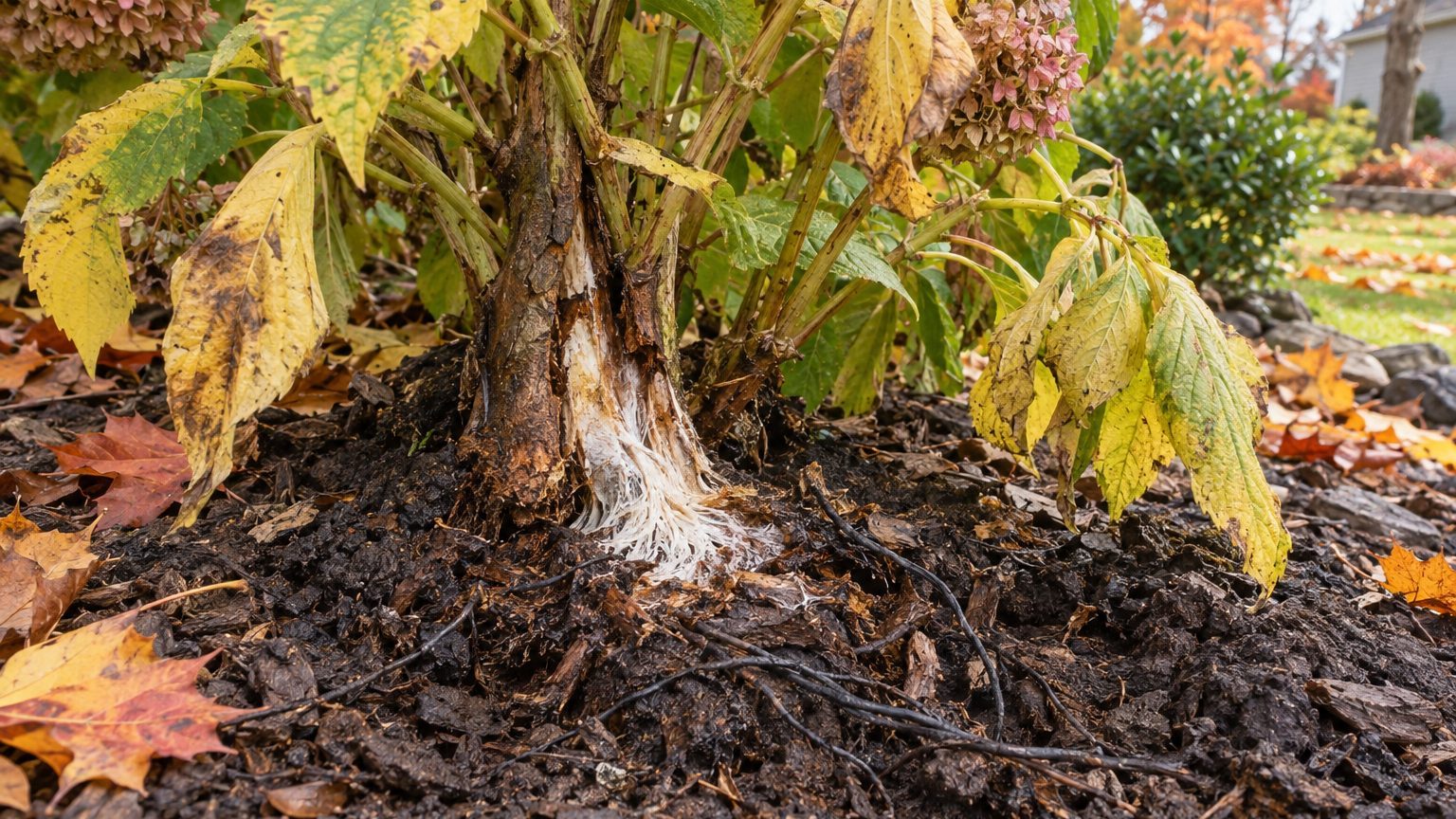
  • Under the bark at the base, a white to cream fungal sheet spreads in a fan shape.
  • Black strands like bootlaces cling to roots or run through the soil near the crown.
  • Clusters of honey-colored mushrooms appear at the base in fall, usually after rain.
  • Bark on the lowest part of the stems turns soft, cracked or loose.

One sign alone proves little, but the white sheet under the bark is the one that decides.

Armillaria Root Rot or Something Else?

Wilting and dieback have many causes, and most of them are easier to fix. The NC State Extension Gardener Plant Toolbox names bacterial wilt among hydrangea diseases and calls nematodes rarely a problem.

Frost is the third suspect, especially on bigleaf. Its buds form the previous summer on last year’s wood, so a late frost or a spring prune removes the flowers without touching the roots.

Looks like The sign that tells them apart
Bacterial wilt A cut stem shows browning inside the wood, but the bark at the base has no white sheet.
Nematode injury Fine roots carry knots or galls, and armillaria leaves none of those.
Late frost on bigleaf Shoots blacken from the tips, the base stays firm and green, and the shrub resprouts.

Spots and pustules on leaves point elsewhere, and those problems have their own pages: Hydrangea Rust on Hydrangeas: Signs, Treatment and Prevention and Anthracnose on Hydrangeas: Signs, Treatment and Prevention. The full list sits in Hydrangea Diseases.

What Causes Armillaria Root Rot, and Where It Is Worst

The cause is the Armillaria fungus, which lives on dead roots and old stumps, then reaches living roots of stressed plants through the soil. It follows woodland history and wet ground more than a climate map, so the regions below are about which hydrangeas grow there.

  • Great Lakes and the North (Michigan, Minnesota, Wisconsin): panicle is rated 3a to 8b by the NC State Extension Gardener Plant Toolbox and smooth is the hardiest, so lots cleared from woods with stumps left behind carry the risk.
  • The South (Georgia, Texas, the Carolinas): bigleaf reaches zones 6a to 11b and oakleaf does well too, and warm, wet soil around old hardwood stumps suits the fungus.
  • Northeast and Mid-Atlantic (New York, Pennsylvania, Virginia): every type is grown here, so watch beds built where a tree came down.
  • The West Coast (Washington, Oregon, California): irrigated shade beds for bigleaf stay damp at the crown for long stretches.

Your state’s page gives the zone, the type and the calendar that fit your yard.

How to Treat Armillaria Root Rot

Treatment here means confirming the problem and removing the source, done this week in this order.

  1. Scrape the bark at the base: use a thumbnail or a knife at the soil line, and a white sheet under the bark settles the question.
  2. Call your county extension office: send a photo or a sample, because the state extension service alone knows what is registered where you live.
  3. Pull mulch off the crown: hydrangeas are shallow-rooted and like mulch, but keep it a hand’s width from the stems so the bark can dry.
  4. Dig out the dead shrub with as many roots as you can: root pieces left in the ground keep the fungus fed.
  5. Remove nearby stumps and large roots: an old stump within reach of the bed is the likely source.
  6. Leave the hole without a hydrangea: ask the extension office which plants tolerate the spot before you replant.

I name no fungicide because I cannot see your state’s registered list. A shrub with a few dead stems and a sound crown may hold on, but watch it through the next fall.

How to Prevent Armillaria Root Rot Coming Back

The NC State Extension Gardener Plant Toolbox lists hydrangea maintenance as low and asks for good drainage, with occasional wet soil acceptable, so prevention follows the calendar.

  • Dormancy: the one safe window to move a plant, roots undisturbed, and the time to clear old stumps from the bed.
  • Planting: choose a spot with good drainage and set the crown at soil level, never buried.
  • Spring: refresh mulch over the shallow roots and keep it off the stems as growth starts.
  • Summer: water at the soil line in dry spells, and keep mowers and string trimmers away from the bark at the base.
  • Fall: check the base after rain for honey-colored mushrooms and scrape one stem if the shrub looks tired.
  • Every year: match the type to your zone, since a stressed plant is the one the fungus picks.

Pruning dates and hardiness differ by type and by state, so use the page for your state before you cut anything.

Where this comes from

The hydrangea types, zones and drainage notes here come from the NC State Extension Gardener Plant Toolbox, Hydrangea entry. That source names leaf spot, bacterial wilt and powdery mildew, plus rust and bud blight on panicle, but does not list armillaria.

The descriptions of the fungus are general, so confirm any diagnosis with your state’s extension service. They can tell you what is present locally and what is allowed in your state.

Common questions

Can a hydrangea recover from armillaria root rot?

Once the white sheet has spread around the crown, recovery is unlikely. A shrub with a sound crown and a few dead stems may hold on, so confirm with your extension office before you dig.

Does it hit every type of hydrangea?

Any type can be hit, so the difference is in the replacement you choose. Bigleaf is rated 6a to 11b and panicle 3a to 8b, so type and zone decide what goes back in.

Do mushrooms at the base mean the shrub is doomed?

Honey-colored mushrooms mean the fungus is active in the wood nearby, and it may be feeding on a stump instead. Scrape the bark at the base and look for the white sheet before you decide.

Anthracnose on Hydrangeas: Signs, Treatment and Prevention

Anthracnose on Hydrangeas: Signs, Treatment and Prevention

Anthracnose on a hydrangea is a fungal leaf disease. It shows up as tan to brown spots that spread in warm, wet weather, and it usually marks the plant rather than kills it. The fix is mostly housekeeping: dry leaves, cleaned-up debris, and no hard pruning on the wrong type. Here is what to look for, inside our Hydrangea Diseases guide.

Anthracnose: What You See

Anthracnose on a hydrangea

The NC State Extension Gardener Plant Toolbox lists leaf spot among hydrangea diseases and gives anthracnose no entry of its own, so these signs follow the general leaf-spot pattern. Look for:

  • Tan, brown or gray-brown spots on the leaves, often ringed darker.
  • Spots that run together into large dead blotches.
  • Browning that starts on lower, shaded leaves and climbs.
  • Dead patches along leaf edges after a long wet spell.
  • Worst from late spring through summer, whenever leaves stay wet for days.

Spots that sit sunk into the leaf and don’t wipe off are the fungus at work. Old spots never turn green again, so judge progress by the new leaves.

Anthracnose or Something Else?

Several hydrangea problems brown a leaf. Color alone won’t sort them, so look at texture and pattern instead.

The NC State Extension Gardener Plant Toolbox says bigleaf needs protection from afternoon sun. That is the first cause to rule out when the browning sits on one side of the shrub only.

Problem Looks like The sign that tells them apart
Powdery mildew A white to gray dusty film on leaf surfaces The film wipes off with a thumb, while anthracnose spots are set into the leaf and stay put
Sun scorch Crisp, papery brown edges or patches Damage sits only on the side facing afternoon sun, and shaded leaves on the same stem stay clean

Bacterial wilt is also named by that source, and it shows as whole shoots going limp, not spotted leaves. Mildew has its own sheet: Powdery Mildew on Hydrangeas: Signs, Treatment and Prevention. Whole-plant decline is a different story, covered in Armillaria Root Rot on Hydrangeas: Signs, Treatment and Prevention.

What Causes Anthracnose, and Where It Is Worst

A fungus causes it. It overwinters in fallen leaves and plant debris, then splashes onto new growth whenever foliage stays wet.

The NC State Extension Gardener Plant Toolbox puts panicle at 3a to 8b and bigleaf at 6a to 11b. It offers no map of disease pressure, so the regions below follow leaf wetness, not a published ranking.

  • Great Lakes and the North (Michigan, Minnesota, Wisconsin): panicle and smooth types dominate, and humid summer stretches with heavy dew keep leaves wet.
  • The South (Georgia, Texas, the Carolinas): bigleaf grows here, and long warm, humid seasons give the fungus more weeks to spread.
  • Pacific Northwest (Washington, Oregon): wet springs and mild temperatures keep foliage damp for long periods.
  • Dry interior West (Colorado, Utah, Nevada): lower risk, unless overhead sprinklers keep wetting the leaves.

Your state’s page has the local calendar for pruning, mulching and cleanup, matched to your zone and hydrangea type.

How to Treat Anthracnose

Start this week, in this order. Most of it costs nothing and does more than any bottle.

  1. Remove spotted leaves: pick them off on a dry day and bag them, never drop them at the base of the plant.
  2. Rake the ground clean: fallen leaves carry the fungus, so clear everything from the soil under the shrub.
  3. Water at the soil line: use a hose or drip line in the morning, and keep sprinklers off the foliage.
  4. Hold the pruners: the NC State Extension Gardener Plant Toolbox says bigleaf flowers on last year’s wood, so a spring cut to chase spots removes the buds. Panicle blooms on current growth and tolerates hard cutting in late winter.
  5. Give it room: pull back groundcover and neighboring plants that crowd the stems and hold moisture in.
  6. Ask your state extension office: it alone knows which fungicides, if any, are registered where you live, and labels differ by state.

Hold off on anything in a bottle until the first five are done. Clean new leaves are the sign it worked.

How to Prevent Anthracnose Coming Back

Prevention follows the calendar, and each step keeps leaves dry or removes the fungus’s winter shelter.

  • Late winter: the NC State Extension Gardener Plant Toolbox says panicle blooms on the current season’s growth, so cut it back hard now, but leave bigleaf alone.
  • Early spring: refresh the mulch, since bigleaf and panicle are both shallow-rooted and benefit from it, and it also blocks soil splash.
  • Through the growing season: water at the base in the morning so leaves dry before evening.
  • Midsummer: pick off the first spotted leaves the day you see them.
  • Autumn leaf drop: rake and bag every fallen leaf under the shrub.
  • Winter tidy: leave hollow stems standing at 12 to 24 inches, because native bees nest in them.

That last step costs nothing in disease control, since the leaf litter is what matters.

Where this comes from

Bloom wood, hardiness, mulch and bee-stem advice come from the NC State Extension Gardener Plant Toolbox entry for Hydrangea. That entry does not describe anthracnose itself, so the disease details here reflect general leaf-spot practice.

Before you spray or prune, check with your state’s cooperative extension service. Registered products and timing vary by state, zone and hydrangea type.

Common questions

Will anthracnose kill my hydrangea?

On an established shrub it mostly disfigures leaves. Repeated bad seasons can weaken a plant, so sanitation matters. Sudden wilting of whole shoots points to a different problem.

Can I compost the spotted leaves?

Bagging them is safer. Home piles often stay too cool to kill the fungus, and the leaves come back to the bed with the compost. Check your local yard-waste rules.

Does my hydrangea type change what I do?

Yes, for pruning. Bigleaf sets buds on last year’s wood, so spring cutting costs flowers. Panicle blooms on new growth and can be cut back hard in late winter. Cleanup and watering are the same for both.

The almanac, state by state. Every date on this site comes from a state’s own frost facts and its extension service’s calendar — and says where it comes from.