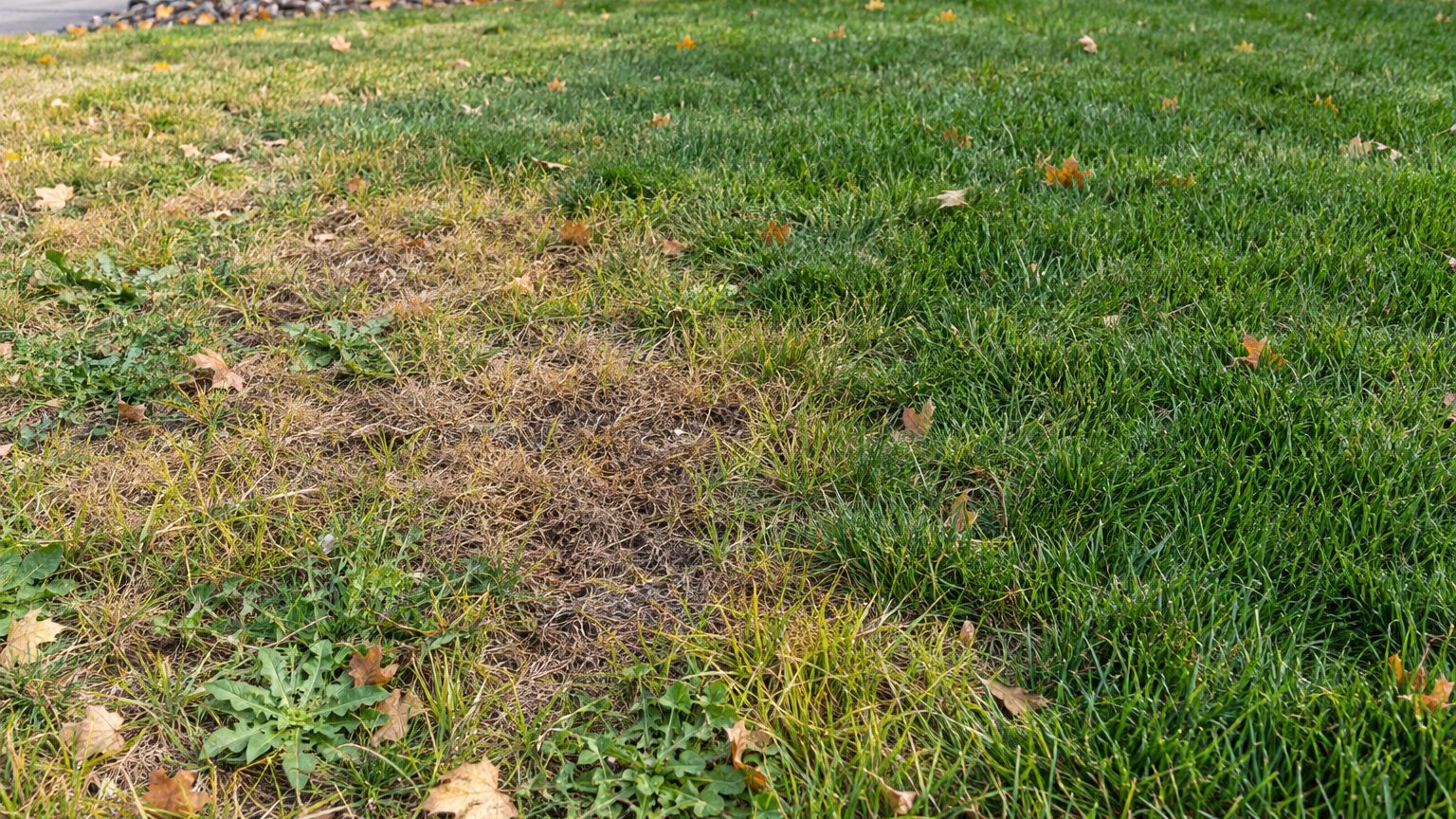
Straw-colored, matted patches show up where the last snowbank melts, and dandelions follow close behind. Those sights are familiar at the start of an Alberta lawn season. Cold winters, chinook thaws, dry summers and short growing seasons shape which problems appear, when they appear and what actually fixes them.
Lawn Pests and Diseases in Alberta
Snow Mold Patches

Snow mold shows up as gray or pinkish, matted circles as snow melts, usually where drifts lingered longest. The grass blades are stuck together in a crust. Gently rake the patches to lift the mat and let air in. Most lawns recover on their own as the weather warms.
Dandelions in Spring
Dandelions spread quickly in thin turf, with their yellow heads and deep taproots. Pulling works best when the soil is damp and you get the whole root. A thick lawn is the lasting fix, because crowded grass leaves them no bare soil to sprout in.
Creeping Bellflower
Creeping bellflower has heart-shaped leaves and spreads by underground roots, so pulled stems return. It is a stubborn weed in Alberta lawns and borders. Dig out what you can, mow regularly, and keep the grass dense, since repeated cutting weakens it over time.
Quackgrass Streaks
Quackgrass looks like coarse, pale green streaks that stand taller than the grass around them. Pull a stem and you find white, pointed rhizomes running underground. Dig out the patch and as much of the rhizome network as possible, then reseed the gap and watch for regrowth.
Necrotic Ring Spot
Necrotic ring spot appears in midsummer as sunken rings or crescents of dead bluegrass with green grass in the center. Stress from drought and compacted soil makes it worse. Water deeply, aerate in late summer, and overseed damaged rings with a mix of grasses rather than bluegrass alone.
Alberta — the year and the numbers
- State
- Alberta
- Hardiness zones
- 4a
- Last spring frost
- May 21
- First fall frost
- September 16
- Annual rain
- 17 in
- Lawn type
- cool-season
- Source
- Environment and Climate Change Canada — Canadian Climate Normals 1981-2010, station CALGARY INT'L A · Calgary
How to Tell Which Lawn Problem You Have
Identify the problem by comparing the patch’s appearance with when and where it appears. A quick tug on the grass helps too. If it lifts like a loose carpet, the roots are damaged; firmly rooted grass still needs the other clues to identify the cause.
| What you see | When and where | Likely problem |
|---|---|---|
| Gray or pink matted circles | Just after snowmelt, under old drifts | Snow mold |
| Yellow flowers on a taproot | Spring, in thin or bare spots | Dandelions |
| Heart-shaped leaves that regrow after pulling | Summer, in sun or part shade | Creeping bellflower |
| Coarse pale streaks with white underground runners | Summer, spreading outward | Quackgrass |
| Sunken rings with green centers | Midsummer heat, dry or compacted ground | Necrotic ring spot |
| Brown, crisp grass that stays firmly rooted | Hot spells, sunny slopes and south sides | Drought stress |
Drought stress is easy to mistake for disease. If brown turf begins to recover after a deep soaking, drought stress is more likely than disease. Patches that stay brown after watering deserve a closer look at the roots.
Where Lawn Problems Are Worst in Alberta
Alberta spans foothills, prairie and parkland, so the same lawn trouble does not strike everywhere with equal force.
- Calgary and the foothills: Chinook winds melt snow and then temperatures drop again, which exposes grass to drying and ice damage. Winter-dried patches are common in spring.
- Edmonton and the parkland: Deeper, longer-lasting snow cover favors snow mold, and cooler, wetter springs keep turf soggy.
- Lethbridge and southern Alberta: Hot, windy, dry summers make drought stress the main worry, and heat-stressed bluegrass is more likely to develop ring spot.
- Peace River country: A shorter season leaves less time for recovery and reseeding, and the thaw comes later.
Spring comes later as you move north, even though Calgary’s last frost averages May 21 and half of years run later than that.
Lawn Care Mistakes That Invite Problems in Alberta
Cutting the Grass Too Short
Scalped grass has shallow roots and leaves bare soil for weeds. Raise the mower deck a notch and mow regularly from May through October. Taller blades shade the soil, which keeps dandelion and quackgrass seeds from getting going and helps the lawn ride out dry spells.
Watering Lightly and Often
Quick sprinkles wet only the surface, so roots stay shallow and summer heat browns the lawn. Water slowly and deeply from May through September, then let the top of the soil dry a little. Deep roots are what carry Alberta turf through a dry spell.
Feeding at the Wrong Time
Fertilizer works best in May and again in September, when the grass can use it. Heavy feeding builds thatch, so check the spongy layer under the green blades. A layer up to 1.3 cm (1/2 inch) is healthy, and above that, dethatch or core aerate in August or September.
Where to Get Lawn Advice in Alberta
Canada has no county extension offices, so lawn questions go to the province, local gardeners and nearby garden centers.
- Alberta Agriculture and Irrigation, through Alberta Agriculture and Irrigation, is the place for provincial guidance on weeds and turf. Check there before treating an unfamiliar patch.
- A local master gardener group can look at photos or visit a sick patch, and spring is a good time to ask.
- A garden center near you knows which grass mixes and weeds are common in your town, so bring a sample of the weed or a bit of the turf.
Common Questions
What Is Dormant Seeding and Does It Work in Alberta?
Dormant seeding means sowing on cold soil so the seed lies still over winter and sprouts in spring. Sow in November; October can also work if the ground is not yet frozen.
When Should You Put Down Crabgrass Preventer in Alberta?
May is the month for it, applied before crabgrass seeds sprout. It only matters if crabgrass has been a problem in your yard before, because many Alberta lawns never see it.
Should You Reseed Patches Left by Snow Mold?
Only if the grass does not fill in on its own after raking. Reseed in August or September, when seed has time to root. If you miss that window, May also works.