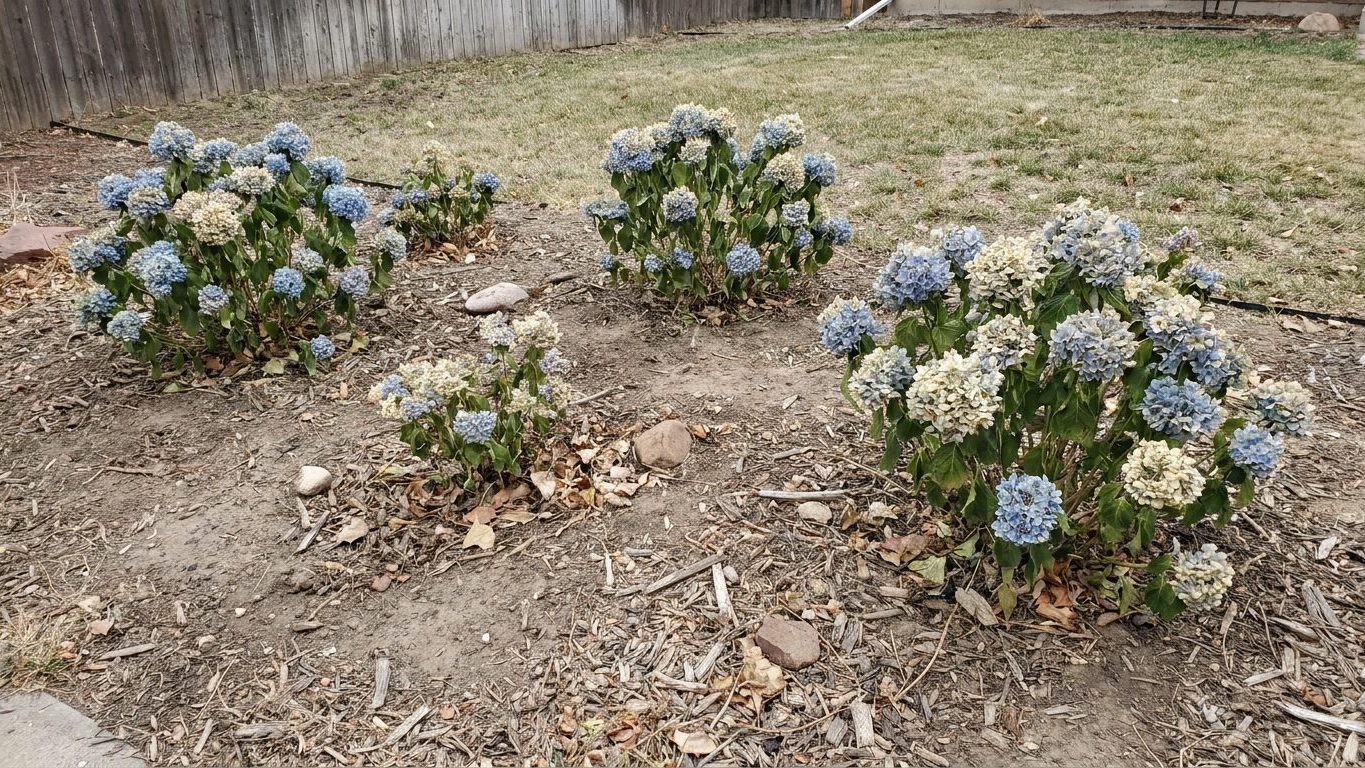
Hydrangeas in Alberta survive on a short leash. Natural Resources Canada rates the province’s reference city at Canadian zone 4a, and the frost-free stretch runs roughly from May 21 to September 16, barely four months. Panicle and smooth types, which bloom on new wood, come back reliably. Bigleaf and oakleaf, tied to old wood, rarely make it through winter unprotected.
Hydrangeas Care Calendar for Alberta

Environment and Climate Change Canada’s Canadian Climate Normals sets Calgary’s average last spring frost at May 21 and the average first fall frost at September 16, a four-month season that Natural Resources Canada rates Canadian zone 4a, colder than most of the continental United States.
- Dormancy: dig, divide, or move a hydrangea only while it sleeps, after leaf drop in fall or before buds swell in spring.
- Planting: set new plants two to three weeks after May 21, once the soil has actually warmed through.
- Mulch-up: pile mulch over the crown once the ground starts to freeze, usually weeks after September 16.
- Spring pruning: cut new-wood bloomers back hard two to three weeks before the average last frost, while still dormant.
- Feeding: apply the first feed once new growth is visible, roughly a month after last frost.
- Bloom watch: expect color through the short run between June and early September, ahead of the average frost.
- Fall shutdown: stop feeding and watering back two to three weeks before September 16 so growth hardens off.
None of these dates are promises, since frost lands later than May 21 in one year out of two.
Best Hydrangeas for Alberta
Zone 4a rules out most of the hydrangea aisle here. Old-wood bloomers set their buds the year before, and Alberta’s winter kills those buds most years, leaving healthy plants that never flower.
New-wood types are the safer bet, since they build their flower buds each spring after the last frost has already passed, whenever that turns out to be.
| Kind | Flowers on | Verdict in zone 4a | Sun |
|---|---|---|---|
| Panicle (Hydrangea paniculata) | New wood | Reliable, dies back hard some winters but rebuilds | Full sun to part shade |
| Smooth (Hydrangea arborescens) | New wood | Reliable, similar to panicle | Part shade |
| Bigleaf (Hydrangea macrophylla) | Old wood, mostly | Rarely survives outdoors, better as a container plant | Part shade |
| Oakleaf (Hydrangea quercifolia) | Old wood | Marginal even with heavy winter protection | Part shade |
Climbing hydrangea and other niche types are on their own pages, since almost none of them handle a Calgary winter without a heated wall to lean on. Gardeners in similarly cold ground, like hydrangeas in Alaska, lean on the same two genera for the same reason.
When to Plant, Prune and Feed Hydrangeas in Alberta
Three windows matter more than any date on a seed packet: planting, pruning, and the last feed of the season, each counted from Calgary’s average frost dates rather than from the month alone.
Push every one of them later at higher elevation or further north, since the reference dates come from a single station at Calgary’s airport.
| Task | Window here | Counted from |
|---|---|---|
| Planting | Early to mid-June | Two to three weeks after the May 21 average last frost |
| Pruning (new-wood types) | Late April, before bud break | Two to three weeks before the May 21 average last frost |
| Feeding | Early June through mid-August | Starts a month after last frost, stops four to five weeks before the September 16 average first frost |
Bigleaf and oakleaf need a different clock entirely, since pruning them wrong is the single most common reason they skip a bloom, and that timing lives on the province’s own planting and pruning calendar.
Hydrangeas Problems in Alberta and What Causes Them
No flowers on a healthy shrub

This is almost always winter cold, not disease. Bigleaf and oakleaf hydrangeas set next year’s buds on this year’s wood, and a zone 4a winter routinely kills those buds even when the plant itself survives. Switch to a new-wood type or grow bigleaf in a pot that overwinters in an unheated garage.
Leaves scorched on the sunny, windy side

Prairie sun paired with dry Chinook wind pulls moisture out of leaves faster than roots can replace it, especially on a west-facing wall. Deep, infrequent watering and a site with afternoon shade solve most of it. Bigleaf shows this first, since its leaves are thinnest.
Stems dead to the ground every winter

Zone 4a cold routinely kills stems back to the snowline or the soil line on anything except panicle and smooth types, which are built to regrow from the root each spring anyway. Treat that dieback as normal pruning, and mulch heavily in fall to protect the crown.
Alberta North to South: How the Dates Shift
Alberta is not one climate, and the reference dates above describe Calgary, not the whole province.
- Southern Alberta (Lethbridge, Medicine Hat): Chinook winds push winters milder and springs earlier than Calgary’s average.
- Central Alberta (Calgary, Red Deer): the reference dates in this piece line up closest here.
- Northern Alberta (Edmonton, Peace River, Grande Prairie): frost lingers later in spring and returns earlier in fall, shrinking the season further.
- Foothills and higher ground (Canmore, Cochrane): elevation adds cold on top of latitude, so push every date later still.
Check the Alberta hub for the rest of what grows here before picking a spot for anything with a hydrangea tag.
Alberta Extension Offices and County Contacts
Alberta Agriculture and Irrigation is the extension service to call before planting anything permanent, and your county or municipal district office is the local branch for soil tests, pest alerts, and hardy variety trials.
- Alberta Agriculture and Irrigation: the province’s extension service for soil and climate questions specific to your district.
- The full hydrangea guide: see how the site covers hydrangeas across every zone it grows in.
- Your county office: the local contact for soil testing and the pest alerts a province-wide page can’t cover.
With the average first frost already behind this date on the calendar, the gesture that matters now is mulch, not fertilizer.
Common questions
Can bigleaf hydrangeas survive winter in Alberta?
Rarely outdoors. Zone 4a cold kills the old wood carrying next year’s buds most winters, so gardeners here either grow bigleaf in a container that overwinters indoors or skip it for a new-wood type.
What is the actual last frost date for Alberta?
There isn’t one for the whole province, only for the station it’s measured at. Calgary’s average last spring frost is May 21, but frost arrives later than that in half of all years, and further north or at higher elevation it runs later still.
Which hydrangea is easiest to grow in Alberta?
Panicle and smooth hydrangeas are the two safest choices, since they bloom on new wood built fresh each spring and can be cut back hard every year without losing a season’s flowers.