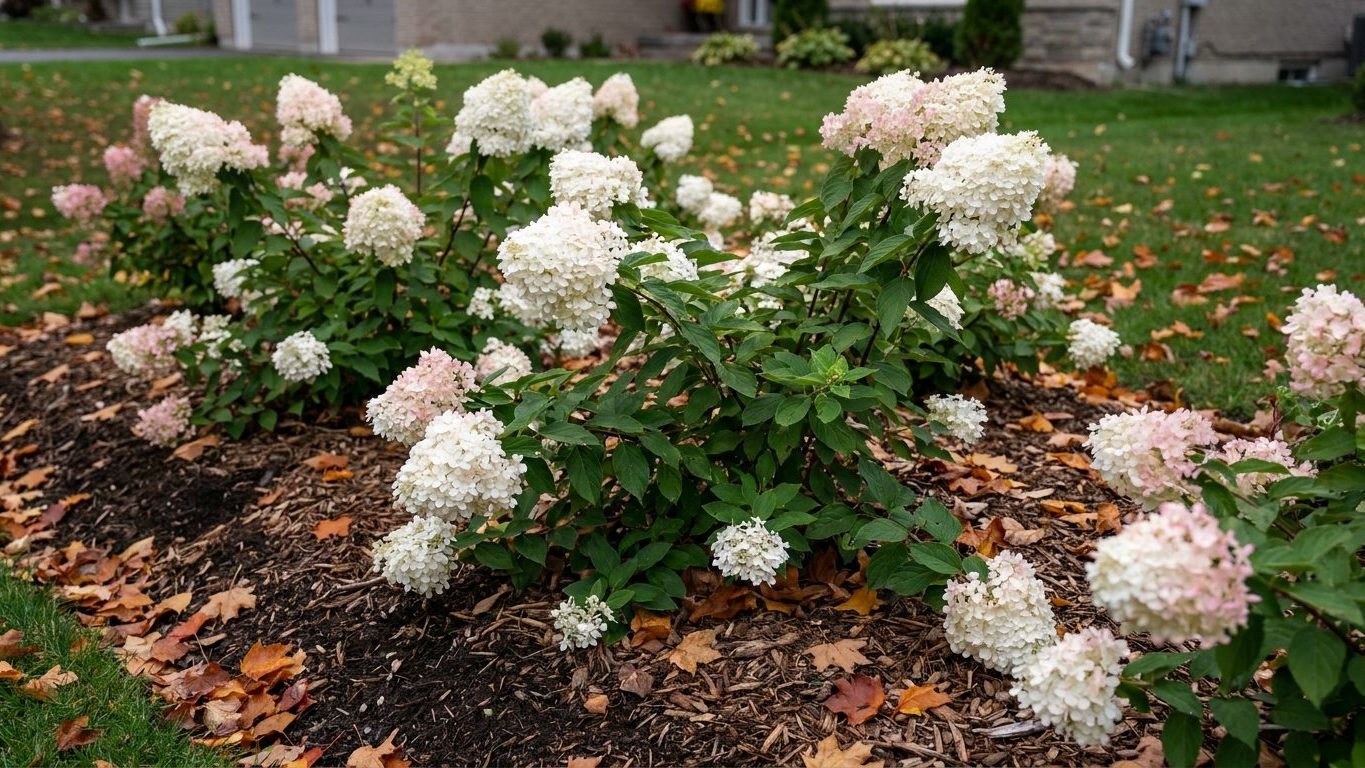
Yes, hydrangeas grow well in Ontario, especially panicle and smooth types that shrug off a hard winter. Bigleaf and oakleaf need a more sheltered spot, since a late cold snap can wipe out the flower buds they carry over from last year. Timing everything to the province’s frost dates and hardiness zone is what separates a full summer of blooms from a shrub that only leafs out.
Hydrangeas Care Calendar for Ontario

Environment and Climate Change Canada’s Canadian Climate Normals set the average last spring frost at April 30 and the first fall frost at October 16 for the Toronto Pearson station, and that roughly five-and-a-half-month stretch is what the whole hydrangea year here is built around.
- Dormancy: late fall through early spring is the one stretch when a hydrangea can be dug up or moved with its roots undisturbed.
- Planting: hold off until two to three weeks past the April 30 average last frost, putting the safer window in mid to late May.
- Pruning old-wood bloomers: cut back spent flower heads in late winter, while the plant is still bare, never once new leaves have opened.
- First feed: work in a balanced fertilizer once the soil has warmed past the last frost, usually the same week as planting.
- Bloom watch: color and cluster size build through July and August, the payoff for any buds that made it through spring.
- Last feed: stop feeding by midsummer so new growth has time to harden before the October 16 average first fall frost.
- Winter prep: mound mulch over the crown of a tender variety before the ground locks up, using mid-October as the cue to act.
That April 30 date is a mean, not a promise, so in roughly half of all years frost lands later, and a gardener who plants right on the average is betting on the other half going in his favor.
Ontario — the year and the numbers
- State
- Ontario
- Hardiness zones
- 7a
- Last spring frost
- April 30
- First fall frost
- October 16
- Annual rain
- 31 in
- Lawn zone
- cool-season
- Source
- Environment and Climate Change Canada — Canadian Climate Normals 1981-2010, station TORONTO LESTER B. PEARSON INT'L A · Toronto
Best Hydrangeas for Ontario
Natural Resources Canada’s Plant Hardiness Site puts Toronto at zone 7a in the Canadian system, a rating built from seven climate variables rather than the single winter-low reading behind the US scale, so it does not convert directly to a USDA number.
Panicle and smooth hydrangeas flower on new wood grown after the last frost, so an Ontario winter rarely costs them a bloom season, while bigleaf and oakleaf set next year’s buds on old wood that a hard cold snap can kill outright before spring even arrives.
| Kind | Flowers on | Verdict here | Why |
|---|---|---|---|
| Panicle | New wood | Reliable | Buds form after the last frost, so winter cold never reaches them |
| Smooth | New wood | Reliable | Dies back hard some winters but regrows and blooms the same year |
| Bigleaf | Old wood | Uneven | A late frost after leaf-out can erase the whole year’s flowers |
| Oakleaf | Old wood | Borderline | Exposed stems can die back to the snow line in a bad winter |
Climbing hydrangea shows up occasionally in sheltered corners, but it and the other less common kinds are on their own pages, worth checking before a whole bed rides on one shrub.
When to Plant, Prune and Feed Hydrangeas in Ontario
Environment and Climate Change Canada’s Canadian Climate Normals anchor every window below to the same two Toronto Pearson averages, an April 30 last spring frost and an October 16 first fall frost.
Counting forward from one date and back from the other turns those two averages into three practical windows instead of a single date circled on a calendar.
| Task | Window here | Counted from |
|---|---|---|
| Planting | Mid to late May | Two to three weeks after the April 30 average last frost |
| Pruning old wood | Late winter, before leaf-out | Ahead of the April 30 average, while the plant is still dormant |
| Last feeding | By early August | About ten weeks before the October 16 average first frost |
New-wood bloomers like panicle and smooth types tolerate a later planting than that if a spring gets away from you, since a missed window only delays the first bloom, not the plant’s survival.
Hydrangeas Problems in Ontario and What Causes Them
No flowers on an otherwise healthy shrub
A bigleaf or oakleaf hydrangea that leafs out fine but skips flowering usually lost its buds to a cold snap after the April 30 average last frost, since those kinds carry flowers over on last year’s wood. A repeat over two winters is worth switching to a panicle or smooth variety instead.
Stems dead back to the ground
Winter injury shows up as blackened, brittle stems come spring, most common on a tender bigleaf variety pushed past its comfort in Canadian zone 7a. The plant often resprouts from the base by June, but that fresh growth won’t flower the same season on an old-wood bloomer.
Leaves scorched right after planting
Foliage that browns at the edges soon after going in the ground is usually transplant stress meeting a cold, drying wind before the roots have caught hold, more likely the closer planting sits to the April 30 average. Water deeply and hold off on fertilizer until new leaves appear.
Ontario North to South: How the Dates Shift
The April 30 and October 16 averages describe the milder band around Toronto, and the season stretches or shrinks the farther a yard sits from Lake Ontario and Lake Erie.
- The Golden Horseshoe and Niagara (Toronto, Niagara-on-the-Lake, Hamilton): lake-warmed air tends to push the last frost earlier and the first frost later than the provincial average, the easiest strip here for bigleaf hydrangeas.
- Eastern Ontario and the Ottawa Valley (Ottawa, Kingston, Cornwall): a more continental climate brings colder winter lows, favoring panicle and smooth types over anything that blooms on old wood.
- Northern Ontario (Sudbury, North Bay, Thunder Bay): frost lingers weeks longer into spring and returns weeks earlier in fall, squeezing the safe planting window from both ends.
None of that changes which shrub survives so much as the calendar wrapped around it, so narrow down to a local forecast.
Ontario Extension Offices and County Contacts
Zone 7a and the Toronto Pearson frost dates above are a starting point, not a substitute for what a particular county actually sees through the year.
- Ontario Ministry of Agriculture, Food and Rural Affairs: the provincial agriculture and food page, a starting point for local growing contacts.
- Your county or region: local staff can confirm frost and soil detail that a province-wide average cannot.
- This month’s gesture: check the calendar above and mulch or plant accordingly before the ground makes the decision for you.
Common questions
Can bigleaf hydrangeas survive Ontario winters?
Often, but not every year. Because bigleaf carries its flower buds through the winter on old wood, a hard cold snap in Canadian zone 7a can kill next summer’s blooms even while the plant itself lives on.
When is the safest time to plant a hydrangea in Ontario?
Wait until two to three weeks after the April 30 average last spring frost, landing in mid to late May, since that date is a mean and frost can still arrive later in any given year.
Do hydrangeas need winter protection in Ontario?
Panicle and smooth types generally do not, since they rebuild their flowers on new wood each spring. Bigleaf and oakleaf benefit from a mulch mound over the crown before the ground freezes, ahead of the October 16 average first frost.