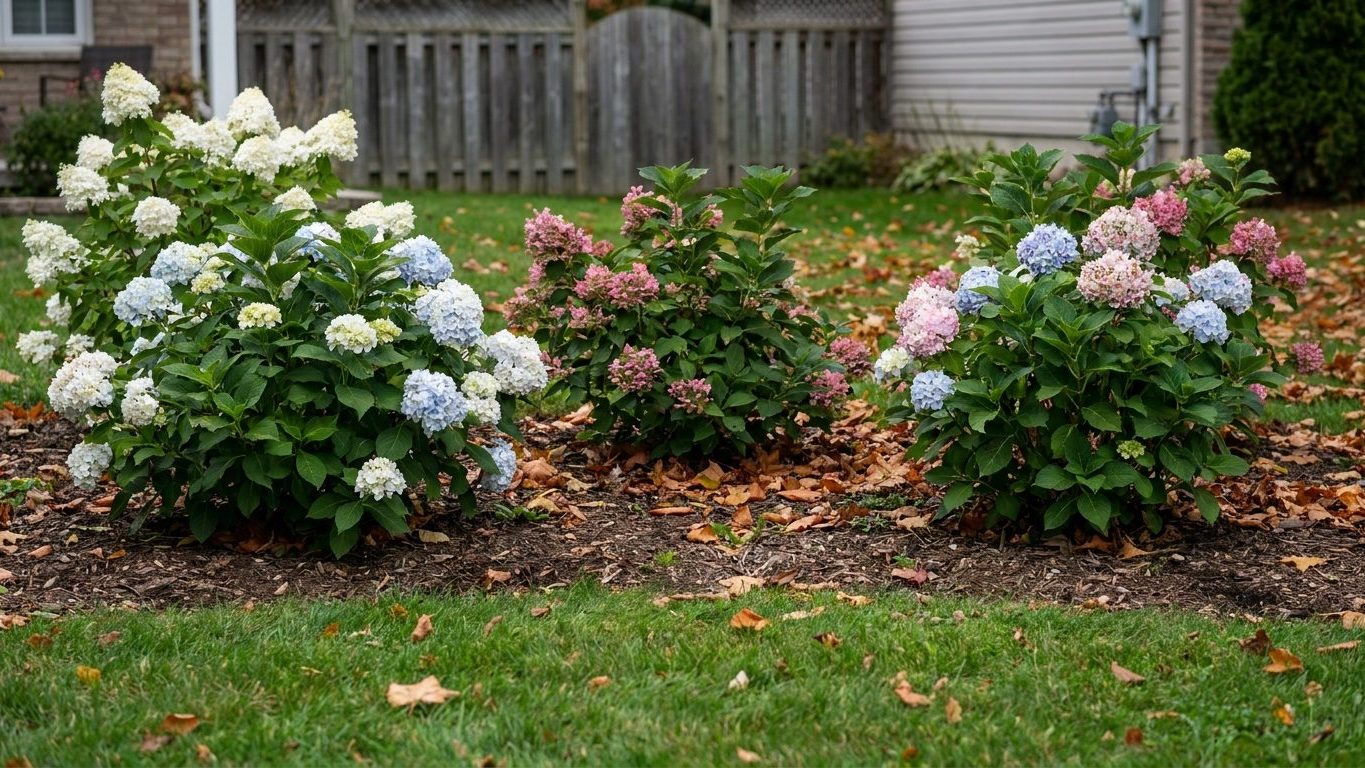
Toronto’s average last spring frost falls April 30, and the average first fall frost lands October 16, according to Environment and Climate Change Canada. That gives Ontario gardeners a plant window in April, May, August, and September, with bigleaf pruning held to June and July, once buds show. Toronto sits at Canadian hardiness zone 7a, though northern districts trail weeks behind.
When to prune hydrangeas in Ontario: The Short Answer
Environment and Climate Change Canada’s Canadian Climate Normals put Toronto’s last spring frost at an average of April 30, a date that works as a midpoint rather than a guarantee, since frost lands later in half of all years.
- January: The shrub sits dormant under any snow cover, so this is a month to leave pruners in the shed. Check that a burlap wrap or mulch collar from fall is still in place, since cold snaps can drop hard even without fresh snow.
- February: Buds stay closed and roots stay frozen, so nothing gets cut or planted this month. Use the quiet weeks to plan where new stock will go once spring frost breaks.
- March: This is the first of three fertilizer rounds on the Ontario calendar, timed to reach roots as they wake before the frost-free stretch opens. Skip pruning still, since April 30 sits weeks away and a hard freeze can still hit swelling buds.
- April: Planting opens this month, but only toward its back half, since a young root ball has no cushion against a late freeze around the average last frost. Hold new stock in pots near a house wall if the soil still feels cold.
- May: Planting continues here with the frost date behind, and this month also carries the second fertilizer round of the season. Water new transplants through any dry stretch, since shallow spring roots dry out fast.
- June: Pruning of bigleaf hydrangeas belongs here, once flower buds show clearly on old wood, so cuts remove only spent or damaged stems. Wait for open blooms before touching a blade, since bigleaf sets next year’s flowers on this year’s growth.
- July: This closes the pruning window for bigleaf types, and it carries the third fertilizer application too. Stop feeding by month’s end so new growth has time to harden before fall.
- August: Planting reopens here, well ahead of the average first fall frost of October 16, giving roots real weeks to settle before cold returns. Choose a cloudy stretch for transplanting, since August heat stresses new roots fast.
- September: This is the last planting month on the calendar, and anything set in the ground now needs mulch by month’s end to buy extra root time before frost. Stop pruning entirely, since a fresh cut this late invites dieback.
- October: The average first fall frost lands October 16, so this month is about protection rather than planting or cutting. Pile mulch over the root zone once the top inch of soil cools, and leave faded flower heads on the stems through winter.
- November: Frost has typically already passed by now, and the plant moves fully into dormancy. Wrap exposed bigleaf varieties in burlap if last winter showed dieback, since a Canadian hardiness zone of 7a still allows hard cold snaps.
- December: Nothing gets planted, fed, or cut this month, and the shrub rests under whatever snow the season brings. Check wraps and mulch after any heavy wind, since bare roots exposed to open air suffer more than covered ones.
None of these windows are fixed dates, since a frost that averages April 30 in Toronto can land later or earlier depending on where in the province you garden.
Ontario — the year and the numbers
- State
- Ontario
- Hardiness zones
- 7a
- Last spring frost
- April 30
- First fall frost
- October 16
- Annual rain
- 31 in
- Lawn zone
- cool-season
- Source
- Environment and Climate Change Canada — Canadian Climate Normals 1981-2010, station TORONTO LESTER B. PEARSON INT'L A · Toronto
How to Work Out the Dates for Your Own Yard
Environment and Climate Change Canada’s Canadian Climate Normals give two anchor dates for Toronto, April 30 for the last spring frost and October 16 for the first fall frost, and everything else in this calendar works backward or forward from that pair.
- Start from the Toronto anchor: treat April 30 and October 16 as the midpoint of your own frost risk, not a hard line, since half of all years run later on both ends.
- Push planting past the spring line: wait until the calendar’s April or May window falls solidly after that midpoint, since a bigleaf root ball newly in the ground has no reserve against a late freeze.
- Back the fall planting off the October line: the calendar’s August and September window sits far enough ahead of October 16 to give roots real weeks to establish before cold returns.
- Hold pruning to the June and July gap: cut bigleaf wood only once flower buds have shown, since the calendar sets pruning there specifically to avoid removing next year’s growth.
- Adjust for your own microclimate: a garden further north or inland from Lake Ontario’s moderating water should push every one of these windows later, while a sheltered spot close to a lake can often start a little earlier.
None of this replaces a local check. A fence line that blocks wind, a slope that drains cold air, or a lake two miles off can shift these dates by weeks in either direction, and the calendar above only holds for a garden that looks roughly like Toronto’s.
Ontario North to South: How the Dates Shift
Ontario stretches from the Carolinian shoreline near Lake Erie to the boreal edge past Lake Superior, and the Toronto anchor dates only describe the middle of that range.
- The southwest shoreline (Windsor, Niagara, the north shore of Lake Erie): the largest lake bodies nearby hold heat into fall and buffer spring cold snaps, so planting and pruning windows here often open earlier than Toronto’s and close later.
- The Golden Horseshoe and central belt (Toronto, Hamilton, the Kitchener-Waterloo corridor): this is the reference band the calendar above is built on, with the mildest swing between the two frost dates.
- Eastern Ontario and the Ottawa Valley (Ottawa, Kingston, the St. Lawrence corridor): further from large lake water, this stretch tends to see fall frost arrive earlier and spring frost linger later than Toronto does.
- The north (Sudbury, North Bay, Thunder Bay): distance from Great Lakes moderation and higher latitude push every date in this calendar back by weeks on both ends, and a shorter frost-free season squeezes the plant and prune windows tighter.
A garden a few hours’ drive from Toronto in any direction can run on a genuinely different calendar, and the province-level guide covers how far that shift usually runs.
Mistakes Ontario Punishes
Pruning bigleaf too early
A warm week in April tempts a cut before flower buds show, but bigleaf sets its blooms on old wood, and cutting before June removes next year’s flowers along with the frost damage. Wait for the calendar’s June and July window and cut only once new growth is visible.
Planting straight after the last frost date
Environment and Climate Change Canada’s Canadian Climate Normals list April 30 as a mean, not a guarantee, so half of all years bring frost later. Hold spring planting toward the back of the April and May window, or shift to the safer August and September stretch instead.
Skipping winter mulch on bigleaf
Natural Resources Canada’s Plant Hardiness Site puts Toronto at Canadian zone 7a, a rating that still allows hard cold snaps to kill exposed bigleaf flower buds even when the wood survives. A thick mulch or leaf pile over the crown before the ground freezes protects next summer’s blooms far better than a bare stem does.
Ontario Extension Offices and County Contacts
Toronto’s frost dates and zone rating are a starting point, not a final answer, and Ontario’s Ministry of Agriculture, Food and Rural Affairs and local county offices carry the rest of the picture for a specific address.
- Your province guide: the frost dates and hardiness zone for Ontario overall, with the full by-region breakdown.
- Which ones hold up here: the varieties suited to Ontario winters and summers, ranked from safest to riskiest.
- What goes wrong here: the pests and problems Ontario hydrangeas actually face, season by season.
Common questions
Can I plant hydrangeas in Ontario in early spring?
Early April sits ahead of the average last frost of April 30, so a root ball planted then carries real risk. The calendar’s April window is safer toward its back half, and May gives even more room once frost has passed.
Do hydrangeas survive Ontario winters without protection?
Toronto’s Canadian hardiness zone of 7a still allows hard cold snaps that damage exposed bigleaf buds, even where the stems themselves survive. A mulch or leaf pile over the crown before freeze-up makes the difference for next summer’s flowers.
When is it too late to prune bigleaf hydrangeas in Ontario?
The calendar closes bigleaf pruning at the end of July. Cutting later removes wood that has already set next year’s flower buds, and it leaves fresh cuts without enough time to harden before fall frost arrives.