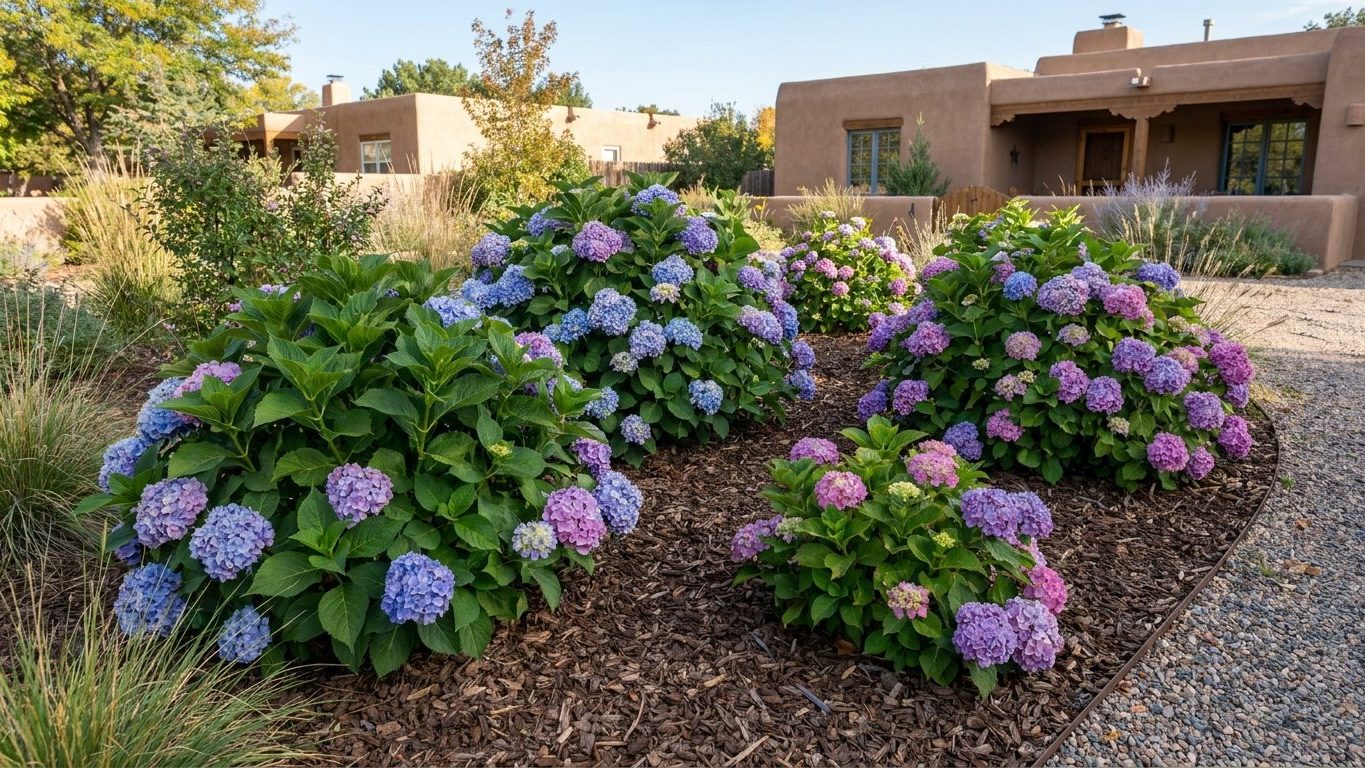
Hydrangeas grow in New Mexico, but which kind decides whether you get flowers. Panicle and smooth hydrangeas bloom on new wood and shrug off the state’s freeze swings, while bigleaf and oakleaf types risk losing their buds most winters outside the mildest pockets. Albuquerque’s frost dates and the state’s 4b to 9a hardiness range set the calendar for planting, pruning and feeding below.
Hydrangeas Care Calendar for New Mexico

In Albuquerque, the reference point for New Mexico’s climate data, the last spring freeze lands between March 31 and April 12, and the first fall freeze shows up between October 29 and November 9, according to NOAA NCEI U.S. Climate Normals 1991-2020, and that gap sets every date below.
- Dormancy: late fall through winter is the only stretch to move a rooted hydrangea without stressing it, while the plant has no leaves to lose.
- Planting: wait until two to three weeks after April 12 to set new hydrangeas out, once the soil has warmed past the last frost window.
- Spring growth: new leaves push out fast once nights stay above freezing, and a late cold snap close to April 12 can still nip soft growth.
- Pruning: cut mophead and bigleaf types back right after bloom fades, and cut panicle and smooth types back in late winter before growth starts.
- Bud set: old wood varieties form next year’s flower buds by mid to late summer, so a hot, dry stretch here can cut next spring’s bloom short.
- Fall prep: stop feeding six to eight weeks before the October 29 freeze date so new growth has time to harden off.
- Winter protection: pile mulch over the root zone once nights near November 9 turn consistently cold, especially at higher elevation.
None of these dates move much once you know your own county’s frost record, and that’s the number worth pinning down before anything else.
New Mexico — the year and the numbers
- State
- New Mexico
- USDA zones
- 4b-9a
- Last spring frost
- March 31 to April 12
- First fall frost
- October 29 to November 9
- Annual rain
- 9 in
- Lawn zone
- transition-season
- Source
- NOAA NCEI U.S. Climate Normals 1991-2020, 32F freeze probabilities · Albuquerque
Best Hydrangeas for New Mexico
New Mexico’s USDA Plant Hardiness Zone Map range of 4b to 9a covers everything from high-desert cold to milder river valleys, and that spread decides which hydrangea types survive winter here without help.
New wood bloomers shrug off a hard freeze because they push fresh buds every spring, while old wood bloomers gamble those buds through winter and often lose them outside the warmest pockets.
| Kind | Flowers on | Verdict in NM | Why |
|---|---|---|---|
| Panicle | New wood | Holds up statewide | Blooms even after a hard freeze kills top growth |
| Smooth (Annabelle type) | New wood | Holds up statewide | Same new-wood habit forgives freeze-thaw swings |
| Bigleaf / mophead | Old wood mostly | Struggles outside mild pockets | Buds set the prior summer often die in a hard winter |
| Oakleaf | Old wood | Marginal outside the mildest zones | Needs winters milder than much of the state sees |
Climbing hydrangea and mountain hydrangea barely register in New Mexico gardens, and the other kinds are on their own pages, since neither fits the state’s swing between hard freeze and high-desert heat.
When to Plant, Prune and Feed Hydrangeas in New Mexico
Planting, pruning and feeding all key off two dates. NOAA NCEI U.S. Climate Normals 1991-2020 puts Albuquerque’s last spring frost between March 31 and April 12 and the first fall frost between October 29 and November 9.
Everything else follows from counting forward or back from those two windows, and the count shifts by variety since old wood and new wood bloomers set their buds at different times of year.
| Task | Window here | Counted from |
|---|---|---|
| Plant | Two to three weeks after April 12 | Last spring frost, Albuquerque |
| Prune old wood (bigleaf, oakleaf) | Right after bloom fades, before late summer | Before next year’s buds set |
| Prune new wood (panicle, smooth) | Late winter, before growth starts | Six to eight weeks before April 12 |
| Feed | Stop six to eight weeks before October 29 | First fall frost, Albuquerque |
Gardeners at higher elevation should push every one of these windows a week or two later in spring and earlier in fall, since cold settles into the mountains before it reaches the Rio Grande valley.
Hydrangeas Problems in New Mexico and What Causes Them
No blooms after a cold winter
Old wood varieties like bigleaf and oakleaf set next year’s flower buds by late summer, and a hard freeze near the low end of the state’s 4b to 9a range can kill those buds outright. Switch to a new wood type, or wrap the base before the first fall freeze near November 9.
Leaves scorched on the sunny side
New Mexico’s dry air and intense afternoon sun pull moisture out of hydrangea leaves faster than most soils can resupply it, especially once heat builds after April 12. Move plants to afternoon shade and deep water twice a week through summer.
Leaves yellow between the veins
Much of New Mexico sits on alkaline caliche soil, and that high pH locks up iron before hydrangea roots can use it, turning new leaves pale with green veins. Work sulfur or an acidifying fertilizer into the planting hole, not after symptoms show.
New Mexico North to South: How the Dates Shift
New Mexico’s frost dates and hardiness zone shift hard between its mountain north and its desert south, and elevation matters as much as latitude here.
- Northern mountains (Taos, Santa Fe, Los Alamos): the coldest end of the state’s 4b to 9a range lands here, with frost arriving earlier in fall and lingering later in spring than Albuquerque’s.
- Rio Grande valley (Albuquerque, Belen, Socorro): this stretch is the reference point the dates above are built on, sitting in the middle of the state’s range.
- Southern desert (Las Cruces, Deming, the Mesilla Valley): warmer winters push toward the mild end of the range, giving old wood bloomers a better shot at surviving to spring.
- Eastern plains (Clovis, Roswell, Portales): wind and open exposure add stress even where winters run milder, so shelter matters as much as zone.
Check the state’s frost dates against your own county before trusting any date.
New Mexico Extension Offices and County Contacts
NMSU’s Cooperative Extension Service, named by the USDA NIFA land-grant directory, coordinates county offices across the state, and your local one knows your elevation and soil better than any statewide average.
- NMSU Cooperative Extension Service: county-by-county contacts for soil tests and local frost advice.
- Your state’s calendar page: the month-by-month dates layered over these three windows.
- Which hydrangeas hold up here: the deeper variety-by-variety breakdown for New Mexico conditions.
Common questions
Can bigleaf hydrangeas survive winter in New Mexico?
They can in the mildest, lowest pockets of the state’s 4b to 9a range, but a hard freeze near the cold end regularly kills the flower buds set the previous summer, leaving the plant alive but bloomless the following spring.
What’s the safest hydrangea to plant across most of the state?
Panicle and smooth types, since both bloom on new wood grown that same season and recover from a hard freeze that would strip a bigleaf variety of its flowers for the year.
When should I stop feeding hydrangeas in the fall?
Cut off fertilizer six to eight weeks before the first fall freeze, which lands between October 29 and November 9 in Albuquerque, so new growth has time to harden before cold arrives.