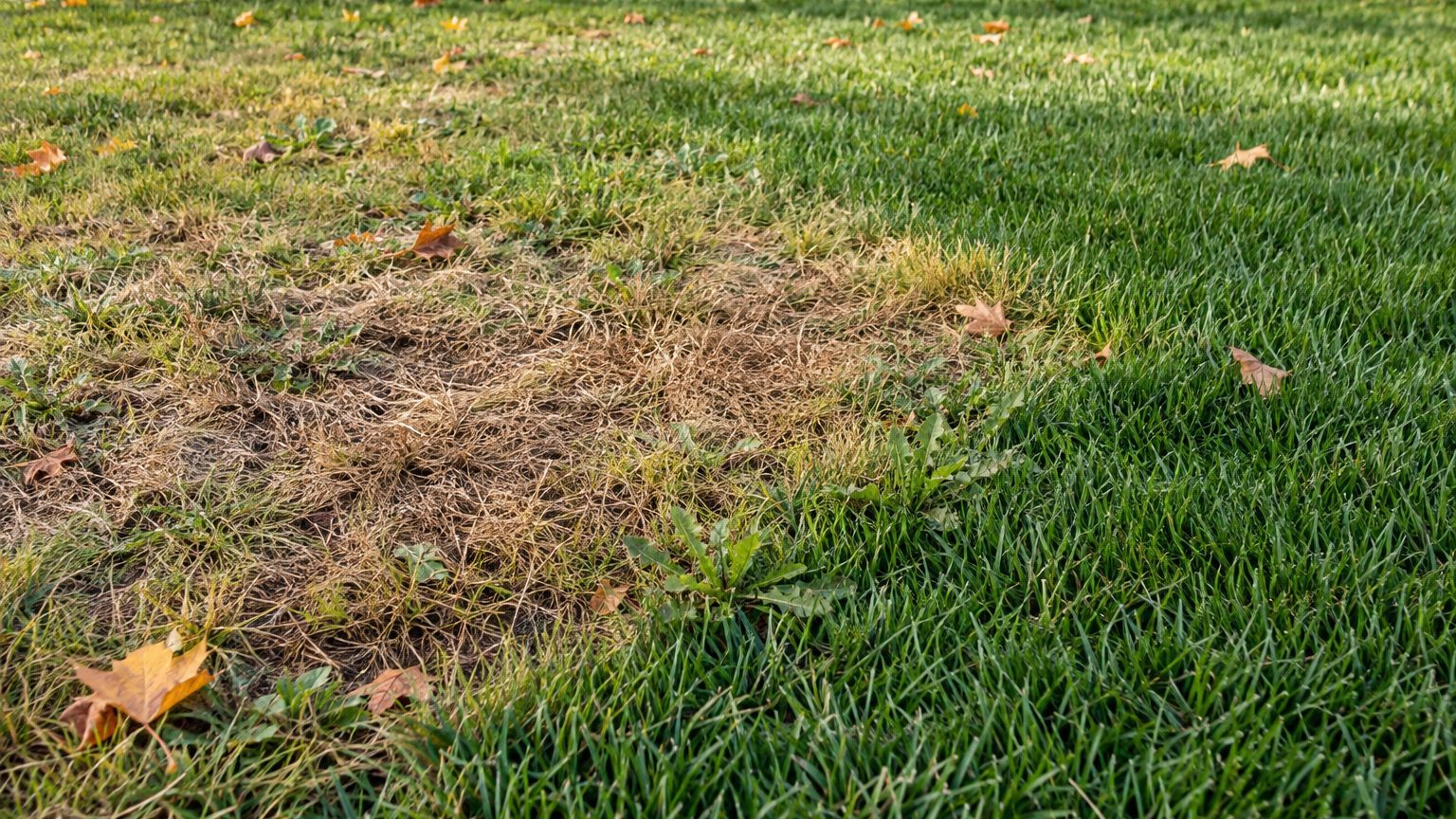
Straw-colored patches show up on a Saskatchewan lawn when the last snow melts, and bare spots or dandelions follow as the weeks warm. Most of what goes wrong here traces back to the long, hard winter, a short growing season and dry summers. Clues in the grass will usually point to the cause, and the fix depends on the season.
Lawn Pests and Diseases in Saskatchewan
Snow Mold After the Melt

Snow mold appears as matted, grayish or pinkish circles in the grass right after snow disappears. It develops under long snow cover on unfrozen ground, and it is common on prairie lawns. Rake the patches gently so the blades lift and dry. Most lawns recover on their own once spring growth starts.
Dandelions and Other Broadleaf Weeds
Dandelions send up rosettes with deep taproots as soon as the soil warms in spring. They take over where grass is thin. Pull them after rain, when the root slides out whole, and fill the hole with seed during the May seeding window. A dense lawn crowds out most seedlings before they get started.
Crabgrass in Summer Heat
Crabgrass is a pale green annual that sprawls flat in a star shape and thrives along hot driveways and sidewalks. It sprouts as the soil warms, so a preventer goes down in May. Frost can still return after the average last frost of May 18 in Saskatoon, so keep that date as the middle of a window, not a safe date.
Leaf Spot in a Wet Summer
Leaf spot shows as small tan blotches with darker edges on the blades, and the lawn looks thin and tired. It turns up after humid or rainy stretches, especially where clippings pile up and grass stays wet overnight. Mow on a dry day, bag or spread the clippings thinly, and water in the morning so the blades dry quickly.
Thick Thatch in Late Summer
Thatch is the spongy brown layer of stems and roots between the green blades and the soil. Press a finger into the turf and it feels like a mattress. Up to 1.3 cm (1/2 inch) is healthy, but beyond that water and fertilizer struggle to get in. Dethatch or core aerate in August or September, while the grass is growing and can fill in.
Saskatchewan — the year and the numbers
- State
- Saskatchewan
- Hardiness zones
- 3a
- Last spring frost
- May 18
- First fall frost
- September 18
- Annual rain
- 14 in
- Lawn type
- cool-season
- Source
- Environment and Climate Change Canada — Canadian Climate Normals 1981-2010, station SASKATOON SRC · Saskatoon
How to Tell Which Lawn Problem You Have
Appearance alone rarely settles it. Pair what the patch looks like with where it sits and when it appeared, then test it with a gentle tug. Grass that pulls up with no roots points to a different cause than grass that stays firmly planted.
Look at the whole yard before you pick a cause. A patch that sits in full sun beside pavement tells a different story from one under a spruce.
| What you see | Where and when | Likely cause |
|---|---|---|
| Matted gray or pink circles | Right after snowmelt, in low spots | Snow mold |
| Rosettes with deep taproots | Spring, in thin turf | Dandelions |
| Coarse pale clumps in a star shape | Midsummer, near hot pavement | Crabgrass |
| Small tan blotches with dark edges | After humid weather, in damp grass | Leaf spot |
| Spongy turf that sheds water | Late summer, across the lawn | Thatch |
Dry, crunchy grass that greens up after watering may be dormant rather than diseased. Thin grass under mature trees usually comes down to shade and root competition, and it needs shade-tolerant seed rather than treatment.
Where Lawn Problems Are Worst in Saskatchewan
The province is large, and what goes wrong in a yard changes with the soil, the rainfall and how far north it sits.
- Regina and the southern prairie: Dry summers and wind stress lawns here, so drought dormancy and weedy thin patches are the usual troubles. Heavy clay soils compact easily and shed water.
- Saskatoon and the central parkland: Hardiness here is Canadian zone 3a. Cold winters can leave snow mold and winter injury as spring complaints.
- Prince Albert and the northern forest edge: Shade from spruce and aspen, a shorter season and cooler soil run weeks behind the south. Moss and thin grass under trees show up more often.
- Cypress Hills: Higher ground gets more moisture and cooler nights, so lawns green up later and stay wet longer.
Use the local timing for any task, and expect the north to start later than the south.
Lawn Care Mistakes That Invite Problems in Saskatchewan
Mowing Too Short
Cutting the grass to a crew cut exposes the soil, which dries out fast and gives weeds room to sprout. Raise the mower deck so the blades stay tall, and cut only a little at a time. Mowing runs from May through October, and a tall lawn shades its own roots through the hot weeks.
Watering Lightly Every Day
Short daily sprinkles keep roots shallow and the surface wet, which suits leaf spot and weeds. Water deeply and less often, in the morning, and let the top of the soil dry between rounds. Watering matters most from May through September, when the grass is actively growing.
Feeding at the Wrong Time
Fertilizer belongs in May and September. Apply the fall feeding while the grass is still actively growing, before winter shuts it down. Skip a midsummer feeding in dry weather, because it can burn stressed grass.
Where to Get Lawn Advice in Saskatchewan
Canada has no county extension offices, so advice comes from the province, local gardeners and nearby growers. Each source answers a different kind of question.
- The Government of Saskatchewan agriculture pages point to provincial guidance on weeds and plant health, so check them when a weed is new to you.
- A local master gardener group can look at a sample or a photo of your patch, and spring is a good time to ask.
- A garden centre in your town knows which grass seed blends suit local soil, so stop in before you buy seed.
Common Questions
When Is Dormant Seeding Done in Saskatchewan?
November is the best time, when the soil is cold and the seed will lie still until spring. October can also work once the soil is cold enough to keep the seed dormant until spring.
Can You Seed Bare Patches in Spring?
Yes, May works as a fallback. August and September give the seed warm soil and time to root before winter, so those months are better when you can wait.
How Late Can You Keep Mowing?
Mowing continues through October, as long as the grass is still growing. Stop when growth stops and frost has taken over.