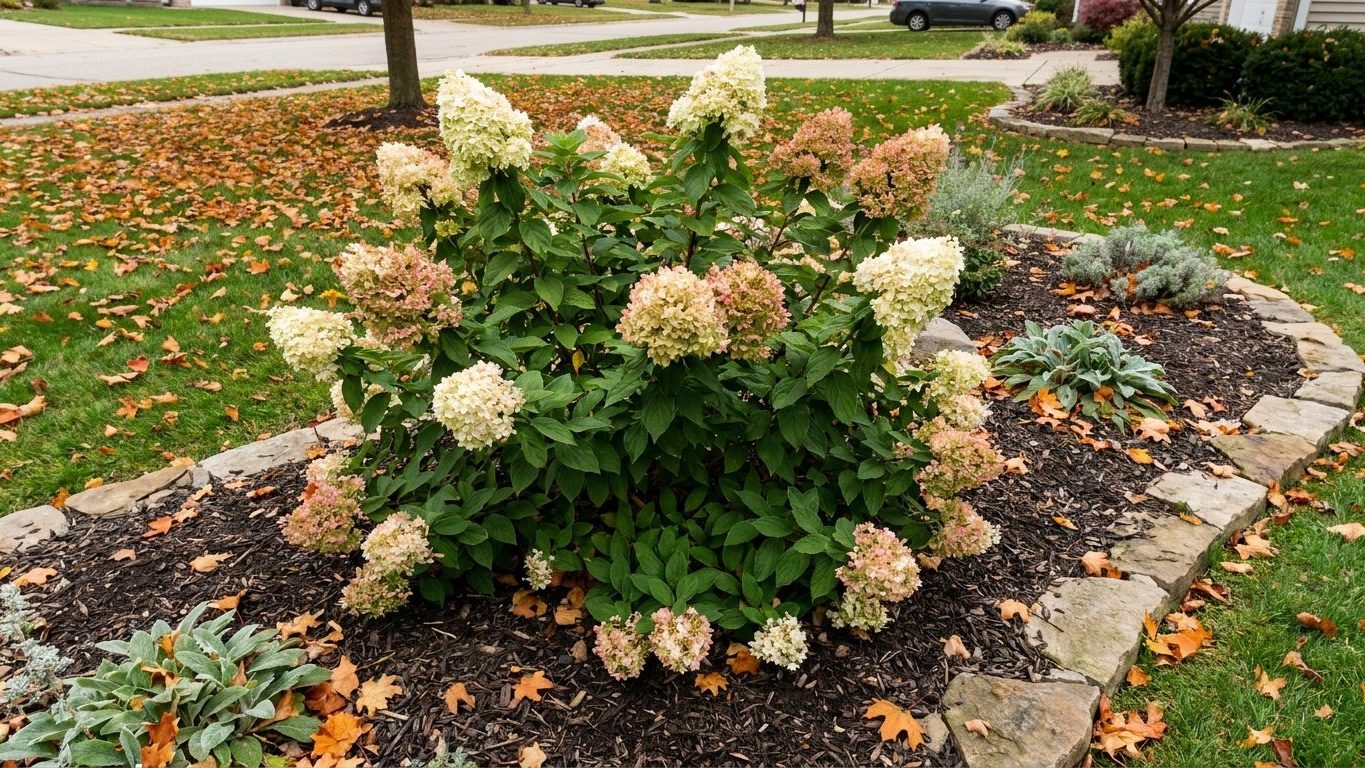
Plant hydrangeas in Wisconsin in April or May, or again in August and September. Prune bigleaf types in June and July.
Freeze dates set one end of those windows and root time sets the other. What follows runs through the year, then shows how to fit the dates to your own yard.
When to prune hydrangeas in Wisconsin: The Short Answer
NOAA NCEI 1991-2020 Climate Normals put Milwaukee’s last spring 32°F freeze at April 16 to April 29 and its first fall freeze at October 17 to October 29, which leaves planting windows in April and May, then August and September.
- January: Do nothing to the plants, since the ground is frozen and the last spring freeze is months away. Leave old flower heads standing.
- February: Plan beds and shop catalogs. Nothing goes in the ground with the April 16 to April 29 freeze range still about two months off.
- March: Fertilize once the ground thaws, a few weeks ahead of the April 16 to April 29 freeze range. Use a slow-release feed and keep it off frozen soil.
- April: Start planting when the soil is workable, and keep frost cloth handy until the April 16 to April 29 range has passed. Bare stems tolerate cold better than new leaves.
- May: Plant and fertilize, now that the last spring freeze range has closed after April 29. Water new shrubs deeply whenever rain falls short.
- June: Prune bigleaf this month, taking only dead wood and weak stems. Spring freezes are weeks behind, so cuts will not draw frost-tender growth.
- July: Finish bigleaf pruning early and give the year’s last feeding. Anything later leaves soft growth too little time to harden before the October 17 to October 29 freeze range.
- August: Plant again, roughly two months ahead of the October 17 to October 29 freeze range. Water deeply through dry spells, because new roots need moisture to establish.
- September: Finish planting by early to mid-month, which keeps about six weeks between the shovel and the freeze. Stop feeding and let growth slow.
- October: Plant nothing, since the freeze arrives October 17 to October 29. Keep watering new shrubs until the ground freezes.
- November: Mulch new plantings once the first freeze has passed. Leave the pruners in the shed, because the next pruning window does not open until June.
- December: The first freeze is behind you and the plants are dormant. Leave stems and dried heads alone.
Those dates belong to Milwaukee. Lakeshore, inland and northern yards drift earlier or later, and the next sections show how to adjust them.
Wisconsin — the year and the numbers
- State
- Wisconsin
- USDA zones
- 3b-6a
- Last spring frost
- April 16 to April 29
- First fall frost
- October 17 to October 29
- Annual rain
- 35 in
- Lawn zone
- cool-season
- Source
- NOAA NCEI 1991-2020 Climate Normals, 32F freeze probabilities · Milwaukee
How to Work Out the Dates for Your Own Yard
Dates come from a subtraction problem, and it starts with two freeze windows.
- Find the last spring freeze range: NOAA NCEI 1991-2020 Climate Normals list Milwaukee’s last 32°F freeze at April 16 to April 29. Anything already leafed out needs cover until that range closes.
- Find the first fall freeze range: For the same station it is October 17 to October 29. Every fall date counts back from that wall.
- Subtract six weeks: Six weeks before October 17 is September 5, and six weeks before October 29 is September 17. Fall planting in Milwaukee therefore ends somewhere between September 5 and September 17, a cushion for roots to grow before the ground firms up.
- Match the result to the calendar months: April, May, August and September are the planting months. A date that lands in October falls outside them, so a late-season nursery sale means waiting for April.
- Slide the range for your yard: Inland southern Wisconsin typically freezes in early October, earlier than Milwaukee. Pull the whole fall range earlier and confirm it with your county office.
Pruning follows a different rule. Bigleaf pruning sits in June and July, well clear of both freeze windows, so no subtraction is needed. Mark it on the calendar and leave it there.
Wisconsin North to South: How the Dates Shift
USDA Plant Hardiness Zone Map 2023 rates Wisconsin from 3b to 6a in the USDA system, so Milwaukee’s dates slide earlier or later depending on where the yard sits.
- Lake Michigan shore (Milwaukee, Racine, Sheboygan): the lake delays the first fall freeze, so fall planting can run a little later than inland, though the water keeps spring cool.
- Inland southern Wisconsin (Madison, Janesville, Beloit): the first freeze typically arrives in early October, so the fall planting range moves earlier than Milwaukee’s.
- Central Wisconsin and the Driftless (Stevens Point, La Crosse, Eau Claire): dates slide earlier as you head north, and low spots and river valleys collect cold air and freeze first.
- The North (Rhinelander, Hayward, Superior): the first freeze comes far earlier, so spring becomes the safer planting season and the fall window shrinks.
The Hydrangeas in Wisconsin page gives the state-level picture for frost and pruning.
Mistakes Wisconsin Punishes
Planting too close to the first freeze
NOAA NCEI 1991-2020 Climate Normals put Milwaukee’s first fall freeze at October 17 to October 29, and a shrub planted in October has no time to root before it hits. Finish by mid-September or wait for April. The Hydrangeas in Wisconsin guide covers the full year.
Cutting bigleaf back in spring

Bigleaf flower buds form on last year’s stems, so a March or April haircut removes the summer bloom. Prune in June or July instead, and take only spent heads and dead wood. Hydrangeas That Grow Well in Wisconsin lists types suited to the winters here.
Feeding after July
Fertilizer belongs in March, May and July. Feeding in August or September pushes soft new growth that a freeze in mid to late October can burn. Stop after July and mulch instead. Damaged tips can pass for disease, so check Hydrangea Pests and Diseases in Wisconsin before treating.
Wisconsin Extension Offices and County Contacts
The USDA NIFA Land-Grant University Extension directory points Wisconsin gardeners to extension.wisc.edu, where county offices answer local questions. The Milwaukee figures are a starting point. Your county office knows your soil and your microclimate.
- Hydrangeas in Wisconsin: the frost dates and the pruning window for the state as a whole.
- Hydrangeas That Grow Well in Wisconsin: which types hold up through the winters here, so you know what to plant on your dates.
- Hydrangea Pests and Diseases in Wisconsin: what to look for once the shrubs are established. Read it before you buy, then call your county office with what you find.
Common questions
Can I plant hydrangeas in Wisconsin in summer?
The planting months on the calendar are April, May, August and September. June and July are for pruning bigleaf, and July also gets the last feeding, so a shrub bought in midsummer can wait for August.
When should I prune hydrangeas in Wisconsin?
For bigleaf, prune in June and July. The calendar covers bigleaf only, so check Hydrangeas That Grow Well in Wisconsin for the other types that suit the state.
When is the first fall freeze in Wisconsin?
NOAA NCEI 1991-2020 Climate Normals give Milwaukee a first fall freeze of October 17 to October 29. Lake Michigan delays it at the lakeshore, inland southern Wisconsin typically freezes in early October, and the north freezes far earlier.