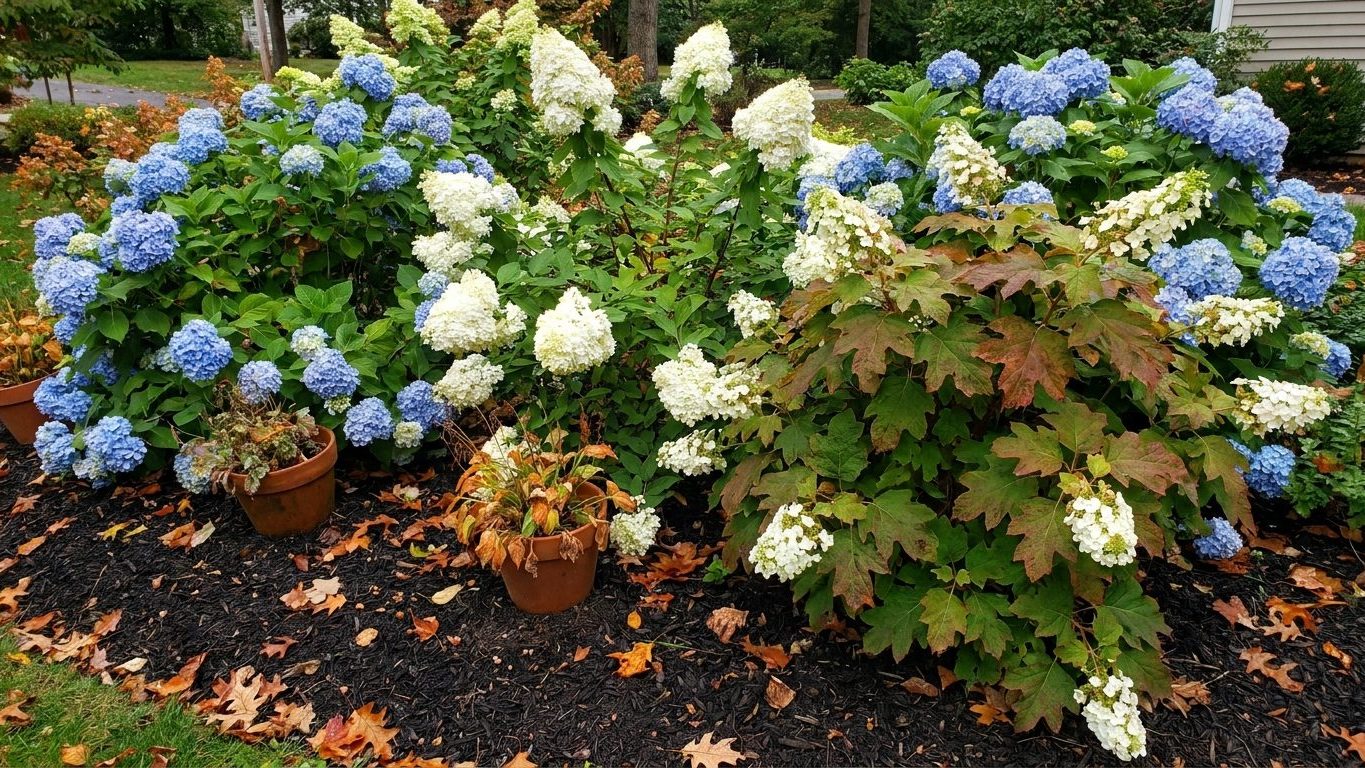
Panicle and smooth hydrangeas grow well in every part of Virginia, from Virginia Beach to the Blue Ridge, because they bloom on new wood each spring and shrug off a late freeze. Bigleaf hydrangea, the classic mophead, only holds up reliably along the coast, where winters stay mild enough to spare its old-wood flower buds.
Hydrangeas that grow well in Virginia: The Short Answer
The USDA Plant Hardiness Zone Map puts Virginia at 5a to 8b, and that spread explains which hydrangea holds up where in the state. Virginia Beach, home to the coastal weather station behind these dates, sits at the mild end of that range, while the Blue Ridge and southwest Virginia run several zones colder.
A shrub that blooms without fail on the coast can lose every bud a hundred miles inland. Here are six that cover the state, ranked from the safest bet to the one that needs the right spot to pay off.
Panicle hydrangea

Hydrangea paniculata blooms on new wood, so a late freeze nipping the stems in spring doesn’t touch the flower buds, which form later. It handles the cold pockets of the Blue Ridge and a Virginia Beach summer with equal ease. This is the shrub I’d plant first, sight unseen.
Smooth hydrangea

Hydrangea arborescens, parent of the popular ‘Annabelle’, is native to the eastern woodlands that include Virginia, so it already suits the state’s freeze-thaw swings. It blooms on new wood too, which makes it nearly foolproof from the mountains to the coast. Afternoon shade keeps the flower heads from flopping in July heat.
Oakleaf hydrangea

Hydrangea quercifolia is native to the Southeast and feels at home in Virginia’s clay soil and part shade. Its cone-shaped blooms fade to a rust color that holds into fall, after the panicle and smooth types have gone bare. The coldest mountain hollows can still burn its buds some winters.
Climbing hydrangea

Hydrangea anomala subsp. petiolaris is hardy statewide but slow, often taking several seasons to bloom while it establishes on a wall or trellis. Once rooted in, it performs about as reliably as the panicle type. Patience is the real requirement here, not the climate.
Mountain hydrangea

Hydrangea serrata is a smaller cousin of bigleaf, with flower buds that survive a harder freeze than the classic mophead. It still blooms mostly on old wood, so a hard late frost in the colder third of the state can cut the show short. It suits Piedmont gardens better than the open Blue Ridge crest.
Bigleaf hydrangea

Hydrangea macrophylla is the classic mophead, with big pink or blue blooms, and it’s the riskiest pick statewide. It sets flower buds on old wood, so a late freeze or hard winter can strip a healthy plant of every bloom. It performs best near Virginia Beach, less well toward the mountains.
Virginia — the year and the numbers
- State
- Virginia
- USDA zones
- 5a-8b
- Last spring frost
- March 20 to April 3
- First fall frost
- November 10 to November 24
- Annual rain
- 47 in
- Lawn zone
- transition-season
- Source
- NOAA NCEI 1991-2020 Climate Normals, 32F freeze probabilities · Virginia Beach
How to Work Out the Dates for Your Own Yard
Working out whether a hydrangea will perform in your yard starts with the same frost window that governs every other spring job in Virginia, adjusted for the fact that flower buds often form months before they open.
- Locate your zone on the map: Virginia spans 5a to 8b, so a shrub rated no colder than zone 7 is a gamble past the Piedmont.
- Check bloom habit before buying: old-wood bloomers set next year’s flowers by late summer, so a hard freeze during NOAA NCEI 1991-2020 Climate Normals’ last spring frost window, March 20 to April 3 near the coast, can wipe them out.
- Weigh the first fall frost too: the same normals put it at November 10 to November 24 near the coast, and a shrub needing a long season to finish wood struggles in the colder third of the state.
- Match bud swell to the frost window: if buds are already swelling before that spring window closes, the plant is exposed, count backward from it rather than forward from planting day.
- Compare against a plant that already works: panicle hydrangea blooms on wood grown after both frost windows close, so it never gambles on a single date.
- Check the reference city against yours: Virginia Beach anchors these dates, so gardens in the Blue Ridge or southwest should push every window later in spring and earlier in fall.
Bigleaf hydrangea fails this test across half the state, since it needs old wood to survive winter intact, and in the colder pockets that’s not a safe bet most years. Panicle passes because it starts fresh each spring, regardless of what winter did to last year’s stems.
Virginia North to South: How the Dates Shift
Elevation and distance from the ocean shift these dates more than latitude does within Virginia, and the direction it moves changes which hydrangea makes sense.
- Coastal Tidewater and Virginia Beach: the mild end of the state, where the frost windows named above apply directly and bigleaf hydrangea has its best odds.
- The Piedmont, around Richmond: spring frost lingers later and fall frost arrives sooner than at the coast, narrowing the season for anything that blooms on old wood.
- The Blue Ridge and Shenandoah Valley: elevation pushes both frost dates further from the coastal window, favoring panicle and smooth over bigleaf.
- Far southwest Virginia: the coldest ground in the state, where the season runs weeks shorter than the coast and only the hardiest new-wood types are worth the effort.
Whichever part of the state you garden in, shift the coastal dates later heading inland and check the Virginia hydrangea calendar for the exact planting and pruning months.
Mistakes Virginia Punishes
Planting bigleaf inland and hoping
Bigleaf sets flower buds on old wood, and inland Virginia’s colder nights kill those buds most winters even when the plant itself survives. Plant it only near the coast, and choose panicle or smooth for the Piedmont and mountains instead, checking the ranked list above before buying on looks alone.
Pruning on the wrong month
Cutting bigleaf back in fall or winter removes the buds it already set for next summer’s flowers. The safe window runs June and July, right after the current bloom fades and before next year’s buds start forming on the new growth.
Skipping afternoon shade
Full sun all day scorches hydrangea leaves fast once Virginia’s summer humidity sets in, especially on bigleaf and oakleaf types. Give it morning sun and afternoon shade instead, and mulch to keep roots cool through the fertilizing months of March, May, and July.
Virginia Extension Offices and County Contacts
The USDA Plant Hardiness Zone Map’s 5a to 8b range is a starting point, not a verdict for your yard, and Virginia Cooperative Extension fills in the rest county by county.
- Virginia Cooperative Extension: ext.vt.edu lists the local office for your county, along with soil testing and plant clinics.
- The Virginia hydrangea calendar: month-by-month planting and pruning dates for wherever you live in the state.
- What goes wrong with hydrangeas in Virginia: the pests and problems specific to this state’s climate, and how to spot each one.
Common questions
Can bigleaf hydrangea survive in the Blue Ridge?
It can survive the cold and still fail to bloom, since the plant itself is hardier than the flower buds it sets on old wood. Most gardeners in the mountains get better results from panicle or smooth hydrangea instead.
When should I plant a new hydrangea in Virginia?
March, April, September, and October are the planting months for the state, giving roots time to settle before summer heat or winter cold arrives.
Why did my hydrangea leaf out but never flower?
An old-wood bloomer like bigleaf or mountain hydrangea likely lost its flower buds to a late frost or a cold winter, even though the rest of the plant survived fine. Switching to a new-wood bloomer solves this for good.