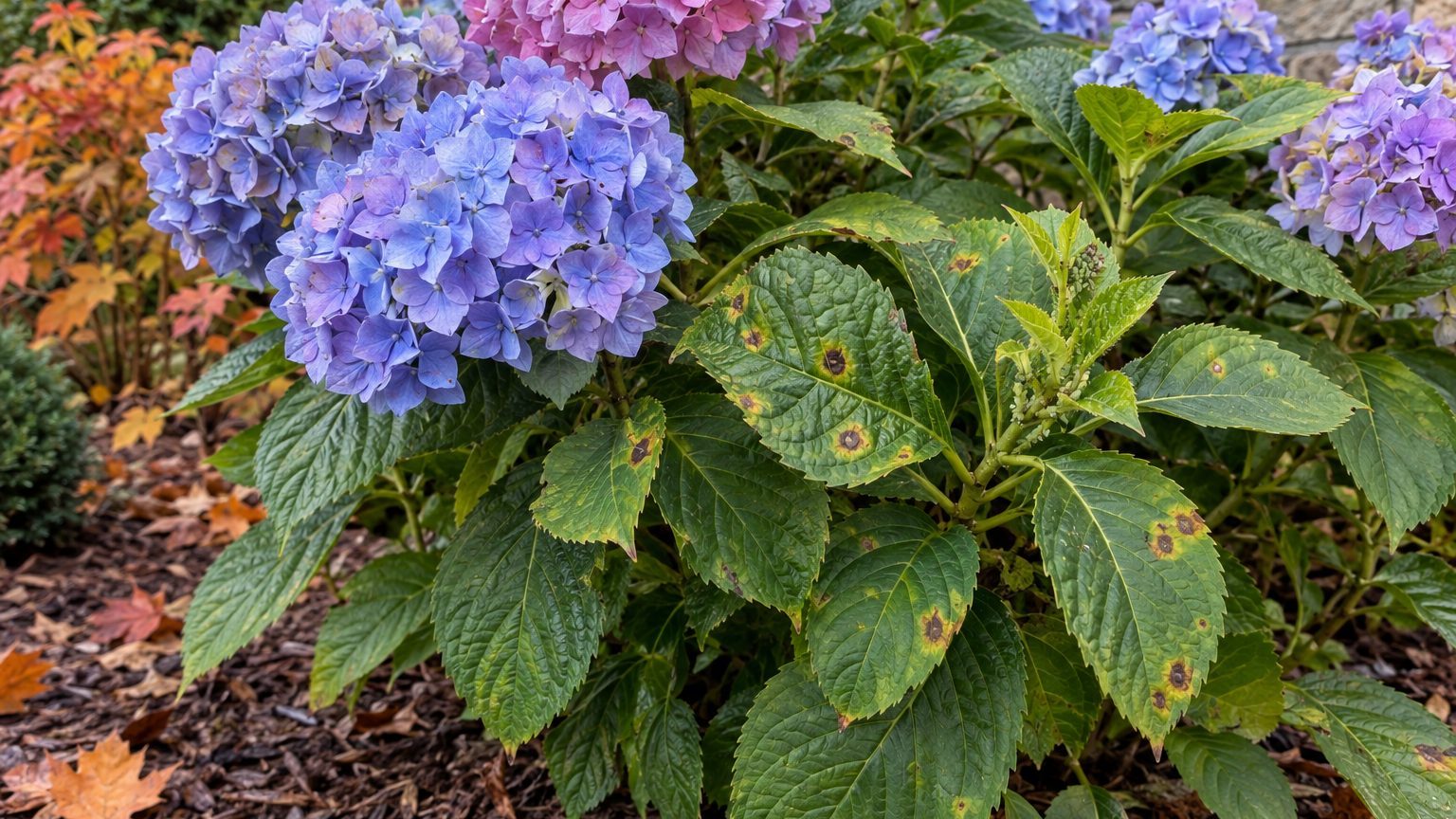
In Salt Lake City, the hydrangea problems homeowners hit most are iron chlorosis from alkaline soil and hard water, plus winterkill of flower buds after a cold snap.
Add aphids and spider mites on new growth, and leaf scorch through the dry, high-elevation summer. Each one has a specific fix tied to this state’s climate and soil chemistry.
Hydrangea pests and diseases Utah: The Short Answer
The USDA Plant Hardiness Zone Map puts Utah at 4a to 9a, and Salt Lake City, the valley this guide uses as its reference point, sits on the milder side of that range.
That mild pocket does not spare local hydrangeas from a short, predictable list of problems: bud winterkill, iron chlorosis, aphids, botrytis, spider mites, and powdery mildew, roughly in that order across the growing season.
No flowers on a healthy shrub

Flower buds formed the summer before often die over winter here, especially after a hard freeze near the fall frost window of October 18 to October 29. Foliage returns fine, bloom does not. Pick a variety that flowers on new wood, or mulch buds heavy before that window closes.
Leaves turning yellow between green veins

Utah’s alkaline soil and hard tap water lock up iron, so mophead and lacecap hydrangeas often show yellow leaves with dark green veins by early summer. Ordinary fertilizer will not fix this. Work in soil sulfur or an iron chelate at planting, then test pH again after a season.
Curled new growth covered in sticky residue
Aphids cluster on tender spring shoots and leave a shiny film that draws ants and sooty mold. They rarely kill an established shrub. A hard spray from the hose every few days, or insecticidal soap on the worst clusters, clears most infestations before the June pruning window arrives.
Gray fuzz on blooms after a cool, wet spell
Botrytis blight shows up as gray, fuzzy patches on flowers and soft brown spots on leaves during damp, cool stretches in late spring. It spreads fast in still, humid air. Cut out and discard affected blooms, and space plants so air moves freely between them.
Speckled, bronze leaves in a hot dry spell
Spider mites thrive in the dry heat of a Utah summer, stippling leaves with tiny pale dots that turn bronze under stress. Fine webbing on the underside confirms it. A strong hose rinse a few times a week, or a miticide if the shrub is heavily infested, breaks the cycle.
Leaves scorched on the sunny side
Full afternoon sun and low humidity crisp leaf edges brown by midsummer, a common sight along the Wasatch Front. This is heat and wind damage, not disease. Move the shrub to morning sun and afternoon shade, and mulch roots deep to hold moisture through August.
White powdery coating on leaves late summer

Powdery mildew appears as a white, dusty film on leaves when nights cool but irrigation keeps foliage damp into evening. It rarely kills the shrub but stunts new growth. Water at the base in the morning instead of overhead, and thin crowded stems to let air through.
Utah — the year and the numbers
- State
- Utah
- USDA zones
- 4a-9a
- Last spring frost
- April 12 to April 29
- First fall frost
- October 18 to October 29
- Annual rain
- 16 in
- Lawn zone
- transition-season
- Source
- NOAA NCEI 1991-2020 Climate Normals, 32F freeze probabilities · Salt Lake City
How to Work Out the Dates for Your Own Yard
The calendar above is a starting point, not a fixed date, and the fastest way to know which problem you actually have is to work backward from your own last frost.
- Mark your last spring frost: NOAA NCEI 1991-2020 Climate Normals puts Salt Lake City’s window at April 12 to April 29, so check bud survival on bigleaf hydrangea once that window closes.
- Watch the first two weeks of new growth: soft, curled tips in that stretch point to aphids, not chlorosis.
- Test soil pH before the March fertilizing pass: yellow leaves with green veins showing up before you feed confirm iron chlorosis rather than a nutrient shortfall.
- Track cool, wet stretches through May: gray fuzz on blooms during that weather is botrytis, not a watering mistake.
- Check leaves during July heat: fine stippling and webbing means spider mites, while crisp brown edges without webbing means scorch instead.
- Note humidity around the June and July pruning window: a white film that shows up now, after overhead watering, is powdery mildew.
Run through this list once a season, in order, and you will know within a week which entry above applies, instead of guessing from a single yellow leaf.
Utah North to South: How the Dates Shift
The frost window from NOAA NCEI 1991-2020 Climate Normals covers Salt Lake City only, and the rest of Utah moves earlier or later around it depending on elevation and the Great Salt Lake.
- The Wasatch Front (Salt Lake City, Ogden, Provo): the valley floor and lake effect push frost later in fall and pull it earlier in spring, giving the mildest window in the state.
- Southern Utah and Dixie (St. George, Cedar City): lower elevation and desert heat mean a longer frost-free stretch, but also harsher sun and faster soil drying, which raises the risk of scorch and mites.
- High country and the Uintas (Park City, Logan, Cache Valley): elevation shortens the frost-free season sharply, so bud winterkill is a bigger risk here than any insect.
- The West Desert (Tooele, Delta): dry air and wide temperature swings favor chlorosis and scorch over fungal problems like botrytis or mildew.
Whatever part of the state you garden in, check the state guide’s frost dates for your own valley before you assume a pest is the whole story.
Mistakes Utah Punishes
Three habits explain most of the sick-hydrangea calls I hear about in this state.
Watering overhead in the evening
Wet foliage overnight in a dry climate still breeds botrytis and powdery mildew, because it is the only humid microclimate the plant sees all day. Switch to a soaker hose or drip line at the base, watered in the morning, and both problems mostly disappear by midsummer.
Planting in full afternoon sun
A spot with hot afternoon exposure will scorch leaves and dry roots fast, no matter how much you water. Give hydrangeas morning sun and afternoon shade, ideally near an east or north wall, and skip the west-facing bed that bakes all July.
Feeding instead of testing the soil
Reaching for fertilizer at the first yellow leaf usually feeds a plant that already has enough nitrogen and not enough iron. Test pH first, since alkaline soil across most of the state drives chlorosis, then correct with sulfur or a chelated iron product.
Utah Extension Offices and County Contacts
The state-wide notes here are a starting point, and your county office through Utah State University Extension can confirm what is happening in your own soil and microclimate.
- Your state page: the frost dates and the pruning window for Utah in one place.
- Which ones hold up here: the varieties that tolerate this soil and this cold.
- The Utah hydrangea calendar: bring a leaf sample or soil test to your county office before treating anything, since chlorosis and mite damage can look alike from a distance.
Common questions
Why do my hydrangea leaves turn yellow every summer in Utah?
Most of the time it is iron chlorosis from alkaline soil and hard water, not a pest or a nutrient shortage. Test soil pH and treat with sulfur or chelated iron rather than reaching for a general fertilizer.
Do I need to spray for pests every year?
No. Aphids and spider mites show up in most years but rarely need chemical treatment. A hard rinse from the hose a few times a week usually keeps both populations low enough to ignore.
Can I still grow hydrangeas if my soil is very alkaline?
Yes, with amendments. Working sulfur or an iron chelate into the planting hole, and retesting pH each season, lets mophead and lacecap varieties hold their color instead of yellowing every summer.