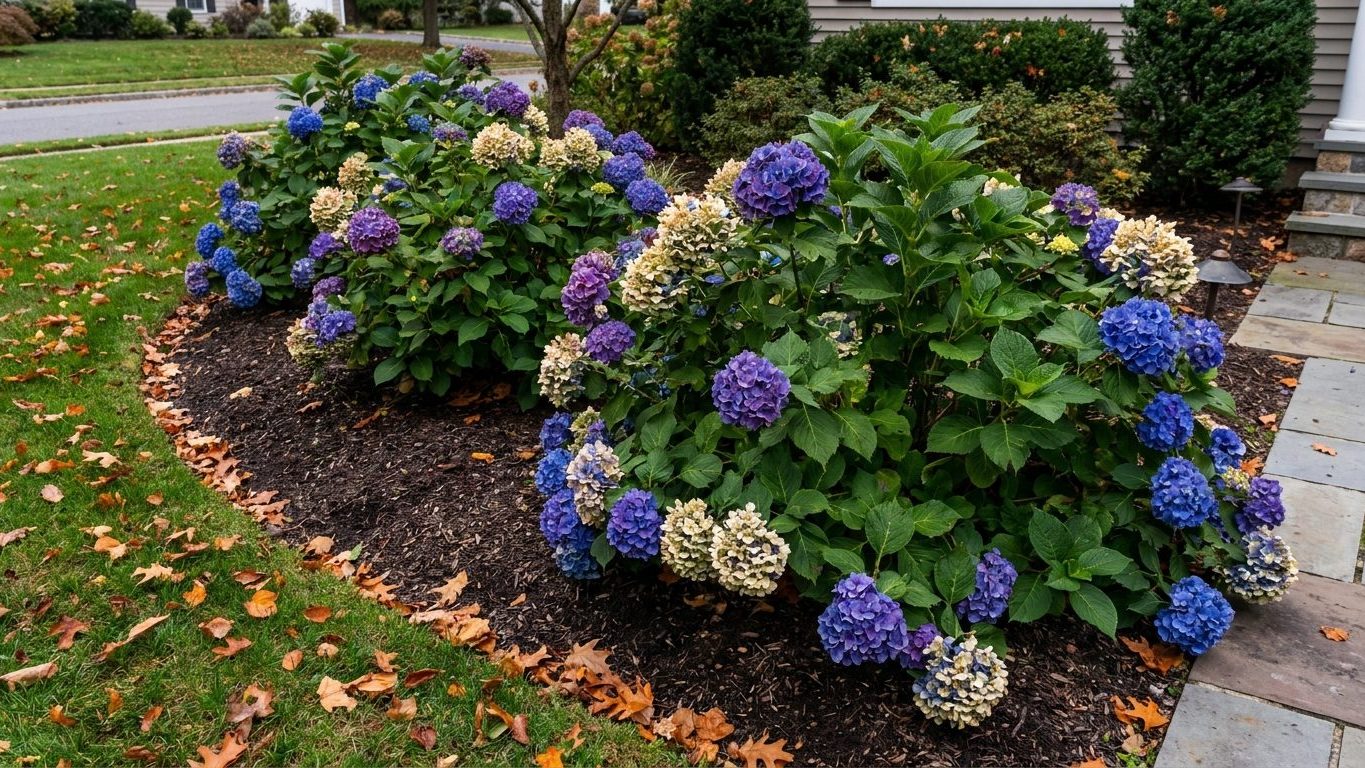
New York’s hydrangeas mostly struggle with cold injury, fungal leaf spotting, and aphids, not with dramatic pest outbreaks. The state’s wide hardiness range means a shrub that sails through a Long Island winter can lose every bud upstate. Bigleaf varieties carry the most risk here, since their flower buds form on the previous year’s wood and rarely survive an Adirondack winter intact.
Hydrangea pests and diseases New York: The Short Answer
New York City serves as the reference point for frost timing here, and the USDA Plant Hardiness Zone Map 2023 places the state anywhere from zone 3b in the high country to 7b along the coast.
That spread is why winter injury outranks every insect or fungus, and why a shrub that thrives in Manhattan can fail entirely in the Adirondacks.
Winter bud blast

Flower buds on bigleaf wood turn brown and mushy in early spring after a hard freeze, especially outside sheltered coastal spots. The fix is siting against a warm wall or under eave cover, and choosing reblooming types over old-wood-only varieties. See the state guide’s calendar for the safe pruning window.
Aphids
Clusters of small green or black insects gather on tender new shoots in late spring, curling leaves and leaving a sticky residue that draws ants. A strong water spray every few days usually clears a light case, and ladybugs handle the rest without spraying anything.
Powdery mildew
A gray-white coating spreads across leaf tops during humid July stretches, particularly where air can’t move between shrubs. Space plants for airflow, water the soil rather than the foliage, and strip badly coated leaves so spores don’t overwinter nearby.
Cercospora leaf spot
Small purple-brown spots ring lower leaves by late summer and can climb the shrub in a wet year, eventually causing early leaf drop. Raking and removing fallen leaves each fall breaks the cycle, since the fungus survives winter in that litter.
Botrytis blight
Flower clusters brown and turn slimy after a stretch of cool, wet bloom-time weather, sometimes spreading into nearby stems in the Hudson Valley’s still air. Deadheading spent blooms promptly and avoiding overhead watering during bloom keeps this fungus from establishing.
Deer browsing

Stems get stripped to bare wood over fall and winter when deer pressure is high, particularly in the Hudson Valley and the Southern Tier. Fencing or a repellent rotation through the dormant season protects the buds that next year’s flowers depend on.
New York — the year and the numbers
- State
- New York
- USDA zones
- 3b-7b
- Last spring frost
- March 23 to April 3
- First fall frost
- November 14 to November 27
- Annual rain
- 50 in
- Lawn zone
- cool-season
- Source
- NOAA NCEI U.S. Climate Normals 1991-2020, 32F freeze probabilities · New York City
How to Work Out the Dates for Your Own Yard
Diagnosing a hydrangea problem in New York starts with the calendar, not the symptom, since timing narrows the list faster than the look of a leaf.
NOAA NCEI’s 1991-2020 Climate Normals put New York City’s last spring frost between March 23 and April 3, and its first fall frost between November 14 and November 27, and that window is the anchor for every step below.
- Mark your local frost window: count backward or forward from the New York City range above based on how much colder or warmer your county runs.
- Note the calendar month you spotted the issue: bud damage shows up right as growth resumes, aphids arrive with the first flush, mildew and leaf spot build through summer heat.
- Check which plant part is affected: buds and stems point to winter injury or deer, leaves point to fungus, and sticky curled shoots point to aphids.
- Match the weather of the past two weeks: a wet stretch favors Botrytis and Cercospora, a dry one rarely does.
- Cross-check against the pruning window: bigleaf pruning falls in June and July here, and cutting outside that window can look like disease damage the following spring.
- Call in a second opinion if the pattern doesn’t fit: a county extension office can confirm a diagnosis from a photo or a sample.
Six steps sound like a lot for a brown leaf, but the frost window and the calendar month usually eliminate half the list before you even look closely.
New York North to South: How the Dates Shift
Elevation and distance from open water do more to shift these dates than latitude alone, and New York’s mix of coastline, lake shore, and mountains creates several distinct pest and disease timelines within one state.
- New York City and Long Island (the coast): the mildest winters in the state, so bud blast is rarer here, but humid summer air keeps powdery mildew and Botrytis lingering longer into fall.
- The Hudson Valley and Capital Region (Albany, Poughkeepsie): colder nights push winter dieback higher on the list, and deer pressure runs heavier through the dormant season.
- Western New York and the lake shore (Buffalo, Rochester): lake-effect snow cover actually insulates roots and buds through winter, but the same moisture feeds fungal leaf disease once summer arrives.
- The Adirondacks and North Country: the shortest growing season and the harshest winters in the state, where bud and stem injury dominate and bigleaf varieties rarely bloom reliably.
The state guide’s zone map fills in exactly where your county falls between these extremes.
Mistakes New York Punishes
Pruning bigleaf on the wrong month
Cutting back old-wood bigleaf varieties outside June and July removes next year’s flower buds along with the wood, then gets blamed on disease when the shrub fails to bloom. Prune only in that window, and only to shape, not to renovate.
Watering the leaves instead of the soil
Overhead watering in New York’s humid summer stretches keeps foliage wet long enough for powdery mildew and Botrytis to take hold, especially in the Hudson Valley’s still air. Switch to a soaker hose or drip line at the base and water in the morning.
Skipping winter protection at the colder edge
Homeowners in zone 3b to 5 country often treat their hydrangea like the coastal varieties on a nursery tag, then lose every bud to a normal winter. Mound mulch over the crown and wrap exposed stems before the ground freezes for good.
New York Extension Offices and County Contacts
The state-wide range of 3b to 7b is a starting point, not a diagnosis, and your county’s Cornell Cooperative Extension office fills in the rest with soil tests and sample identification.
- Your state page: the frost dates and the pruning window for New York in one place.
- Which ones hold up here: the varieties that shrug off a 3b winter and the ones that only work on the coast.
- Cornell Cooperative Extension: county offices that will look at a leaf or a photo and confirm what’s actually going on.
Common questions
Do I need to spray my hydrangea every year in New York?
No. Most established shrubs here get through a season with good spacing, morning watering, and a fall leaf cleanup, without any spray program at all.
Why did my hydrangea leaf out fine but never flower?
On bigleaf varieties, that’s almost always winter bud blast rather than a pest, since the leaf buds and flower buds die at different temperatures and the leaves often survive when the flowers don’t.
Is it worth planting hydrangeas at all in the Adirondacks?
Panicle and smooth types handle that cold reliably since they bloom on new wood each year, while bigleaf varieties struggle enough there that most growers skip them in favor of the hardier species.