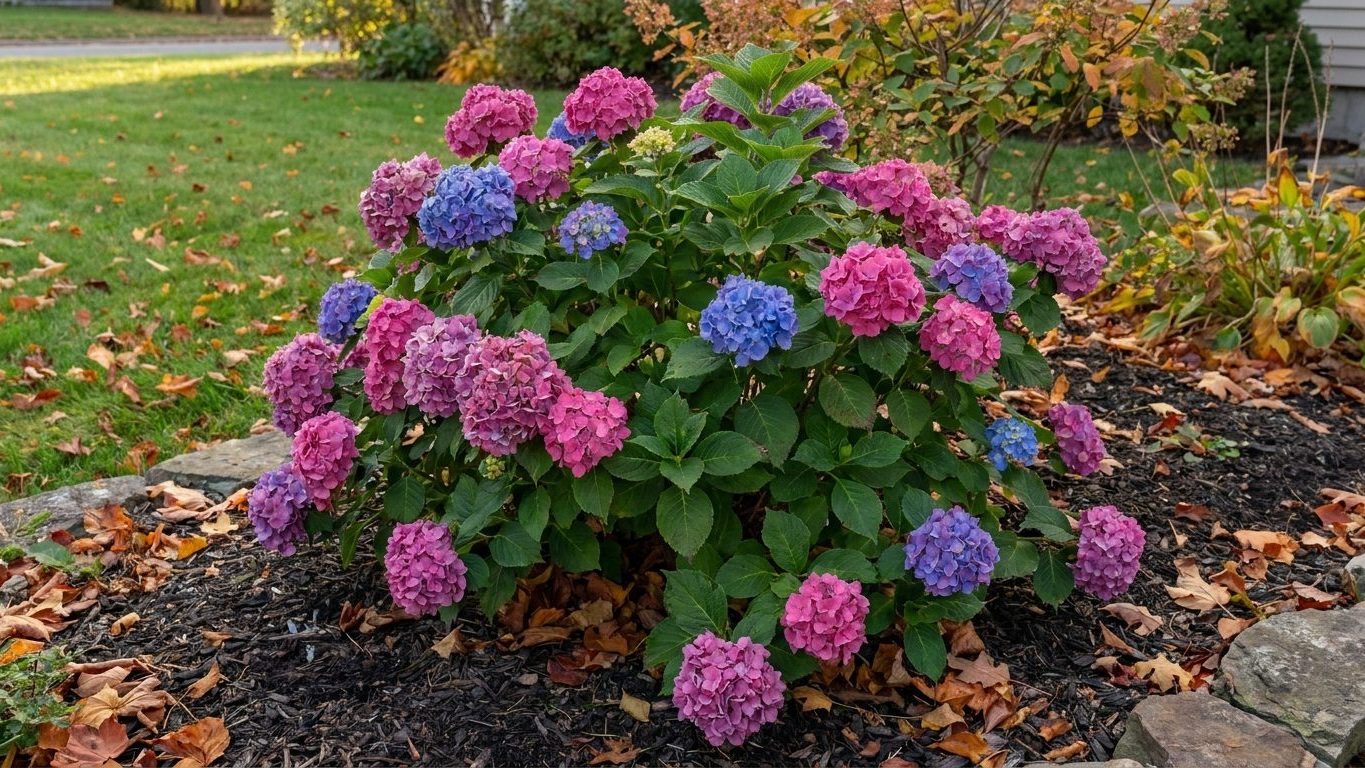
Plant hydrangeas in New Brunswick after the average last spring frost, around May 23 in Moncton, or in late summer once nights cool, through September. Prune bigleaf varieties only in June or July, right after bloom, since this province’s Canadian hardiness zone 5a winters can kill wood cut too early or too late. The window is narrow: work around it, not against it.
When to prune hydrangeas in New Brunswick: The Short Answer
New Brunswick’s growing season runs on a short leash, and each month asks for a different move around the frost dates that bracket it.
- January: The shrub sits fully dormant under this province’s Canadian zone 5a winters, so there is nothing to plant or cut. Check that mulch still covers the root zone after any thaw.
- February: Cold still holds, and pruning cuts made now would open the stem to more damage before spring arrives. Look for swollen buds low on the stem as the only sign of life.
- March: Environment and Climate Change Canada’s Canadian Climate Normals put Moncton’s average last spring frost at May 23, so frost is still two months off and the ground is often too wet to dig. Hold containers indoors or in a sheltered spot.
- April: Frost risk stays high this close to the May 23 average, so planting still waits. Start easing any potted hydrangea toward outdoor light for a week or two.
- May: This month opens the plant window, but the frost mean falls mid-month, so waiting until late May is the safer bet than trusting the calendar page alone. Fertilizing also starts now, once new growth shows.
- June: Planting continues, and this is the first of two months set aside for pruning bigleaf hydrangeas, right after the spring flush fades. Cut spent blooms back to the first strong bud, no further.
- July: The second pruning month for bigleaf types, and the second fertilizing month too. A cut made now still leaves time for the plant to set next year’s buds before fall.
- August: The plant window reopens for late-summer additions, since cooler nights ease transplant stress. Roots get a full two months to settle before the first frost.
- September: The last month in the plant window, and often the safest for anyone who missed spring. First fall frost averages October 2, so plants set now still have roughly a month of open ground.
- October: The first fall frost mean lands around October 2, so this is not a planting month, and digging now risks fresh roots meeting a hard freeze. Add a fresh mulch layer instead.
- November: Dormancy sets in, and the plant needs no attention beyond a check on mulch depth over the root crown. No cutting, no digging.
- December: The shrub sits fully dormant through the coldest stretch of the year. This is a good month to plan next year’s spot rather than touch the plant itself.
Two windows matter more than the rest: the late-May start once frost risk fades, and the June-through-July stretch for cutting back bigleaf wood without losing next year’s blooms.
New Brunswick — the year and the numbers
- State
- New Brunswick
- Hardiness zones
- 5a
- Last spring frost
- May 23
- First fall frost
- October 2
- Annual rain
- 47 in
- Lawn zone
- cool-season
- Source
- Environment and Climate Change Canada — Canadian Climate Normals 1981-2010, station MONCTON · Moncton
How to Work Out the Dates for Your Own Yard
Working out your own dates starts with the zone this province sits in, since every other figure below works around that one number.
- Weigh the zone against the shrub: Natural Resources Canada’s Plant Hardiness Zone by Municipality places Moncton at Canadian zone 5a, cold enough that anything bred for milder zones needs a sheltered wall or heavy winter mulch to survive here at all.
- Start from the average last frost: Moncton’s mean date lands May 23, so count back three to four weeks for hardening off pots and count forward the same span before trusting open ground.
- Match the calendar window: this site’s own month list opens planting only in May, June, August, and September, so line up the closest of those four with your actual frost-free stretch.
- Watch the ground, not just the calendar: New Brunswick soil often stays cold and wet well into May, and digging into saturated ground does more harm than waiting another week.
- Count back from the first fall frost for late planting: with the mean landing October 2, an August or September planting still needs four to six weeks of root growth before that date arrives.
None of this replaces a walk around your own yard. A slope that drains fast or a wall that holds heat can shift these dates by a week in either direction, and I’d trust that over a printed chart.
New Brunswick North to South: How the Dates Shift
Moncton anchors the figures above, but the coast, the river valley, and the northern uplands each pull the dates a different way.
- The Fundy Coast (Saint John, St. Andrews, the Sussex corridor): the bay keeps spring cooler and fall milder than inland Moncton, so both frost dates tend to slide later.
- The Saint John River Valley (Fredericton, Woodstock, the Upper Valley): cold air pools at night in the low ground, and frost can settle here after it has already lifted around Moncton.
- The Northeast and the Highlands (Bathurst, Campbellton, the Miramichi headwaters): higher ground and a longer reach into winter push both frost dates against the shrub, cutting the safe planting stretch shorter than the provincial figures suggest.
Whichever corner of the province you garden in, treat the Moncton-based window as a starting point, not a guarantee, and check the New Brunswick guide for the fuller picture.
Mistakes New Brunswick Punishes
Cutting back in fall
Bigleaf hydrangeas set next year’s flower buds on the wood grown this year, so a fall cleanup that trims stems removes blooms before they even form. Save the cuts for June or July, right after the flowers fade, and let fall growth stand through winter.
Planting the week the snow melts
New Brunswick soil often stays cold and waterlogged well past the thaw, and a shrub planted before frost risk has actually passed sits in ground too wet to grow real roots. Wait until the plant window opens in May, and lean toward its later half.
No winter mulch on the crown
Natural Resources Canada’s Plant Hardiness Zone by Municipality places Moncton in Canadian zone 5a, cold enough to kill an unprotected root crown even when top growth looks fine come spring. Pile mulch over the base once the first fall frost mean of October 2 has passed, and pull it back only after new growth shows.
New Brunswick Extension Offices and County Contacts
The Moncton figures above are a starting point, and county soil can shift them by a week either way. Agriculture and Agri-Food Canada is the next stop for anyone who wants a local check before digging.
- Your New Brunswick guide: the frost dates and pruning window for wherever you live in the province.
- Which ones hold up here: the varieties suited to Canadian zone 5a winters, ranked from safest to riskiest.
- What goes wrong here: the pests and problems this province’s growers actually report, season by season.
Common questions
Can I plant hydrangeas in New Brunswick in fall?
Yes. August and September both sit inside the plant window, and roots set then still get four to six weeks of growth before the first fall frost mean of October 2 arrives.
Is New Brunswick too cold for hydrangeas?
Not for every type. Moncton’s Canadian zone 5a rules out the least hardy varieties without protection, but several hold up well here, covered on the varieties page for this province.
When should I prune hydrangeas in New Brunswick?
Stick to June or July for bigleaf types, right after the blooms fade. Cutting in fall or early spring removes next year’s flower buds before they ever open.