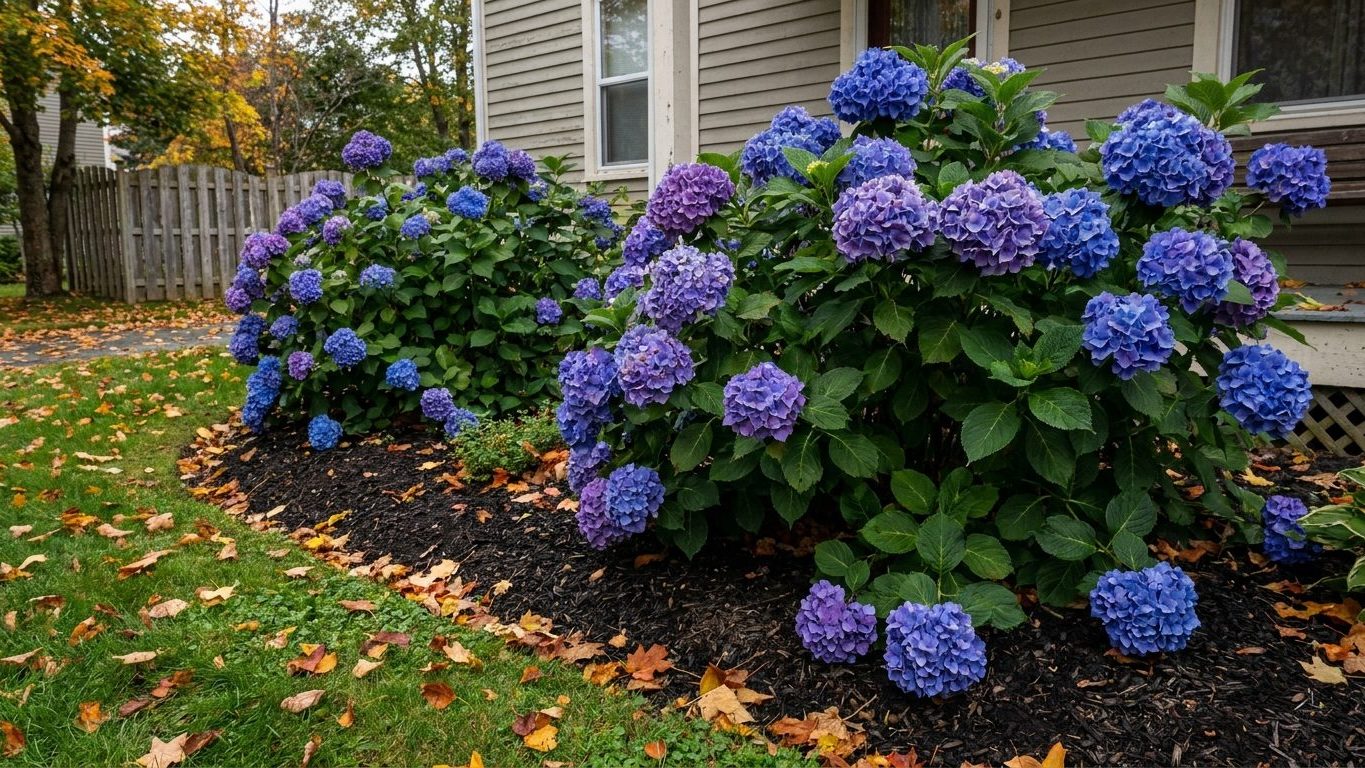
Nova Scotia’s planting calendar runs May through September, with a pause between spring and late-summer windows built around Halifax’s frost dates. If you garden near Halifax Stanfield International Airport, the reference station for the whole province, the short version is this: plant in May, June, August, or September, and save bigleaf pruning for June and July, after the last frost has passed and the flower buds have shown themselves.
When to prune hydrangeas in Nova Scotia: The Short Answer
Environment and Climate Change Canada’s Canadian Climate Normals put Halifax’s mean last spring frost at May 7, and its mean first fall frost at October 18, the two dates every gesture below works around.
- January: the ground stays frozen and hydrangeas sit fully dormant. Leave any winter mulch or burlap in place and skip fertilizer or pruning entirely.
- February: deep dormancy continues across the province. Order new plants or research varieties now, but keep the shovel put away until the ground softens.
- March: frost is still the rule, weeks ahead of the May 7 average. Cut out only wood that’s obviously dead and brittle, and leave anything showing a hint of green.
- April: the last frost is close but hasn’t passed. Hold off on planting, and don’t touch bigleaf hydrangea buds, which are already swelling toward bloom.
- May: both the plant and fertilize windows open. Once your yard’s frost has cleared the May 7 average, this is the month to set new hydrangeas in the ground and feed established ones.
- June: planting continues and bigleaf pruning begins. Cut back spent or damaged wood on bigleaf types now, right after bloom starts, never in fall.
- July: the second fertilize window overlaps the tail end of pruning. Feed again, and finish any bigleaf cuts before next year’s flower buds start to set.
- August: a planting month, with soil still warm enough for roots to settle in before fall. New shrubs going in now have real time to establish.
- September: the last planting window of the year. Get plants in the ground early in the month so roots have time to grow before the mean fall frost.
- October: the mean first fall frost lands October 18. Stop planting, water deeply before the soil cools, and start building winter protection for bigleaf hydrangeas.
- November: hydrangeas head into dormancy for good. Mound mulch over the root zone and wrap or cage bigleaf types to protect next year’s flower buds.
- December: full dormancy across the province. There’s no planting, fertilizing, or pruning gesture this month, and the calendar picks back up in spring.
Natural Resources Canada rates Halifax at zone 6b in its Canadian hardiness system, a seven-variable scale that doesn’t convert to a USDA number, so treat it as a local reference, not a match for a US zone elsewhere on this site.
Nova Scotia — the year and the numbers
- State
- Nova Scotia
- Hardiness zones
- 6b
- Last spring frost
- May 7
- First fall frost
- October 18
- Annual rain
- 55 in
- Lawn zone
- cool-season
- Source
- Environment and Climate Change Canada — Canadian Climate Normals 1981-2010, station HALIFAX STANFIELD INT'L A · Halifax
How to Work Out the Dates for Your Own Yard
Halifax’s averages are a starting point, not a guarantee for your particular yard, so the real work is counting backward and forward from them.
- Find your local frost pattern: compare how your yard behaves each spring against the Halifax Stanfield average, since inland and low-lying spots often run later than May 7.
- Add a buffer past the mean last frost: wait beyond May 7 before setting out new bigleaf hydrangeas, since a late frost can still nip fresh growth after the average date passes.
- Count backward from the mean first frost: work back from October 18 to make sure a September planting gets real root time before the ground cools.
- Match the gesture to the open window: plant only in May, June, August, or September, and prune bigleaf only in June or July, since nothing outside those months belongs on this calendar.
- Read your own microclimate: watch how snow melts and frost lingers in your yard compared with a neighbor’s, since a low spot or a north-facing bed can lag the average by real time.
None of this changes the calendar above, it just tells you where you sit inside it. A shrub planted in a sheltered dooryard bed behaves differently from the same shrub on an open, windswept lot barely a few miles away.
Nova Scotia North to South: How the Dates Shift
Nova Scotia’s coastline, its inland valleys, and its highlands don’t warm or cool at the same pace as Halifax.
- The Atlantic coast and harbor towns (Halifax itself, the South Shore, the Eastern Shore): the ocean holds its heat longer, so spring often arrives a touch later and fall frost holds off a touch later too, softening both ends of the calendar.
- The Annapolis Valley and inland lowlands: sheltered by hills and farther from open water, this belt tends to warm faster in spring and can see an earlier fall chill than the coast does.
- Cape Breton and the northern highlands: higher elevation and a shorter frost-free stretch push both windows later in spring and earlier in fall than anything read at Halifax Stanfield.
For the province-wide numbers these regional shifts adjust, the Nova Scotia hydrangea guide carries the frost dates and hardiness zone in full.
Mistakes Nova Scotia Punishes
No flowers on a healthy shrub

Pruning bigleaf hydrangeas in fall or winter cuts off next year’s flowers, since this variety sets its buds on old wood the summer before. Keep every cut inside the June-to-July window this calendar gives, and check the guide to which varieties hold up here if you’re not sure what’s growing.
Bud damage after a mild stretch in late winter
A warm run in February or March coaxes bigleaf buds to swell early, then a hard frost kills them before summer starts. Leave winter mulch and any burlap wrap in place until real spring warmth holds, not just a few mild days in a row.
New plants set out too late in September
Environment and Climate Change Canada puts the mean first fall frost at October 18, and a hydrangea planted right before that date hasn’t had time to root before the ground cools. Get September plantings in early in the month, and treat August as the safer end of the fall window.
Nova Scotia Extension Offices and County Contacts
The Halifax numbers are a province-wide starting point. For soil-specific advice, Nova Scotia’s provincial agriculture office and county contacts carry the local detail.
- Nova Scotia Department of Agriculture: the provincial extension service for soil testing, pest identification, and local advisories.
- Which ones hold up here: the companion guide to hydrangea varieties suited to this province’s zone and coastline.
- What goes wrong here: the guide to the pests and problems this climate actually produces.
Common questions
Can I plant hydrangeas in Nova Scotia in early spring?
The calendar’s earliest plant window opens in May, after the mean last frost of May 7 has usually passed. Planting in March or April risks new growth meeting a frost that, in half of all years, falls even later than that average.
Is Nova Scotia’s zone 6b the same as a USDA zone?
No. It’s a Canadian hardiness zone built on seven climate variables rather than the single minimum-temperature measure the USDA scale uses, and Natural Resources Canada doesn’t offer a simple conversion between the two systems.
What’s the latest I can plant a hydrangea before winter?
September is the last month on this calendar, and getting it in early in the month matters, since the mean first fall frost lands October 18 and roots need real time to settle before the ground cools.