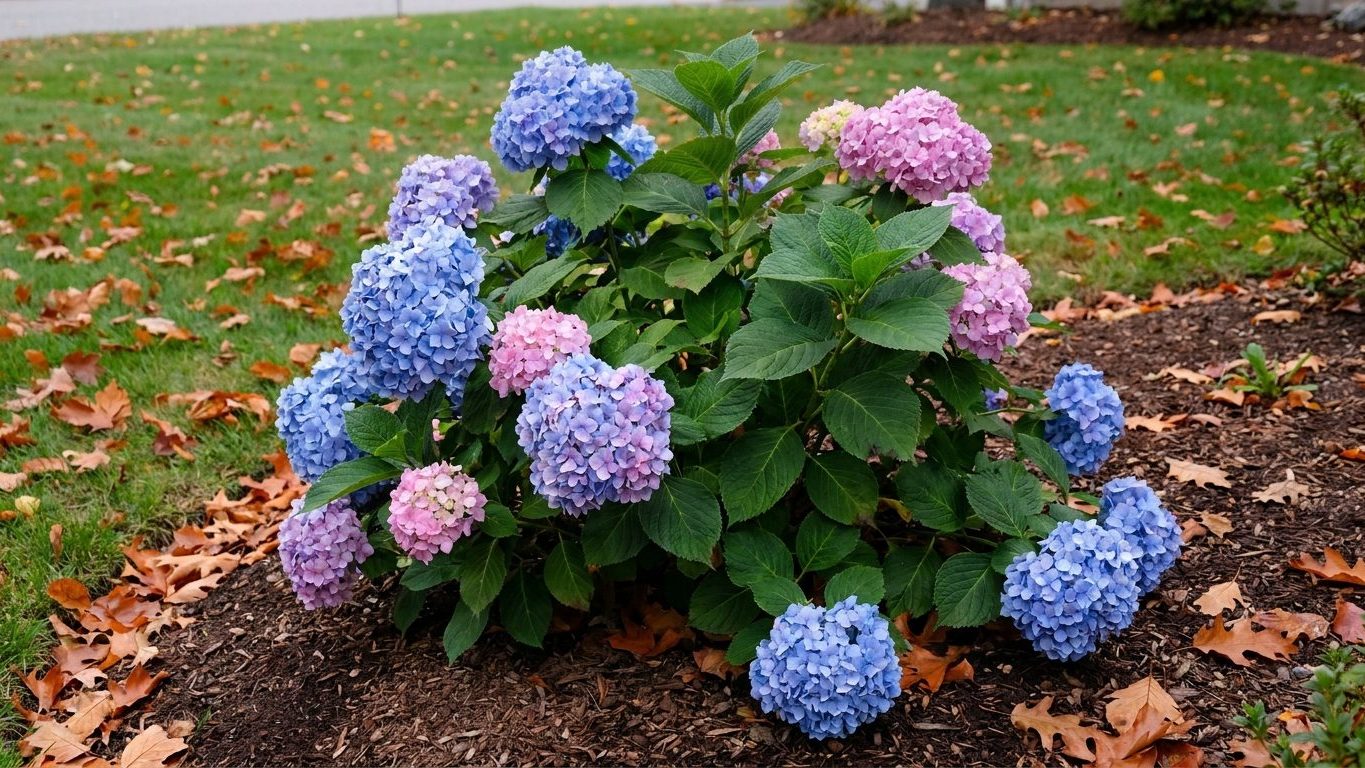
In Boston, the two problems homeowners call me about most are bud blast on bigleaf hydrangeas after a late frost and powdery mildew during humid July stretches. Everything else, from Japanese beetles to lime-induced yellowing, follows a fairly predictable order tied to the region’s frost windows and USDA zones 5a to 7b.
Hydrangea pests and diseases Massachusetts: The Short Answer
Bud blast and powdery mildew top the list for Boston-area yards, with aphids, Japanese beetles, cercospora leaf spot, and lime-induced chlorosis rounding out the season. NOAA NCEI 1991-2020 Climate Normals puts Boston’s last spring frost at April 1 to April 8, and that single window explains why so many bigleaf hydrangeas skip flowering some years while looking perfectly healthy otherwise.
No flowers on a healthy shrub

Bud blast happens when a late cold snap after bud swell kills the flower buds inside the stems. The last frost window runs April 1 to April 8, so anything colder after that damages tissue. Mulch stems in fall and skip pruning past July, see the calendar page.
Aphids clustering on new growth
Small green or black insects cluster on tender shoot tips in May and June, curling new leaves and leaving a sticky residue behind. Ants often tend them for the honeydew. A strong water spray knocks most colonies off, and ladybugs usually finish the job within a week or two.
Leaves scorched on the sunny side
Scorch shows up as brown, papery patches on leaves facing full afternoon sun during July heat spikes. It is a water stress signal, not a disease, and it worsens in sandy or compacted soil. Deep water once weekly and mulch to hold moisture through the July feeding window.
Powdery mildew film on leaves

A gray-white coating on top leaf surfaces spreads fastest during muggy stretches in June and July, right when bigleaf pruning is due. Crowded shrubs with poor airflow show it worst. Space plants, prune for airflow during that same window, and avoid overhead watering in the evening.
Japanese beetles skeletonizing leaves

These metallic green beetles chew leaves down to the veins from early to mid July, leaving a lace-like skeleton behind. They cluster in groups and feed fastest in full sun. Hand-pick them into soapy water each morning, since sprays rarely keep pace with a fresh wave.
Cercospora leaf spot climbing the stem

Small purple-brown spots start on lower leaves in August and climb upward as the season cools toward the November 3 to November 14 frost window. Wet foliage spreads the fungus fast. Remove and discard spotted leaves rather than composting them, and water at the soil line only.
Yellow leaves with green veins
This chlorosis pattern points to iron lockup in alkaline soil, common near foundations and driveways where lime leaches in over time. It is not a pest or a fungus, just a pH problem. A soil test through your county extension office settles it before you spend money on fertilizer.
Massachusetts — the year and the numbers
- State
- Massachusetts
- USDA zones
- 5a-7b
- Last spring frost
- April 1 to April 8
- First fall frost
- November 3 to November 14
- Annual rain
- 44 in
- Lawn zone
- cool-season
- Source
- NOAA NCEI 1991-2020 Climate Normals, 32F freeze probabilities · Boston
How to Work Out the Dates for Your Own Yard
Boston’s frost windows are a starting point, not a fixed schedule, so I walk my own yard through this sequence every year before deciding what to spray, prune, or simply leave alone.
- Mark your last frost window: NOAA NCEI 1991-2020 Climate Normals puts Boston’s last spring frost at April 1 to April 8, so treat any date inside that range as still risky for swollen buds.
- Scout for blackened bud tips two weeks later: by mid to late April, damaged buds turn brown and mushy while healthy ones stay firm and green to the touch.
- Watch airflow once pruning starts: the bigleaf pruning window runs June and July, and shrubs spaced out during that stretch see less powdery mildew by late summer.
- Check leaves weekly through the July feeding window: aphids and beetle damage both show up fastest on the soft new growth that follows a July feeding.
- Reassess in September as growth slows: cercospora spots that were only on lower leaves in August often climb higher on the stem by this point, telling you it is fungal rather than sun scorch.
- Stop treating and mulch before the first fall frost: that window lands November 3 to November 14, and anything still active on the shrub after that becomes a next-spring problem, not a this-year one.
None of these steps move because a neighbor’s shrub looks different, since a warmer microclimate near brick or pavement can push every stage a week or two earlier than a yard in open ground.
Massachusetts North to South: How the Dates Shift
The USDA Plant Hardiness Zone Map puts the coldest pockets of the state near zone 5a and the mildest coastal edge closer to 7b, and that spread changes when each problem in this guide shows up.
- Coastal Boston and Cape Cod (zones 7a to 7b): the ocean’s moderating effect keeps frost windows late and short, so mildew and beetle season simply runs longer than it does inland.
- MetroWest and the Worcester Hills (zones 6a to 6b): frost arrives sooner in fall and lingers later in spring, tightening the bud blast risk window described above.
- Pioneer Valley and the Connecticut River lowlands (zones 6a to 6b): cold air drains off the valley floor on clear nights, giving a brief reprieve even as the surrounding hills freeze first.
- The Berkshires and western uplands (zones 5a to 5b): the shortest frost-free stretch in the state pushes every timeline in this guide roughly two to three weeks earlier in fall and later in spring.
None of that changes which problems show up, only when, so lean on the state hydrangea guide for the frost dates that anchor your own yard.
Mistakes Massachusetts Punishes
Pruning bigleaf in fall
Cutting stems back after summer removes the very buds already set for next year’s blooms, since bigleaf hydrangea flowers only on old wood laid down the previous season. The safe window runs June and July, nothing later. Wait until then, and check the calendar page for the exact months every year.
Feeding past July
A late feeding pushes soft new growth right as the first fall frost approaches, landing November 3 to November 14 in most years around Boston. That tender growth freezes first and invites stem dieback all winter. Stick to the March, May, and July feeding months and stop there completely.
Skipping mulch before winter
Bare soil around the crown lets root-zone temperatures swing hard through a Massachusetts winter, especially where the state’s hardiness range runs as cold as zone 5a inland. A three-inch mulch ring holds soil temperature steadier and protects the same buds that a late frost would otherwise catch.
Massachusetts Extension Offices and County Contacts
Boston’s frost dates are a regional starting point, and the real answers for your yard sit with your county extension office and UMass Extension, which track local pest pressure and soil results all season long.
- Your state page: the frost dates and the hardiness zone range for every part of Massachusetts in one place.
- Which ones hold up here: the bigleaf, panicle, and smooth hydrangea varieties that actually take a Massachusetts winter.
- UMass Extension: soil testing, pest identification, and the county office list at ag.umass.edu.
Common questions
Do deer eat hydrangeas in Massachusetts?
Deer browse bigleaf and smooth hydrangea leaves and buds readily, especially in suburban yards near wooded edges. Panicle hydrangea gets bothered less often. A simple fence around young plants through the first few winters solves most of the damage.
When should I stop worrying about frost killing new buds?
Once you’re past the last frost window of April 1 to April 8 by a couple of weeks, new growth is generally out of danger for the season. Watch the forecast closely in that stretch rather than trusting the calendar date alone.
Can I treat powdery mildew organically?
Yes, a homemade spray of water with a small amount of horticultural oil or baking soda works on light cases if applied early. Spacing plants for airflow and watering at the soil line matter more than any spray, organic or not.