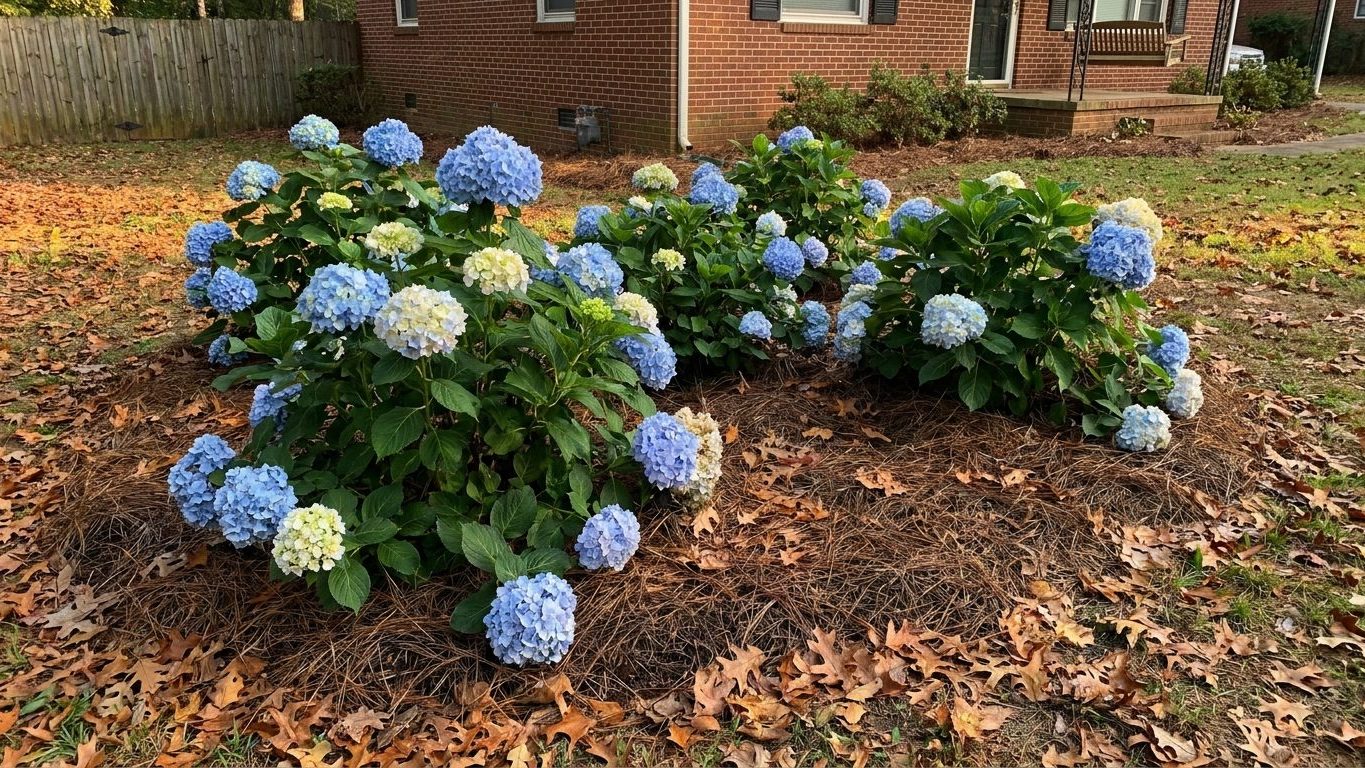
In and around Atlanta, Georgia’s mild winters and thick summer humidity mean hydrangea problems rarely disappear for good, they just rotate through the calendar. Leaf spot, powdery mildew, aphids, and root rot account for most of the damage local yards see, and each one tends to show up on cue with the season’s heat and moisture.
Hydrangea pests and diseases Georgia: The Short Answer
USDA Plant Hardiness Zone Map puts Atlanta at 6a to 9b, and that narrow band of mild winters is why gardeners here fight nearly the same lineup of hydrangea troubles every year, just on a rolling schedule tied to the state’s calendar of fertilizing, planting, and pruning windows.
Aphids
Small green or black clusters crowd new stem tips right as hydrangeas go into the ground during the March and April planting window, curling leaves and leaving a sticky residue behind. A strong water spray or insecticidal soap knocks them back before they call in ants and sooty mold.
Cercospora leaf spot
Purple-rimmed brown spots spread up from the lower leaves once humidity settles in, and by the May fertilizing round a shrub can look half-defoliated from the ground up. Clearing fallen leaves and watering the soil instead of the foliage slows the spread most reliably.
Powdery mildew
A gray-white dusting coats top leaf surfaces during July’s sticky heat, more of a cosmetic problem than a killer but ugly enough to notice from the porch. Spacing plants for airflow and skipping overhead watering keeps it from building year over year.
Japanese beetles

Metallic green beetles skeletonize leaves down to lace during the same June and July stretch set aside for pruning bigleaf types, often stripping a shrub in days. Hand-picking into soapy water each morning works better here than most sprays, since beetles keep flying in from neighboring yards.
Spider mites

Fine stippling and faint webbing show up on leaf undersides during hot, dry spells later in summer, worse on shrubs already stressed by too much sun. A hard hose-down every few days breaks up colonies without reaching for a miticide.
Botrytis blight
Gray, fuzzy mold settles on flower heads and soft new growth during cool, damp stretches heading toward the November to December frost window. Deadheading spent blooms and cutting back overcrowded stems opens the airflow that keeps this fungus from taking hold.
Root rot
Wilting leaves on a well-watered shrub usually trace back to soggy soil, a problem that surfaces most often at the September and October planting window when new roots meet heavy clay. Raised beds or amended, well-drained soil at planting time prevent most cases outright.
Deer browsing
Ragged, torn leaf edges and stripped buds appear as cooler weather sends deer looking for tender greens through fall and into dormancy. Fencing or a repellent rotation protects the shrub better than any single spray, since deer adapt to scent alone within a season.
Georgia — the year and the numbers
- State
- Georgia
- USDA zones
- 6a-9b
- Last spring frost
- March 11 to March 29
- First fall frost
- November 13 to December 1
- Annual rain
- 50 in
- Lawn zone
- transition-season
- Source
- NOAA NCEI 1991-2020 Climate Normals, 32F freeze probabilities · Atlanta
How to Work Out the Dates for Your Own Yard
Matching a symptom to its actual cause takes a walk around the shrub and a look at the calendar, since most of these problems announce themselves on a schedule tied to Georgia’s frost dates.
- Check the calendar first: NOAA NCEI 1991-2020 Climate Normals put Atlanta’s last spring freeze between March 11 and March 29, so aphids and early leaf spot showing up before that window closes are simply arriving on schedule, not a sign of a bigger problem.
- Look at where the damage sits on the plant: spotting on lower, older leaves points to Cercospora, while a dusty film on top leaves in July heat is powdery mildew instead.
- Time it against the prune window: chewed, skeletonized leaves during the June and July bigleaf pruning stretch are almost always Japanese beetles, not a fungus.
- Test the soil before blaming a bug: a wilting shrub in soil that stays wet days after rain points to root rot, especially near the September and October planting window.
- Watch the weather, not just the date: a run of cool, damp days pushing toward the November 13 to December 1 first frost window favors Botrytis over any insect.
- Rule out deer last: torn, ragged edges rather than clean holes or skeletonized veins usually mean deer, not an insect at all.
None of these six checks needs a lab test. A shrub failing more than one at once usually has a weaker problem riding along on a stronger one, most often root rot inviting in a leaf fungus.
Georgia North to South: How the Dates Shift
Georgia’s frost numbers above come from an Atlanta airport station sitting inside an urban heat island, so pest and disease timing shifts once a yard sits farther north in the mountains or south near the coast.
- North Georgia mountains (Blue Ridge, Dahlonega, Blairsville): cooler nights slow fungal problems like Cercospora and Botrytis but also push the growing season later, so beetle and aphid pressure lags a few weeks behind the rest of the state.
- The Piedmont and Atlanta metro (Atlanta, Athens, Macon): this is the reference zone for the frost windows above, with the fullest overlap of every pest and disease on this list.
- The coastal plain and coast (Savannah, Brunswick, Valdosta): milder winters mean pests barely slow down, so aphids, mites, and root rot in heavy, poorly drained soil show up earlier and linger longer into fall.
Whichever part of the state a yard sits in, the frost dates above are the starting point, adjusted a few weeks earlier or later for elevation and distance from the coast.
Mistakes Georgia Punishes
Watering the foliage after dark
Georgia’s humid nights already keep leaves wet for hours, so an evening sprinkler pass adds the extra moisture that Cercospora leaf spot and Botrytis blight need to spread through a bed. Watering the soil directly in the morning, timed to the March, May, or July fertilizing rounds, keeps foliage dry by nightfall instead.
Planting shrubs too close together
Tight spacing traps the same humid air that spreads powdery mildew and leaf spot from one shrub to the next within a single season. Leaving real air gaps at the March, April, September, or October planting windows costs a little visual fullness now but saves the whole bed later.
Leaving fallen leaves under the shrub all winter
Leaf litter left in place over winter carries Cercospora and Botrytis spores straight into next spring’s new growth. Raking and disposing of dropped leaves before the November to December frost window closes breaks that cycle at the cheapest point in the whole calendar.
Georgia Extension Offices and County Contacts
Georgia’s zone and frost numbers above are a state-level start, and county Extension staff can narrow things down with a plant clinic that identifies a leaf sample on the spot.
- Your state page: the frost dates and pruning window for bigleaf types where you live.
- Which hydrangeas hold up here: the varieties worth planting given Georgia’s humidity and heat.
- UGA Extension: county offices that can confirm a pest or disease from an actual leaf or stem sample.
Bringing a sample to the county office beats guessing from a photo, every time.
Common Questions
What’s the most common hydrangea disease in Georgia?
Cercospora leaf spot turns up more often than anything else here, favored by Georgia’s humid summers and appearing on lower leaves first before working upward through the plant.
Do I need to spray hydrangeas every year in Georgia?
Most Georgia yards get by with better watering habits and airflow rather than a regular spray schedule, saving fungicide and insecticide for a shrub that’s already showing clear symptoms.
Can root rot be fixed once it starts?
A shrub with advanced root rot rarely recovers in place, but improving drainage and cutting back watering can save a mildly affected plant before symptoms spread to the whole root system.