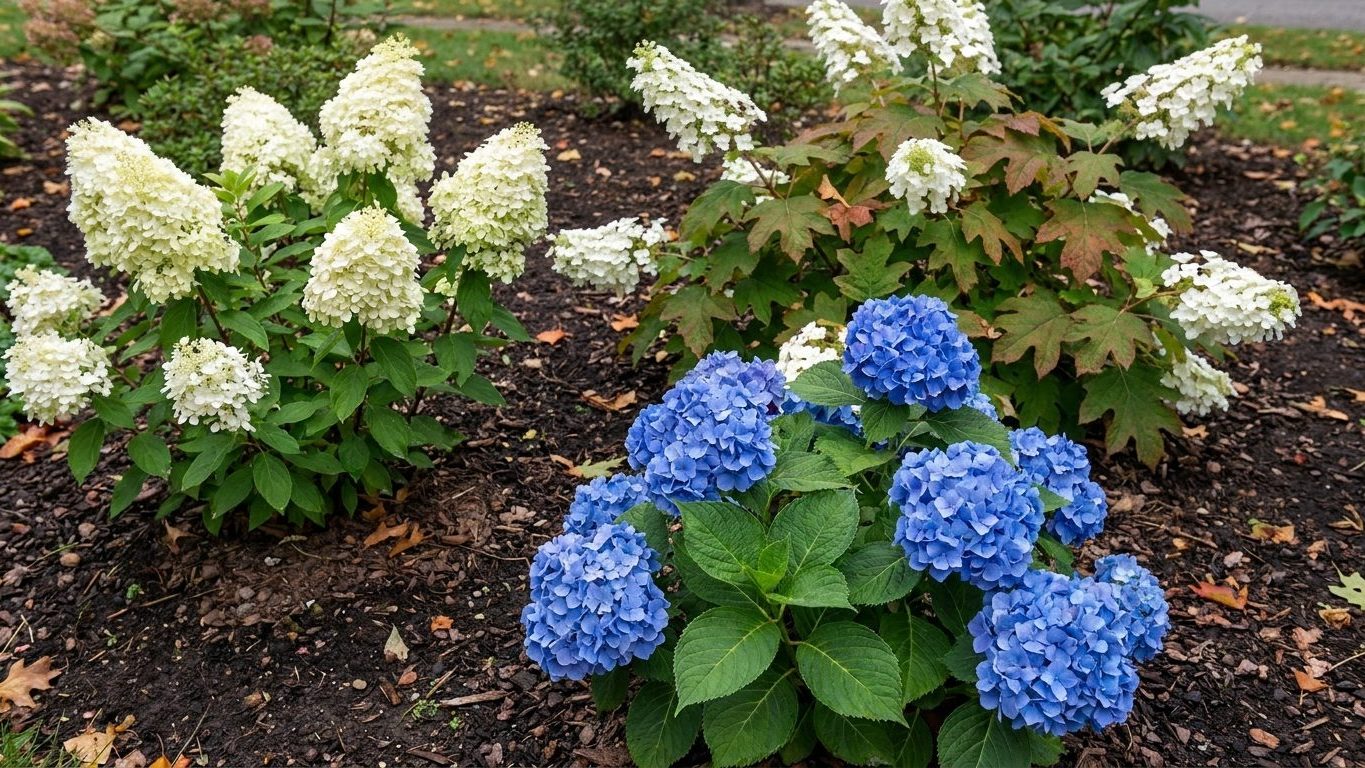
Connecticut gardeners get good news here: several hydrangea species handle the state’s cold winters and humid summers without much fuss. Panicle and smooth hydrangeas are the safest bets from the shoreline to the northwest hills, blooming reliably every year. Bigleaf, the type most people picture, is riskier because a late spring freeze can wipe out the flower buds before they open.
Hydrangeas that grow well in Connecticut: The Short Answer
The USDA Plant Hardiness Zone Map places Connecticut between zone 6a and 7b, with Bridgeport on Long Island Sound anchoring the mildest, warmest end of that range. That single fact decides which hydrangeas thrive here, since shrubs that bloom on new wood shrug off a hard winter while the ones that set next year’s flowers on old wood gamble every year on whether the buds survive.
Panicle hydrangea (Hydrangea paniculata)

This is the hydrangea that never disappoints in Connecticut. It blooms on new wood, so even a brutal winter in the Northwest Hills can’t touch next summer’s flowers. It also tolerates full sun and the state’s heavy clay soils better than anything else on this list.
Smooth hydrangea (Hydrangea arborescens)

A Connecticut native relative, smooth hydrangea shrugs off freeze-thaw winters the same way panicle does, by flowering on new wood. It prefers a bit more shade and moisture, which suits the shadier yards common in the state’s older neighborhoods.
Oakleaf hydrangea (Hydrangea quercifolia)

Oakleaf holds up well across most of Connecticut and adds fall color none of the others offer. Its main weakness is wind, since an exposed hilltop or a gust off the Sound can scorch the foliage, so a sheltered spot keeps it looking its best.
Mountain hydrangea (Hydrangea serrata)

Mountain hydrangea is a smaller cousin of bigleaf with noticeably tougher flower buds. It still sets its blooms on old wood, so a late frost can nip a few, but it comes back with color far more often than true bigleaf in the state’s colder pockets.
Climbing hydrangea (Hydrangea anomala subsp. petiolaris)

Once established, climbing hydrangea handles Connecticut winters without complaint and can cover a wall or trellis for decades. The catch is patience, since it can take several seasons to root in, and a young plant stays more exposed to winter injury than an older one.
Bigleaf hydrangea (Hydrangea macrophylla)

Bigleaf is the riskiest choice on this list, and the one most homeowners already own. It sets its flower buds on old wood the summer before, so a hard freeze anywhere in Connecticut’s 6a to 7b range can kill the buds while leaving the shrub itself alive but flowerless.
Connecticut — the year and the numbers
- State
- Connecticut
- USDA zones
- 6a-7b
- Last spring frost
- April 2 to April 12
- First fall frost
- October 28 to November 10
- Annual rain
- 44 in
- Lawn zone
- cool-season
- Source
- NOAA NCEI 1991-2020 Climate Normals, 32F freeze probabilities · Bridgeport
How to Work Out the Dates for Your Own Yard
Working out your own planting window starts with Bridgeport’s frost data and shifts earlier or later depending on where you garden in Connecticut.
- Start with the last spring frost: NOAA’s 1991-2020 Climate Normals for station USW00094702 put Bridgeport’s last spring freeze between April 2 and April 12, the earliest safe mark on the coast.
- Add two to three weeks before digging: soil stays cold into mid-April, so the state’s listed planting window runs April, May, August, or September rather than the frost date itself.
- Check the fall frost before pruning bigleaf: Bridgeport’s first fall freeze lands between October 28 and November 10, and pruning after midsummer risks cutting off next year’s buds before that cold arrives.
- Match the pruning window to the plant: bigleaf and mountain hydrangea only get pruned in June or July, right after their old-wood flowers fade, never in fall.
- Feed on the state’s three-pass schedule: fertilize in March, May, and July so the shrub isn’t pushing soft new growth right before the first fall frost.
Panicle hydrangea makes this easy, since it blooms on new wood and doesn’t care when it gets pruned or how early frost arrives. Bigleaf is the one that tests the calendar, because a warm March followed by an April freeze inside Bridgeport’s window can undo a whole year of buds before summer starts.
Connecticut North to South: How the Dates Shift
Connecticut is a small state, but its frost dates move by weeks depending on distance from the Sound and elevation inland.
- The Shoreline (Bridgeport, New Haven, Stamford): the Sound moderates temperatures enough that this strip carries the mildest, latest fall frost and earliest spring thaw, favoring bigleaf and mountain hydrangea.
- The Connecticut River Valley (Hartford, Middletown, Wethersfield): a few miles inland, cold air settles at night, pushing the safe planting window later and making bigleaf pruning riskier.
- The Northwest Hills (Litchfield, Norfolk, Cornwall): the highest, coldest corner of the state, where panicle and smooth hydrangea outperform bigleaf almost every year.
- The Quiet Corner (Putnam, Woodstock, Pomfret): eastern Connecticut’s rural northeast, with a similar cold lag to the hills, and oakleaf plantings that need shelter from open fields.
The state page carries the frost and hardiness numbers for wherever you garden, since Bridgeport’s dates don’t hold true once you’re thirty miles inland.
Mistakes Connecticut Punishes
Pruning bigleaf after midsummer
Cutting back bigleaf or mountain hydrangea after July removes next year’s flower buds before they’ve formed, since both bloom on old wood. Prune only in June or July, right after the flowers fade, matching the state’s calendar window.
Skipping winter protection on exposed bigleaf
A bigleaf planted against a windy, unsheltered wall in the Northwest Hills or the river valley loses its flower buds more often than one tucked near a foundation or hedge. Wrap the base, or plant mountain hydrangea there instead.
Fertilizing too close to the first frost
Feeding outside the state’s three-pass schedule pushes soft new growth right as the first fall freeze approaches, and NOAA’s Climate Normals put that date at Bridgeport between October 28 and November 10. Stick to March, May, and July, and let the plant harden off after that.
Connecticut Extension Offices and County Contacts
Bridgeport’s frost dates are a starting point, not the final word for your own yard. Local frost pockets, soil, and pest pressure vary enough that county advice fills in the rest.
- Your state page: the frost dates and hardiness zone for wherever you live in Connecticut.
- The month-by-month calendar: when to plant, prune, and fertilize hydrangeas, tied to the frost window.
- What goes wrong here: the pests and problems Connecticut hydrangeas run into, season by season.
Reach out to UConn Extension before planting if your yard sits in a known frost pocket.
Common Questions
Do hydrangeas need winter protection in Connecticut?
Bigleaf and mountain hydrangea benefit from mulch or a wrap around the base in the Northwest Hills and river valley, done before the first fall freeze between October 28 and November 10. Panicle and smooth hydrangea need none.
Can I grow bigleaf hydrangea in Connecticut?
Yes, especially along the Shoreline where Bridgeport’s milder zone helps flower buds survive. Expect a bloomless year now and then in the Northwest Hills or the river valley, where winter cold reaches the old-wood buds.
What is the best time to plant hydrangeas in Connecticut?
The state’s calendar lists April, May, August, and September as planting months, spaced around the hottest stretch of summer and the coldest weeks near the frost dates.