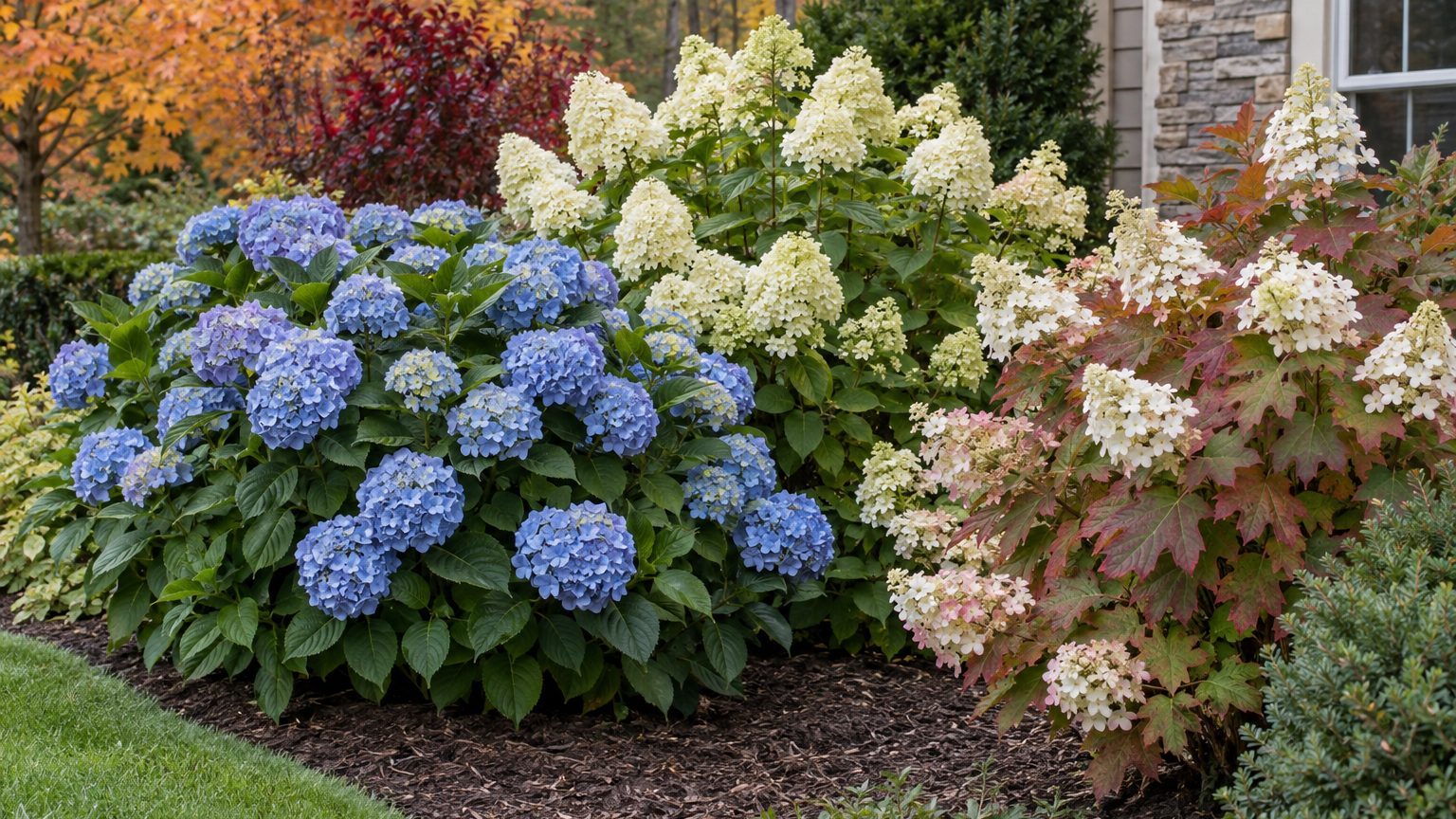
Panicle and smooth hydrangeas are the two types that shrug off a Colorado winter and the state’s dry, alkaline soil, with Denver serving as the reference city for the region’s climate data.
Bigleaf types, the mophead most people picture, rarely bloom here because a late spring frost erases the buds they set the previous fall, leaving healthy leaves but an empty summer.
Hydrangeas that grow well in Colorado: The Short Answer
The USDA Plant Hardiness Zone Map puts Colorado at 3b to 7b, and Denver, the state’s reference city for that scale, sits toward the milder end of the range on the high plains.
That number measures one thing, the average extreme minimum winter temperature, so the six varieties below are ranked by how well they handle that cold plus the state’s wind, altitude, and alkaline soil.
Mountain towns and the western slope run their own separate patterns, often colder and shorter than Denver’s, so a variety that thrives on the Front Range can still struggle at 9,000 feet.
Panicle hydrangea (Hydrangea paniculata)

This is the one variety nearly every Colorado gardener can grow. It flowers on new wood, so a hard freeze that kills last year’s buds does not cost a season of blooms, and it tolerates the dry, alkaline soil along the Front Range. Full sun leaves it blooming into fall.
Smooth hydrangea (Hydrangea arborescens)

Native to North America and bred for cold, arborescens cultivars push new stems and flower buds every spring no matter how late frost lingers into May. It handles clay and rocky soil better than most ornamental shrubs, though heavy wet spring snow can flatten its stems temporarily.
Oakleaf hydrangea (Hydrangea quercifolia)

This species holds up in the state’s milder pockets but wants shelter from wind and winter sun, so an east-facing wall works better than an open yard. Its oak-shaped leaves turn deep red in fall, a color none of the hardier varieties offer, though a hard late freeze can still nip its early buds.
Mountain hydrangea (Hydrangea serrata)

A close relative of bigleaf, serrata sets its flower buds on old wood too, but its stems tend to survive winter a bit better. In Colorado it still needs a sheltered spot, a layer of mulch, and a forgiving fall, since two bad years in a row wear the plant down.
Bigleaf hydrangea (Hydrangea macrophylla)

This is the classic mophead most people picture, and it disappoints most often here. It blooms on the previous year’s wood, so any freeze between fall and spring can erase the whole display, leaving green leaves and no flowers at all, a pattern that repeats almost every other year along the Front Range.
Climbing hydrangea (Hydrangea petiolaris)

The riskiest choice on this list, petiolaris wants steady moisture and years to establish before it climbs or blooms at all. Colorado’s low humidity and fast-draining soil work against it, so it belongs on a shaded, irrigated wall rather than a typical yard, and it can take seasons to flower.
Colorado — the year and the numbers
- State
- Colorado
- USDA zones
- 3b-7b
- Last spring frost
- May 1 to May 11
- First fall frost
- September 30 to October 12
- Annual rain
- 15 in
- Lawn zone
- transition-season
- Source
- NOAA NCEI 1991-2020 Climate Normals, 32F freeze probabilities · Denver
How to Work Out the Dates for Your Own Yard
I work backward from Denver’s frost window rather than a fixed date, since NOAA NCEI’s 1991-2020 Climate Normals for station USW00003017 put the last spring freeze at May 1 to May 11 and the first fall freeze at September 30 to October 12.
Counting back from that fall window matters more than counting forward from spring, since bigleaf and mountain types need enough weeks of warmth to reset new buds before the first freeze arrives.
- Mark the frost window: treat May 1 to May 11 as your last freeze and September 30 to October 12 as your first, since planting inside that gap gives roots a full season before cold returns.
- Wait for the window to close: hold off setting a nursery hydrangea in the ground until after May 11 passes, since new growth planted into a lingering frost rarely recovers.
- Pick a month from the plant window: the state calendar keeps planting open in May, June, July, and August, so choose the earliest slot your yard’s exposure allows.
- Fertilize on the two set dates: feed in May and again in July, spacing the applications instead of relying on one heavy dose.
- Prune bigleaf only in June or July: since it sets next year’s buds on this year’s growth by late summer, pruning outside that window cuts off next year’s flowers.
- Recheck the fall window before frost: stop fertilizing and pruning once the calendar reaches September 30, giving the shrub time to harden off before October 12.
None of these dates are fixed, since a warm spring can pull the window earlier and an early mountain storm can close it just as fast.
If you garden above Denver’s elevation, especially in the foothills or mountains, push both windows later in spring and earlier in fall, since higher gardens can see frost even in summer.
Local microclimates, a south-facing wall, a low spot that pools cold air, can shift these windows by a week or more in either direction.
Colorado North to South: How the Dates Shift
Latitude barely matters across Colorado’s compact north-south span, but elevation changes by thousands of feet within a single afternoon’s drive, and that is what actually moves these windows.
Hail season overlaps with bloom time nearly everywhere in the state, adding another variable beyond frost alone.
- The Front Range (Denver, Colorado Springs, Fort Collins): the mildest stretch of the state and the closest match to the frost window used for Denver.
- The Eastern Plains (Sterling, Burlington, Lamar): open and windy, with hail that shreds broad hydrangea leaves even when frost isn’t the problem.
- The Mountain Corridor (Vail, Breckenridge, Leadville): a far shorter season where a summer frost is possible, and panicle hydrangea is often the only type worth trying.
- The Western Slope (Grand Junction, Durango, Montrose): drier and often milder in winter than the mountains just to the east, running its own separate frost pattern.
Whatever part of Colorado you garden in, use your own city’s frost dates on the state page rather than Denver’s, since elevation alone can shift bloom timing by weeks.
Mistakes Colorado Punishes
Colorado’s climate punishes a few specific habits more than others, and each one is easy enough to fix once you see it coming. None of them are exotic problems, just habits imported from a wetter, milder climate.
Planting bigleaf in an open bed
Bigleaf sets its flower buds on old wood, and an exposed spot leaves those buds open to the first hard frost of fall or a lingering one in spring, killing an entire season’s display in one night. Plant panicle or smooth hydrangea instead, or tuck bigleaf against a sheltered, wind-blocked wall.
Pruning outside the June-July window
Cutting bigleaf or mountain hydrangea in early spring or late fall removes the wood that already holds next year’s buds, since the state calendar keeps the prune window at June and July for good reason. Wait until then, and prune panicle types in late winter instead, well before new growth starts.
Ignoring the soil’s alkaline pH
Front Range soil often runs alkaline enough to lock a hydrangea’s color at pink even when a gardener wants blue, and it can stunt roots that are bred for more acidic ground back east. Work in sulfur or acidic compost at planting time, and test pH before blaming the water or the weather.
Colorado Extension Offices and County Contacts
The state’s hardiness range of 3b to 7b is only a starting point, and a county extension office fills in what a general guide never can, right down to the soil pH on your own block. Colorado State University Extension keeps that information organized county by county.
- Colorado State University Extension: find your county office for soil testing, local frost advice, and answers specific to your elevation.
- Your state hub: the Colorado hardiness zone and reference-city context that every date here is built from.
- The Colorado hydrangea calendar: the month-by-month planting, fertilizing, and pruning windows laid out for your yard.
Common Questions
Can I grow a blue bigleaf hydrangea in Colorado?
Blue blooms need acidic soil and a mild winter, and Colorado offers neither along most of the Front Range. A few gardeners manage it in a sheltered, heavily amended bed, but panicle or smooth hydrangea gives a reliable bloom without fighting the soil every year.
Do hydrangeas need shade in Colorado?
Most need less sun here than the same variety would get in a humid state, since Colorado’s afternoon sun scorches leaves more than it might elsewhere. Afternoon shade still helps bigleaf and oakleaf types, while panicle and smooth hydrangeas tolerate full sun.
Why did my hydrangea survive winter but never flower?
This is almost always a bigleaf or mountain hydrangea that set its buds the previous fall, then lost them to a hard freeze or an ill-timed spring pruning. Switching to a variety that blooms on new wood solves the problem for good.