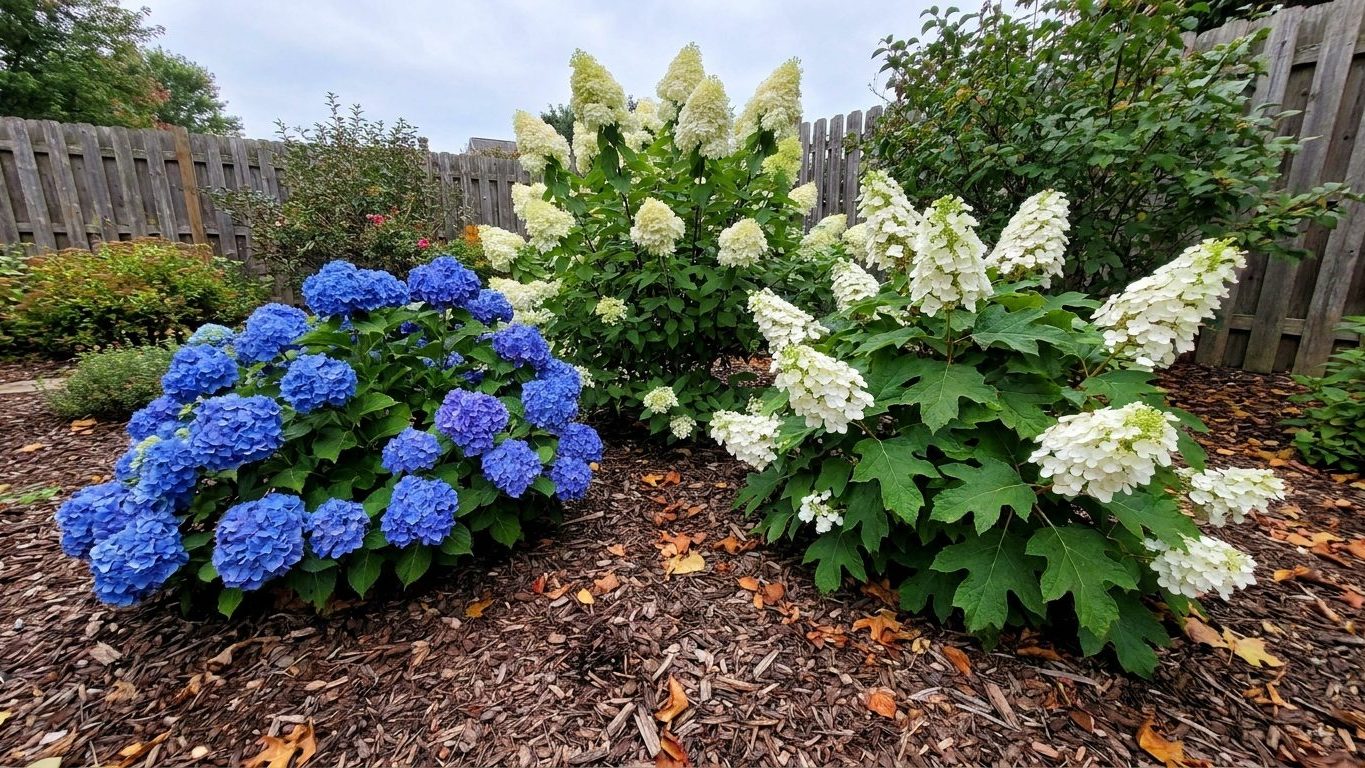
Panicle and smooth hydrangeas are the safest bets for Iowa yards, from Des Moines north to the Minnesota line. Both bloom on new wood, so they shrug off winters that kill flower buds on other types. Bigleaf and mountain hydrangeas can survive here but often skip blooming after a cold winter, and oakleaf needs a sheltered spot away from open, windswept ground.
Hydrangeas that grow well in Iowa: The Short Answer
The USDA Plant Hardiness Zone Map puts Iowa at 4b to 6a, with Des Moines sitting roughly in the middle of that range. That single fact decides which hydrangeas bloom here reliably and which ones survive the winter but stay bare most summers.
Panicle Hydrangea

Panicle hydrangea, Hydrangea paniculata, blooms on new wood, so a hard Iowa winter that kills the top growth still leaves a full show of white or pink cone-shaped flowers by August. It tolerates full sun and the freeze-thaw swings common statewide without protection.
Smooth Hydrangea

Smooth hydrangea, Hydrangea arborescens, is native to the eastern half of the country and treats an Iowa winter like a non-event. Cultivars such as Annabelle die back to the ground most years and still push out round white blooms every summer from new growth.
Climbing Hydrangea

Climbing hydrangea, Hydrangea anomala subsp. petiolaris, survives Iowa cold just fine once its woody vine is a few years old, but it can take three or four seasons before it flowers at all. Give it a sturdy wall or trellis and patience.
Oakleaf Hydrangea

Oakleaf hydrangea, Hydrangea quercifolia, handles the milder winters near the Missouri border better than the open country near the Minnesota line. Its flower buds form the summer before, so an exposed site in northern Iowa can lose next year’s blooms to a late cold snap.
Bigleaf Hydrangea

Bigleaf hydrangea, Hydrangea macrophylla, is the variety most homeowners picture, with its blue or pink mophead blooms, but Iowa winters routinely kill the flower buds that formed the prior fall. The shrub itself often survives, it just skips flowering after a cold season.
Mountain Hydrangea

Mountain hydrangea, Hydrangea serrata, is a close cousin of bigleaf with thinner stems and even less cold tolerance. It can defoliate to the ground in a typical Iowa winter and needs a sheltered courtyard or south-facing wall to bloom reliably most years.
Iowa — the year and the numbers
- State
- Iowa
- USDA zones
- 4b-6a
- Last spring frost
- April 12 to April 24
- First fall frost
- October 14 to October 25
- Annual rain
- 37 in
- Lawn zone
- cool-season
- Source
- NOAA NCEI 1991-2020 Climate Normals, 32F freeze probabilities · Des Moines
How to Work Out the Dates for Your Own Yard
Picking a hydrangea for your own yard means running the same math the nursery runs, just with your microclimate instead of the county average.
- Find your zone card: Iowa runs 4b to 6a on the USDA map, so a lot depends on whether your lot sits in a low frost pocket or a sheltered south-facing yard.
- Check the bloom wood: new-wood bloomers like panicle and smooth shrug off Iowa’s coldest nights, old-wood bloomers like bigleaf and mountain hydrangea often lose next year’s flowers to that same cold.
- Count from the last spring frost: NOAA NCEI 1991-2020 Climate Normals put that date at Des Moines between April 12 and April 24, so anything planted before mid-April risks a late freeze on new growth.
- Count from the first fall frost: the same records put it at Des Moines between October 14 and October 25, giving roots about five months to establish before the ground freezes.
- Plant inside the state’s windows: April, May, August, or September, so roots get settled before summer heat or before that fall freeze arrives.
- Start with the safer name first: a smooth hydrangea such as Annabelle earns trust in year one, a classic bigleaf like Nikko Blue is the one to test only after that.
Annabelle survives an Iowa January because its flower buds form on the growth that follows, not on wood that has to overwinter. Nikko Blue keeps its buds through a mild winter but loses them the year the thermometer drops hard, which is most years here.
Iowa North to South: How the Dates Shift
The USDA Plant Hardiness Zone Map spreads Iowa across 4b to 6a, and that spread doesn’t apply evenly from Lyon County to Lee County, so hydrangea choice should shift with it.
- Northern Iowa (near the Minnesota line): the state’s 4b end of the range holds here, so lean on panicle, smooth, and climbing hydrangea, and treat oakleaf as an experiment against a sheltered wall.
- Central Iowa (Des Moines and the corridor around it): sits closer to the middle of that 4b to 6a spread, giving oakleaf and even a well-mulched bigleaf a fighting chance most winters.
- Southern Iowa (near the Missouri border): the mildest corner of the state, closest to the 6a end, is where bigleaf and mountain hydrangea are most likely to actually flower on old wood some years.
Ask your county extension office which end of that range your yard falls on before betting on a mophead bigleaf.
Mistakes Iowa Punishes
Pruning bigleaf in fall
Cutting back bigleaf or mountain hydrangea in October removes the flower buds that already set for next summer, since both bloom on the previous year’s wood. Wait until new leaf buds swell in spring, and confine any pruning to the June or July window Iowa State Extension recommends for bigleaf.
Planting too early in spring
Setting a young hydrangea in the ground before the frost risk has passed exposes tender roots to a hard freeze they aren’t ready for yet. Hold new plantings for the April, May, August, or September windows, and give roots a full mulch layer through their first winter here.
Skipping winter mulch on bigleaf
Leaving bigleaf or mountain hydrangea bare through an Iowa winter lets deep cold reach crown buds that are already borderline hardy in this range. Pile a thick layer of leaves or straw over the base after the ground freezes solid, then pull it back once spring growth starts.
Iowa Extension Offices and County Contacts
Iowa’s 4b to 6a range is a starting point, not a forecast for your yard. Your county office tracks local frost patterns and can confirm which hydrangeas neighbors are actually growing successfully nearby.
- Iowa hydrangea calendar: the month-by-month planting and pruning windows for the whole state.
- What goes wrong here: the pests and cold-damage patterns Iowa hydrangea owners run into most.
- Iowa State University Extension and Outreach: county-level advice tailored to your specific frost pocket.
Common questions
Can bigleaf hydrangeas survive winter in Iowa?
The shrub itself usually survives Iowa’s 4b to 6a range, but the flower buds set on old wood often die in a hard winter. Many bigleaf hydrangeas in Iowa come back green and leafy with no blooms most summers.
What is the best hydrangea for Iowa winters?
Panicle and smooth hydrangea are the safest picks because both bloom on new wood, so winter dieback doesn’t cost them next year’s flowers, unlike bigleaf or mountain hydrangea.
When should I plant hydrangeas in Iowa?
Stick to the state’s April, May, August, or September windows, giving roots time to settle before summer heat or before the first fall frost arrives between October 14 and October 25 at Des Moines.