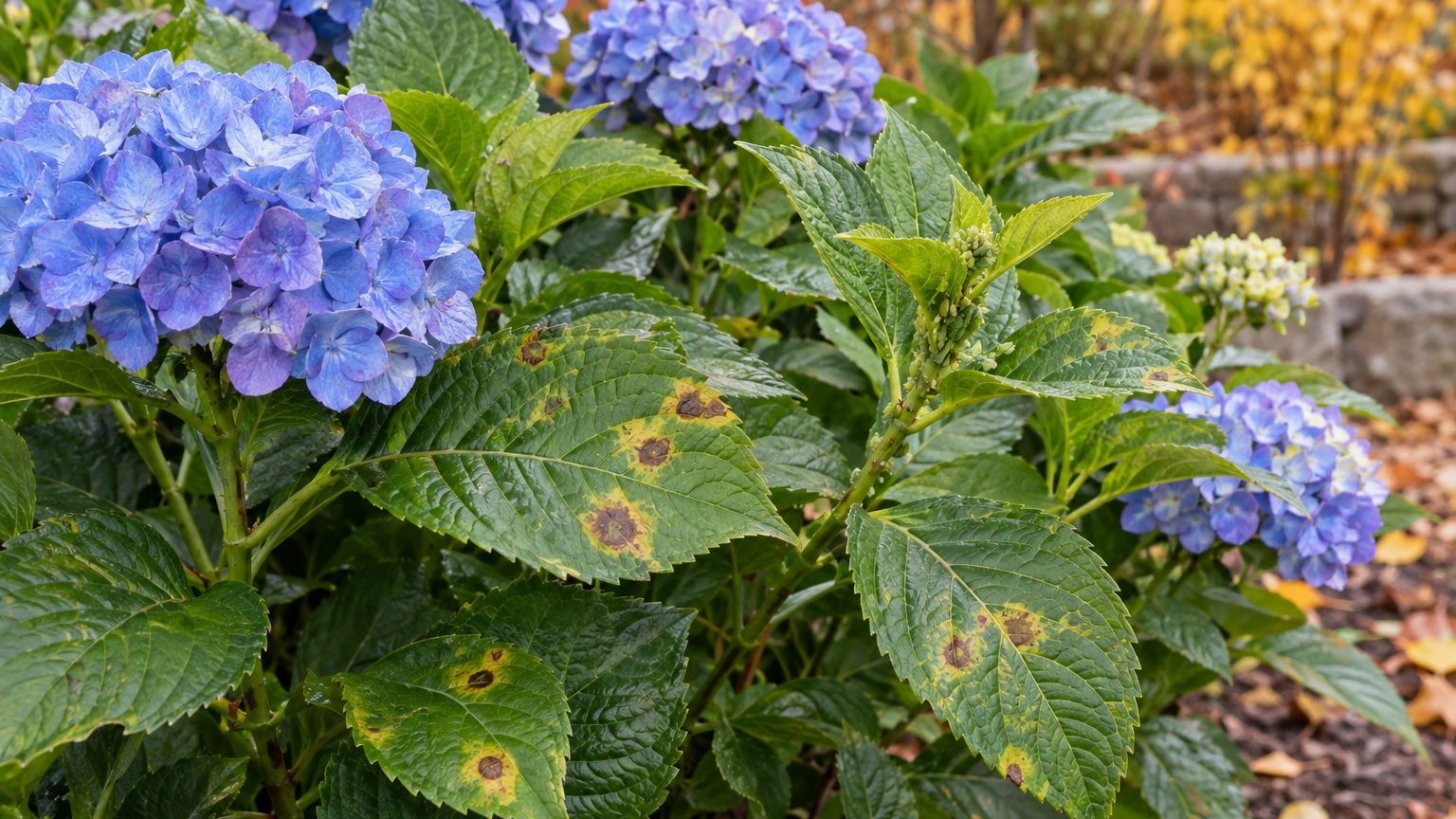
Hydrangeas in Nebraska run into five recurring problems across a season: aphids on spring growth, powdery mildew and Cercospora leaf spot through humid summer weeks, botrytis blight around bloom time, and spider mites once August turns dry. None of these are unique to the state, but Nebraska’s swing from a late, cold spring to a hot, dry late summer decides which one shows up first and how hard it hits.
Hydrangea pests and diseases Nebraska: The Short Answer
Lincoln’s frost-free stretch, which NOAA NCEI U.S. Climate Normals places at April 12 to April 23 for the last spring freeze and October 15 to October 26 for the first fall freeze, is the same calendar every problem below has to work inside.
Five distinct issues turn up on hydrangeas grown across Nebraska yards, each tied to a specific stretch of that window rather than to the plant itself, and none of them are unique to this state.
The swing between a cold, late spring and a hot, dry August decides which one shows up first and how hard it hits a given shrub, and catching each by its own signs, instead of guessing from a bag on a store shelf, is what actually saves the flush.
Aphids
Small green or black insects cluster on the soft tips of new growth right as leaves push out inside the spring frost window, curling foliage and leaving a sticky film behind. A strong water spray or insecticidal soap knocks them back within days, and checking new growth weekly through May catches them before flower buds even form.
Powdery mildew
A gray-white, dusty coating spreads across leaf tops during humid stretches of early summer, thriving wherever air sits still between crowded shrubs. Spacing plants for airflow and watering the soil instead of the leaves keeps spores from settling in the first place, and a sulfur-based fungicide applied early stops it before it climbs the whole plant.
Cercospora leaf spot
Small purple-brown circles with tan centers dot older, lower leaves first, usually showing by midsummer as heat and humidity both peak. The fungus survives in fallen leaf litter over winter, so raking and discarding dropped foliage each fall breaks the cycle far better than any spray applied once symptoms appear.
Botrytis blight
Flower clusters and young stems turn brown and mushy after cool, wet stretches, often right around bloom time in early summer. Pruning out the damaged tissue and improving airflow around the base of the shrub matters more here than any fungicide, since the fungus feeds mainly on dead plant material left sitting in place.
Spider mites

Fine webbing and stippled, bronze-toned leaves show up during the dry heat that often follows Lincoln’s hottest weeks, well before the fall frost closes the season in October. Mites hate a strong hose-down, so rinsing leaf undersides twice a week during dry spells usually ends the problem without reaching for a chemical at all.
Nebraska — the year and the numbers
- State
- Nebraska
- USDA zones
- 4a-5b
- Last spring frost
- April 12 to April 23
- First fall frost
- October 15 to October 26
- Annual rain
- 32 in
- Lawn zone
- cool-season
- Source
- NOAA NCEI U.S. Climate Normals 1991-2020, 32F freeze probabilities · Omaha
How to Work Out the Dates for Your Own Yard
Matching a symptom to the right fix starts with the calendar, not the leaf itself, since narrowing down the timing eliminates most of the list before you even look closely at the plant.
- Place the date on the calendar: NOAA NCEI U.S. Climate Normals puts Lincoln’s last spring frost at April 12 to April 23, and any damage showing up before that window closes usually means cold stress or aphids on tender new growth, not fungus.
- Check what the air did last week: powdery mildew and botrytis blight both follow humid, still stretches, while spider mites and scorch follow the driest week of summer instead.
- Flip a leaf over: fine webbing or tiny moving specks under close look mean spider mites, not disease, and no fungicide in the shed will touch them.
- Note which leaves are hit first: older, lower leaves usually mean Cercospora leaf spot working up from fallen debris, while damage starting on new tips points to aphids instead.
- Match it to the pruning window: damage that shows up right after cutting bigleaf hydrangea back in June or July is often a stress reaction to the cut, not a new pest.
- Rule out simple sunburn: leaf edges browning only on the side facing full afternoon sun point to scorch from heat and wind, not to any pest or fungus at all.
Running through these six checks before reaching for any spray usually narrows six possible problems down to one, and it saves buying a fungicide or insecticide that would have done nothing for the actual cause sitting in a particular Nebraska yard this week.
Nebraska North to South: How the Dates Shift
Nebraska stretches far enough east to west that the same pest can behave differently depending on elevation, humidity, and how close a yard sits to the Missouri River.
- The Panhandle and higher elevations (Scottsbluff, Chadron, Alliance): colder air pools longer into spring here, and pest and disease pressure typically trails a week or two behind Lincoln’s calendar.
- The Missouri River valley in the east (Omaha, Nebraska City, Bellevue): extra humidity off the river keeps powdery mildew and leaf spot active later into fall than farther west.
- The Sandhills and north-central plains (Valentine, Ainsworth, Broken Bow): wind and dry air favor spider mites and leaf scorch over any fungal problem most seasons.
- Southeast Nebraska (Lincoln, Beatrice, Falls City): sits closest to the reference-city dates used throughout this guide, with the least lag of any region.
Whichever part of the state a yard sits in, the state guide’s frost dates are a starting point, and the local pattern still decides which of these five problems shows up first.
Mistakes Nebraska Punishes
Fertilizing outside the March, May, July window
A feeding applied in late summer pushes soft new growth right before Lincoln’s first fall frost, October 15 to October 26, and that tender growth is what cold damage and botrytis hit first. Stick to the three-month feeding schedule and skip any bag labeled for fall use on hydrangeas here.
Pruning bigleaf hydrangea outside June or July
Cutting bigleaf types earlier or later than the June to July window removes the very wood that carries next year’s blooms, since this species sets buds on old growth. A shrub pruned in April or September often looks diseased the following spring when it’s really just bare of flower buds.
Planting too late in fall
A hydrangea set into the ground after the August or September planting window has little time to root before the October frost arrives, and thin roots going into winter show up as dieback that gets blamed on disease. Stick to the spring or late-summer planting months instead.
Choosing bigleaf for the coldest yards
Nebraska’s zone 4a-5b range, per the USDA Plant Hardiness Zone Map, sits at the cold edge for bigleaf hydrangea, and a hard winter kills flower buds even when the plant survives. Panicle and smooth hydrangea tolerate that range far better and skip most of the dieback that gets mistaken for pest damage.
Nebraska Extension Offices and County Contacts
Lincoln’s frost dates and the zone 4a-5b range are a starting point, not a full diagnosis for a specific yard, and Nebraska Extension keeps the county-level detail a single state figure can’t cover.
- Frost dates and hardiness zone: the anchors for every date in this list.
- Which ones hold up here: the varieties that tolerate Nebraska’s zone 4a-5b range without yearly dieback.
- The month-by-month calendar: fertilizing, planting, and pruning windows lined up against Lincoln’s frost dates.
Call the county office before spraying anything, since a quick photo sent in usually settles which of these problems is actually on the shrub this week.
Common questions
What is the most common hydrangea disease in Nebraska?
Powdery mildew and Cercospora leaf spot show up most often in Nebraska yards, both tied to humid stretches of summer rather than to any one variety of hydrangea.
Do Nebraska’s cold winters kill hydrangea pests along with the plant?
A hard freeze inside the zone 4a-5b range knocks back overwintering aphids and mites, but it rarely reaches fungal spores sitting in fallen leaf litter, which is why fall cleanup matters more than winter cold for disease control.
When should I treat for spider mites in Nebraska?
Watch for stippled, bronze leaves during the driest weeks of summer, typically after Lincoln’s hottest stretch and before the October 15 to October 26 fall frost closes the season, and start with a strong water rinse twice a week before reaching for any chemical.