Skip to content

Why Hydrangeas Turn Pink or Blue, and How to Change It

Why Hydrangeas Turn Pink or Blue, and How to Change It

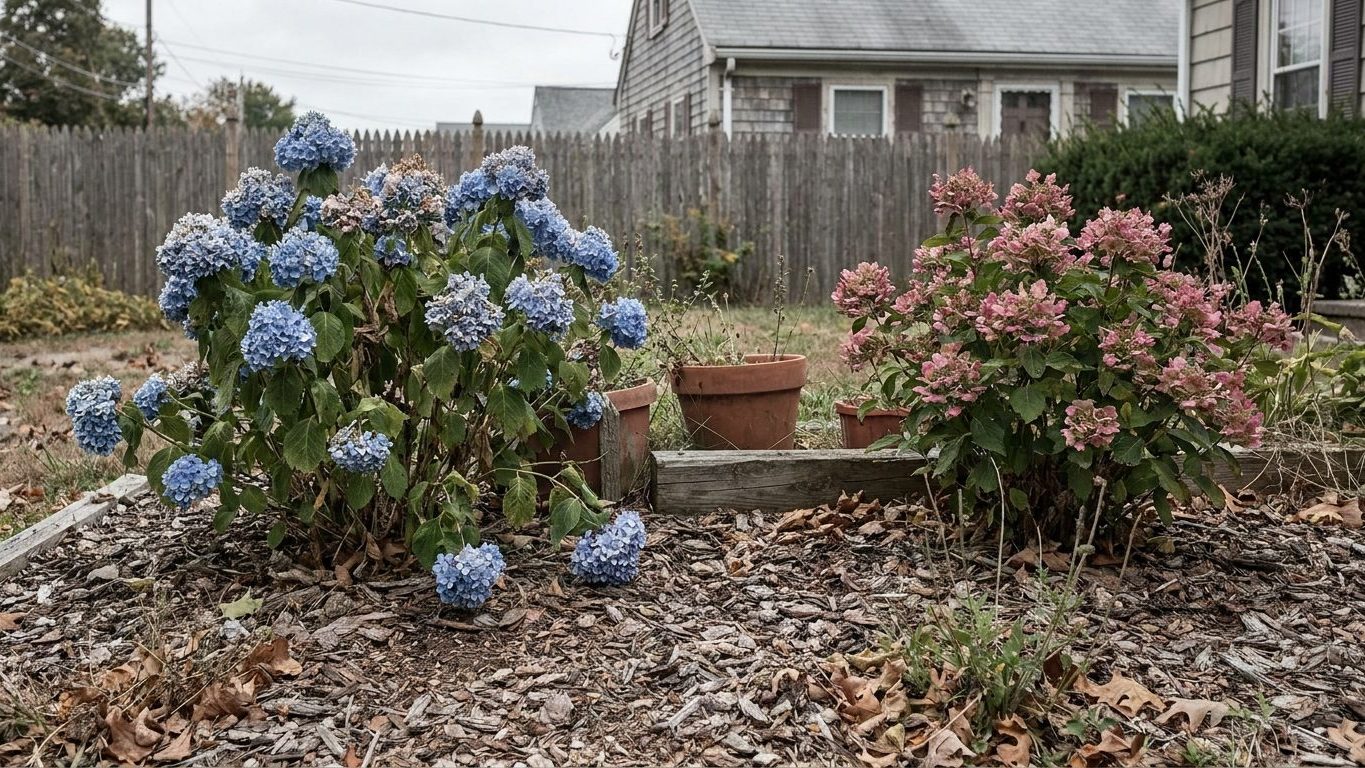
Hydrangea flowers pick up aluminum from the soil, and how much aluminum the roots can use depends on pH. Below about 5.5 the shrub turns blue, above about 6.5 it turns pink, with purple in between. That switch only works on two kinds of hydrangea, and the fix most kitchen tips suggest isn’t the one that actually moves it.

Hydrangea Color Soil Ph: The Short Answer

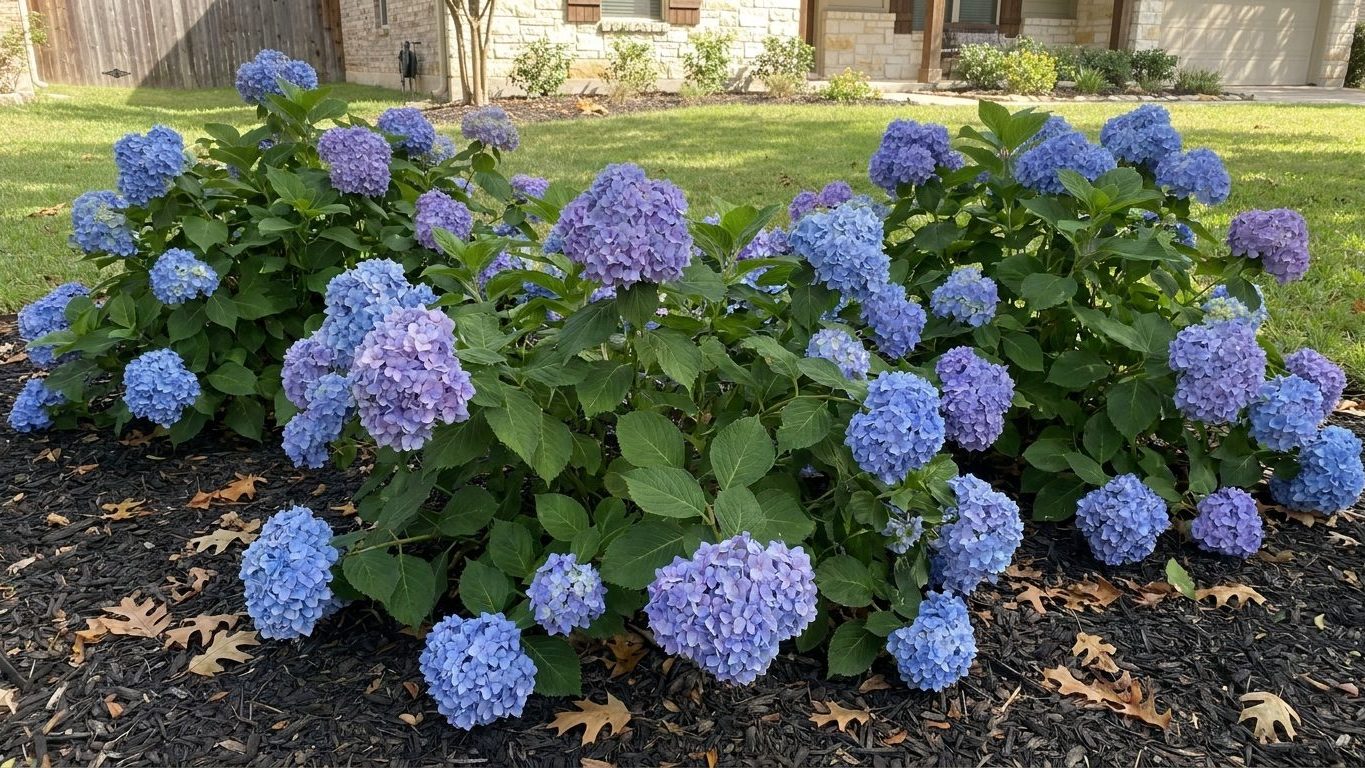
NC State Extension Gardener Plant Toolbox puts the color line at about pH 5.5 for blue and about pH 6.5 for pink, with purple in the gap between. Only bigleaf and mountain hydrangeas respond this way, the rest hold their color no matter what’s in the ground.

Aluminum sulfate acidifies the soil for blue, garden lime pushes it toward alkaline for pink. Which move makes sense depends on your existing soil, and that starting point varies more than a national page can cover.

The state selector below this section opens the page built for your zone. It carries the frost dates and pruning window that decide when an amendment actually reaches the roots in time to matter this season.

A soil test still beats guessing from a flower’s color, since a shrub can sit right on the edge of the range for years. The reading itself, not the color you see today, is what tells you which amendment to reach for.

Hydrangea Color Soil Ph, Step by Step

Why Hydrangeas Turn Pink or Blue, and How to Change It

Changing a bigleaf or mountain hydrangea’s color is a soil chemistry job worked into the ground, not a spray applied to the flowers.

  1. Test the soil first: a home kit or a lab test tells you where you actually stand instead of guessing from last year’s blooms.
  2. Water deeply before you amend: dry soil carries granules unevenly, so give the root zone a deep soak, covered in hydrangea watering, the day before you apply anything.
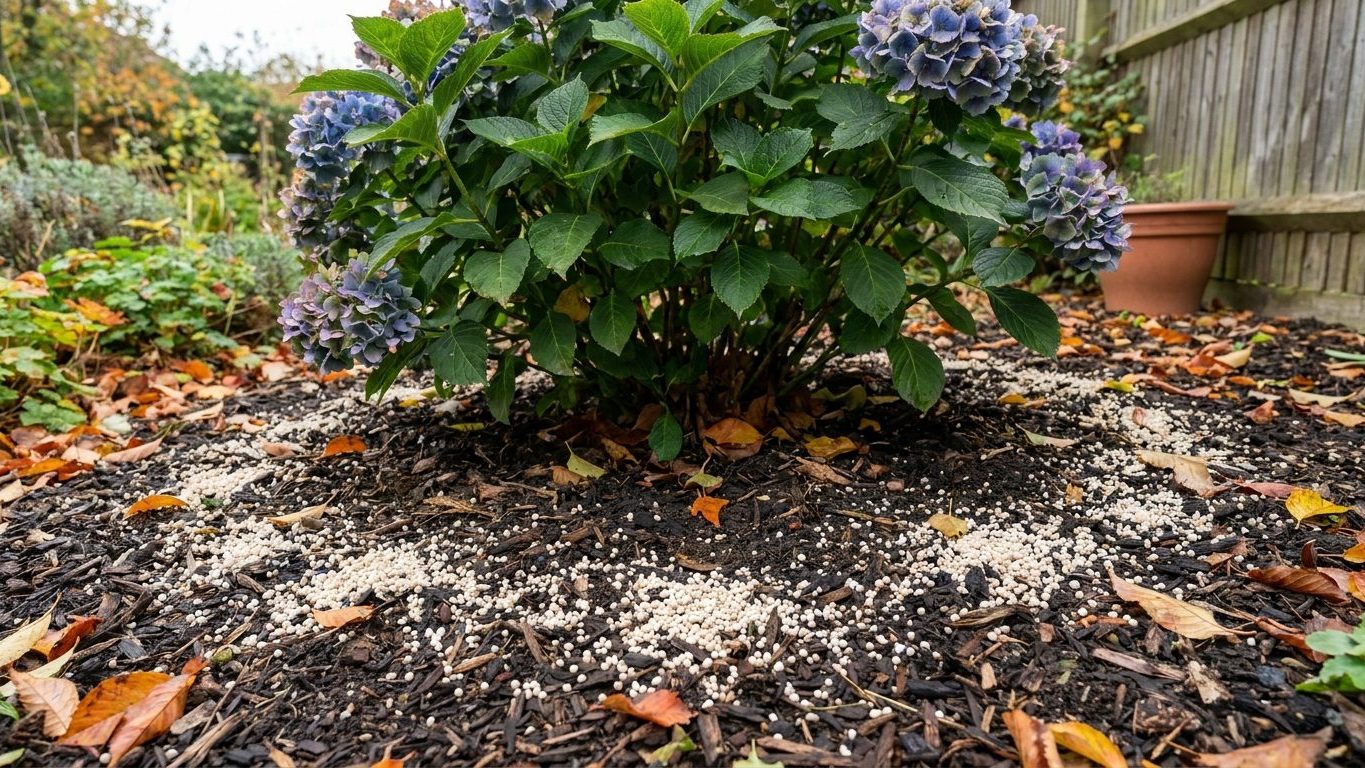
  3. Apply aluminum sulfate for blue: work it into the top few inches around the drip line to pull the reading toward and below 5.5.
  4. Apply garden lime for pink: raise the reading toward and above 6.5, in smaller doses spread across more than one application.
  5. Skip the high-phosphorus fertilizer: it locks aluminum up in the soil where roots can’t reach it, which nudges blue flowers back toward pink even when the pH itself hasn’t moved.
  6. Recheck in six to eight weeks: soil pH shifts slowly, and next season’s flowers, not this season’s, usually show the fuller change.

None of this touches panicle, smooth, oakleaf or climbing hydrangeas, whose color follows the calendar instead of the soil test. If you’re starting new shrubs to try this on, hydrangea propagation covers rooting cuttings true to the parent plant, aluminum uptake and all.

Hydrangea Color Soil Ph by Hydrangea Type

NC State Extension Gardener Plant Toolbox lists bigleaf’s hardiness at 6a to 11b and panicle’s at 3a to 8b. Only these two, along with mountain hydrangea, answer to soil pH at all, while the rest shift with the calendar instead, whatever the ground offers.

Bigleaf flowers form on last year’s wood, so a hard prune or a late frost removes next season’s color before it starts. Mountain hydrangea sets buds the same way but tolerates a late frost better, which makes it the safer bet in colder yards.

Kind Flowers on USDA zones Changes color with pH
Bigleaf Last year’s wood 6a–11b Yes, blue to pink
Panicle Current season’s growth 3a–8b No, ages white to pink
Mountain Old wood — Yes, buds handle late frost better than bigleaf’s

Smooth, oakleaf and climbing hydrangeas keep their own bloom-color story, tied to age and light rather than pH. The other kinds are on their own pages for pruning and placement.

Hydrangea Color Soil Ph: Mistakes That Cost a Season

Amending soil for a hydrangea that never turns blue

Panicle, smooth, oakleaf and climbing hydrangeas don’t answer to pH, so working aluminum sulfate into their roots does nothing but shift a number on a soil test. Check which type is actually growing before buying an amendment, the hydrangea hub covers the differences by type.

Coffee grounds in the planting hole

Coffee grounds in the planting hole — Why Hydrangeas Turn Pink or Blue, and How to Change It

Coffee grounds and citrus peel are a common home fix for blue flowers, but the pH shift they cause is small and inconsistent. Color depends on aluminum being available to the roots, not on the soil smelling acidic. Aluminum sulfate does that job at a measured rate, kitchen scraps don’t.

Pruning bigleaf into a tidy mound in fall

Bigleaf hydrangea sets its flower buds the summer before, on last year’s wood, so a fall cleanup cut removes next year’s blooms along with the stems. Panicle can take a hard cut in late winter since it flowers on new growth instead. Prune bigleaf before August 1, and save the hard cuts for panicle types.

Hydrangea Color Soil Ph in Your State

The pH numbers above hold everywhere. What changes by zone is the calendar, when to test, when to amend and when it’s safe to prune without losing next year’s buds.

  • Your state page: the frost dates and pruning window for your zone, plus which type holds up best locally.
  • Local extension office: a lab soil test gives an exact pH reading instead of a guess from last year’s flower color.
  • The hydrangea hub: care basics for every type, useful before deciding which amendment applies.

Common questions

Can I turn a pink hydrangea blue by burying nails or pennies in the soil?

Metal buried in soil doesn’t reliably lower pH or release aluminum in a form roots can use, so results are inconsistent. Aluminum sulfate, applied at a measured rate and checked against a soil test, is the amendment that actually does the job.

Will amending the soil work on a white hydrangea?

Not for most white varieties, since the pH color range covers blue through pink in bigleaf and mountain hydrangea, and true whites don’t carry that pigment shift. White panicle and smooth varieties follow their own color arc as flowers age instead of responding to soil.

How long does it take to see a color change after amending?

Soil pH moves slowly, so flowers already open this season usually keep their color. Recheck the soil in six to eight weeks, and expect the fuller change to show up on next year’s buds.
How to Propagate Hydrangeas from Cuttings and Layering

How to Propagate Hydrangeas from Cuttings and Layering

Most hydrangeas root well from a softwood stem cutting or from layering a low branch pinned to the soil, and the method that works best depends on the type in your yard. Bigleaf and panicle hydrangea root fastest, while old-wood types like oakleaf and climbing hydrangea often layer better than they cut.

Propagating Hydrangeas: The Short Answer

Stem cuttings and layering both work on hydrangeas, and NC State Extension Gardener Plant Toolbox names both as the genus’s propagation methods, with panicle hydrangea also growing from seed. The general rule holds across zones 3a through 9b, but the type in your yard decides the wood you cut and when.

A bigleaf cutting comes from softwood taken before the shrub sets next year’s flower buds, since bigleaf blooms on last year’s wood. Panicle hydrangea roots just as easily but blooms on the current season’s growth, so cuttings and a hard prune can happen the same year.

Your own zone decides how long a cutting has to root before frost, and that window shifts widely across the country. The state selector just below this section opens the page built for where you garden, with the frost dates that apply there.

Propagating Hydrangeas, Step by Step

How to Propagate Hydrangeas from Cuttings and Layering

The steps are the same whether you’re rooting a mop-head or layering an oakleaf, only the wood and the calendar change.

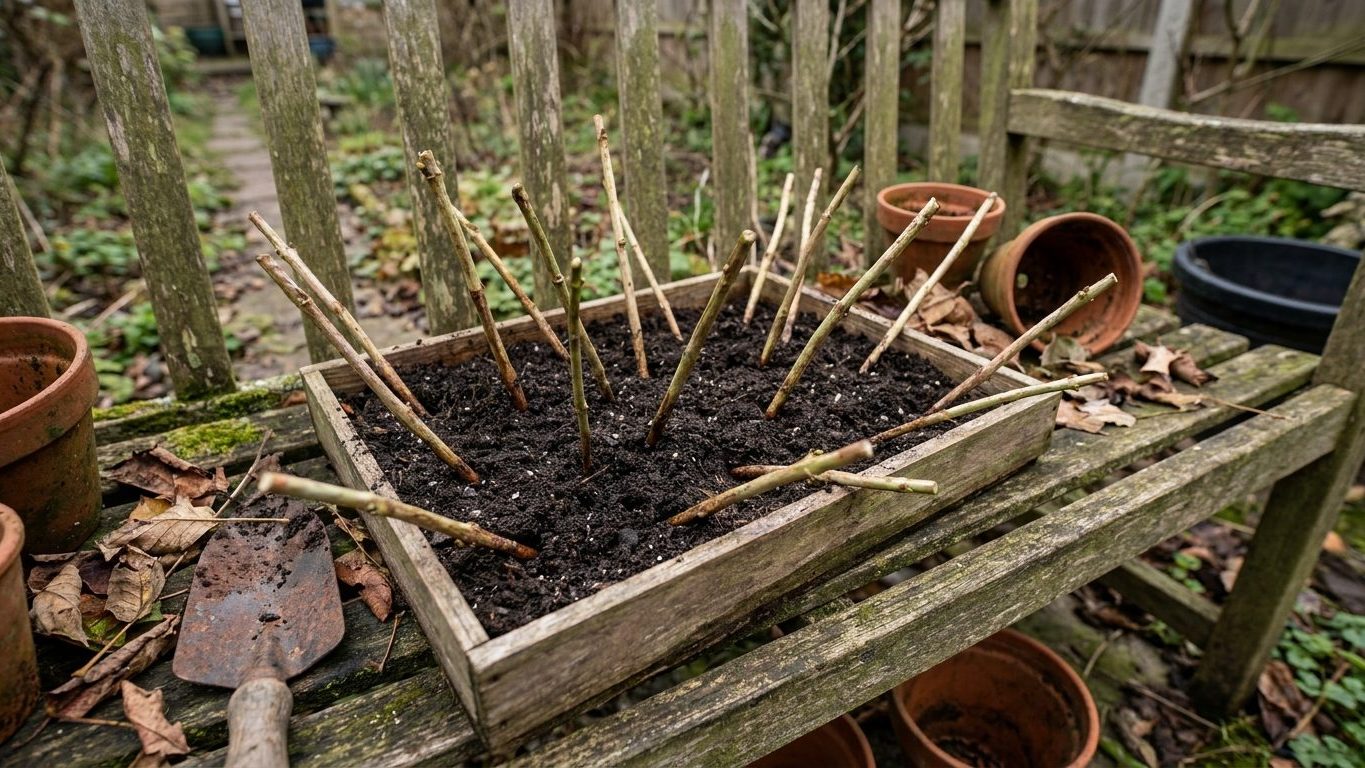
  1. Cut a stem tip just below a leaf node: choose a non-flowering shoot, since a shoot that’s already budding puts its energy into blooms instead of roots.
  2. Strip the lower leaves: keep only the top set, and halve any leaf that’s still large, so the cutting loses less moisture before roots exist to replace it.
  3. Set the cutting in damp, loose mix: sand, perlite, or a light potting blend all drain well enough, and drainage matters more than fertility at this stage.
  4. Cover it to hold humidity: a clear bag or a plastic dome keeps the air moist without soaking the mix, and it comes off once new leaves appear.
  5. Layer a low, flexible branch instead: for oakleaf, mountain, or climbing hydrangea, bend a branch to the ground, wound the underside where it touches soil, and pin it down, since these old-wood types root slowly from cuttings but layer reliably over a full season.
  6. Move a rooted plant only once it resists a gentle tug: a cutting that pulls free easily hasn’t rooted yet, and moving it too soon undoes weeks of work.

NC State Extension Gardener Plant Toolbox rates macrophylla and paniculata as rapid growers, which is why their cuttings often show fresh growth sooner than the rest of the genus. Panicle is also the one hydrangea listed as growing from seed, though a seedling takes longer to flower than a cutting and won’t match its parent exactly.

Propagating Hydrangeas by Hydrangea Type

NC State Extension Gardener Plant Toolbox puts bigleaf at 6a to 11b and panicle at 3a to 8b, and the two also flower on completely different wood, which is the detail that decides whether a cutting taken this summer even has flowers to lose.

Smooth hydrangea, sold as Annabelle, blooms on new wood and is the hardiest of the genus, so its cuttings tend to strike fastest of all. Climbing hydrangea clings by aerial rootlets and is famously slow to start flowering, even once it’s rooted and planted out.

Kind Flowers on USDA zones Sun
Bigleaf Last year’s wood 6a-11b Dappled or part shade, protect from afternoon sun
Panicle Current season’s growth 3a-8b Full sun

Smooth, oakleaf, mountain, and climbing hydrangea all propagate the same way, but the source doesn’t pin a zone range or a sun preference to each of them, so the other kinds are on their own pages in this guide.

Propagating Hydrangeas: Mistakes That Cost a Season

No blooms after a spring prune

No blooms after a spring prune — How to Propagate Hydrangeas from Cuttings and Layering

Bigleaf and mountain hydrangea set their flower buds the previous summer on old wood, so a spring cut, or a late frost, removes those buds before they ever open. Prune right after flowering instead, and take cuttings from the new growth that follows rather than from stems you’ve just cut back.

Coffee grounds that never turn flowers blue

Coffee grounds that never turn flowers blue — How to Propagate Hydrangeas from Cuttings and Layering

Coffee grounds and citrus peel barely shift soil pH, and colour only changes in bigleaf and mountain hydrangea anyway, never in panicle, smooth, oakleaf, or climbing types. What actually moves blue toward pink is available aluminum, which acidic soil releases and high-phosphorus fertilizer locks away.

A cutting that never calluses

A cutting that never calluses — How to Propagate Hydrangeas from Cuttings and Layering

A stem cut from hardwood, the woody growth from a season or two back, roots far slower than a softwood tip, since macrophylla and paniculata are rated as rapid growers mainly on new growth. Choose a bendable, non-flowering shoot instead, and keep the mix damp rather than wet while roots form.

Propagating Hydrangeas in Your State

NC State Extension Gardener Plant Toolbox puts the genus at zones 3a through 9b nationwide, but that hides real gaps between a bigleaf shrub near the coast and a panicle hydrangea further inland, so timing depends on where you garden.

  • Your state page: the frost dates and the pruning window where you live.
  • Which ones hold up here: the types rated for your zone, from bigleaf to panicle.
  • Your local extension office: a soil test before you decide to acidify anything for colour.

Common questions

Can I propagate a hydrangea from a flower stem?

Better to skip it. A flowering stem is putting its energy into the bloom, not into new roots, so a non-flowering shoot roots faster and more reliably.

How long does a hydrangea cutting take to root?

NC State Extension Gardener Plant Toolbox rates macrophylla and paniculata as rapid growers, and new leaf growth on those cuttings often shows up within a few weeks. The source doesn’t give an exact day count, and the pace still shifts with zone, season, and the type you’re rooting.

Does layering work for every type?

The source lists layering for the genus as a whole, and it tends to suit old-wood types especially well. Oakleaf, mountain, and climbing hydrangea, all slower to root from cuttings, often layer more reliably over a full season.

When to Plant Hydrangeas, State by State

When to Plant Hydrangeas, State by State

Plant hydrangeas in early spring once the soil thaws, or in early fall while the ground still holds warmth, six or more weeks before the first hard frost. The right week shifts with your USDA zone and with the type in your cart, since old-wood and new-wood bloomers answer to different clocks. The table below gives each state its own window and zone, one box per state, so the guessing stops there.

When to plant Hydrangeas: The Short Answer

Most gardeners plant in a spring window and again in a fall window, skipping high summer heat and hard freezes. NC State Extension Gardener Plant Toolbox puts the genus at USDA zones 3a through 9b, though that range depends entirely on which hydrangea sits in the pot.

Bigleaf and mop-head types run 6a to 11b and set buds on last year’s wood, so a late frost or a spring prune erases the coming bloom. Panicle types run 3a to 8b and flower on wood grown this season, which forgives a hard late-winter cut.

Three things move the actual date: your zone, the type in your cart, and how far your region’s winters and summers swing.

  • Zone: how early the ground thaws and how soon frost returns.
  • Type: old-wood bloomers need different timing than new-wood bloomers.
  • Region: coastal, mountain, and high-plains sites push both windows differently.

The state-by-state table just below turns those three factors into one answer for where you live. Each box lists the months and the USDA zone for that state, nothing more.

When to plant Hydrangeas, Step by Step

When to Plant Hydrangeas, State by State

The sequence decides more than the calendar date, since a shrub planted well within a six-week window outperforms one rushed into the ground on the “correct” day.

  1. Pick the window first: plant in early spring once the soil is thawed and crumbles in your hand, or in early fall while the ground still holds summer warmth.
  2. Check the soil pH: NC State Extension Gardener Plant Toolbox lists hydrangea soil as ranging from acid, below 6.0, through neutral, 6.0 to 8.0, to alkaline, above 8.0, and on bigleaf and mountain types that same number becomes flower color later.
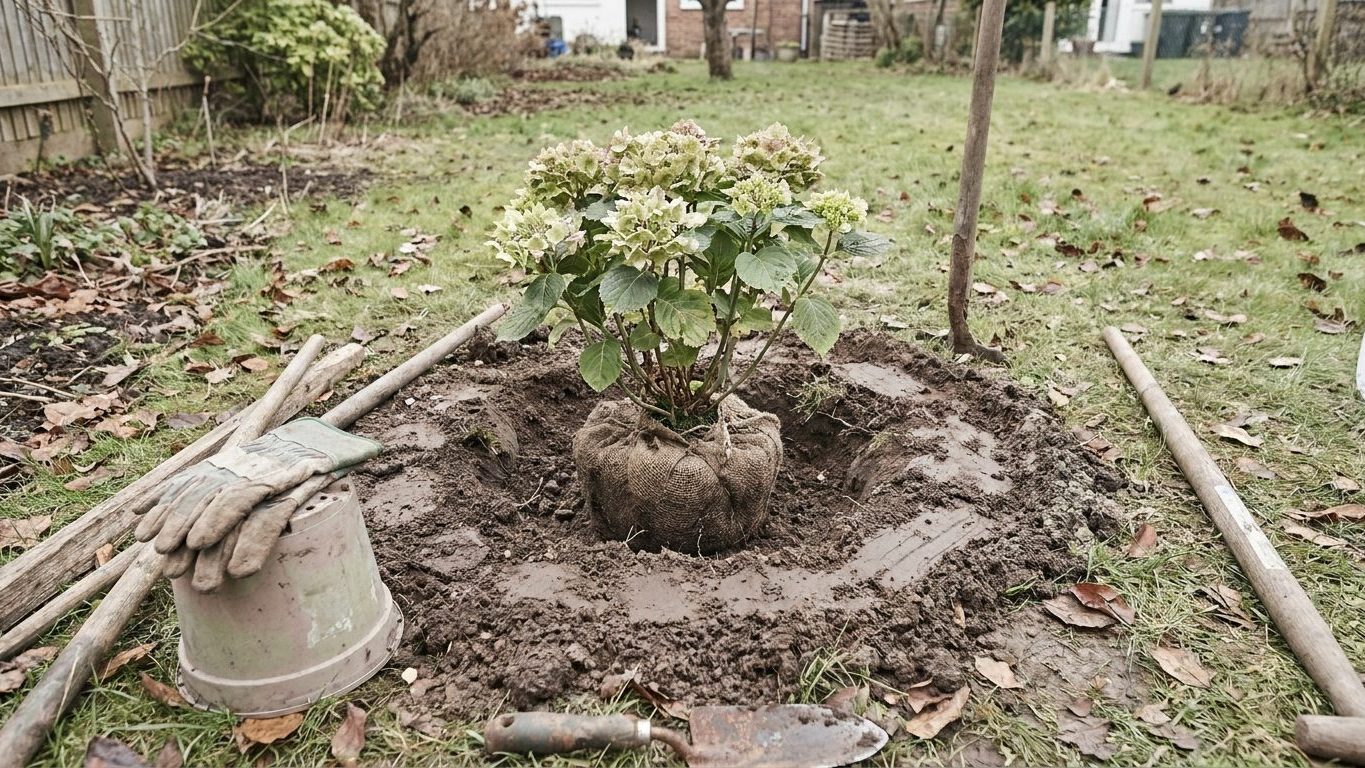
  3. Dig wide, not deep: bigleaf and panicle are both shallow-rooted, so a hole twice the width of the root ball beats one dug deep and narrow.
  4. Match spacing to the mature size: leave 3 to 6 feet around a bigleaf, as much as 25 feet around a panicle, and about 5 feet around an oakleaf.
  5. Water in, then mulch: soak the root ball at planting and lay mulch over those shallow roots to hold moisture through the first season.
  6. Leave the pruning shears in the shed: wait until you know whether the shrub blooms on old wood or new before making any cut at all.

None of this fixes one single date. It fixes the order, soil first, hole second, spacing third, water and mulch last, so whichever week you land on, the shrub starts from the same footing.

When to plant Hydrangeas by Hydrangea Type

NC State Extension Gardener Plant Toolbox splits the genus into old-wood bloomers, which set buds the summer before, and new-wood bloomers, which grow and flower in the same season. That difference decides both the planting window and the pruning date.

Bigleaf sets buds on last year’s wood, so anything that damages a stem before bloom, frost or a spring cut, takes the flowers with it. Panicle flowers on wood it grows this year, so a hard late-winter cut only delays bloom, it never cancels it.

Kind Flowers on USDA zones Sun
Bigleaf / mop-head / lacecap Last year’s wood 6a–11b Dappled to deep shade, protect from afternoon sun
Panicle / peegee Current season’s growth 3a–8b Full sun, the only hydrangea that takes it well

Smooth, oakleaf, mountain and climbing hydrangeas each carry their own old-wood or new-wood rule too, but the other kinds are on their own pages, where their zones and pruning windows get the same treatment.

When to plant Hydrangeas: Mistakes That Cost a Season

Flowers pruned away in spring

Flowers pruned away in spring — When to Plant Hydrangeas, State by State

Bigleaf sets its buds the previous summer, so a spring cleanup often slices off the shoots that were about to bloom. NC State Extension Gardener Plant Toolbox puts the cutoff at before August 1, once the year’s flowers have faded, never once fall arrives.

Leaves scorched on the sunny side

Leaves scorched on the sunny side — When to Plant Hydrangeas, State by State

Bigleaf wants dappled or deep shade and suffers when afternoon sun hits it straight on, while panicle is the one type that takes full sun well. Planting a bigleaf where a panicle would thrive burns the leaf edges by midsummer.

Blue flowers that turn pink anyway

Blue flowers that turn pink anyway — When to Plant Hydrangeas, State by State

Color shifts with soil pH only on bigleaf and mountain types, blue below about 5.5 and pink above about 6.5, while panicle, smooth, oakleaf and climbing hydrangeas never change no matter the soil. A high-phosphorus fertilizer locks up the aluminum blue flowers need, a feeding choice that shows up as a color problem.

When to plant Hydrangeas in Your State

This national rule sets the two windows, but not the week, since that depends on your USDA zone and your area’s frost dates. Your state’s own page turns those two variables into the months and zone for where you actually garden.

  • Your state page: the frost dates and the planting window for your zone, spelled out month by month.
  • Which types hold up here: whether bigleaf survives your winter unprotected or a panicle is the safer bet.
  • Your local extension office: the nearest source for a soil test and a pest or disease question specific to your county.

Common questions

Can hydrangeas be planted in summer?

Summer heat stresses a shallow-rooted shrub before its roots have spread, so most gardeners hold off until early fall instead. A summer planting can work with regular water, but it asks more of the gardener than either shoulder season does.

Do all hydrangeas need shade?

No, panicle hydrangea is the one type NC State Extension Gardener Plant Toolbox names as taking full sun well, while bigleaf, mountain, oakleaf and climbing types want dappled or deep shade and scorch in direct afternoon sun.

Are hydrangeas toxic to pets?

Only bigleaf hydrangea is documented toxic, and only if a dog, cat or horse eats a large quantity of bark, flowers, leaves or stems, causing nausea, stomach pain, vomiting and sweating. The other types in this genus carry no such documented toxicity.

Aphids on Hydrangeas: How to Spot Them and Get Rid of Them

Aphids on Hydrangeas: How to Spot Them and Get Rid of Them

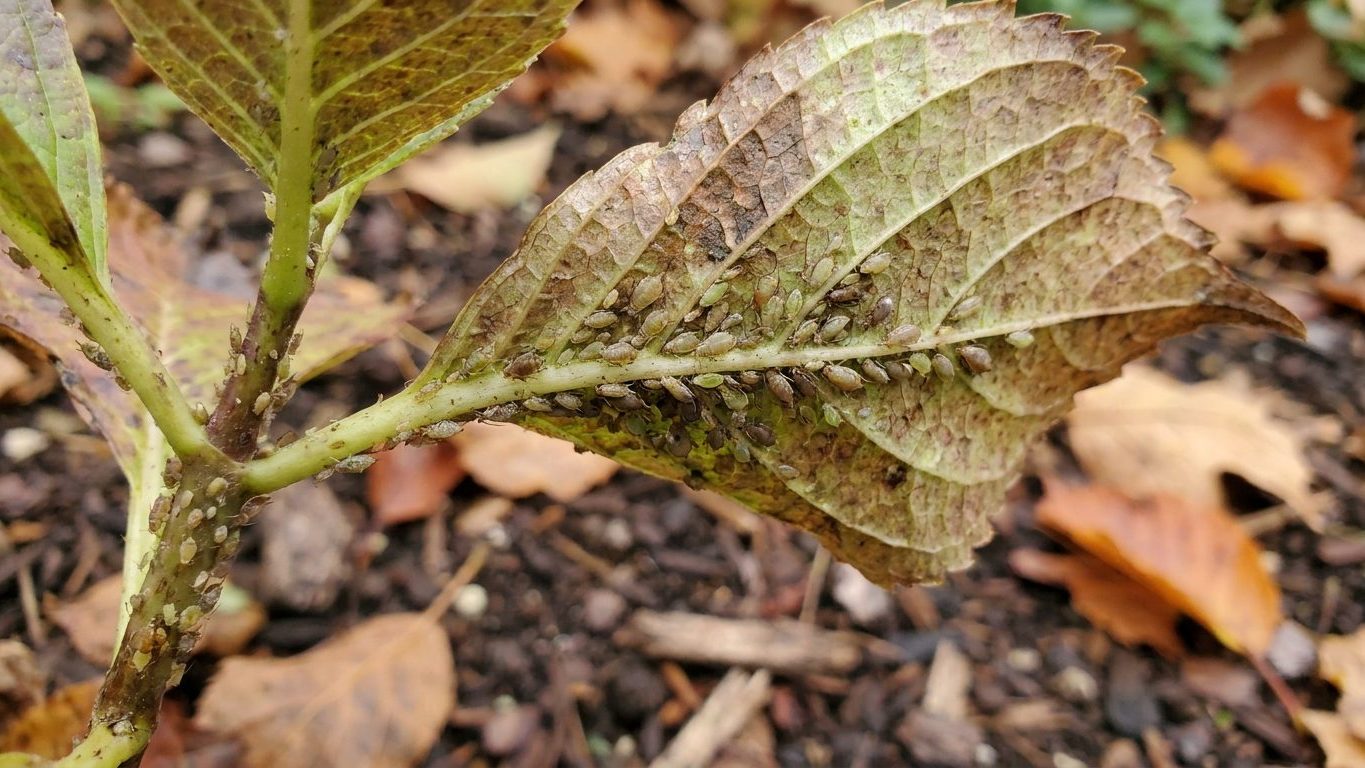
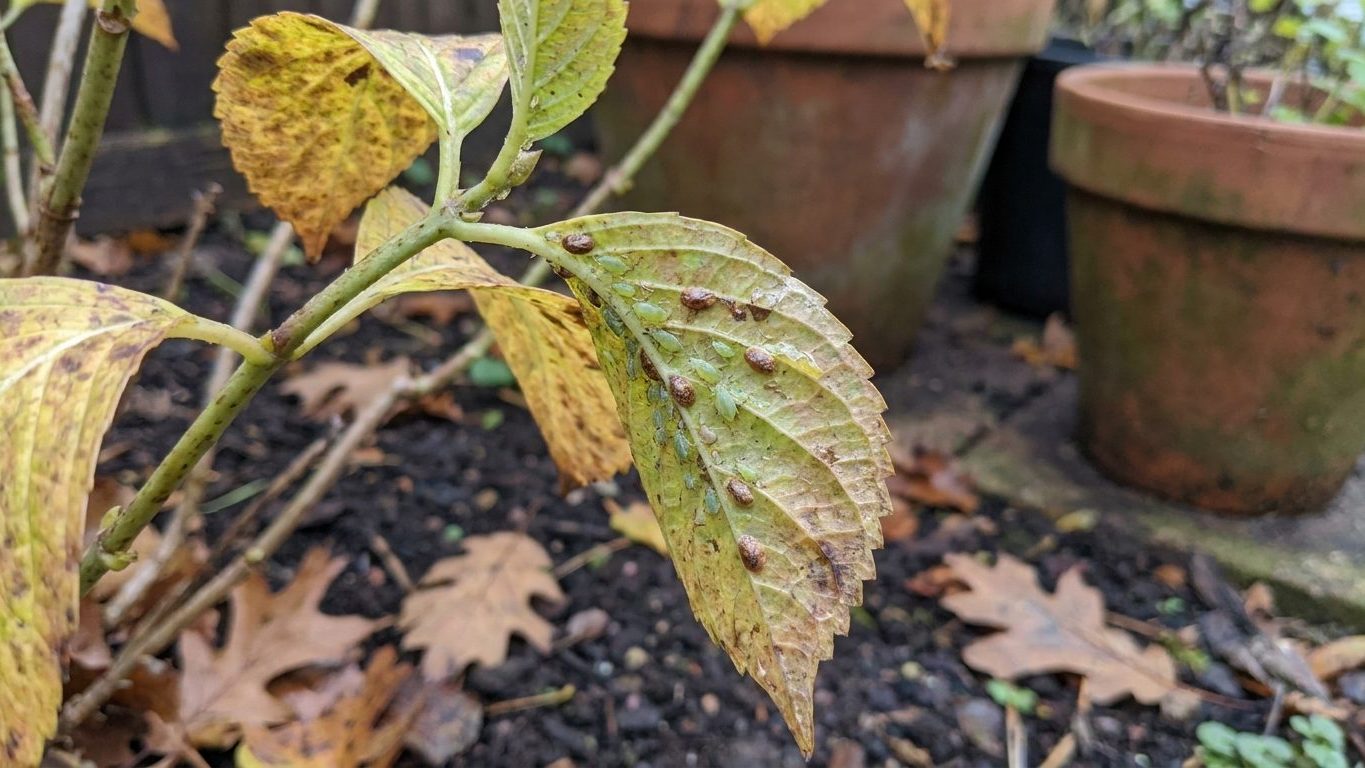
Aphids on hydrangea show up as tiny, soft-bodied insects, green, black, or pink, clustered on new stems, leaf undersides, and unopened buds, mostly in spring and early summer. NC State Extension Gardener Plant Toolbox lists them among the pests that turn up on this genus and calls the group rarely a problem. Sticky honeydew and curling leaves are usually the first clue.

Aphids: What You See

Aphids on Hydrangeas: How to Spot Them and Get Rid of Them

Aphids arrive as a cluster, not a lone bug, and they settle first on the softest growth a hydrangea has to offer.

  • Color runs from pale green to black, sometimes pink, depending on the colony.
  • Shape is small, pear-bodied, and soft, with no hard shell.
  • Location is the tip of new stems, the underside of young leaves, and unopened flower buds.
  • Timing runs from spring into early summer, when growth is soft and fast.
  • Sticky residue on leaves below the colony is honeydew, and it often draws ants.
  • Leaves near a heavy colony curl or pucker instead of lying flat.

NC State Extension Gardener Plant Toolbox lists aphids among the pests that occasionally turn up on hydrangea, alongside scales, nematodes, and mites, and calls the whole group rarely a problem. The tissue they favor is always the newest and softest growth on the plant, and that detail is what separates them from most look-alikes.

Aphids or Something Else?

Two or three other problems leave a similar mess on hydrangea leaves and stems, and it pays to check the sign that actually decides which one you’ve got before you treat anything.

The source’s own pest and disease list for hydrangea names scale, mites, and powdery mildew alongside aphids, and each one leaves its own kind of clue behind on the leaf.

Kind Looks like The sign that tells them apart
Scale Small waxy bumps clustered on stems Scale stays fixed in place, aphids crawl and cluster on soft new growth
Powdery mildew A pale, dusty coating on leaf surfaces Mildew is dry and powdery, aphid damage leaves a sticky honeydew film instead
Mites Leaves that look dusty or bronzed Mites are nearly invisible without a hand lens, aphids are visible as a cluster

Nematodes and bacterial wilt are also on the source’s list, but their signs are underground or systemic rather than something you can spot on a leaf, so the other kinds are on their own pages.

What Causes Aphids, and Where It Is Worst

Aphids find hydrangea through soft new growth, and colonies build fastest in the weeks right after a spring flush, especially on a plant pushed hard with quick-release nitrogen.

  • The South and Gulf Coast (Georgia, Texas, the Carolinas): warm springs bring an earlier flush on bigleaf hydrangea, which NC State Extension Gardener Plant Toolbox lists as hardy through USDA zone 11b, giving aphids a longer window before summer heat slows new growth.
  • The Upper Midwest and Northeast (Michigan, Minnesota, New York): panicle hydrangea, hardy to zone 3a, leafs out later, so the aphid window lines up with a single, shorter spring flush.
  • The Pacific Northwest (Washington, Oregon): mild, humid springs keep new growth soft for weeks at a stretch, which is exactly the tissue aphids prefer.

Your own zone and hydrangea type decide how long that window stays open, so check your state page before you plan a treatment.

How to Treat Aphids

Most colonies on hydrangea need nothing more than a few minutes of attention this week, taken in order.

The order that works

  1. Check the undersides of leaves and buds first: aphids cluster low and out of sight, especially in the top few inches of new growth.
  2. Knock them off with a strong jet of water: this alone clears most light colonies without harming the plant, since NC State Extension Gardener Plant Toolbox calls aphids rarely a problem on hydrangea overall.
  3. Look for ants and honeydew before deciding to treat: heavy ant traffic on a stem is a reliable sign the colony is worth a second look.
  4. Leave nearby plantings alone for a week: ladybugs and lacewings often clear a light colony on their own once they find it.
  5. Call your state extension office for a labeled product: only your state’s service knows what’s approved for hydrangea where you live.
  6. Recheck weekly through the spring flush: new growth keeps arriving, so a colony can rebuild fast if the plant keeps pushing soft tissue.

When a spray is actually needed

A normal year rarely calls for one, since the source treats aphids as a minor pest on this genus. The exception is a young plant with only a handful of stems, where even a light colony can slow its first season of growth.

How to Prevent Aphids Coming Back

Prevention on hydrangea has less to do with the aphids themselves and more to do with the growth they’re chasing.

  • Mulch in spring: a steady layer keeps roots cool and moist, since both bigleaf and panicle hydrangea are shallow-rooted and benefit from it.
  • Skip high-nitrogen fertilizer: quick-release nitrogen pushes exactly the soft new growth aphids prefer, so a slow-release feed or none at all keeps growth steadier.
  • Water at the soil line: keeping foliage drier makes it a little less inviting to sap-feeding pests looking for a place to settle.
  • Prune only at the right time for your type: the correct timing depends on whether your hydrangea flowers on old wood or new growth, so check your type’s page before you cut.
  • Leave some stems standing through winter: NC State Extension Gardener Plant Toolbox notes that native bees nest in the dead hollow stems, cut to 12 to 24 inches and left until they break down, and those same beneficial insects help keep pest colonies in check.
  • Walk the bed weekly once new growth starts: catching a small colony early, before it reaches the buds, keeps a hose rinse enough to handle it.

None of this guarantees a season without aphids, but together it keeps a colony rare and easy to manage when one does show up.

Where this comes from

The identification details, zone ranges, and pest list here come from NC State Extension Gardener Plant Toolbox’s hydrangea profile, a standard reference for home gardeners across hardiness zones.

Aphid pressure, timing, and treatment options shift by state and by hydrangea type, so check with your own state’s extension service before you spray anything.

Common questions

Do aphids kill hydrangea?

Rarely. NC State Extension Gardener Plant Toolbox calls aphids a minor pest on this genus, and a healthy plant usually outgrows a light colony on its own within a couple of weeks.

Are aphids the reason my hydrangea leaves are curling?

They can be, but check the underside of the leaf first. Curling from a colony comes with honeydew and often ants, while curling without either points toward a disease instead.

Do ants on my hydrangea mean I have aphids?

Usually, yes. Ants feed on the honeydew aphids leave behind, and a line of them climbing a stem is often the first sign of a colony before you spot the insects themselves.

Limelight Hydrangea: Size, Zones, Pruning and Care

Limelight Hydrangea: Size, Zones, Pruning and Care

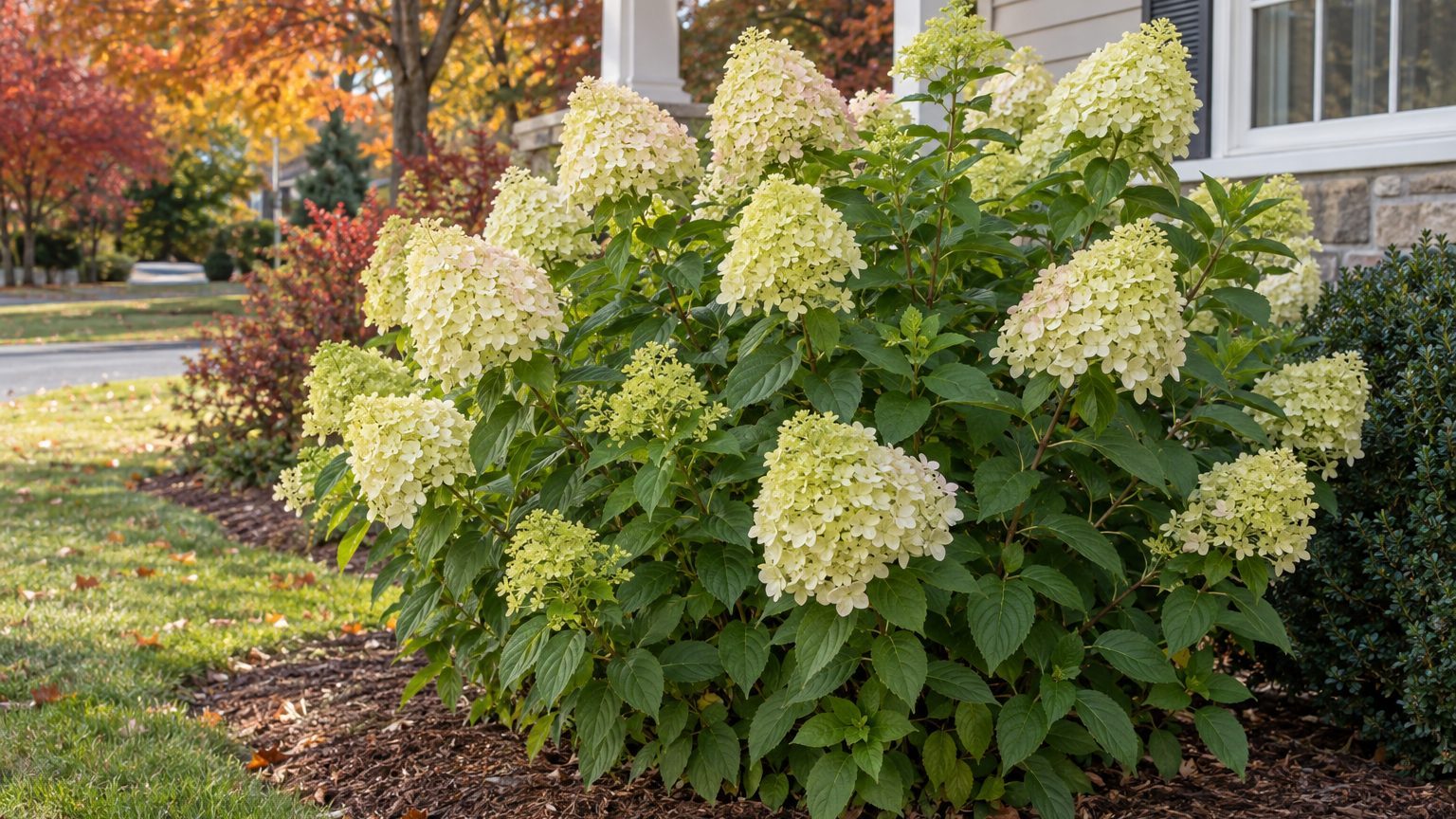
Limelight hydrangea (Hydrangea paniculata ‘Limelight’) grows in USDA zones 3 through 8, tolerating far more sun and cold than a bigleaf hydrangea. It blooms on new wood, opening lime green in midsummer and aging to pink by fall. A mature shrub reaches 6 to 8 feet tall and wide, needing one late-winter pruning cut a year rather than constant care.

What This Variety Is

Limelight is a panicle hydrangea, Hydrangea paniculata under the skin, and that parentage decides almost everything else about it. It blooms on new wood, so the flower buds it needs this summer are ones it has not grown yet.

Missouri Botanical Garden Plant Finder lists it for USDA zones 3 to 8, a range wide enough to cover a Duluth, Minnesota winter and an Atlanta, Georgia summer. Mature plants reach 6 to 8 feet tall and just as wide, built as a rounded shrub rather than a vine or a groundcover.

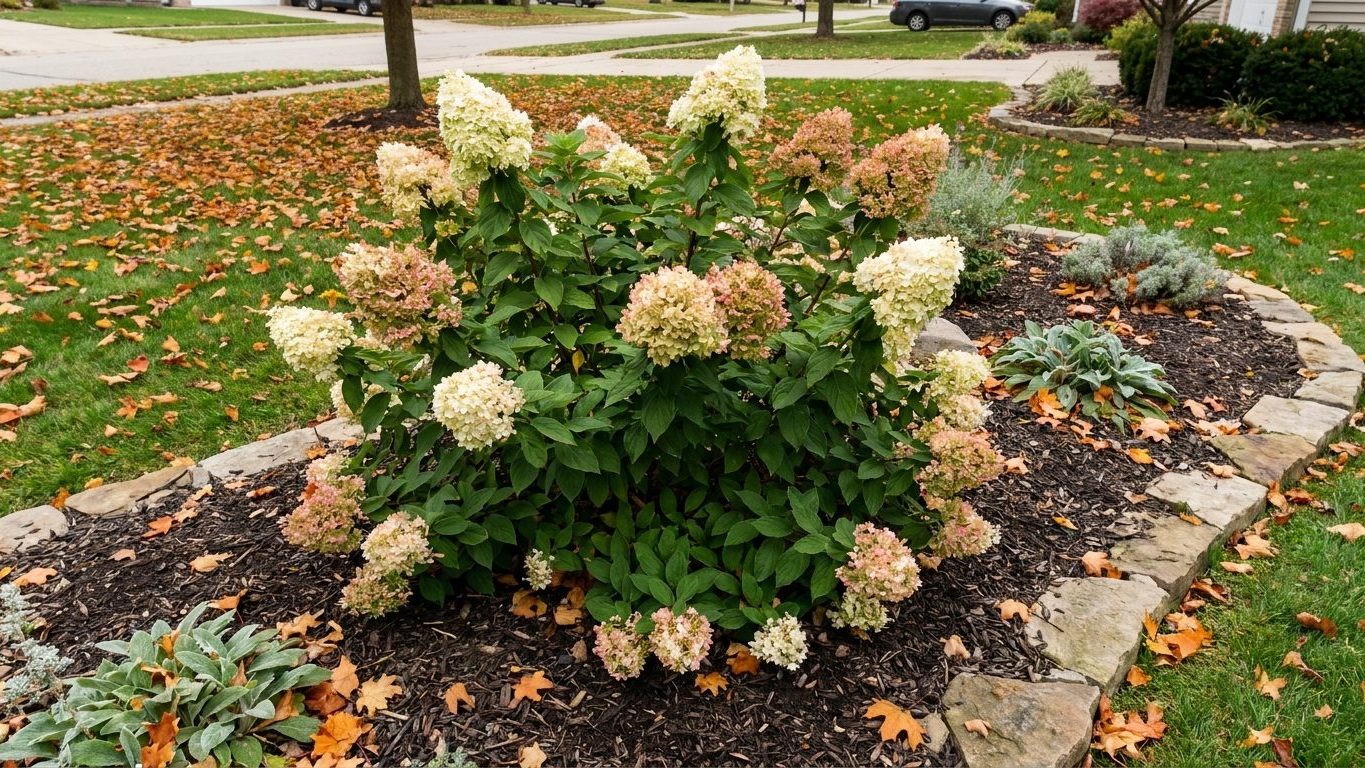
The flower heads open lime green in midsummer and age toward pink and tan by fall. It takes more direct sun than a bigleaf hydrangea without wilting for good, which is the trait that decides where it goes in a yard.

Where It Grows: Zones and Regions

Missouri Botanical Garden Plant Finder rates Limelight for USDA zones 3 to 8, and inside that band the plant behaves differently depending on how hot the summer runs.

  • Great Lakes and the North (Michigan, Minnesota, Wisconsin): winters here test the lower end of the range, and a Duluth planting often comes back from the roots even after a hard freeze kills the top growth.
  • Northeast and Mid-Atlantic (New York, Pennsylvania, Virginia): this sits in the middle of the zone range, where full sun all day rarely causes trouble and the shrub holds its shape without staking.
  • The Upper South (Tennessee, North Carolina, Kentucky): summers run hot enough that some afternoon shade keeps the flower heads from fading fast in July.
  • The Deep South (Georgia, South Carolina, Texas): near the top of the zone range, an Atlanta yard does better with morning sun and afternoon cover, since all-day heat stresses the roots.

Below zone 3 or above zone 8, the plant is pushing past the range the source gives, and results get unreliable in either direction. The state selector below leads to the page for where you live, with frost dates and the pruning window specific to your zone.

The Year With It, Season by Season

Spring

Limelight leafs out later than the smooth hydrangeas planted nearby, often waiting until the soil has warmed before pushing new stems. This is also the window for the one pruning cut it needs, since flower buds form on wood grown this same season.

Early summer

New shoots stretch fast once the weather turns warm, and by early summer the shrub has already set the buds that will open later. A skipped watering during a dry stretch here can shrink the flower heads that follow.

Midsummer bloom

Midsummer bloom — Limelight Hydrangea: Size, Zones, Pruning and Care

Flower heads open lime green from midsummer on, holding that color for weeks before pink tones creep in. Full sun through this stretch keeps the color saturated, while heavy shade leaves the panicles pale and floppy on their stems.

Late summer heat

In the hottest weeks, leaves on the sunniest side can wilt by afternoon even with damp soil, a normal response rather than a sign of disease. The plant usually perks back up by evening, and a deep watering every few days carries it through.

Fall color change

The blooms age from green to shades of pink and tan through fall, and many growers leave them on the shrub for the look alone. Cutting stops here, since new growth this late will not have time to harden off.

Winter dormancy

The shrub drops its leaves and goes fully dormant, with the dried flower heads often staying put through snow. Because next year’s flowers grow on wood made after dormancy breaks, winter damage to the tips rarely costs a season of bloom.

Diseases and Pests It Resists

Limelight carries a lighter pest and disease load than the bigleaf hydrangeas grown farther south, according to Missouri Botanical Garden Plant Finder, which lists no serious insect or disease problems for the species.

Occasional trouble shows up in wet years, mostly cosmetic rather than plant killing, and it rarely needs a spray program to stay healthy.

Threat This one Source
Serious insects None documented as serious —
Serious diseases None documented as serious —
Leaf spot Occasional, cosmetic —
Powdery mildew Occasional in humid, still air —

Bigleaf and oakleaf hydrangeas carry their own separate pest notes, and those live on their own pages rather than here.

Where to Plant It in a Yard

Give it a spot with room to spread to 6 to 8 feet across, since crowding it against a foundation or a walkway means constant pruning just to keep the path clear.

  • Your state page: the frost dates and the pruning window where you live.
  • Which hydrangea holds up here: a side-by-side look at how this variety compares with bigleaf and oakleaf types for your zone.
  • Pruning by month: the cutting calendar that keeps a new-wood bloomer like this one flowering on schedule.

Plant it where the state page for your area marks the pruning window, and the summer bloom takes care of itself.

Common questions

Does Limelight hydrangea need full sun?

It handles more sun than a bigleaf hydrangea, and in the northern part of its range full sun all day usually works fine. In the Deep South, morning sun with afternoon shade keeps the leaves from wilting during the hottest weeks.

Why is my Limelight hydrangea not blooming?

A healthy plant with no flowers usually points to a pruning cut made too late in the season, removing the new wood before it had time to set buds. Since it blooms on wood grown the same year, cutting in late winter rather than midsummer avoids the problem.

How tall does Limelight hydrangea get?

Mature plants reach roughly 6 to 8 feet tall and just as wide, which is worth planning for before it goes in the ground. A spot too close to a walkway or foundation means fighting its size every year instead of enjoying it.

When to Prune Hydrangeas in Michigan

When to Prune Hydrangeas in Michigan

In the Detroit area, hydrangeas go into the ground in spring or late summer, once the frost risk has passed or before fall’s frost returns. Plant from April through September, skipping the hottest stretch of midsummer, and prune bigleaf varieties only in June and July, after the buds reveal whether they survived winter. Get this timing wrong and you lose a season of blooms.

When to prune hydrangeas in Michigan: The Short Answer

When to Plant and Prune Hydrangeas in Michigan

The calendar below breaks the growing year into what actually needs doing, month by month, measured against the average frost dates for the Detroit area.

  • January: The shrub is dormant and the ground is frozen, so there is nothing to plant or cut. Use the month to plan which spot gets morning sun and afternoon shade.
  • February: Still too cold to plant, but nurseries start taking orders for spring stock. Check any burlap wrap from fall and refresh it if wind has torn it loose.
  • March: This is the first fertilize month on the Michigan calendar, applied once the soil has thawed enough to work. Hold off on pruning bigleaf types until their buds show green.
  • April: MSU Extension puts the last spring frost around April 30 in the Detroit area, with early to mid May typical farther north across the Lower Peninsula. Planting can start this month, but keep frost cloth ready for a cold night.
  • May: Both the second fertilize window and a plant month land here, once the frost risk has mostly passed. New shrubs settle in fastest with consistent watering through their first few weeks.
  • June: The pruning window for bigleaf hydrangeas opens, once flower buds make clear which wood survived winter. Cut only the dead stems, since live wood still holds this year’s blooms.
  • July: Pruning continues alongside the third fertilize application of the season. Water deeply during any dry stretch, since shallow watering encourages weak roots right when heat peaks.
  • August: A plant month returns as nighttime temperatures start easing. Container-grown shrubs planted now have roughly two months to establish before the ground cools.
  • September: The last plant month on the calendar, timed to give roots a head start before the ground turns cold. Avoid heavy pruning here, since it wastes energy the plant needs for winter.
  • October: The first fall frost lands somewhere between October 6 and October 21 in zone 6a. Mulch around the base once leaves drop, but wait until the ground has cooled to avoid trapping heat.
  • November: Wrap tender bigleaf varieties in burlap once temperatures settle below freezing overnight. Skip this step for panicle or smooth types, which shrug off Michigan winters without help.
  • December: The shrub is fully dormant and needs no attention beyond checking that snow load isn’t bending branches. Brush heavy snow off gently rather than shaking the whole shrub.

Nothing on this list replaces a close look at your own yard, since a sheltered south wall and an open field a mile apart can run two full weeks apart in spring.

How to Work Out the Dates for Your Own Yard

Finding your own dates starts with the same frost window everyone in the region uses, then adjusts for what sits around your specific yard.

  1. Start from the last spring frost: MSU Extension marks it around late April in the Detroit area, sliding into early to mid May farther north across the Lower Peninsula.
  2. Subtract two weeks for a head start on foliage, not flowers: planting a container-grown shrub two weeks before that date still works if you can cover it on a cold night, since it’s the roots settling in that matters most.
  3. Add two weeks after frost for anything grown from a smaller pot: a young shrub with a thin root system handles a late cold snap worse than an older one, so waiting the extra two weeks costs little.
  4. Check your zone against the state range: USDA Plant Hardiness Zone Map data place Michigan between zone 4a and zone 6b, and a shrub rated only for warmer zones struggles anywhere colder on that scale.
  5. Watch the fall frost window before the last plant month closes: with the first fall frost landing between October 6 and October 21 in zone 6a, a shrub planted in September has roughly a month to root before cold arrives.
  6. Pick the variety before the date, not after: a panicle hydrangea tolerates the full swing of a Michigan winter, while a bigleaf type planted late without enough time to establish often loses its buds to the first hard freeze.

None of this replaces watching your own soil, since a low spot that collects cold air can run a full week behind a slope thirty feet away.

Michigan North to South: How the Dates Shift

Michigan’s hydrangea dates don’t move the same amount everywhere, since the Great Lakes push and pull the growing season depending on which shore you’re near.

  • The Upper Peninsula: frost lingers longest here, pushing both the plant window and the bigleaf pruning window later than the rest of the state, and favoring panicle or smooth types over bigleaf.
  • The Lake Michigan shoreline: the lake holds warmth into fall and slows spring warming, which softens the frost swing and can let planting stretch a little later without much added risk.
  • Southeast Michigan, including the Detroit area: this is the reference point for the state’s frost dates, and it runs the mildest window of the three, with the widest cushion for both planting and pruning.

Whichever part of the state applies to you, the state guide lines up the actual weeks against your county rather than the statewide range.

Mistakes Michigan Punishes

Pruning bigleaf hydrangeas in fall

Cutting bigleaf stems back in September or October removes the buds already set for next year, since this variety blooms on old wood. The state calendar keeps pruning to June and July for exactly this reason. Let any fall cleanup wait until spring, once dead wood is obvious.

Planting after the September window closes

A shrub planted in October has barely a month before the first fall frost arrives, leaving roots too shallow to survive winter heaving. September is the last plant month on the calendar for this reason. Move any late-arriving nursery stock into a container for winter instead of rushing it into the ground.

Skipping winter wrap on bigleaf types

Leaving a bigleaf hydrangea bare through a Michigan winter kills the flower buds even when the plant itself survives, since those buds sit above ground and freeze exposed. Panicle and smooth varieties don’t need this step, but bigleaf types do. Wrap the crown in burlap once temperatures settle below freezing at night.

Michigan Extension Offices and County Contacts

The state figures here are a starting point, and the county office fills in what actually applies to your soil and your microclimate.

  • MSU Extension: the outreach directory connects to the county office nearest your address.
  • Your county extension office: staff there track local frost patterns and can confirm which side of the state’s zone range your yard falls on.
  • Michigan State University Plant & Pest Diagnostics: send a photo before the next plant month opens if a shrub shows something the calendar can’t explain.

Common questions

Can I plant hydrangeas in Michigan in fall?

Yes, within limits. August and September are both plant months on the state calendar, giving roots enough time to settle before the first fall frost arrives in October. Planting later than that leaves too little time for roots to establish before the ground cools.

Do hydrangeas survive Michigan winters without protection?

It depends on the type. Panicle and smooth hydrangeas handle the state’s USDA Plant Hardiness Zone range of 4a to 6b without help, while bigleaf varieties often need a burlap wrap to protect flower buds that sit exposed above ground.

When is it too late to prune a bigleaf hydrangea?

Once July ends. The calendar keeps bigleaf pruning to June and July specifically because the shrub sets next year’s buds on old wood soon after, and cutting later removes flowers before they even form.

Hydrangea Pests, Season by Season: How to Spot and Stop Them

Hydrangea Pests, Season by Season: How to Spot and Stop Them

Most hydrangeas fend off pests on their own. NC State Extension Gardener Plant Toolbox names only aphids, scales, nematodes, and mites for the whole genus, and calls all four rare. Deer are the real threat, browsing buds through fall and winter no matter the zone. What decides the outcome is which hydrangea you grow, since old-wood types lose a season to missing buds while new-wood types simply regrow.

Hydrangea Pests: The Short Answer

Hydrangea pest pressure stays low across the genus. NC State Extension Gardener Plant Toolbox names aphids, scales, nematodes, and mites as the pests to know, and calls all four rarely a problem in a genus that spans USDA zones 3a through 9b.

Deer are the one exception, browsing stems and dormant buds no matter the zone or the type. A single pass through a bigleaf hydrangea can strip the buds that would have opened as flowers.

What changes the real risk is which hydrangea you grow, since bigleaf and mountain types flower on last year’s wood while panicle types flower on new growth. Losing buds costs a bigleaf its whole season, but a panicle simply regrows and blooms regardless.

The state selector below this section opens the page built for your zip code. It carries local pest notes and the pruning calendar that apply where you live.

Hydrangea Pests, Step by Step

Hydrangea Pests, Season by Season: How to Spot and Stop Them

Pest and disease pressure moves through a hydrangea in a fairly fixed order across the growing year, from soft new leaves in spring to dormant wood in winter.

  1. Check new growth for aphids first: NC State Extension Gardener Plant Toolbox lists aphids among the four pests it names for the genus, and they cluster on the soft tips as new leaves unfold.
  2. Look under leaves for mites and scales next: both tend to show up once the canopy fills in, and the source calls both rarely a problem, so a light hand is enough.
  3. Watch for leaf spot and powdery mildew through humid stretches: both diseases appear on the source’s list for the genus and spread fastest when foliage stays wet overnight.
  4. Add rust and bud blight to the watch list on panicle types: the source names both as extra risks specific to H. paniculata, usually showing up later in the season as buds form.
  5. Check for nematodes if a plant wilts despite regular water: nematodes work in the soil and root zone, and the source lists them as rarely a problem but worth ruling out first.
  6. Fence or spray for deer once wood goes dormant: deer browse stems and buds through fall and winter, and a bigleaf or mountain hydrangea loses next year’s flowers when the buds it already set get eaten.

None of these six pests usually becomes a real infestation, and the source’s own summary calls maintenance for the genus low. The one step that changes a season’s outcome is the last one, since old-wood types cannot simply regrow what deer take over winter.

Hydrangea Pests by Hydrangea Type

Pest and disease exposure tracks the wood a hydrangea blooms on. Old-wood types carry their whole season’s flowers through winter as exposed buds, which is exactly what deer target.

New-wood types like panicle regrow after damage, but they pick up their own disease risks that old-wood types don’t share.

Kind Flowers on USDA zones Pest or disease note
Bigleaf / mop-head / lacecap Last year’s wood 6a-11b Only type documented toxic to pets in quantity
Panicle / peegee Current season’s growth 3a-8b Only type also listed with rust and bud blight
Smooth (Annabelle-type) New wood — Hardiest of the genus
Mountain Old wood — Buds tolerate late frost better than bigleaf
Climbing Old wood — Slow to start flowering, clings by aerial rootlets

Oakleaf hydrangea also flowers on old wood, but the source gives it no separate pest or disease note, so it stays on its own page rather than in this table.

Hydrangea Pests: Mistakes That Cost a Season

Pruning at the wrong time

Pruning at the wrong time — Hydrangea Pests, Season by Season: How to Spot and Stop Them

Bigleaf, mountain, oakleaf, and climbing hydrangeas set their buds the previous summer, so a late prune removes flowers before they open. Prune those types right after bloom, and save hard cuts for panicle and smooth types instead. The exact window belongs on the state page.

Trusting deer resistance

Trusting deer resistance — Hydrangea Pests, Season by Season: How to Spot and Stop Them

The source lists deer both as a damage agent and under resistance to challenges for the genus, which is a contradiction worth noting rather than trusting. Where deer actually browse, they eat hydrangea stems and buds regardless of that label, so fencing or repellent beats faith in the plant list.

Chasing blue with coffee grounds

Chasing blue with coffee grounds — Hydrangea Pests, Season by Season: How to Spot and Stop Them

Coffee grounds shift soil pH by a very small amount, which is why kitchen remedies disappoint. Flower color on bigleaf and mountain hydrangeas moves with available aluminum, and high-phosphorus fertilizer locks that aluminum up, pushing blue toward pink even when the acidity looks right.

Hydrangea Pests in Your State

The national list holds everywhere: aphids, scales, mites, nematodes, and deer. Timing and pressure both shift by zone and by which type is planted.

  • Your state page: the frost dates and the pruning window for the hydrangea type you grow.
  • Which type holds up here: your hardiness zone matched against bigleaf, panicle, smooth, oakleaf, mountain, or climbing needs.
  • Local extension office: the closest source for an outbreak that doesn’t show up on a national list.

Common Questions

Do hydrangeas attract pests that spread to other plants nearby?

The source lists only aphids, scales, nematodes, and mites for the genus, and calls all four rarely a problem, with no note of spreading to neighboring plants.

Are hydrangeas deer resistant?

The source itself is split, listing deer both as a resistance factor and as a damage agent. What’s actually observed is browsing, so plant as if deer will visit if they’re active locally.

Which hydrangea is toxic if a pet chews on it?

Only bigleaf hydrangea is documented toxic, and only in large quantities, through cyanogenic glycosides in the bark, flowers, leaves, and stems. It affects cats, dogs, and horses as well as people.

Mulching Hydrangeas: When, How Deep and What to Use

Mulching Hydrangeas: When, How Deep and What to Use

A 2 to 4 inch layer of shredded bark or chopped leaves, pulled back an inch from the stems, is the standard for every hydrangea type. When you lay it down shifts with your zone: cool-climate gardeners mulch in late fall to protect the root zone through winter, while warm-zone gardeners often mulch again in late spring to hold moisture through summer heat.

Mulching Hydrangeas: The Short Answer

NC State Extension Gardener Plant Toolbox lists the hydrangea genus across USDA zones 3a through 9b, but that range means little on its own. The right zone, and the right mulching window, depend entirely on which hydrangea you grow.

Bigleaf and panicle hydrangeas are both shallow-rooted, so a mulch layer protects the roots from heaving and drying out. The genus overall needs low maintenance once it’s established and mulched.

The state selector below this section carries the frost dates and mulching window for where you garden. Pick your state and skip straight to the numbers that apply to your yard.

Mulching Hydrangeas, Step by Step

Mulching Hydrangeas: When, How Deep and What to Use

Mulching a hydrangea is less about a single date and more about a sequence, six gestures done in order, whichever type you grow.

  1. Wait until the soil matches the season: mulch a cool-climate shrub once the first hard frost has stopped active growth, and mulch a warm-zone shrub as summer heat sets in, never onto frozen or bone-dry ground.
  2. Clear the base first: rake back old leaves and last year’s mulch to the drip line so the crown is visible, since bigleaf and panicle hydrangeas are both shallow-rooted and their surface roots sit close to whatever gets piled on top.
  3. Lay 2 to 4 inches, no more: a thicker layer holds too much moisture against shallow roots and invites the leaf spot and powdery mildew this genus is prone to.
  4. Keep an inch of bare soil at the stem: mulch touching the crown traps moisture against the bark and encourages bacterial wilt, so pull the layer back before walking away.
  5. Water once, deeply, after spreading: this settles the mulch and closes the air pockets that dry out shallow feeder roots faster than bare soil would.
  6. Check the layer again before the wood ripens: a hydrangea’s wood ripens through the season, it doesn’t harden off, and a layer washed thin by then won’t protect the root zone through whatever comes next.

None of this changes what goes under the mulch. Shredded bark, chopped leaves and pine straw all work; what matters is the depth and the gap at the stem, not the brand of material. Skip fresh wood chips that haven’t started breaking down, since they can tie up nitrogen right at the surface where the shallow roots are feeding.

Mulching Hydrangeas by Hydrangea Type

The table below only fills in where the type has both a zone range and a light preference on record. Two hydrangea types meet that bar, and they’re also the two gardeners mulch most differently across the year.

NC State Extension Gardener Plant Toolbox puts bigleaf at 6a to 11b, flowering on last year’s wood, so a hard freeze after bud set removes the blooms. Panicle spans 3a to 8b and flowers on the current season’s growth, so a hard late-winter cutback won’t cost a single bloom.

Kind Flowers on USDA zones Sun
Bigleaf (mop-head, lacecap) Last year’s wood 6a–11b Part shade, protect from afternoon sun
Panicle (peegee) Current season’s growth 3a–8b Full sun, the only one that takes it well

Smooth, oakleaf, mountain and climbing hydrangeas each mulch the same way, 2 to 4 inches, kept off the crown, but their pruning windows and cold tolerance differ enough that they’re covered on their own pages within the hydrangea guide rather than squeezed into this table.

Mulching Hydrangeas: Mistakes That Cost a Season

Mulch piled against the crown

Mulch piled against the crown — Mulching Hydrangeas: When, How Deep and What to Use

A thick cone of mulch against the stems holds moisture right where the bark meets the soil, and bacterial wilt, one of the diseases named for this genus, starts in exactly that kind of damp. Pull the layer back an inch from every stem, and check the diseases page if leaves wilt despite regular water.

Fresh wood chips spread too deep

Fresh wood chips spread too deep — Mulching Hydrangeas: When, How Deep and What to Use

Unaged chips piled past 4 inches tie up nitrogen at the surface and stay wet against bigleaf and panicle’s shallow roots, the same damp conditions behind leaf spot and powdery mildew. Keep the layer at 2 to 4 inches and let chips sit a season before spreading them fresh.

Treating every type on one calendar

Mulching a panicle and a bigleaf on the same date ignores that one flowers on new wood and the other on last year’s growth, so a schedule built for one costs blooms on the other. Check the pruning page for the window that actually matches what’s growing in the yard.

Mulching Hydrangeas in Your State

The national window here won’t tell you when to mulch in your own yard. Your state’s frost dates and the hydrangea types sold locally change both the timing and the depth, so the numbers live on the state page instead of here.

  • Your state page: the frost dates and the mulching window for where you live.
  • Which types hold up here: whether bigleaf survives your winters unprotected or needs the extra insulation mulch provides.
  • Your extension office: the local service that can confirm soil pH and disease pressure specific to your county.

Common questions

Does the mulch color change flower color?

No. Mulch dye has no effect on bloom color. Only bigleaf and mountain hydrangeas shift between blue, purple and pink, and that shift tracks soil pH and available aluminum, not what sits on top of the soil. Panicle, smooth, oakleaf and climbing hydrangeas keep their color regardless of pH.

Can I use grass clippings instead of bark mulch?

Fresh clippings mat down and can smother the shallow roots that bigleaf and panicle depend on, so a thin, dried layer works better than a thick, fresh one. Shredded bark or chopped leaves still make the more reliable choice around the crown.

Should I remove mulch in spring?

Pull back the old layer to check the crown for rot, then refresh it rather than stripping it away entirely. A hydrangea’s wood ripens through the season, and a bare root zone right as new growth starts leaves shallow roots exposed to swings in moisture.

When to Plant Hydrangeas in Texas: Dates and Varieties

When to Plant Hydrangeas in Texas: Dates and Varieties

Yes, hydrangeas grow in Texas, but the state’s frost dates swing by weeks from the Gulf Coast to the Panhandle, and that swing decides which kind blooms and when to cut it back. Houston’s growing season stretches from early February to mid-December. Farther north and west, the window shrinks fast. Match the dates and the species to your corner of the state, and hydrangeas hold up fine here.

Hydrangeas Care Calendar for Texas

Growing Hydrangeas in Texas: Dates and Varieties

Houston’s IAH station shows the last spring frost falling between February 4 and March 1, and the first fall frost between December 1 and December 19, per NOAA NCEI’s 1991-2020 Climate Normals. Texas spans USDA zones 6a to 10a, per the USDA Plant Hardiness Zone Map, and that decides which hydrangea survives where you live.

  • Dormancy: the safe window to dig up or move a plant, roots undisturbed, runs while the shrub sits bare between the December frost and the February thaw.
  • Planting: new shrubs go in during February and March, once the worst frost risk has cleared, or again in October and November as the fall heat finally breaks.
  • Fertilizing: feed in March, May, and July, matching the spring growth push and the two flushes that follow the summer heat.
  • Bud set: next spring’s flower buds form on this year’s wood through late summer, so nothing gets cut back carelessly come August or September.
  • Pruning bigleaf: trim spent blooms in June and July, right after flowering, and never in fall or winter.
  • Frost watch: once the first freeze lands, somewhere between December 1 and December 19, pile mulch at the base and let top growth die back on its own.
  • Recovery: a shrub that skipped its June cutback usually still leafs out fine the next spring, it just carries fewer blooms.

Miss one of these windows and the plant almost always survives, it just skips a year of flowers.

Best Hydrangeas for Texas

Texas’s 6a to 10a range, per the USDA Plant Hardiness Zone Map, covers everything from Panhandle winters to Gulf Coast humidity, so no single hydrangea works everywhere in the state. The kind that thrives in Houston’s shade can sulk in Amarillo, and the one that shrugs off a Panhandle freeze can scorch near the coast.

Four kinds cover most Texas yards. The rest, from climbing hydrangea to newer reblooming crosses, are rare enough here that they get their own page rather than a line in this table.

Kind Verdict here Why
Bigleaf (mophead/lacecap) Best on the Gulf Coast, iffy inland Wants steady moisture and part shade, struggles in West Texas heat and wind
Panicle Solid statewide pick Blooms on new wood, tolerates more sun and the harshest stretch of summer
Oakleaf Strong in East Texas woodland gardens Native to the Gulf South, handles part shade and humid summers well
Smooth (‘Annabelle’ type) Better toward North Texas and the Panhandle Cold-hardy but wilts fast in deep South Texas heat

Climbing hydrangea and the reblooming bigleaf types are the ones I get asked about most after these four, but they stay niche enough in Texas conditions to cover on a dedicated page.

When to Plant, Prune and Feed Hydrangeas in Texas

Three windows matter more than the rest of the calendar. Planting, feeding, and cutting back bigleaf wood each follow their own logic, tied to how fast the ground warms and how long the heat holds on.

The planting and pruning months come from the state’s own calendar. The frost dates anchoring them are NOAA NCEI’s 1991-2020 Climate Normals for Houston’s IAH station, the last freeze falling between February 4 and March 1.

Task Window here Counted from
Planting February, March, then October, November Starts once the last frost clears, Feb 4 to March 1, and again before the first frost, Dec 1 to 19
Fertilizing March, May, July Set to the spring growth flush and the two heat-season pushes that follow
Pruning bigleaf June, July Right after the spring bloom fades, before next year’s buds start forming

Panicle and smooth hydrangeas skip the bigleaf pruning rule since they flower on new wood. That timing lives on the state’s month by month calendar page rather than here.

Hydrangeas Problems in Texas and What Causes Them

No blossoms the spring after planting

This usually traces back to pruning at the wrong end of the calendar. Cut bigleaf wood outside the June and July window and the shrub sacrifices next year’s buds. Stick to that window and skip any fall cutback.
Leaves crisped on the hottest exposure

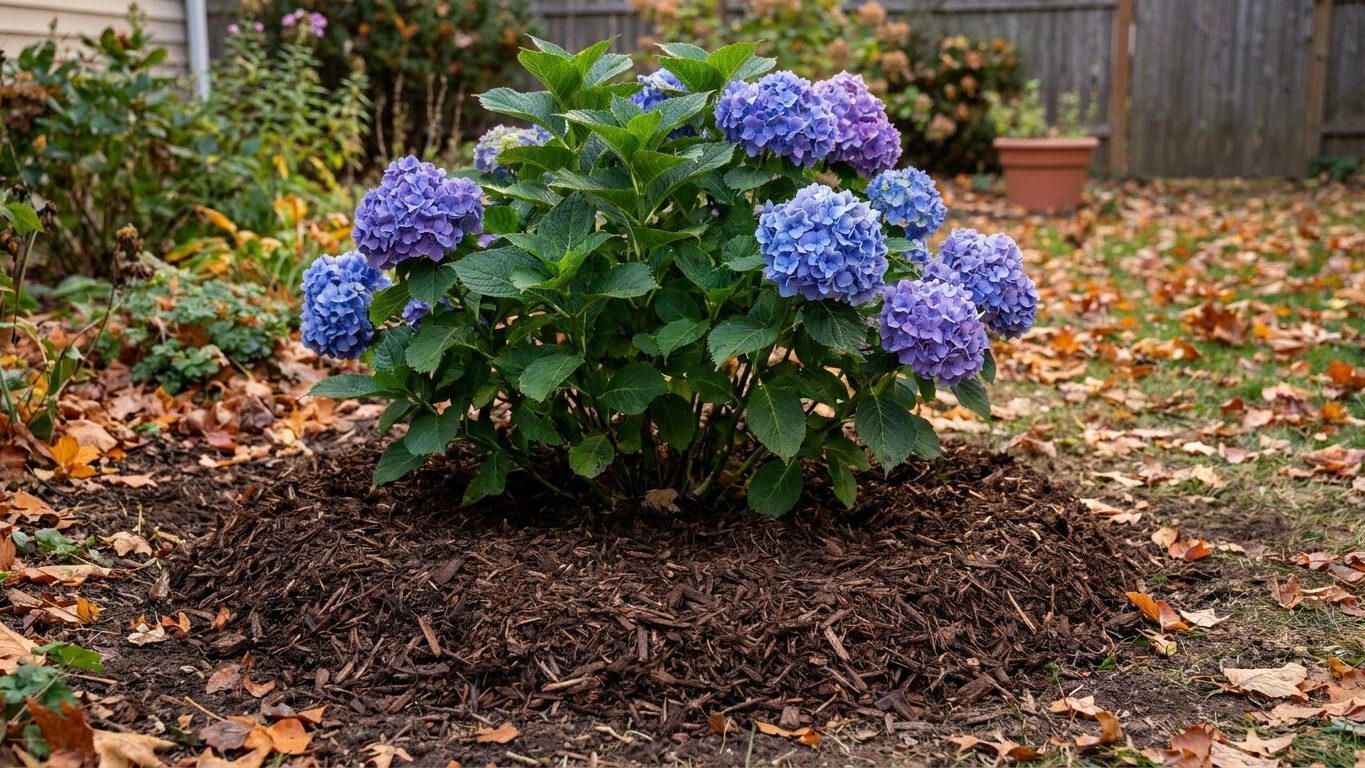
Full sun through a Gulf Coast summer stresses bigleaf hydrangea past what part shade allows. Move it east-facing or under high canopy, and water deep rather than often once the heat settles in for good.

Bud dieback far from the Gulf

Away from Houston’s mild end of the state’s 6a to 10a range, a late cold snap after buds swell kills the flower show even though the shrub itself survives. Mulch heavy through the last stretch before the local last frost date.

Texas North to South: How the Dates Shift

Houston’s last freeze, February 4 to March 1, sits at the mild end of the state’s spread, per NOAA NCEI’s Climate Normals for the IAH station, and every other region shifts from there.

  • Gulf Coast (Houston, Corpus Christi, Beaumont): the mildest end of the range, frost arrives latest and leaves earliest, favoring shadier, wetter conditions bigleaf hydrangea prefers.
  • East Texas Piney Woods (Lufkin, Tyler, Nacogdoches): close to Houston’s timing but with more filtered light under pine canopy, suiting oakleaf and bigleaf both.
  • Hill Country and Central Texas (Austin, San Antonio): mid-range on the state’s zone spread, with harsher sun and thinner, more alkaline soil pushing gardeners toward panicle.
  • North Texas (Dallas-Fort Worth): frost comes weeks earlier and lingers weeks later than on the coast, shortening the safe planting windows on both ends.
  • Panhandle and West Texas (Amarillo, Lubbock): the coldest corner of the state’s 6a to 10a range, where smooth hydrangea’s cold tolerance matters more than any other trait.

Whatever corner of Texas this is, the state’s own calendar page lines up the exact months for that spot.

Texas Extension Offices and County Contacts

The 6a to 10a range and the Houston frost dates above are a starting point, not a substitute for what’s happening on one specific block. A county extension office, or Texas A&M AgriLife Extension Service, can confirm what holds true where a particular yard sits.

  • Your state page: the frost dates and the pruning window laid out above, in one place.
  • Which ones hold up here: a longer look at bigleaf, panicle, oakleaf, and smooth side by side.
  • What goes wrong here: the pests and diseases that show up on Texas hydrangeas specifically, beyond the climate issues covered above.

This month, the move is simple: check the calendar table above and match the next task to whichever window is open right now.

Common questions

Can hydrangeas survive Texas summers?
Yes, especially panicle and oakleaf types. Bigleaf hydrangea needs part shade and consistent water once Houston-area heat settles in past the spring bloom.

What month should I prune hydrangeas in Texas?
For bigleaf, June and July, right after the flowers fade. Panicle and smooth types tolerate a late-winter cut instead, since they bloom on new wood.

Do hydrangeas need acidic soil in Texas?
Bigleaf hydrangea’s bloom color shifts with soil pH, and many Texas soils run more alkaline than the Southeast, which is part of why blue blooms are harder to hold onto here.

When to Fertilize Hydrangeas, and What to Use

When to Fertilize Hydrangeas, and What to Use

Fertilizing hydrangeas means feeding as new growth starts each spring and easing off well before the plant needs to slow down for the year. The right window shifts by hardiness zone and by which hydrangea you grow, since bigleaf types set next year’s blooms on old wood while panicle types flower on new growth entirely. Type decides more than the calendar does.

Fertilizing Hydrangeas: The Short Answer

NC State Extension Gardener Plant Toolbox puts the genus at USDA zones 3a through 9b, but that depends entirely on the type. Bigleaf hydrangeas run 6a to 11b, while panicle types stretch from 3a to 8b, so the same calendar month reads differently in each zone.

The general rule feeds new growth in spring and stops before the plant sets next year’s flower buds. Bigleaf hydrangeas bloom on last year’s wood and get pruned before August 1, so a late feeding pushes soft growth right when the plant needs to stop.

Panicle hydrangeas flower on the current season’s growth instead, so they tolerate a longer feeding window and a hard cutback in late winter. The type you grow decides more than the calendar does.

The table below, one state per box with its months and its zone, gives the fertilizing window where you live.

Fertilizing Hydrangeas, Step by Step

When to Fertilize Hydrangeas, and What to Use

Feeding a hydrangea well means acting in this order, from the first flush of new growth to the last mulch of the season.

  1. Identify the bloom wood: bigleaf and mountain hydrangeas set flower buds on last year’s wood, while panicle and smooth types bloom on the current season’s growth, and that difference decides how much room there is to push new growth with a feeding.
  2. Feed as new leaves emerge: this is when a medium to rapid grower like macrophylla or paniculata actually uses the nitrogen, instead of it sitting unused in cold soil.
  3. Match the fertilizer to the color, on bigleaf and mountain only: NC State Extension Gardener Plant Toolbox puts blue at below about pH 5.5, and pink above about pH 6.5, with purple in between.
  4. Skip high-phosphorus formulas on a blue hydrangea: phosphorus locks up the aluminum the plant needs for blue color, which pushes flowers toward pink even when the soil pH hasn’t moved at all.
  5. Mulch right after feeding: both macrophylla and paniculata are shallow-rooted, so a mulch layer holds moisture and nutrients near the roots instead of letting them wash past.
  6. Stop before the prune date for your type: bigleaf hydrangeas get pruned before August 1 since next year’s buds are already forming, while panicle types tolerate feeding later since they get cut back hard in late winter.

Coffee grounds and citrus peel are a widely held belief for turning flowers blue, but the pH shift they cause is too small to matter much. What actually moves the color is available aluminum in the soil, and a proper amendment reaches it far more reliably.

Fertilizing Hydrangeas by Hydrangea Type

NC State Extension Gardener Plant Toolbox lists bigleaf hydrangea at USDA zones 6a to 11b, blooming on last year’s wood, while panicle hydrangea covers zones 3a to 8b on the current season’s growth.

Color follows the same split. Bigleaf and mountain hydrangeas shift between blue and pink with soil pH, while panicle, smooth, oakleaf and climbing types stay white, cream, pink or green as the season ages, regardless of what’s in the soil.

Kind Flowers on USDA zones Sun
Bigleaf Last year’s wood 6a–11b Part to deep shade
Panicle Current season’s growth 3a–8b Full sun

Smooth, oakleaf, mountain and climbing hydrangeas are on their own pages, since the source gives each only one of these figures rather than the full set shown here.

Fertilizing Hydrangeas: Mistakes That Cost a Season

No flowers on an otherwise healthy bigleaf

No flowers on an otherwise healthy bigleaf — When to Fertilize Hydrangeas, and What to Use

Bigleaf hydrangeas form next year’s flower buds the previous summer, so a spring prune or a late frost removes them before they ever open. The fix is timing any cut before August 1 and checking which type is actually planted, since panicle hydrangeas forgive that same cut.

A blue hydrangea turning pink for no reason

High-phosphorus fertilizer, the kind sold for roses and blooms, locks up the aluminum a bigleaf or mountain hydrangea needs for blue color, pushing flowers toward pink even if the soil pH hasn’t changed at all. Checking the fertilizer label solves what looks like a soil problem.

Acidifying soil under a panicle hydrangea

Panicle, smooth, oakleaf and climbing hydrangeas don’t change color with soil pH, so aluminum sulfate or a pile of coffee grounds does nothing but shift soil chemistry for no reason. Save the color amendments for bigleaf and mountain hydrangeas, the only two that respond to them.

Fertilizing Hydrangeas in Your State

The national rule doesn’t hand out a date, since bigleaf and panicle hydrangeas span several hardiness zones between them, and the frost that ends one state’s growing season hasn’t touched the ground yet in another. Your state page fills in the exact window.

  • Your state page: the frost dates and the pruning window where you live.
  • Which type grows there: whether your zone supports bigleaf, panicle, or both at once.
  • Your local extension office: a soil test and a fertilizer recommendation matched to your actual soil, not the national average.

Common Questions

Can I use the same fertilizer on every hydrangea in my yard?

Only if flower color doesn’t matter to you. Color-neutral fertilizers work fine on panicle, smooth, oakleaf and climbing hydrangeas, but bigleaf and mountain hydrangeas need the color effect factored in, since phosphorus locks up the aluminum that keeps flowers blue.

Do coffee grounds actually turn hydrangeas blue?

Barely. NC State Extension Gardener Plant Toolbox notes that coffee grounds and citrus peel can acidify soil enough to shift color, but the effect is small next to a proper aluminum sulfate application, and what the plant needs most is available aluminum, not just a lower pH number.

Is it safe to fertilize hydrangeas if I have pets in the yard?

The fertilizer itself isn’t the pet risk, the plant is. Only bigleaf hydrangea is documented toxic, and only if large quantities are eaten, causing nausea, stomach pain and vomiting in pets and people alike. Fertilizer labels carry their own separate pet warnings worth reading too.

The almanac, state by state. Every date on this site comes from a state’s own frost facts and its extension service’s calendar — and says where it comes from.