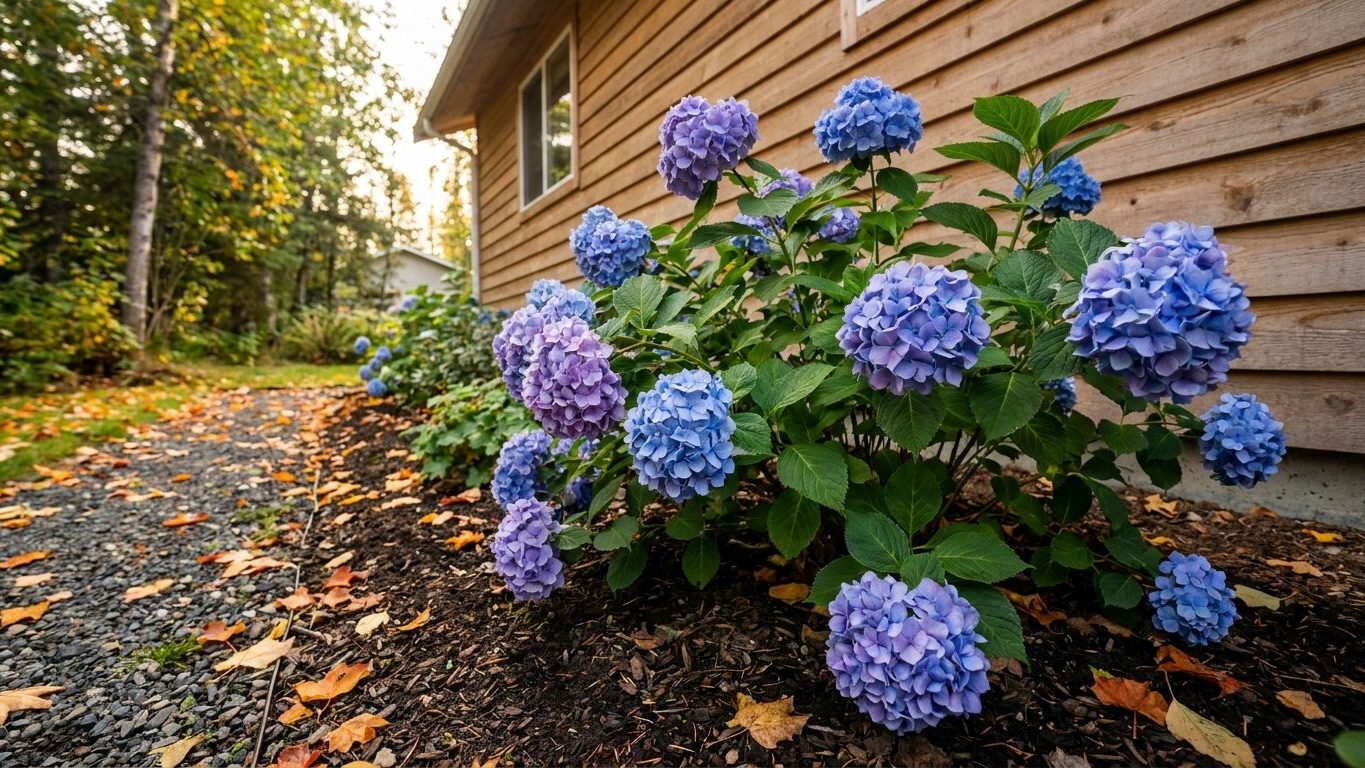
In Anchorage, the safest hydrangea planting window runs May through August, after the last spring frost (May 3 to May 12) has passed and before the first fall frost arrives between September 22 and October 1. Bigleaf varieties get pruned only in June and July, once new growth shows which stems survived winter.
When to prune hydrangeas in Alaska: The Short Answer
NOAA NCEI 1991-2020 Climate Normals put Anchorage’s last spring frost at May 3 to May 12 and its first fall frost at September 22 to October 1, a spread that anchors the plant window at May through August and narrows bigleaf pruning to June and July.
- January: the ground is locked and no hydrangea goes into it. Use the quiet weeks to order bare-root stock for spring.
- February: still solid dormancy across Southcentral Alaska. Check any stored pots in an unheated garage for dried-out roots.
- March: soil stays frozen well past the calendar’s start of spring. Begin hardening off any greenhouse-grown starts near a bright window.
- April: thaw is uneven and the last frost is still weeks away. Dig and amend planting holes as soon as a spot drains freely.
- May: the plant window opens, and the last frost, May 3 to May 12, should be behind you before roots go in. This is also the first of two fertilizing months.
- June: planting continues, and bigleaf pruning opens for the first time this year. Cut only stems that show no green under the bark.
- July: the second fertilizing month and the last month for bigleaf pruning. Feed once and finish any shaping before growth hardens off.
- August: the plant window closes at month’s end. Anything set in the ground now needs the rest of summer to root before cold returns.
- September: the first fall frost lands somewhere between September 22 and October 1. Stop pruning and start mulching exposed crowns.
- October: frost has typically already arrived by now. Pile mulch deeper over the root zone and stop watering once the ground stiffens.
- November: full dormancy returns to Southcentral Alaska. Wrap marginal shrubs in burlap if wind exposure is a problem.
- December: snow cover, where it falls consistently, becomes the best insulation a hydrangea root ball can get. Leave it in place.
Every one of these months moves later the farther north or inland you garden, since Anchorage sits at the mild end of a state that runs from USDA zone 1a to 8a. The four months on the plant list are not a suggestion, they are what the short season allows.
Alaska — the year and the numbers
- State
- Alaska
- USDA zones
- 1a-8a
- Last spring frost
- May 3 to May 12
- First fall frost
- September 22 to October 1
- Annual rain
- 16 in
- Lawn zone
- cool-season
- Source
- NOAA NCEI 1991-2020 Climate Normals, 32F freeze probabilities · Anchorage
How to Work Out the Dates for Your Own Yard
Working out your own dates starts with the same station data behind the state numbers, then adjusts for what’s actually happening in your yard.
- Start from the frost range: NOAA NCEI 1991-2020 Climate Normals set Anchorage’s last spring frost at May 3 to May 12, so treat mid-May as the earliest safe date rather than a fixed line.
- Match it to the plant window: the four-month stretch from May through August is when soil and air both stay warm enough for roots to establish, so any of those months works once frost has cleared.
- Reserve the pruning weeks: bigleaf hydrangeas only get cut back in June and July, since cutting outside that stretch removes the buds already set for next year’s bloom.
- Count backward from fall frost: with the first fall frost due September 22 to October 1, late August becomes the practical cutoff for new plantings, giving roots a few weeks to settle before cold returns.
- Adjust for elevation and distance from the coast: gardens outside the Anchorage bowl, especially inland or at higher elevation, should shift every one of these windows earlier in fall and later in spring.
None of this replaces watching your own ground. A warm microclimate against a south-facing wall can beat these dates by a week or two, while a low frost pocket in the same yard can lag well behind them.
Alaska North to South: How the Dates Shift
Alaska’s frost dates and hardiness range shift hard across the state, and Anchorage’s numbers describe only the mild middle of that spread.
- Southcentral coastal (Anchorage, Kenai Peninsula, Mat-Su Valley): closest to the reference dates, with marine air keeping both frost dates milder than inland spots at the same latitude.
- The Interior (Fairbanks, Denali area): frost arrives weeks earlier in fall and lingers later in spring, cutting the already short plant window down further.
- Southeast (Juneau, Sitka, Ketchikan): a wetter, more marine climate keeps winters milder than the Interior, sitting toward the warmer end of the state’s hardiness range.
- The North (North Slope, Utqiagvik): growing seasons run so short that the plant and prune windows described here don’t reliably apply at all.
The state guide lays out how far these regional swings move the calendar for where you actually garden.
Mistakes Alaska Punishes
Planted before the ground actually thaws
Southcentral soil often looks bare weeks before it’s workable, and roots set into cold, wet ground rot instead of establishing. Wait until the last frost, May 3 to May 12, has passed and stick to the May through August plant window.
Bigleaf pruned outside June and July

Cutting bigleaf stems in spring or fall removes the buds already formed for next year, since this species blooms on old wood. Save the pruners for the June and July window and skip any other month entirely.
Containers left outside all winter
A pot’s root ball freezes solid far faster than the same roots would in open ground, and Alaska’s winter minimums are severe enough to kill it outright. Move containers into an unheated garage or sink the pot into a garden bed before the first fall frost.
Alaska Extension Offices and County Contacts
Anchorage’s dates are a starting point, not a guarantee for every yard in the state. UAF Cooperative Extension Service agents adjust for your borough’s soil, wind exposure, and microclimate.
- Your state page: the frost dates and the pruning window for where you live in Alaska.
- Which ones hold up here: the hydrangea varieties worth planting in this climate, and which ones to skip.
- What’s going wrong: the pests and problems this state’s growers actually report, and what fixes them.
Common questions
Can hydrangeas survive winter outdoors in Alaska?
In sheltered Southcentral yards, some do, particularly where snow builds up and stays over the root zone all winter. Farther inland or north, winters cut too far into the state’s hardiness range for most varieties to make it through unprotected.
What month should I fertilize hydrangeas in Alaska?
May and July are the two feeding months that fit Alaska’s short growing season, giving roots a boost right after planting and again mid-summer before growth slows for fall.
Why didn’t my bigleaf hydrangea bloom this year?
Pruning outside the June and July window is the most common cause, since bigleaf sets its buds on the previous year’s stems and cutting at the wrong time removes them before they ever open.