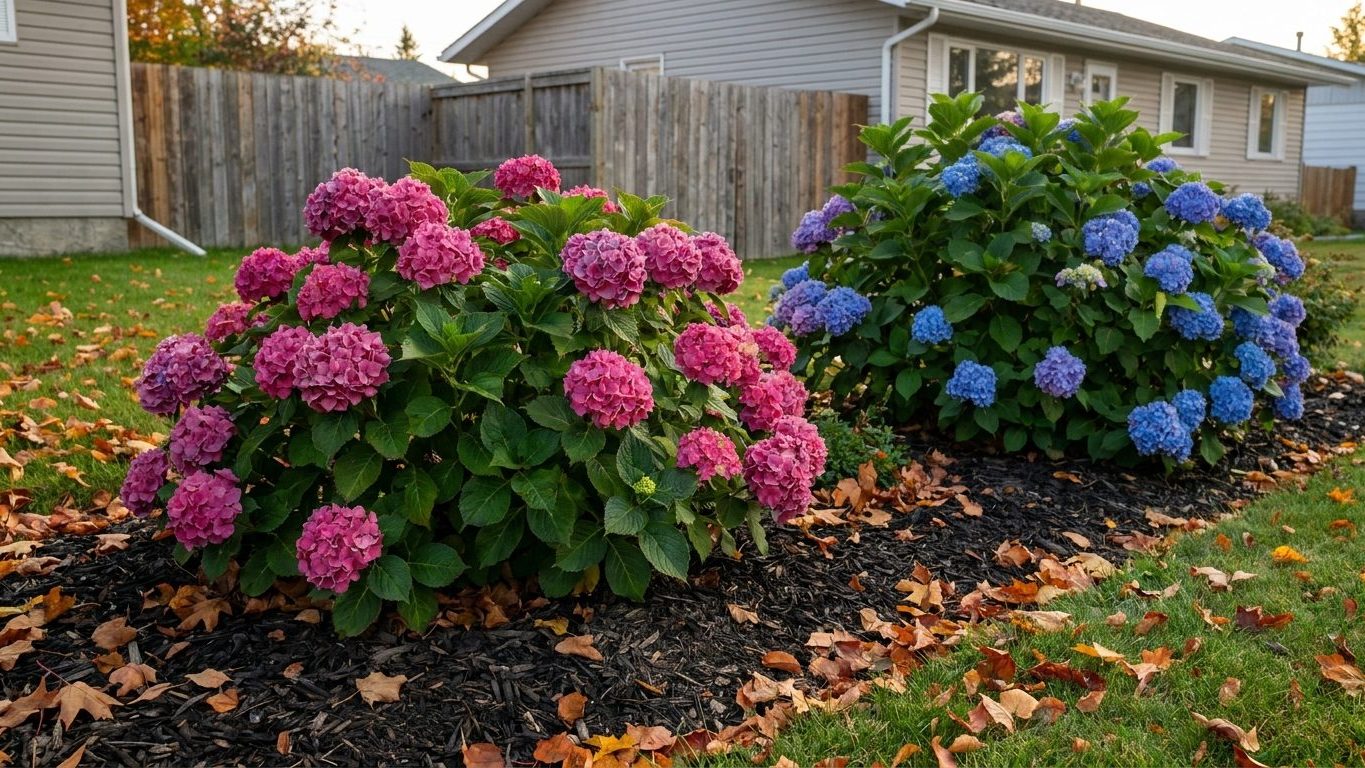
In Yellowknife, the safest stretch to set new hydrangeas in the ground runs from June through July, well after the mean May 25 spring frost has passed and with enough weeks left before the season turns. Pruning bigleaf types waits until that same June or July window, once live wood is obvious against whatever winter took.
When to prune hydrangeas in Northwest Territories: The Short Answer
Yellowknife’s climate sits in Canadian hardiness zone 1b according to Natural Resources Canada’s Plant Hardiness Site, and every hydrangea task below answers to that cold rather than to a calendar built for an easier corner of the country.
- January: The ground stays locked and plants rest fully dormant under snow cover. Skip any pruning or feeding, since nothing above ground needs attention yet.
- February: Cold holds steady well below any planting range. Check that mulch or snow still covers the crown, and leave the plant alone otherwise.
- March: Frost still grips the soil weeks ahead of the mean spring thaw. Use the month to order stock rather than dig, since the ground won’t cooperate yet.
- April: Soil starts to soften as the mean frost date approaches, but a hard freeze can still return. Prep beds and amend soil, holding off on actual planting.
- May: Environment and Climate Change Canada’s Canadian Climate Normals put the mean spring frost at May 25 for the Yellowknife A station, and the plant window opens this month. Wait for the back half of May before setting root balls in the ground.
- June: The plant window continues, and this is also when pruning bigleaf hydrangeas becomes safe. Cut only what shows clear winter damage, since live buds still carry this year’s bloom.
- July: Both planting and a fertilize pass line up this month. Feed once now, and finish any remaining bigleaf pruning before growth hardens off for the season.
- August: The plant window closes at month’s end, so a new hydrangea needs enough weeks left to root before cold returns. Stop fertilizing to avoid pushing soft growth into fall.
- September: The mean first fall frost lands September 18, a date that arrives faster here than in most of the country. Mulch heavily and wrap exposed crowns before that week.
- October: Dormancy sets in fast, and snow cover often becomes the best insulation available. Leave winter protection in place and resist the urge to open it back up.
- November: Deep cold settles in for good, with no planting, pruning, or feeding task left to do. Confirm mulch hasn’t blown clear and move on.
- December: Full dormancy holds through the darkest month, with snowpack doing the protective work. Wait for the calendar to turn back toward spring before touching anything.
That May 25 figure is a mean, not a guarantee, so treat late May as the earliest safe start rather than a fixed date on the wall.
Northwest Territories — the year and the numbers
- State
- Northwest Territories
- Hardiness zones
- 1b
- Last spring frost
- May 25
- First fall frost
- September 18
- Annual rain
- 11 in
- Lawn zone
- cool-season
- Source
- Environment and Climate Change Canada — Canadian Climate Normals 1981-2010, station YELLOWKNIFE A · Yellowknife
How to Work Out the Dates for Your Own Yard
Your own yard rarely matches the Yellowknife A weather station exactly, so the territory’s mean dates are a starting point you adjust, not a schedule you copy.
- Start from the mean frost dates: Environment and Climate Change Canada’s Canadian Climate Normals place the mean spring frost at May 25 and the mean fall frost at September 18 for Yellowknife A, and both mark the middle of a spread, not a hard line.
- Match your site to the plant window: Keep new plantings inside May, June, July, and August, the four months the territory’s calendar times as safe, leaning toward the back half if your yard sits low or shaded.
- Watch the ground, not the date: Wait for soil that gives easily under a shovel, since frozen subsoil can persist well past the mean thaw in a zone 1b climate.
- Time bigleaf pruning to new growth: Hold pruning cuts for June or July, when live wood is obvious, rather than guessing in spring before buds show.
- Build in a frost buffer for exposed spots: Open clearings and low ground cool faster than the Yellowknife A station records, so treat September 18 as a deadline to finish work, not a date to work up to.
None of this replaces a look at your own thermometer. The territory-wide numbers describe Yellowknife, and a site a few miles off can run a full week either side of them.
Northwest Territories North to South: How the Dates Shift
Northwest Territories covers a stretch of latitude wide enough that the Yellowknife A numbers describe only the North Slave basin around the capital.
- North Slave and Great Slave Lake (Yellowknife, Behchoko, Dettah): the lake itself moderates the worst cold, and this stays the mildest hydrangea window in the territory.
- Dehcho and the southern river valleys (Fort Simpson, Fort Providence, Fort Liard): river country runs a touch milder again, though the same short season still applies.
- Sahtu and the central Mackenzie Valley (Norman Wells, Tulita, Fort Good Hope): expect the frost season to close in earlier and reopen later than the Yellowknife mean suggests.
- Beaufort Delta and the Arctic coast (Inuvik, Tuktoyaktuk, Sachs Harbour): the highest latitude and the closest ocean exposure push hydrangea culture to its practical limit.
The territory-wide page carries the Yellowknife A reference dates, and a community far from that station should plan on its own window running later, not earlier.
Mistakes Northwest Territories Punishes
Planting Before the Ground Actually Thaws
Calendar pages tempt an early start, but frozen subsoil can outlast the May 25 mean well into June some years. Wait for soil that crumbles under a trowel, and hold new stock in a sheltered spot until then.
Pruning Bigleaf Outside June or July

Cutting back in fall or early spring removes buds that already carry next year’s bloom on bigleaf types. Keep cuts inside June or July, once live wood is obvious against winter damage.
Skipping Mulch Before the September Frost
Treating a zone 1b yard like a milder province skips the one step that matters most here. Pile mulch and wrap crowns before the September 18 mean fall frost, not after the first hard freeze arrives.
Northwest Territories Extension Offices and County Contacts
The Yellowknife A figures are a territory-wide starting point, and the rest of the answer sits with local offices and the territorial agriculture program.
- Your territory page: the frost dates and the pruning window for the reference station, in one place.
- Which ones hold up here: the hydrangea types worth trying against a Canadian zone 1b winter.
- Northwest Territories agriculture services: the territorial program at iti.gov.nt.ca for local advice before you plant.
Common questions
Can hydrangeas survive winter in Northwest Territories without protection?
Most types struggle unprotected in Canadian zone 1b. Mulch and crown protection before the mean September 18 fall frost make the difference between a plant that returns and one that doesn’t.
Is late May too early to plant hydrangeas in Yellowknife?
The mean spring frost lands May 25, and that’s a midpoint, not a safe cutoff. Waiting into the back half of the plant window, June rather than early May, gives more room for a late frost.
Why does the pruning window fall in June and July here?
By June, live wood is easy to tell from winter-killed growth, and cuts made then don’t remove next year’s buds. Pruning earlier, before growth resumes, risks cutting into wood that was only dormant.