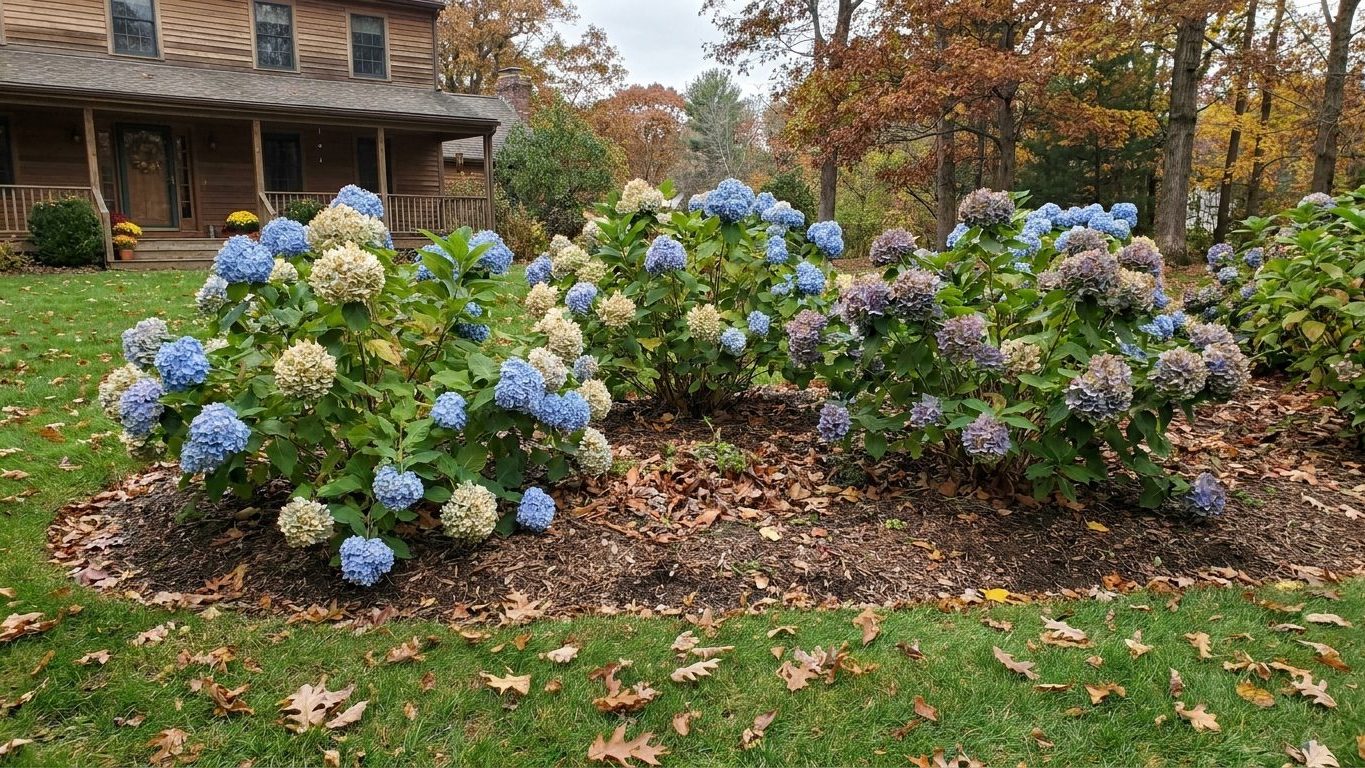
Hydrangeas grow well across most of Rhode Island, where a Zone 6a to 7b climate and a frost-free stretch of roughly six months give bigleaf, panicle, smooth and oakleaf types enough season to root, bloom and harden off before winter. Coastal towns run milder than inland valleys, and both planting and pruning windows trace back to the same two dates: last spring frost and first fall frost.
Hydrangeas Care Calendar for Rhode Island

In Providence, NOAA NCEI’s 1991-2020 Climate Normals put the last spring frost between April 7 and April 17 and the first fall frost between October 24 and November 3. The USDA Plant Hardiness Zone Map places the state at Zone 6a to 7b, mild enough for most common hydrangea types.
- Dormancy: from late fall through late winter is the one stretch to dig, split or move a hydrangea without disturbing its roots.
- Planting: set new shrubs in the ground two to three weeks after the last spring frost, once the soil has warmed and drained.
- Bud break: new leaves push out through April, the signal that the plant has cleared winter dormancy.
- First feeding: a light dose of fertilizer goes down as soon as leaves unfurl, not before.
- Summer bloom and water: from June through August, a deep soak once a week keeps flower heads from wilting in the heat.
- Pruning: timing depends on the type, right after bloom fade for old-wood bloomers, late winter for new-wood ones.
- Frost prep: once the first fall frost lands, ease off watering and mulch the base to protect next year’s buds.
Coastal towns run a week or two milder than these Providence dates, inland valleys colder, so treat this ribbon as the state’s middle ground and check your own county before committing a shrub to the ground.
Rhode Island — the year and the numbers
- State
- Rhode Island
- USDA zones
- 6a-7b
- Last spring frost
- April 7 to April 17
- First fall frost
- October 24 to November 3
- Annual rain
- 48 in
- Lawn zone
- cool-season
- Source
- NOAA NCEI U.S. Climate Normals 1991-2020, 32F freeze probabilities · Providence
Best Hydrangeas for Rhode Island
Not every hydrangea shrugs off a Rhode Island winter the same way. The split that matters most is where next year’s flowers form, on last year’s stems or on wood the plant grows fresh each spring.
The state’s Zone 6a to 7b range, drawn from the USDA Plant Hardiness Zone Map, means winter lows can dip cold enough to kill old wood in an average year, especially away from the coast. That single fact decides which types bloom reliably here.
| Kind | Flowers on | Verdict here | Why |
|---|---|---|---|
| Panicle (H. paniculata) | New wood | Best bet statewide | Blooms even after a hard prune, tolerant of the full 6a to 7b range |
| Smooth (H. arborescens) | New wood | Solid statewide choice | Dies back in cold winters but rebuilds and flowers the same year |
| Bigleaf (H. macrophylla) | Mostly old wood | Reliable near the coast, risky inland | Old wood buds can be killed by an inland cold snap |
| Oakleaf (H. quercifolia) | Mostly old wood | Fine in the milder 7b pockets | Stems and buds can suffer dieback in harder winters |
Climbing hydrangea can work too on a sheltered, warm wall, the other kinds are on their own pages with the fuller picture on which cultivars perform best.
When to Plant, Prune and Feed Hydrangeas in Rhode Island
Three dates decide the hydrangea year in Rhode Island, and all three trace back to the same frost window NOAA NCEI’s 1991-2020 Climate Normals report for Providence, April 7 to April 17 in spring and October 24 to November 3 in fall.
Old-wood bloomers like most bigleaf and oakleaf types skip the spring pruning window entirely, since a spring cut removes the very buds set to flower that summer.
| Task | Window here | Counted from |
|---|---|---|
| Planting | Late April into early May | Two to three weeks after last spring frost |
| Feeding | Early to mid May | Three to four weeks after last spring frost, once leaves unfurl |
| Pruning new-wood types | Late February into March | Four to six weeks before last spring frost |
| Fall mulch and winter prep | Mid to late October | One to two weeks before first fall frost |
The month-by-month version of this same ribbon, with deadheading and mulch depth included, lives on Rhode Island’s hydrangea calendar page.
Hydrangeas Problems in Rhode Island and What Causes Them
No flowers on an otherwise healthy shrub
An old-wood type that looks fine but skips blooming usually lost its buds to a late freeze near the April 7 to April 17 frost window, not to disease. Skip the spring pruning shears, let it recover, and check the which-ones page before replacing it.
Old wood dead after a cold winter
Inland gardens sitting toward the colder end of the state’s Zone 6a to 7b range can lose stems outright in a hard winter. Cut dead wood back to live tissue in spring and expect a lighter bloom that season on old-wood types.
New growth blackened by an early frost
A first fall frost arriving as early as October 24 can catch soft new growth still pushing from a late-summer prune or feeding. Hold off on fertilizer and pruning by late summer so the plant has time to harden off before that date.
Rhode Island North to South: How the Dates Shift
Rhode Island is small, but the coast and the inland hills don’t run on quite the same calendar.
- The coast (Newport, Westerly, Narragansett): mild air off the water keeps this stretch on the warmer end of the state’s zone range, letting old-wood buds survive winters that would kill them a few miles inland.
- Providence and the inland valleys (Providence, Cranston, Warwick): sits closest to the reference frost dates, a fair middle ground for planting and pruning.
- The northern hills (Woonsocket, Chepachet, Glocester): colder pockets where old-wood bigleaf and oakleaf types are the most likely to lose buds over winter.
None of these local shifts change the state’s overall frost-free math by much, but they do decide how confidently a coastal versus inland gardener can lean on old-wood bloomers.
Rhode Island Extension Offices and County Contacts
The Zone 6a to 7b figure and the Providence frost dates above are a starting point, not a guarantee for every yard in the state.
- University of Rhode Island Cooperative Extension: the state’s land-grant service for soil tests, disease diagnosis and local advice.
- Your county’s extension office: often the fastest way to confirm frost dates for your exact town rather than the airport average used here.
- Rhode Island’s hydrangea calendar page: the month-by-month version of the windows outlined above, sorted by task.
This month, that call is simple: stop feeding, keep watering through any dry stretch, and leave the pruning shears in the shed until after next summer’s blooms fade.
Common questions
Can I plant hydrangeas in Rhode Island in fall?
Yes, as long as it happens well before the first fall frost, which lands between October 24 and November 3 in Providence. Aim for at least six weeks of root growth before that date, earlier is safer inland.
Do Rhode Island winters kill hydrangeas outright?
Rarely for panicle or smooth types, which regrow from the roots even after a hard dieback. Bigleaf and oakleaf shrubs can lose their flower buds in a cold winter without losing the whole plant.
Why didn’t my hydrangea bloom this year?
The most common cause in this state is a late spring freeze or an ill-timed prune that removed old-wood buds. Check the timing of your last cutback before assuming the plant is sick.