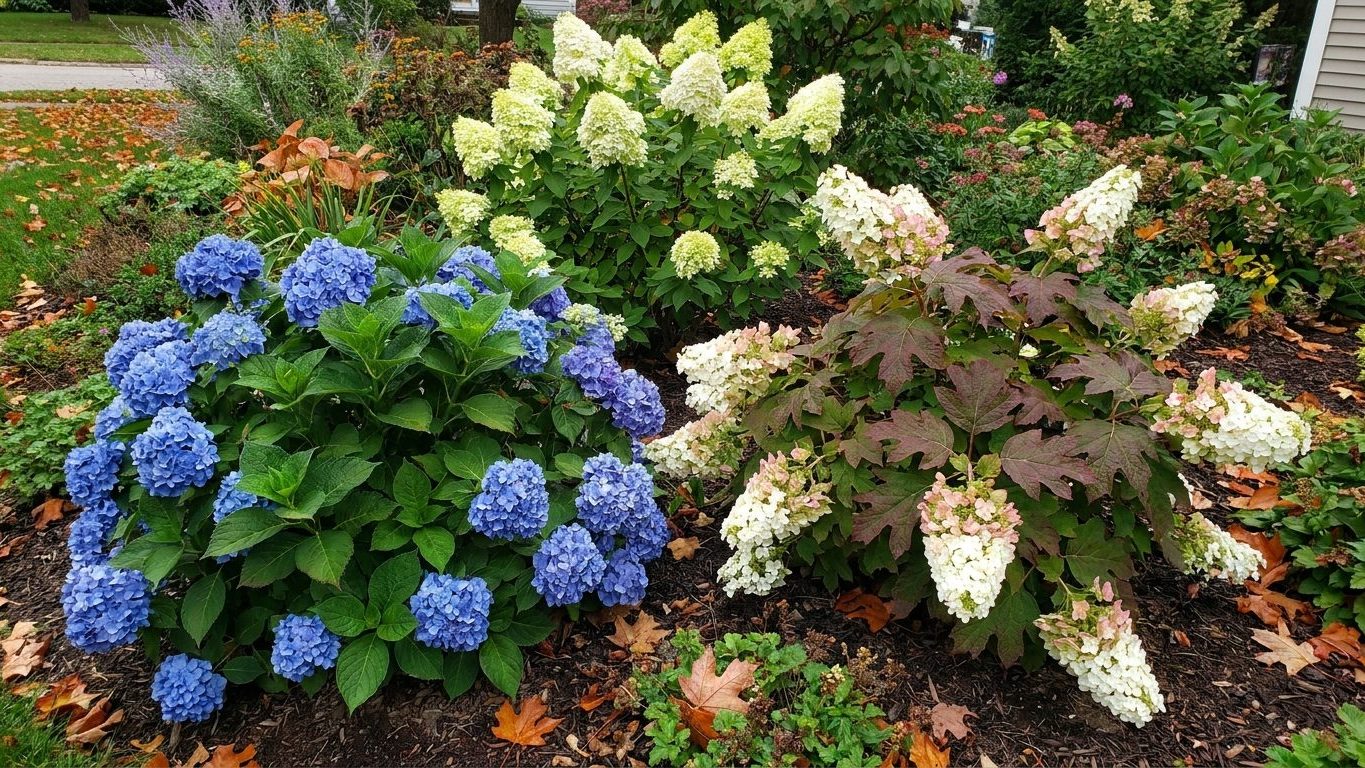
Panicle and smooth hydrangeas are the safest choices for New Mexico’s high desert, holding up through Albuquerque’s wide hardiness range and intense sun. Bigleaf and climbing hydrangea are the riskiest, punished by late spring freezes and alkaline soil that locks up bloom color. The order below runs from sturdiest to most demanding, with the reasoning behind each one.
Hydrangeas that grow well in New Mexico: The Short Answer
New Mexico’s high desert doesn’t do plants any favors. Intense sun, alkaline soil, and swings between freeze and thaw sort hydrangeas fast. The varieties below run from the ones that shrug off this climate to the ones that need real coddling to survive it.
Panicle hydrangea

Panicle hydrangea (Hydrangea paniculata) is the one to plant first here. The USDA Plant Hardiness Zone Map puts Albuquerque’s range at 4b to 9a, and panicle types cover that entire spread. They bloom on new wood, so a late spring freeze that nips the tips doesn’t erase the season’s flowers.
Smooth hydrangea

Smooth hydrangea (Hydrangea arborescens), native across much of the eastern and central US, tolerates New Mexico’s dry air better than most. It also flowers on new wood, and its roots recover fast after a hard winter. Give it afternoon shade and it holds up through summer heat too.
Oakleaf hydrangea

Oakleaf hydrangea (Hydrangea quercifolia) takes sun better than its glossy-leaved cousins, and its foliage colors up in fall. It still needs a wind-sheltered spot, since dry gusts scorch the broad leaves before the plant can recover.
Mountain hydrangea

Mountain hydrangea (Hydrangea serrata), a smaller and tougher relative of bigleaf hydrangea, takes cold reasonably well. But it still sets buds on old wood, so a late frost after growth starts can wipe out that year’s flowers even while the shrub itself survives.
Bigleaf hydrangea

Bigleaf hydrangea (Hydrangea macrophylla) is the variety most homeowners picture, and it struggles here. Old-wood buds get caught by New Mexico’s freeze-thaw swings, and alkaline soil locks up the aluminum that turns blooms blue, leaving flowers a washed-out pink no matter the intent.
Climbing hydrangea

Climbing hydrangea (Hydrangea anomala subsp. petiolaris) is the riskiest pick on this list. It wants steady moisture and dappled shade, two things this high desert rarely offers on its own, and it can take years to establish even under ideal care.
New Mexico — the year and the numbers
- State
- New Mexico
- USDA zones
- 4b-9a
- Last spring frost
- March 31 to April 12
- First fall frost
- October 29 to November 9
- Annual rain
- 9 in
- Lawn zone
- transition-season
- Source
- NOAA NCEI U.S. Climate Normals 1991-2020, 32F freeze probabilities · Albuquerque
How to Work Out the Dates for Your Own Yard
Albuquerque’s frost window is the starting point, not the final word, since suburban and rural yards often run colder in spring and warmer into fall than the airport gauge that sets it.
NOAA NCEI’s U.S. Climate Normals put Albuquerque’s last spring freeze between March 31 and April 12, and the first fall freeze between October 29 and November 9. Count backward from those windows and forward past them to plan the year around your own hydrangeas.
Subtract about two weeks from that spring window if you want to start hardening off container-grown hydrangeas outdoors, and you land in the second half of March for most Albuquerque-area yards. Push it later at elevation.
- Mark your county’s frost pattern first: if you garden above the valley floor or away from the river, push both windows a week or two earlier in fall and later in spring.
- Choose new-wood bloomers for the coldest pockets: panicle and smooth hydrangea set buds after the last freeze has passed, so they don’t gamble on the exact date.
- Hold off on bigleaf unless you have a sheltered courtyard: its old-wood buds already formed by late winter, so prune only in June or July if you must, after last frost risk fully clears.
- Plant in the windows the calendar marks: March, April, August, and September give roots time to settle before either extreme arrives.
- Fertilize only in the months marked for it: March, May, and July feed active growth without pushing tender new shoots into a late frost.
- Add mulch before the first fall freeze arrives: a few inches down by late October buffers shallow roots against the swings that come with November.
Panicle hydrangea survives an Albuquerque winter without any protection. Climbing hydrangea, needing steady shade and moisture this high desert rarely supplies on its own, often doesn’t make it past its second summer here.
New Mexico North to South: How the Dates Shift
Elevation moves these dates harder than latitude does in New Mexico, and it pushes them in both directions across a single state.
- Northern mountains and high country (Santa Fe, Taos, Los Alamos): elevation above 7,000 feet pushes the last spring frost later and the first fall frost earlier, shortening the safe window on both ends.
- Rio Grande Valley and central corridor (Albuquerque, Belen, Socorro): this is the band the reference frost dates above describe, milder than the mountains but still wide between day and night temperatures.
- Southern desert and the Bootheel (Las Cruces, Deming, Lordsburg): lower elevation and a longer frost-free stretch favor oakleaf and bigleaf types that need more growing season, though summer sun still demands afternoon shade.
- Eastern plains (Clovis, Roswell, Tucumcari): flatter, windier terrain dries soil fast, another reason to lean on drought-tolerant panicle and smooth types out there.
Check the state guide’s elevation notes for the pocket closest to your own yard before locking in a planting date.
Mistakes New Mexico Punishes
Planting bigleaf hydrangea in open sun
Bigleaf hydrangea’s broad leaves wilt fast under New Mexico’s intense UV and low humidity, even when the soil underneath stays moist. Plant it only where afternoon shade breaks the sun by early afternoon, or switch to panicle or smooth hydrangea instead.
Ignoring the alkaline soil
Most New Mexico soils run alkaline, which locks up iron and aluminum and leaves hydrangea leaves yellow between the veins while blooms stay a flat pink. Work in sulfur or an acidifying soil amendment before planting, and test again the following spring.
Skipping mulch before winter
Bare soil around the root zone freezes and thaws repeatedly through New Mexico’s wide day-to-night swings, heaving shallow roots right out of the ground. A few inches of mulch applied in fall evens out that swing and protects the buds panicle and smooth types are setting for spring.
New Mexico Extension Offices and County Contacts
New Mexico State University’s Cooperative Extension Service runs a county office network that fills in what one statewide hardiness number can’t answer, from local frost pockets to soil test results.
- Your state page: the frost dates and hardiness range for New Mexico gathered in one place.
- The New Mexico hydrangea calendar: month-by-month planting, fertilizing, and pruning windows already matched to this climate.
- What goes wrong with hydrangeas in New Mexico: the pests and problems specific to this state, and how to spot them early.
Start at aces.nmsu.edu to find the office covering your county, and ask them to confirm your own soil’s pH before you plant.
Common Questions
Do hydrangeas need afternoon shade in New Mexico?
Most do. The intensity of high-desert sun scorches leaves by midday even when soil moisture is fine, so morning sun with afternoon shade suits nearly every variety on this list better than full-day exposure.
Can I get blue blooms on bigleaf hydrangea here?
Rarely without heavy soil amendment. New Mexico’s alkaline soil locks up the aluminum that produces blue color, so blooms tend toward pink or a muddy lavender unless the soil is acidified and retested seasonally.
Which hydrangea needs the least water in New Mexico?
Smooth and panicle hydrangea tolerate dry stretches better than bigleaf, oakleaf, or climbing types, though none of them are true drought plants and all still need regular water through the hottest weeks of summer.