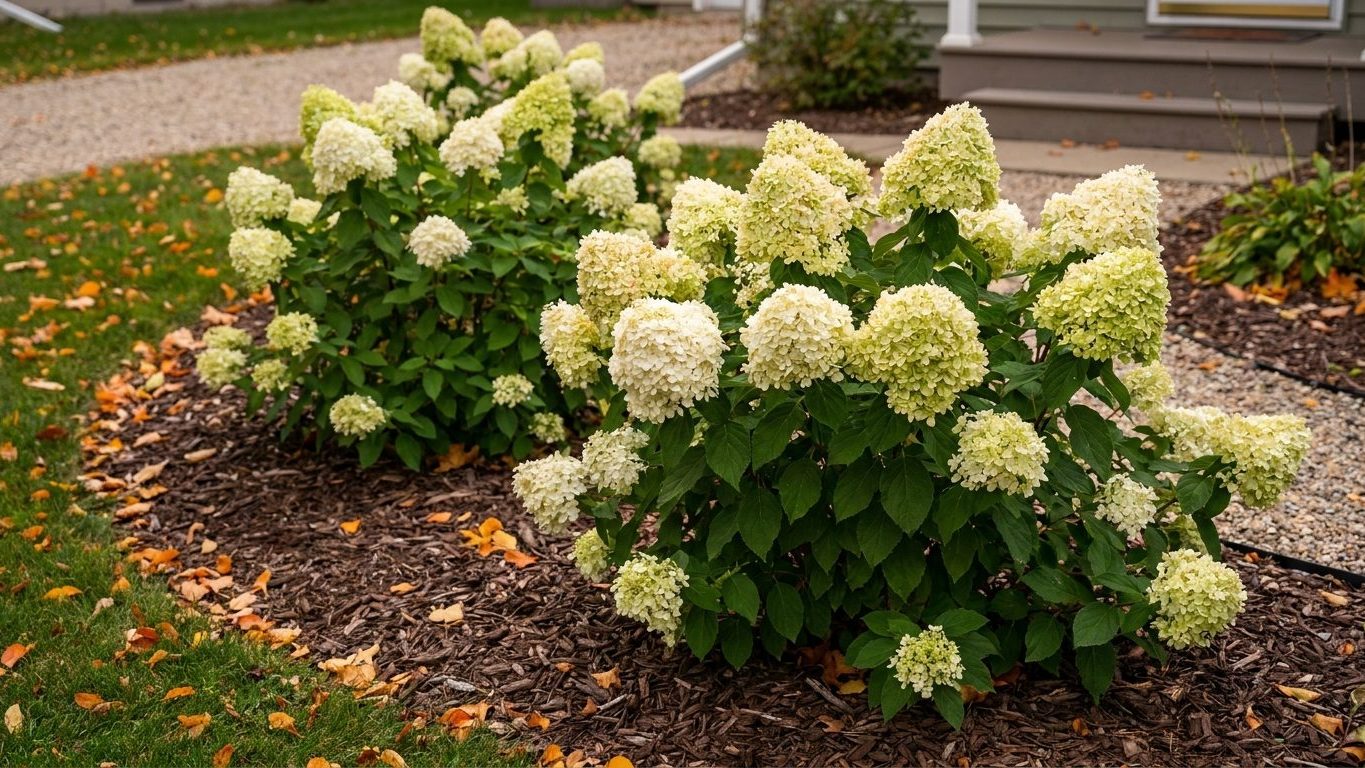
In North Dakota, plant hydrangeas May through August, after Fargo’s last spring frost clears, typically between May 4 and May 15. Prune bigleaf types in June or July, right after bloom, never later. The sections below cover the month-by-month calendar, how to adjust for your own county, and the mistakes this climate won’t forgive.
When to prune hydrangeas in North Dakota: The Short Answer
Every calendar here keys off Fargo, where NOAA NCEI’s 1991-2020 Climate Normals put the last spring frost between May 4 and May 15 and the first fall frost between September 25 and October 5, so treat both as ranges tied to that one station, not a guarantee for your yard.
- January: the ground is frozen solid in Fargo, hydrangeas sit dormant under whatever mulch went down in fall. Nothing to plant or prune, just check that snow cover hasn’t blown off the crown.
- February: still deep winter, weeks away from any frost-free stretch. Leave the shrub alone and watch for wind-burned tips above the snow line.
- March: the last frost is still six to eight weeks out. Soil is too cold and wet to dig, so this is a planning month, not a planting one.
- April: frost risk stays open until mid-May at the earliest. Hold new plants in their pots a little longer rather than trusting one warm afternoon.
- May: the plant window opens and the first fertilizer round goes down. Wait until the frost has actually cleared your yard, not just the calendar date.
- June: still inside the plant window, and the first pruning month for bigleaf hydrangeas. Cut spent blooms and dead wood once flowering has finished.
- July: the last full month to plant with confidence, plus a second fertilizer round. Finish any bigleaf pruning before the month closes.
- August: the final plant month on the calendar. New roots need this stretch to settle before fall cooling starts.
- September: the first fall frost can arrive as early as the 25th. Stop feeding and give a deep watering before that first cold snap.
- October: frost has usually landed by the 5th. Once the ground starts to firm up, pile on mulch for winter.
- November: the hard freeze sets in for good. Finish mulching and wrap exposed stems if the yard sits open to wind.
- December: full dormancy across the state. There’s nothing to do now but let the shrub ride out winter.
Everything below adjusts these twelve months for where you actually live, from the valley floor to the edge of the badlands.
North Dakota — the year and the numbers
- State
- North Dakota
- USDA zones
- 3a-4b
- Last spring frost
- May 4 to May 15
- First fall frost
- September 25 to October 5
- Annual rain
- 24 in
- Lawn zone
- cool-season
- Source
- NOAA NCEI U.S. Climate Normals 1991-2020, 32F freeze probabilities · Fargo
How to Work Out the Dates for Your Own Yard
Fargo’s frost dates are the reference point, the steps below translate them into a schedule that fits wherever you actually garden.
- Find your county’s frost dates: call your local extension office or check a county-level frost map, since Fargo’s May 4 to May 15 window can run a week or two later once you’re away from the airport station that measures it.
- Wait for the soil, not just the calendar: hydrangea roots stall in cold, wet ground, so hold off even after the plant month opens if the soil is still slow to warm.
- Match the plant window to your own last frost: the state’s May through August plant window only pays off once your county’s last frost has passed, planting too early risks a stray freeze on new growth.
- Prune only after bloom, inside June or July: bigleaf hydrangeas set next year’s buds on this year’s wood, so pruning outside that two-month window costs you flowers the following summer.
- Count back from the first fall frost: stop fertilizing roughly six weeks before your county’s fall frost so new growth has time to harden instead of freezing soft.
- Mulch once the ground starts to freeze: USDA’s Plant Hardiness Zone Map puts North Dakota at 3a to 4b, cold enough that an unprotected crown can die back to the ground over a single hard winter.
Run through these six checks before you dig, and the state’s broad window turns into a date that actually fits your yard.
North Dakota North to South: How the Dates Shift
Fargo sits in the Red River Valley, the lowest and often mildest ground in the state, so everywhere else tends to run colder on one end of the season or the other.
- Red River Valley (Fargo, Grand Forks, Wahpeton): the flattest, lowest elevation in the state, frost usually behaves closest to the numbers above.
- South central and the Missouri Plateau (Bismarck, Mandan, Dickinson): higher and drier ground pushes the last spring frost a little later and the first fall frost a little earlier than the valley sees.
- The northern tier near the Canadian border (Devils Lake, Rugby, Minot): the growing season runs shorter on both ends, treat Fargo’s window as the generous edge, not the rule.
- The western badlands and higher ground (Dickinson, Medora): elevation and wind exposure shave off more growing days, so a spot sheltered by a wall or windbreak matters more here than almost anywhere else in the state.
Check the state guide for the full county breakdown before committing a bigleaf hydrangea to open ground anywhere outside the valley.
Mistakes North Dakota Punishes
No flowers the summer after pruning
Bigleaf hydrangeas set their buds on old wood, so pruning in September or October, when the shrub still looks tidy, cuts off next year’s blooms before they even form. Keep pruning inside the June or July window and skip it entirely in fall.
Leaves blackened days after planting
Setting hydrangeas out in April, ahead of Fargo’s last frost window of May 4 to May 15, invites a freeze that blackens new leaves overnight. Wait until the plant window opens in May and the soil has actually warmed.
Stems dead to the ground by April
A bare crown left unmulched through a 3a to 4b winter often comes back as roots only, with every stem killed above the soil line. Pile several inches of mulch over the base once the ground starts to freeze, and pull it back gradually as new growth appears.
North Dakota Extension Offices and County Contacts
Fargo’s frost window is a starting point, not the final word. North Dakota State University Extension and your county office carry the block-by-block detail your yard actually needs.
- Your state page: the frost dates and pruning window for North Dakota, plus the hardiness zone range that decides what’s worth planting.
- Which ones hold up here: the varieties bred for a 3a to 4b winter, ranked from safest to riskiest.
- What goes wrong: the pests and problems that show up on North Dakota hydrangeas, in the order they appear each season.
Common questions
Can hydrangeas survive North Dakota winters at all?
Some can, some can’t. Panicle and smooth types handle the state’s 3a to 4b range without much trouble, while bigleaf varieties often lose their flower buds to a hard winter even when the shrub itself survives. Check which ones hold up here before choosing one for an exposed spot.
What happens if I plant hydrangeas in April?
You’re gambling against Fargo’s last frost window, which runs May 4 to May 15, so an April planting can still get hit by a freeze that blackens new leaves or kills the plant before roots establish. Wait for the May through August plant window instead.
Do I need to prune hydrangeas every single year?
Not necessarily. Bigleaf types only need pruning in June or July to remove spent blooms and dead wood, and skipping a year rarely hurts them. Panicle and smooth varieties tolerate a harder late-winter cut if you’d rather shape them then.