In Michigan, the hydrangea problems worth watching are cold-driven, not pest-driven, since winter dieback and frost-killed flower buds outrank any insect or fungus most years. Around Detroit, the USDA hardiness range of 4a to 6b and a last frost that can linger into early May set the season’s risk before a single aphid shows up.
Hydrangea pests and diseases Michigan: The Short Answer
Michigan hydrangeas run into trouble in a fairly predictable order across the growing season, from cold damage in early spring to fungal issues once summer humidity settles in. Here is what actually shows up, in the order it appears, and what has worked for the shrubs I have walked past for years.
Blackened stem tips in early spring
Michigan’s winters explain most dieback before any pest gets blamed. USDA Plant Hardiness Zone Map places the state’s growing range at 4a to 6b, cold enough to kill unprotected stem tips on bigleaf hydrangeas most years. Cut back to the first live, green bud once new leaves show, and check the which-ones-hold-up guide before fall.
No blooms on stems that leafed out fine
This is bud blight, not disease. A late cold snap after growth starts, common when frost lingers into late April in the Detroit area, kills flower buds while leaves survive. Skip pruning after midsummer, and lean on panicle or smooth types, which set buds on new wood.
Sticky curled new leaves
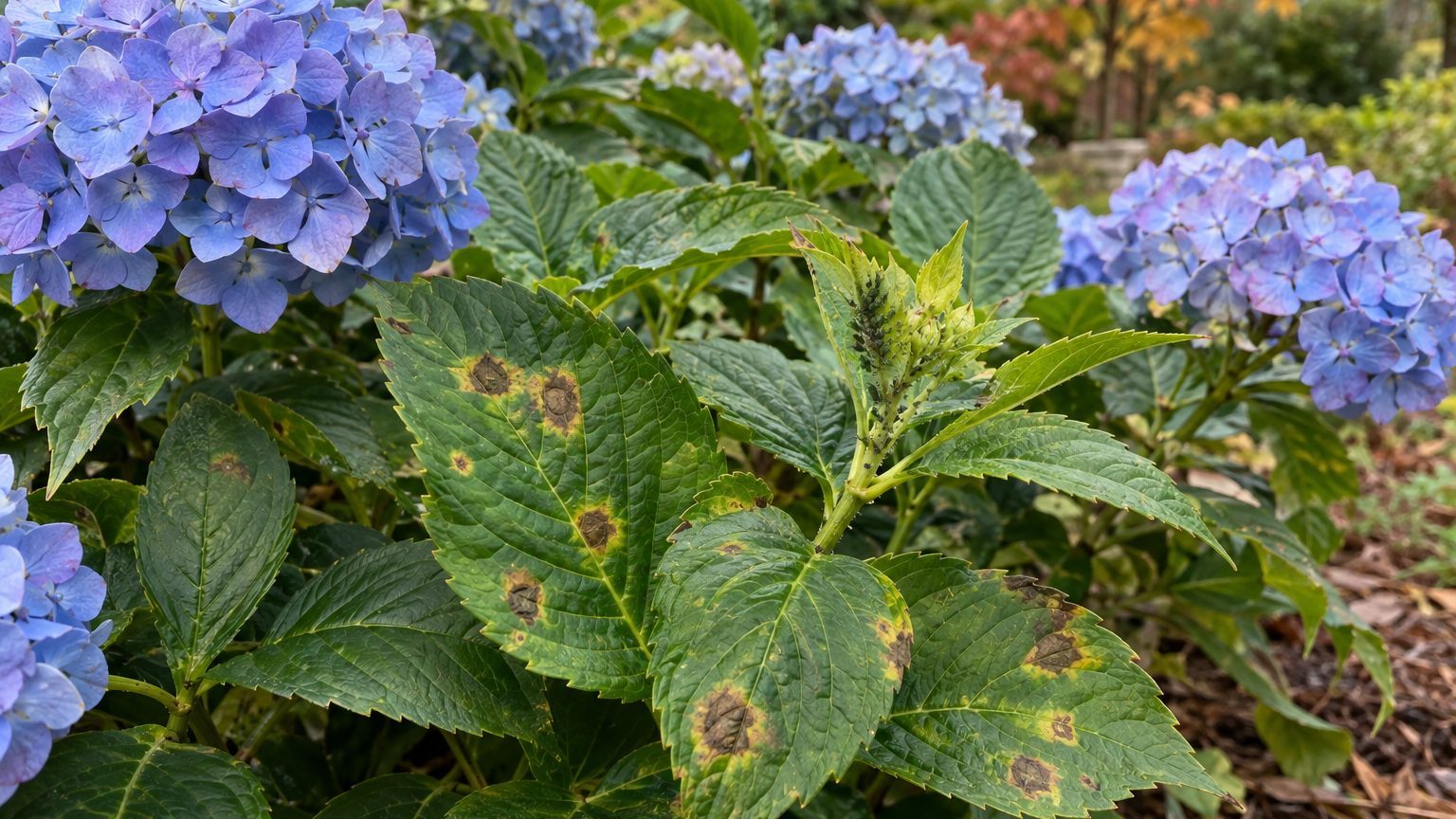
Aphids cluster on tender new growth in late spring and leave a sticky residue that draws ants and sooty mold. A strong water spray every few days knocks most colonies off before they curl the leaf tips permanently, and ladybugs usually finish the job outdoors.
White powdery coating on leaves
Michigan’s humid Great Lakes summers push powdery mildew onto crowded plants by midsummer, coating leaves in a gray-white film that rarely kills but stunts blooms. Space shrubs for airflow, water the soil instead of the leaves, and remove the worst leaves rather than spraying fungicide on a shrub that will drop them anyway in fall.
Brown spots ringed in purple

Cercospora leaf spot shows up as small brown circles with a purple edge on the lower, older leaves after a wet stretch. It rarely spreads to the blooms. Rake and discard fallen leaves each fall instead of composting them, since the fungus overwinters in that leaf litter.
Wilting despite soaked soil

Wilting leaves on a shrub that has had plenty of rain usually points to root rot, not thirst, especially in heavy clay that holds water after Michigan’s summer downpours. Pull mulch back from the base, check for soft brown roots, and move the shrub to higher ground if the problem repeats next season.
Michigan — the year and the numbers
- State
- Michigan
- USDA zones
- 4a-6b
- Last spring frost
- April 30 in the Detroit area; early to mid May across most of the Lower Peninsula
- First fall frost
- October 6 to October 21
- Annual rain
- 34 in
- Lawn zone
- cool-season
- Source
- MSU Extension — Frost-Free Dates · Detroit
How to Work Out the Dates for Your Own Yard
Figuring out when to check for damage or treat a problem starts with your local frost window, not a fixed date on a seed packet.
- Start from your last frost: MSU Extension’s Frost-Free Dates puts the last spring frost around April 30 in the Detroit area, with early to mid May typical across most of the Lower Peninsula, so hold off judging winter dieback until new leaves are due.
- Watch the fertilize window: the state calendar runs fertilizing in March, May, and July, and a shrub that skips its spring feeding often shows weaker leaves that mildew finds first.
- Match planting to April, May, August, or September: hydrangeas planted outside those months struggle to root before either summer heat or the first fall frost, which lands October 6 to October 21 in zone 6a.
- Prune bigleaf types only in June or July: cutting outside that window removes the buds meant for next year’s blooms, the same buds a late frost can already threaten.
- Recheck after the first hot, humid week: powdery mildew and leaf spot both need humidity, so the calendar’s July fertilizing window doubles as a good reminder to walk the bed for early spots.
None of this replaces walking the bed yourself. The calendar sets the outside edges, but soil, shade, and how sheltered your yard sits inside those Michigan frost windows will move the real dates by a week or two in either direction.
Michigan North to South: How the Dates Shift
Michigan’s own hydrangea troubles shift with the lake and the latitude, not just the calendar.
- The Upper Peninsula and the far north (colder pockets near Lake Superior): winter dieback and bud blight are the default problem, since the growing season barely gives buds time to harden before the first hard freeze.
- West Michigan near Lake Michigan (the lakeshore fruit belt): the same lake effect that delays spring frost also holds humidity, so powdery mildew and leaf spot show up more than dieback.
- Southeast Michigan around Detroit (the state’s mildest corner): frost damage eases first here, but aphids and root rot in heavy clay soil become the bigger nuisance once summer rain sets in.
- Inland and central counties (away from either lake): temperature swings are sharper, so bud blight from a late spring snap stays the most common complaint of the four.
Check the state guide for the frost and pruning windows that apply where you actually garden before assuming your neighbor’s problem is yours.
Mistakes Michigan Punishes
Pruning in fall
Cutting bigleaf stems back after summer removes next year’s flower buds along with any dead wood, since the calendar’s prune window is June and July only. Wait for that window, and if in doubt, remove just the spent flower heads and leave the rest of the stem through winter.
Watering overhead in humid weather
Sprinklers that wet the leaves in July’s humid stretch feed both powdery mildew and leaf spot at once. Switch to soaker hoses or hand-watering at the base, and do it in the morning so any splashed leaf has hours to dry before evening.
Planting outside the window
Setting a hydrangea into the ground in June or October skips the planting windows entirely. MSU Extension’s Michigan Garden Calendar puts the first fall frost at October 6 to October 21 in zone 6a, too soon for roots planted that late to settle in. Stick to April, May, August, or September instead.
Michigan Extension Offices and County Contacts
USDA Plant Hardiness Zone Map’s 4a to 6b range is a starting point, not a diagnosis for what’s on your particular shrub. Michigan State University Extension’s county offices, reached through canr.msu.edu, look at your actual leaves and soil before naming a pest or disease.
- Your state page: the frost dates and the pruning window for all of Michigan in one place.
- Which ones hold up here: the varieties that shrug off a Michigan winter versus the ones that struggle.
- MSU Extension: your county office for a hands-on look at what’s actually on your shrub.
Common questions
What is the most common hydrangea disease in Michigan?
Powdery mildew and Cercospora leaf spot show up most often once Michigan’s summer humidity settles in, especially on crowded bigleaf shrubs planted too close to a fence or another plant. Neither usually kills the shrub, but both weaken next year’s blooms if the fallen leaves aren’t raked up each fall.
Why didn’t my hydrangea bloom this year in Michigan?
The usual cause is bud blight, not disease. A late frost after the buds have swollen kills the flower before it opens even though the leaves look fine. Panicle and smooth hydrangeas, which set buds on new wood, dodge this problem better than bigleaf types.
Do I need to spray hydrangeas for pests in Michigan?
Rarely. Aphids and the fungal leaf issues common in the state usually respond to a strong water spray, better airflow, and watering at the soil rather than the leaves, so routine fungicide or insecticide spraying isn’t the first answer for most yards.