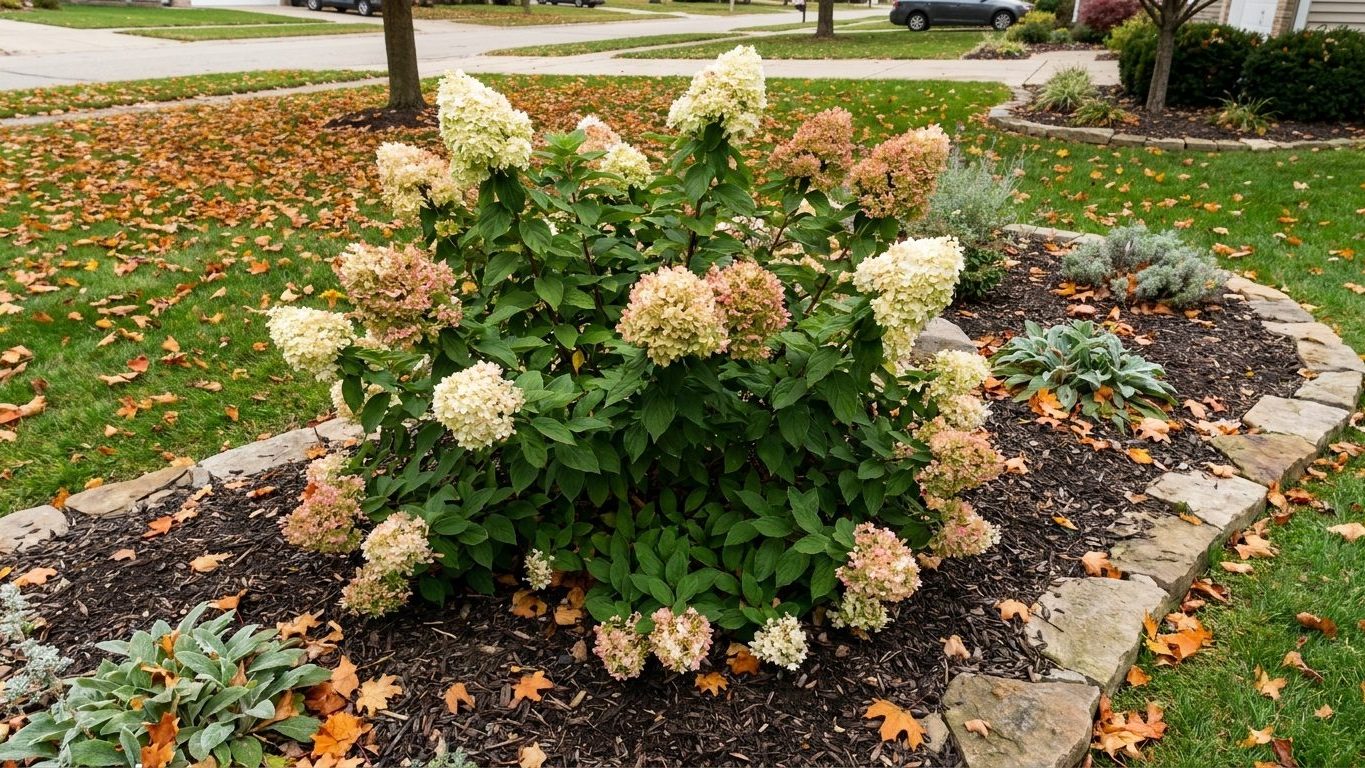
The answer to when to plant hydrangeas in Wyoming is May through August, once the last spring freeze has passed. Bigleaf pruning belongs in June and July, and feeding in May and July.
Those windows are built around Laramie, where the season is short and frost can return late or arrive early. Everything below explains how the dates work and how to adjust them for your own yard.
When to prune hydrangeas in Wyoming: The Short Answer
Every date hangs on two frost ranges in Laramie: NOAA NCEI 1991-2020 Climate Normals give May 7 to May 18 for the last spring freeze and September 24 to October 5 for the first fall freeze.
- January: Nothing to plant, cut or feed, with the last freeze still months away. Leave the dried flower heads standing, since they hold snow around the crown.
- February: Stay off the beds. Frozen ground that thaws at midday compacts easily, and no task is due before the last-freeze range.
- March: Order shrubs now so they are in hand when the window opens after May 18. Hold off on pruning, because bigleaf cuts belong to June and July.
- April: Keep new plants in their pots, since the last freeze has not yet come. Set them outside on mild days and bring them in on freezing nights.
- May: Plant once the last-freeze range of May 7 to May 18 is behind you, and give the first feeding when new growth shows. Cover new plants with a sheet if a late freeze threatens.
- June: Planting continues, and bigleaf pruning opens. Wait until new growth shows which stems survived, then remove only the dead ones.
- July: Give the second feeding and finish bigleaf pruning before the month ends. Planting is still open, but new shrubs need steady watering in dry heat.
- August: This is the last month to plant, well ahead of the first fall freeze. Skip fertilizer now, because new growth would not harden in time.
- September: The planting window has closed, and the first-freeze range begins on the 24th. Keep a sheet ready, and do no cutting or feeding.
- October: The first freeze has usually landed by now. Water the bed once if the fall is dry, and let the leaves drop on their own.
- November: Mulch the crown with shredded leaves or bark once the ground starts to freeze. The goal is soil that stays cold and steady.
- December: Rest. Check that wind has not stripped the mulch, and leave the stems uncut.
The short season sets the limit: roughly 130 frost-free days at 6,000 feet, with frost possible in any month at higher elevations. Treat May 18 as a floor for planting, not a promise, and keep a frost cover close through August.
Wyoming — the year and the numbers
- State
- Wyoming
- USDA zones
- 3a-6a
- Last spring frost
- May 7 to May 18
- First fall frost
- September 24 to October 5
- Annual rain
- 15 in
- Lawn zone
- cool-season
- Source
- NOAA NCEI 1991-2020 Climate Normals, 32F freeze probabilities · Cheyenne
How to Work Out the Dates for Your Own Yard
The calendar is built on Laramie, so your yard needs a small adjustment, and NOAA NCEI 1991-2020 Climate Normals supply the two anchors: a last spring freeze of May 7 to May 18 and a first fall freeze of September 24 to October 5.
- Mark the last-freeze range: Write down May 7 to May 18 and treat May 18 as your earliest safe planting day. A low corner or a spot that funnels cold air can freeze later than the airport station.
- Count back from the fall range: Start from September 24 to October 5 and subtract the weeks you want roots to settle before the ground freezes. A range minus weeks is still a range, so your planting deadline is a stretch of days, never one date.
- Adjust for your elevation: The frost-free stretch is roughly 130 days at 6,000 feet, and yards higher up get less. Push your start toward the late end of the May range, and favor early summer over late summer.
- Test the soil, not the calendar: Plant when the soil crumbles instead of clumping and nights have stayed above freezing for several days running. A shovel tells you more than a date on a phone.
- Set the pruning month: Bigleaf pruning sits in June and July, so wait until new growth shows which stems survived, then cut before July ends.
Feeding follows the same logic. The May feeding waits for the last-freeze date you chose, and the July one lands well before the fall range begins.
Wyoming North to South: How the Dates Shift
The USDA Plant Hardiness Zone Map spans 3a to 6a across Wyoming, so Laramie’s dates are one point on a wide range, and elevation does most of the sorting.
- Southeast plains and the Laramie Basin (Cheyenne, Laramie, Wheatland): Laramie is the reference. Cheyenne and Wheatland sit lower and open the window somewhat earlier, while high, windy yards near Laramie see freezes linger into late spring.
- Big Horn Basin (Cody, Powell, Worland): This is the state’s low, warm, dry corner. Planting can start earlier and run later, though drying wind means watering matters more than frost.
- Northeast (Sheridan, Gillette, Sundance): Lower ground than Laramie moves the window earlier. Hard cold snaps out of the north can still arrive fast, so keep covers handy.
- Western mountain valleys (Jackson, Pinedale, Star Valley): Cold air pools here, so the window opens later and closes sooner. Frost can appear in any month, and a covered or sheltered spot is worth the effort.
For the wider picture of what each zone can carry, the state guide Hydrangeas in Wyoming is the place to start.
Mistakes Wyoming Punishes
Planting on the first warm day
NOAA NCEI 1991-2020 Climate Normals put Laramie’s last spring freeze at May 7 to May 18, and a warm spring afternoon proves nothing. Tender new shoots blacken at the first hard night. Hold plants in pots until after May 18, then choose sturdier types from Hydrangeas That Grow Well in Wyoming.
Cutting bigleaf in early spring
Bigleaf sets next year’s flower buds on old stems, so a spring haircut removes the blooms. Wait for June or July, when new growth shows which stems survived, and cut only what is dead or spent. Dieback sometimes has another cause, so compare it with Hydrangea Pests and Diseases in Wyoming.
Feeding late in the season
Feeding after July pushes soft new growth, and the first fall freeze, September 24 to October 5, catches it before it hardens. Feed in May and July only, then stop, even if the plant looks hungry in late summer. For how the shrub overwinters afterward, see Hydrangeas in Wyoming.
Wyoming Extension Offices and County Contacts
The frost ranges here belong to Laramie, so treat them as a starting point. University of Wyoming Extension (uwyo.edu/uwe) and your county extension office know your local frost pockets, soil and wind, and they answer what no state figure can.
- Your state page: Hydrangeas in Wyoming covers what the shrub needs here, from soil to winter.
- Which ones hold up here: Hydrangeas That Grow Well in Wyoming names the types that cope with this climate.
- What goes wrong here: Hydrangea Pests and Diseases in Wyoming lists what to watch for through the season. Read it once the shrub is planted, then call your county office about anything it leaves open.
Common questions
Can I plant hydrangeas in Wyoming in September?
The planting window closes with August, and Laramie’s first fall freeze arrives September 24 to October 5. A shrub set in that late has little time to root. Keep it in its pot in a sheltered spot and plant it the following May.
When should bigleaf hydrangeas be pruned in Wyoming?
June and July. By then new growth shows which stems survived the winter, so you can remove the dead ones without cutting off next year’s flower buds. Cutting earlier in spring risks losing the blooms.
Do hydrangeas need feeding, and when?
The calendar for Wyoming lists two feedings, May and July. Give the first once new growth shows after the last freeze, and the second in July. Stop after that, so new growth can harden before the first fall freeze.