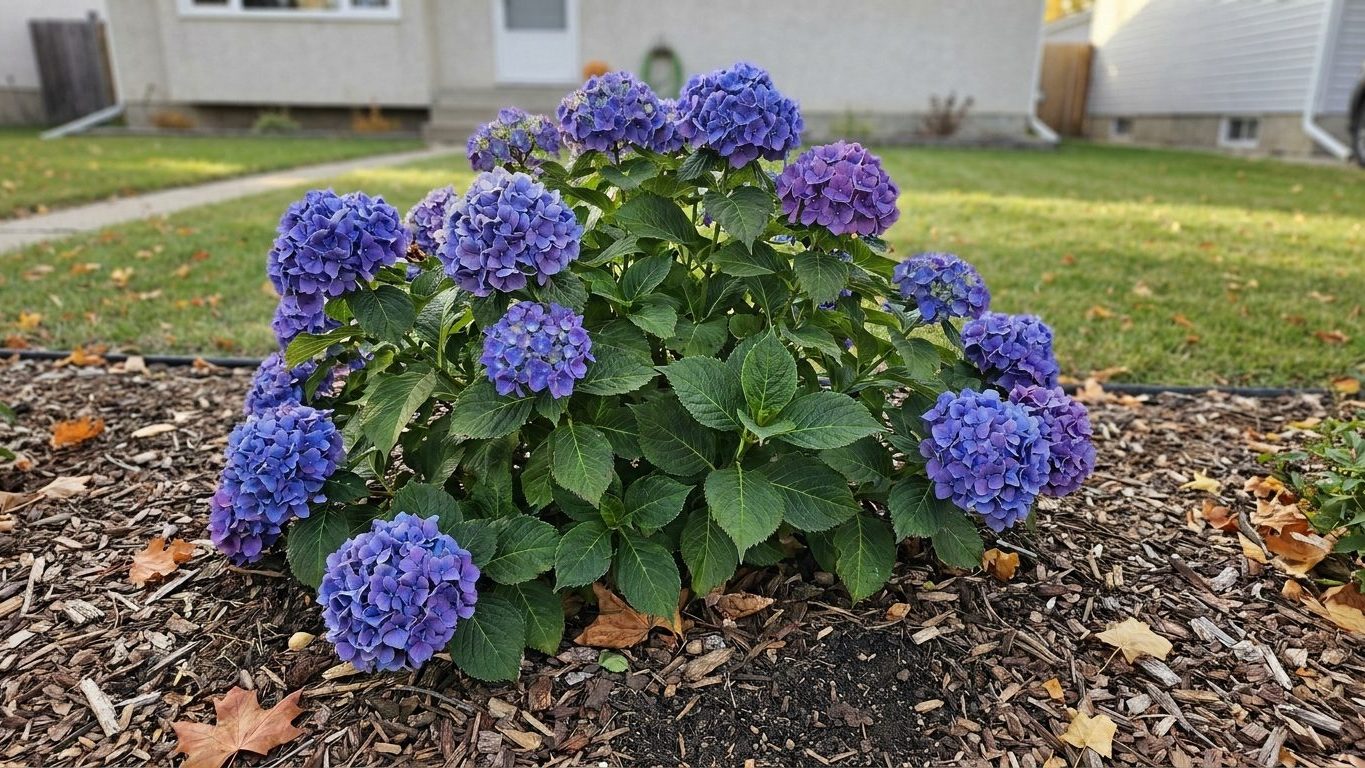
In Saskatoon and across Saskatchewan, hydrangeas go into the ground anywhere from May through August, after the average May 18 last frost has cleared and before the cold returns around September 18. Bigleaf varieties get their only pruning in June or July, right after they bloom. A Canadian hardiness zone of 3a here leaves less room for guessing than in almost any other place this site covers.
When to prune hydrangeas in Saskatchewan: The Short Answer
Environment and Climate Change Canada’s Saskatoon SRC station puts the average last spring frost at May 18 and the average first fall frost at September 18, and every date on this calendar is built around that four-month window.
- January: The ground is frozen solid and nothing goes in or out of it. Use these quiet weeks to plan bed sites and order dormant stock for spring.
- February: Snow cover is still doing the work of insulating roots for you. Check catalogs now so plants ship in time for the May window.
- March: Frost is still the rule here, not the exception. Hold off on any digging until the soil thaws well past this point.
- April: The average last frost is still weeks away. Prepare planting holes and amend soil so you’re ready the moment risk drops.
- May: Planting opens this month, right around the average May 18 last frost, and it’s also the first fertilizing month. Give it a week or two past that date before setting roots in the ground.
- June: Planting continues, and pruning of bigleaf hydrangeas starts as soon as the first flush of blooms fades. Cut spent flower stems back to a healthy bud pair, nothing more.
- July: Pruning and the second fertilizing round both fall here. Keep cuts limited to spent wood, since next year’s buds are already forming lower on the stem.
- August: This is the last month to plant. Skip fertilizer from here on so new growth has time to harden before fall.
- September: The average first frost lands mid-month. Water deeply before it hits, since a well-hydrated plant handles cold better than a dry one.
- October: Growth has stopped and leaves are dropping. Pile mulch over the root zone once the ground starts to firm up.
- November: Winter protection matters most now, given the zone 3a nights ahead. Wrap or mound tender stems if you’re growing a bigleaf type.
- December: The plant sits fully dormant under whatever snow has fallen. Resist the urge to prune, since a winter cut removes next year’s flower buds.
Treat May 18 as a midpoint, not a guarantee, since frost lands later than that in half the years on record. Planting between June and July, once the soil has fully warmed, gives Saskatoon gardeners the widest safety margin without losing much of the growing season.
Saskatchewan — the year and the numbers
- State
- Saskatchewan
- Hardiness zones
- 3a
- Last spring frost
- May 18
- First fall frost
- September 18
- Annual rain
- 14 in
- Lawn zone
- cool-season
- Source
- Environment and Climate Change Canada — Canadian Climate Normals 1981-2010, station SASKATOON SRC · Saskatoon
How to Work Out the Dates for Your Own Yard
Environment and Climate Change Canada’s May 18 average last frost and September 18 average first frost are the two numbers every other date counts back or forward from.
- Start from the average last frost: mark May 18 on your calendar, then remember it’s a mean, so the real safe date often runs a week or two later in a cooler spring.
- Count forward instead of back for planting: since the window opens in May, give the soil until early June to warm before setting out a bigleaf hydrangea, and hold panicle types until June if your yard is shaded or low-lying.
- Match pruning to the bloom, not the calendar: bigleaf types only get cut in June or July, right after their first flush fades, since cutting later removes the buds already set for next year.
- Count back from the first fall frost for the last fertilizer round: with the average frost landing September 18, the July fertilizing pass in the table is close to the last safe feeding, since anything later pushes soft growth into the cold.
- Watch your own microclimate, not just the station: a yard against a south wall or downtown in Saskatoon warms faster than an open field outside town, so treat the frost dates as a starting range rather than a fixed line.
None of this replaces watching your own soil and sky. A thermometer pushed a few inches into the bed on a May morning tells you more about planting day than any provincial average ever will.
Saskatchewan North to South: How the Dates Shift
Natural Resources Canada’s Plant Hardiness zone of 3a for Saskatoon is the reference point, but it shifts across the province: colder toward the north, milder near the Manitoba and US borders in the south.
- The south (near Estevan, Weyburn and the US border): slightly milder winters push both frost dates a little wider than Saskatoon’s, giving hydrangeas a few extra safe days on each end of the season.
- Central parkland (Saskatoon, Regina): this is the reference zone the dates above are built on, with the average May 18 to September 18 window holding closest to true here.
- The north (Prince Albert, La Ronge and beyond): forest and Shield country runs colder, and the safe planting window shrinks from both ends, so treat every date as arriving later.
Check the province page for the frost dates and hardiness zone that apply closest to your own town before you commit a hydrangea to the ground.
Mistakes Saskatchewan Punishes
Planting before late May
Setting a hydrangea out in April or early May, before the average May 18 frost has passed, is the fastest way to lose one in Saskatchewan. Roots stunted by a late freeze rarely recover the same season. Wait until the soil has warmed and stick to the May through August planting window.
Pruning bigleaf hydrangeas in fall
Cutting back a bigleaf hydrangea in September or October removes the buds it already set for next summer’s blooms, since those form on old wood right after the June or July flush. A shrub that looks healthy but never flowers the following year is almost always a fall-pruning mistake, not a hardiness one.
Skipping winter mulch in a zone 3a yard
Leaving the root zone bare going into a Saskatoon winter, where Natural Resources Canada rates the local hardiness at zone 3a, is a common way to lose a hydrangea that sailed through the growing season fine. Pile mulch over the roots by October, before the ground locks up for good.
Saskatchewan Extension Offices and County Contacts
The frost dates above come from a single Saskatoon station, so they’re a starting point, not the final word for every yard in the province. County offices and the province’s own extension service fill in what’s local to your soil.
- Saskatchewan’s provincial extension service: the agribusiness and natural resources contacts page connects growers to local agricultural staff across the province.
- Which ones hold up here: the sibling guide ranking hydrangea types by name, from the hardiest for zone 3a to the riskiest.
- What goes wrong here: the sibling guide covering the pests and problems that show up on Saskatchewan hydrangeas, in the order they appear through the season.
Common questions
Can I plant hydrangeas in Saskatchewan in the fall?
The plant window for this province runs May through August, and nothing after that gives roots enough time to establish before the average September 18 first frost. Stick to a spring or summer planting date instead.
Do hydrangeas survive winter in zone 3a?
Panicle and smooth hydrangeas, which flower on new wood, generally handle a Canadian zone 3a winter better than bigleaf types, which can lose their buds to cold even under mulch. Check the sibling guide to which varieties hold up before choosing one.
When should I fertilize hydrangeas in Saskatchewan?
The calendar for this province calls for two feeding rounds, one in May and one in July, timed so new growth has all summer to harden off before the average September 18 frost arrives.