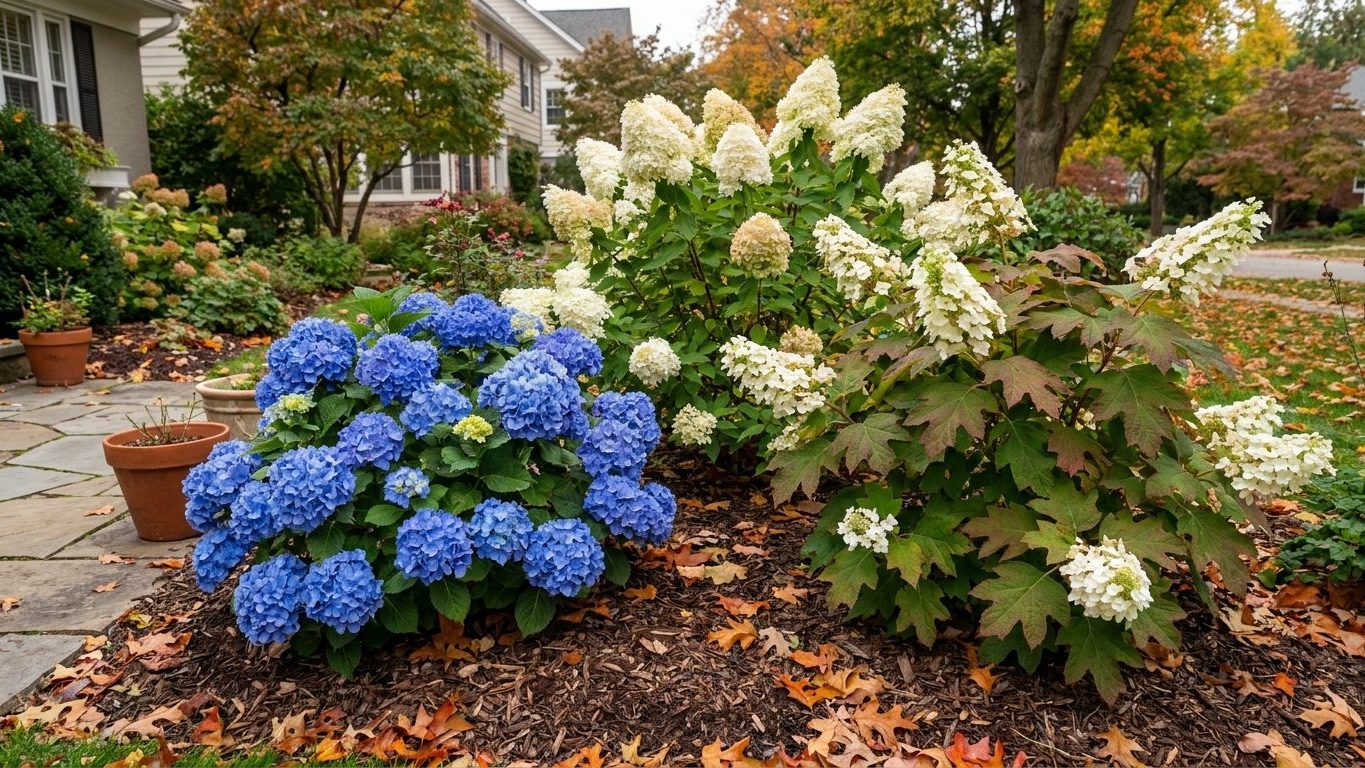
Panicle and smooth hydrangeas are the safest bets for a Nova Scotia yard, since both bloom on new wood and shrug off the freezes that hit Halifax, the province’s reference city for hardiness data. Bigleaf types survive too, but only the reblooming cultivars are worth the gamble here. Zone 6b, in the Canadian system, is the number that decides most of this.
Hydrangeas that grow well in Nova Scotia: The Short Answer
Natural Resources Canada’s Plant Hardiness Site puts Halifax at zone 6b in the Canadian system, a rating built from seven climate variables rather than the single minimum-temperature figure the USDA uses south of the border.
That distinction matters here: a shrub that blooms on last year’s wood can lose every bud to a Halifax winter even where the average low sounds mild, while one that blooms on the current season’s growth just starts over each spring.
That single mechanic, old wood versus new wood, sorts the six varieties below from safest to riskiest for this province.
Panicle hydrangea

Hydrangea paniculata blooms on new wood, so a hard Halifax winter never touches next summer’s flowers. It tolerates full sun better than any other type on this list and shrugs off zone 6b lows without a scratch. This is the shrub to plant if the yard has failed with anything else.
Smooth hydrangea

Hydrangea arborescens, the native behind the Annabelle types, is even hardier than panicle since it grows wild well north of Halifax. It blooms on new wood, so a late frost only delays flowering. Heavy blooms can flop after rain, but that is a staking problem, not a survival one.
Climbing hydrangea

Hydrangea anomala subsp. petiolaris tolerates zone 6b once established against a wall or fence that blocks the worst wind. It is slow, often taking three or four seasons before it flowers at all. Patience is the real cost here, not winter damage.
Reblooming bigleaf hydrangea

Hydrangea macrophylla normally sets its buds on old wood, which a Halifax winter can kill outright. The reblooming cultivars, bred to also flower on new growth, recover from a hard freeze instead of sitting bare all summer. Plant one against a wall with southern exposure and mulch the crown heavy each fall.
Mountain hydrangea

Hydrangea serrata behaves like a smaller, tougher cousin of bigleaf, with buds that survive slightly colder snaps. It still blooms mostly on old wood, so a severe Halifax winter can wipe out a season’s flowers even though the plant itself lives on. Treat it as a bonus bloomer, not a sure thing.
Oakleaf hydrangea

Hydrangea quercifolia sits at the edge of what zone 6b allows, and a Halifax winter without reliable snow cover can kill it back to the ground. It needs a sheltered spot, a thick mulch blanket, and some luck. Gardeners further inland or at higher elevation should expect more dieback than those near the coast.
Nova Scotia — the year and the numbers
- State
- Nova Scotia
- Hardiness zones
- 6b
- Last spring frost
- May 7
- First fall frost
- October 18
- Annual rain
- 55 in
- Lawn zone
- cool-season
- Source
- Environment and Climate Change Canada — Canadian Climate Normals 1981-2010, station HALIFAX STANFIELD INT'L A · Halifax
How to Work Out the Dates for Your Own Yard
Halifax’s frost window sets the boundaries, but a shrub’s own biology decides how much of that window it actually needs. The six steps below turn a mean frost date into a working plan for one specific yard.
- Check the frost window first: Environment and Climate Change Canada’s Canadian Climate Normals put the last spring frost at Halifax Stanfield around May 7 on average and the first fall frost around October 18, with either date landing later in half of all years.
- Push tender planting past the mean: wait two to three weeks past May 7 for anything not fully hardy, since half of all years bring frost after that date.
- Match the shrub to the season length: a panicle or smooth hydrangea planted anywhere in that stretch has the full run of the season to root in, while a reblooming bigleaf wants the earlier half of the window so its new wood has time to harden before October arrives.
- Use the planting months on the calendar: plant in May, June, August, or September, since those four months line up with cooler soil and steadier moisture, and skip July for anything going into open ground.
- Prune bigleaf on its own clock: June and July are the only pruning months for bigleaf types, done right after bloom so next year’s buds have time to form before frost.
- Fertilize on the two-month plan: May and July feedings cover the season, and nothing applied later, since a fall feeding pushes soft growth into the first freeze.
Panicle hydrangea can use this entire span and comes through reliably near Halifax. Oakleaf hydrangea, planted on the same calendar, often needs a second try, since its buds are already old wood by the time an early fall frost arrives.
Nova Scotia North to South: How the Dates Shift
Halifax’s frost window is a coastal reading, and the actual dates for hydrangeas shift earlier or later once you move inland, gain elevation, or tuck into a sheltered valley.
- The Atlantic coast (Halifax, Lunenburg, Yarmouth): ocean air moderates winter lows and delays spring warmth, so buds often survive storms that would kill the same shrub a short drive inland, though the same damp air also feeds more fungal spotting late in the season.
- The Annapolis Valley (Kentville, Wolfville, Middleton): hills on both sides trap warmth, letting the valley floor start spring earlier and hold summer heat longer, which favors reblooming bigleaf and oakleaf types that struggle everywhere else in the province.
- Cape Breton and the northern mainland (Sydney, Antigonish, Amherst): colder air settles in first and clears out last, narrowing the safe window for anything that sets its buds on old wood and rewarding the toughest panicle and smooth cultivars instead.
- Inland and upland pockets (Truro, inland Colchester and Cumberland counties): distance from the moderating ocean lets frost pool in low ground on clear nights even during months the coast would call safe.
Weigh these differences against Halifax’s numbers before trusting them for a yard thirty miles inland or up a hillside.
Mistakes Nova Scotia Punishes
Pruning bigleaf in fall
Cutting back Hydrangea macrophylla in September or October removes the old wood that already carries next year’s flower buds, and Halifax’s mean frost date of October 18 leaves no season left to regrow anything lost. Prune bigleaf hydrangeas only in June or July, right after the blooms fade, and never later.
Fertilizing after midsummer
A feeding applied in August or September pushes soft new growth toward the season’s first frost instead of toward dormancy, and that tender growth never hardens off before the cold arrives. Stick to the two windows that work here, May and July, and stop feeding after that.
Skipping crown mulch on tender types
Oakleaf and standard bigleaf hydrangeas planted without a thick mulch blanket over the crown often die back to the ground here, since a Nova Scotia winter without reliable snow cover leaves roots exposed to cold the plant did not evolve for. A four-inch layer laid before the ground freezes replaces that missing snow cover.
Nova Scotia Extension Offices and County Contacts
Halifax’s zone number is a starting point, not the final word, and the province’s agriculture office fills in what a single reference station cannot.
- Nova Scotia Department of Agriculture: novascotia.ca/agri lists extension contacts and horticulture resources for growers across the province.
- Your county’s agricultural resource coordinator: local staff can confirm whether a shrub tolerates the microclimate of a specific valley, coastline, or upland pocket.
- This province’s hydrangea calendar: check it before the ground freezes, since fall is when most county coordinators book spring consultations.
Common questions
Can bigleaf hydrangea survive winter in Nova Scotia?
Standard bigleaf hydrangea often loses its flower buds in a Halifax winter, since those buds form on the previous year’s stems and zone 6b cold routinely kills them back. Reblooming cultivars recover because they also set buds on new growth, which is why they show up higher on the safe list here.
What is the best month to plant hydrangeas in Nova Scotia?
May, June, August, and September are the planting months that work in this province, giving roots time to establish before summer heat or fall frost. Avoid planting in the heart of July, when a fresh root ball has to fight both dry heat and transplant stress at once.
Does Nova Scotia’s hardiness zone match the US zones on this site?
No. Natural Resources Canada rates Halifax at zone 6b using seven climate variables, while the USDA system used for American states relies on one, average minimum winter temperature. The two numbers cannot be converted directly, so a Canadian 6b is not the same growing reality as a US 6b.