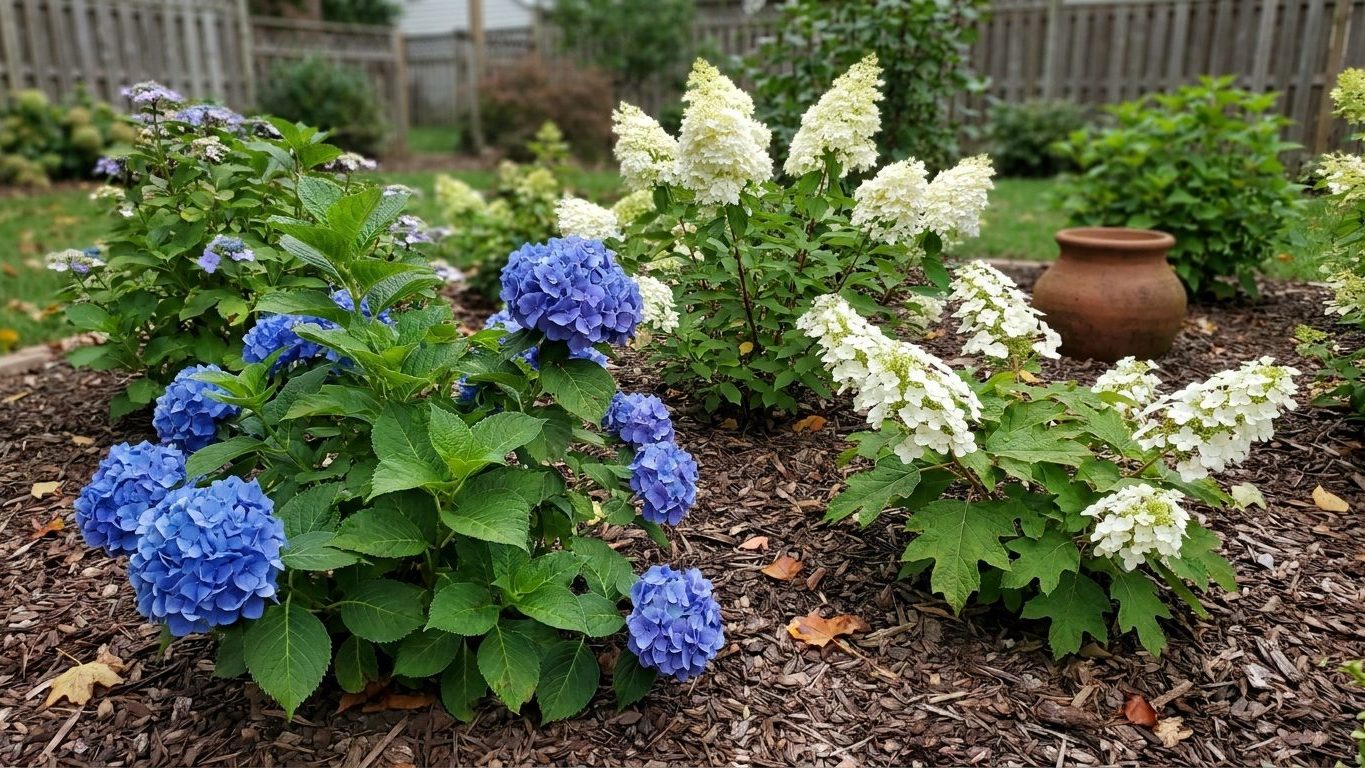
Panicle and smooth hydrangeas are the two safest bets for a Prince Edward Island yard, since both set their flower buds on new wood and rebuild every spring no matter how hard the winter bites. Climbing and oakleaf hydrangeas can work in a sheltered corner. Bigleaf hydrangeas, the mophead type sold at most garden centers, carry the highest risk here and often skip blooming entirely after a rough winter.
Hydrangeas that grow well in Prince Edward Island: The Short Answer
Natural Resources Canada’s Plant Hardiness Site places Charlottetown, the reference city for this island, in Canadian hardiness zone 5b.
That number decides almost everything on this list, because a hydrangea that rebuilds its flower buds on new wood every spring shrugs off a zone 5b winter, while one that stores next summer’s blooms on stems standing through a Charlottetown winter can lose the whole show in a single hard freeze.
The six names below run from the safest choice for this exposure to the one that asks the most from a gardener willing to gamble.
Panicle hydrangea (Hydrangea paniculata)

This is the one that never disappoints on the Island. It blooms on new wood, so even a winter that kills the stems back to the snow line still leaves a full show of cone-shaped flowers by late summer. It also tolerates the wind off the water better than most.
Smooth hydrangea (Hydrangea arborescens)

Just as forgiving as panicle types and just as new-wood dependent. Cut it back hard in spring and it still fills out with rounded white clusters by midsummer. The winter doesn’t touch next year’s bloom because the bloom hasn’t formed yet.
Climbing hydrangea (Hydrangea petiolaris)

Slower to settle in than the shrub types, but genuinely hardy once its roots are established. It wants a wall or fence that breaks the worst gusts, and it can take three seasons before the flowers show up in any number.
Oakleaf hydrangea (Hydrangea quercifolia)

A borderline choice on this island. The oak-shaped foliage and fall color make it worth the gamble, but the flower buds form the summer before, so a wind-sheltered corner matters more here than it would further south.
Mountain hydrangea (Hydrangea serrata)

Related to bigleaf and just as prone to losing flower buds in a hard freeze, though its smaller frame recovers faster from a rough season. Treat it as a container plant that overwinters somewhere unheated but out of the direct wind.
Bigleaf hydrangea (Hydrangea macrophylla)

The classic mophead is the riskiest name on this list for the Island. Its flower buds form on old wood the summer before, and a Charlottetown winter can erase those buds before spring even starts, leaving healthy green leaves and no flowers at all.
Prince Edward Island — the year and the numbers
- State
- Prince Edward Island
- Hardiness zones
- 5b
- Last spring frost
- May 16
- First fall frost
- October 17
- Annual rain
- 46 in
- Lawn zone
- cool-season
- Source
- Environment and Climate Change Canada — Canadian Climate Normals 1981-2010, station CHARLOTTETOWN A · Charlottetown
How to Work Out the Dates for Your Own Yard
The frost window here isn’t a single day, it’s a range built around a mean, and knowing how to count backward and forward from that midpoint matters more than memorizing the date itself.
- Start from the average last spring frost: Environment and Climate Change Canada puts it at May 16 for Charlottetown, and that figure is a mean date, not a guarantee, so one year in two the real frost lands later.
- Treat the weeks around that date as the risk zone: anything planted right on May 16 is planted at the coin-flip point of the season, not on the safe side of it.
- Wait for the calendar’s actual planting months: the site’s own schedule for this island keeps new hydrangeas out of the ground until May, then opens again in June, August, and September, spreading the risk instead of betting on one week.
- Count forward to the average first fall frost: October 17 marks the other end of the season, so anything planted in September has only a few weeks to root before cold sets in.
- Match the variety to the wood it blooms on: a panicle or smooth hydrangea planted in that May window blooms on wood grown after the frost risk has passed, while a bigleaf planted the same week is still gambling on buds that formed the year before.
- Prune bigleaf only inside the window the calendar sets: June and July, after bloom, so a late freeze never lands on a fresh cut.
A panicle hydrangea planted in early June, weeks past the mean frost date, roots through summer and blooms on schedule no matter what January does to it.
A bigleaf planted the same week still needs a mild winter to flower at all, which is the whole difference between a plant that survives here and one that merely visits.
Prince Edward Island North to South: How the Dates Shift
A province this size still isn’t one climate, and coastal exposure moves these dates around more than distance alone would suggest.
- The North Shore (Prince County, Queens County): direct exposure to Gulf of St. Lawrence winds keeps spring cooler here and tends to push the safe planting start later than the harbor towns.
- Charlottetown and the harbor belt (Queens County): the water around the harbor moderates both ends of the season, part of why the reference station for this whole province sits right here.
- Kings County and the east: farther from the Northumberland Strait’s moderating effect, this end of the island tends to see both frost dates drift further apart from the mean than the sheltered center does.
None of that changes the mean dates published for Charlottetown. It just means a garden on an exposed point should treat the window as starting later and closing earlier than the province-wide figure suggests.
Mistakes Prince Edward Island Punishes
Pruning bigleaf hydrangeas in fall
Cutting back a bigleaf hydrangea in September or October removes the very wood that would have carried next summer’s flowers. The calendar for this island keeps that pruning to June and July, right after bloom, so the plant has a full season to set new buds before frost returns.
Planting outside the window and hoping for the best
A hydrangea set in the ground in April or late October has almost no time to root before Environment and Climate Change Canada’s mean frost dates of May 16 and October 17 close in from either side. The island’s planting months run May, June, August, and September for that reason.
Leaving bigleaf hydrangeas unprotected through winter
Bigleaf buds form the summer before and sit exposed through a Charlottetown winter with nothing but bark for cover. A mound of leaves or mulch piled over the base once the ground firms up protects buds that panicle and smooth varieties never needed shielding for in the first place.
Prince Edward Island Extension Offices and County Contacts
The Canadian hardiness zone for Charlottetown is a starting point, not the full picture, and the province’s own agriculture office fills in what a general zone map leaves out.
- Prince Edward Island Department of Agriculture: the province’s agriculture topic page, for local advisories that affect what goes into the ground near water.
- Your state page: the Prince Edward Island guide, gathering the frost dates and the pruning window for this island in one place.
- What goes wrong here: the companion page on pests and problems specific to island hydrangeas, plus a reminder to call ahead if your lot touches the shoreline where buffer rules apply.
Common questions
Can bigleaf hydrangeas survive winter in Prince Edward Island?
The plant itself usually survives, since roots and crown are hardier than flower buds, but those buds often don’t. Expect green leaves most years and blooms only after a mild winter, which is why panicle and smooth types are the safer choice for anyone who wants flowers every summer.
What is the best time to plant hydrangeas on the island?
The planting months set for this island are May, June, August, and September, chosen to sit clear of the average frost dates at either end of the season. Early May and late September carry more risk than the weeks in the middle of those months.
Do hydrangeas need winter protection in a Canadian zone 5b climate?
Panicle and smooth hydrangeas don’t need it, since they rebuild from the ground each spring. Bigleaf, mountain, and oakleaf types benefit from a mound of leaves or mulch over the base once the ground firms up, protecting the buds that carry next year’s bloom.